Interesting Things with JC #1522: "Project Echo" – In 1960, a huge silver balloon crossed the night sky, reflecting human voices without ever hearing them. This episode traces the moment a simple idea bent the future of communication and accidentally tuned into the birth of the universe.
Curriculum - Episode Anchor
Episode Title: Project Echo
Episode Number: 1522
Host: JC
Audience: Grades 9–12, college intro, homeschool, lifelong learners
Subject Area: Physics, Engineering, History of Science, Space Technology
Lesson Overview
Students will:
Define the concept of passive satellite communication and its historical context.
Compare early satellite technologies with modern communication satellites.
Analyze the significance of the Holmdel Horn Antenna and its unexpected discovery.
Explain how Project Echo contributed to the development of global telecommunications.
Key Vocabulary
Satellite (ˈsa-tə-ˌlīt) — A human-made object placed in orbit to serve a technological or observational purpose. In this episode, Echo 1 was a passive satellite used to reflect radio waves.
Maser (ˈmā-zər) — A device that amplifies microwave signals using stimulated emission, essential for detecting weak signals from space.
Microwave (ˈmī-krō-ˌwāv) — Electromagnetic waves used in communication technologies; signals bounced off Echo 1 were microwaves.
Passive Satellite (ˈpa-siv ˈsa-tə-ˌlīt) — A satellite that does not transmit but reflects signals, like Echo 1.
Cosmic Microwave Background (CMB) (ˈkä-zmik ˈmī-krō-ˌwāv) — Faint radiation left over from the early universe, accidentally discovered via the Holmdel antenna.
Narrative Core
Open: On a summer night in 1960, a bright point in the sky captured national attention—a strange new star that was actually a man-made satellite: Echo 1.
Info: Echo 1 was a 100-foot-wide balloon, a passive satellite reflecting microwave signals across the U.S., proving radio signals could bounce off objects in orbit.
Details: Using the Holmdel Horn Antenna, engineers achieved the first satellite phone call and tested various modulation techniques. This passive system demonstrated viable communication without onboard electronics.
Reflection: An unexpected outcome of the project was the Nobel Prize–winning discovery of the cosmic microwave background—the "echo" of the Big Bang.
Closing: These are interesting things, with JC.
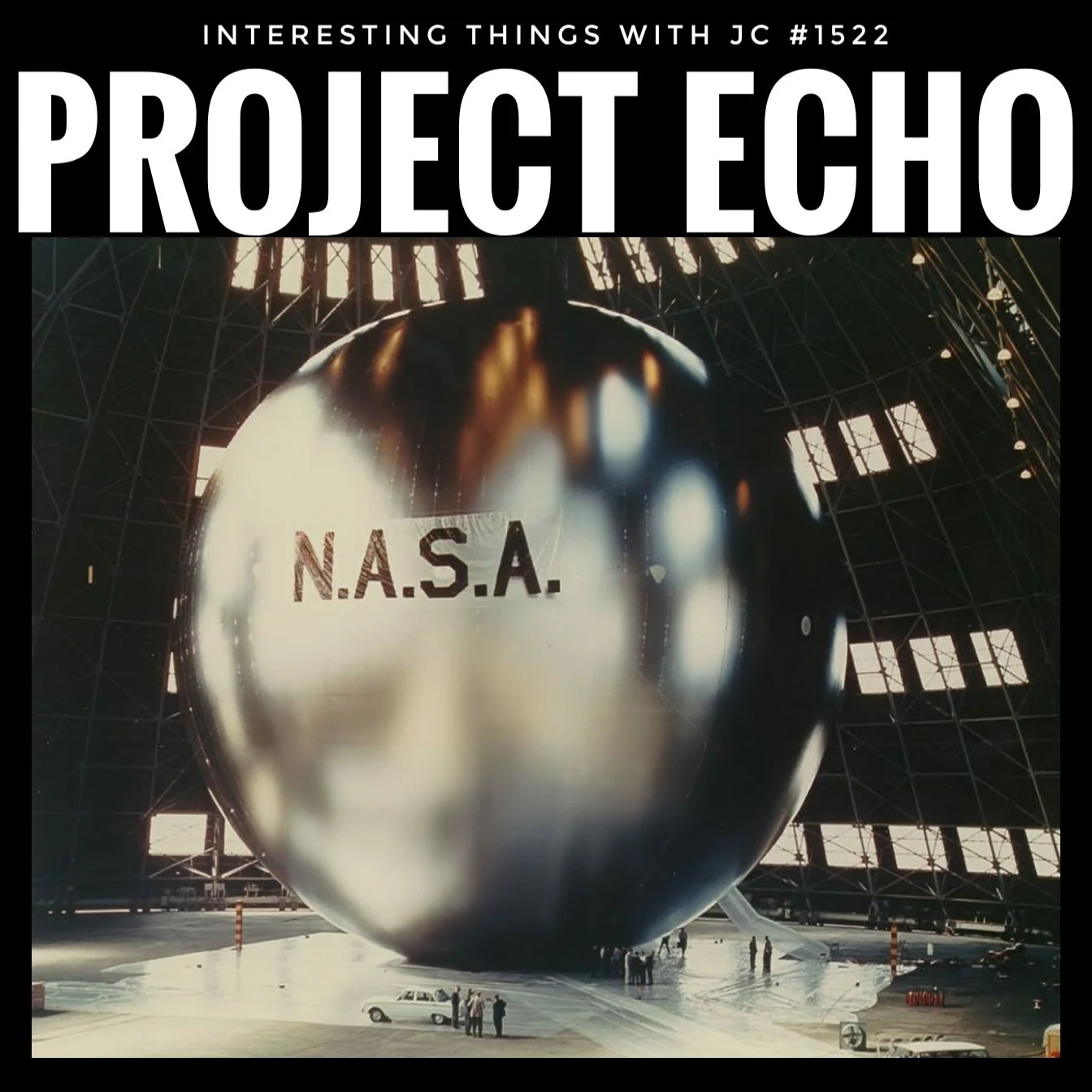
Large silver balloon-like satellite labeled "N.A.S.A." fills an indoor hangar, surrounded by people and vehicles for scale. The reflective spherical object is Echo 1, a passive communications satellite from 1960, used for bouncing radio signals. The structure is housed under a high arched ceiling with grid-like windows, illustrating the satellite’s enormous size. The image highlights early space communication technology as featured in Interesting Things with JC, Episode #1522: Project Echo.
Transcript
Interesting Things with JC #1522: "Project Echo"
On a clear night in late summer of 1960, people across the United States stepped outside and pointed to the sky. Moving slowly overhead was what looked like a new star, steady and bright, crossing the darkness without blinking. It wasn’t a planet. It wasn’t an aircraft. It was a human voice, waiting to be heard.
That light was Project Echo, and more specifically Echo 1, launched on August 12, 1960. Echo 1 was unlike anything ever placed in orbit. It wasn’t a machine in the modern sense. It had no computers, no transmitters, no receivers. It was a balloon. A sphere 100 feet wide, about 30 meters across, made of aluminized Mylar thinner than a human hair. Once inflated in low Earth orbit, roughly 1,000 miles up, or about 1,600 kilometers, it became a mirror in the sky.
The idea was almost audacious in its simplicity. If radio waves could be aimed precisely enough, they could be bounced off that mirror and returned to Earth somewhere else. No amplification. No onboard electronics. Just physics, geometry, and power.
On launch day, engineers transmitted microwave signals from the Jet Propulsion Laboratory facility at Goldstone, California. Those signals traveled more than 3,000 miles, about 4,800 kilometers, up to the balloon and back down to receivers at Bell Telephone Laboratories in Holmdel, New Jersey. The round-trip signal loss was enormous. The returned power was measured in microwatts. But it came back, clear enough to prove the concept worked.
Just three days later, on August 15, 1960, something quiet historic happened. Engineers completed the first two-way telephone conversation ever conducted by satellite. Real voices. Coast to coast. Spoken words were injected upward as modulated radio waves, reflected off that silver sphere, and recovered on the other side. The delay was noticeable, a couple of seconds, enough to remind everyone the conversation had gone to space and back. But it worked.
The key to hearing those faint echoes sat in a quiet field in New Jersey. The Holmdel Horn Antenna looked less like a dish and more like a giant metal trumpet, about 20 feet by 20 feet, roughly 6 by 6 meters. Built in 1959, it was designed to listen. Inside, cryogenically cooled maser amplifiers, chilled with liquid helium, reduced background noise to levels unheard of at the time. The antenna tracked Echo 1 precisely, pulling intelligible speech out of what would otherwise have been lost in static.
Engineers pushed the system hard. They tested frequency modulation, amplitude modulation, single-sideband transmission, and narrow-band phase modulation. Every technique was used to squeeze meaning out of impossibly weak signals. Through early 1961, they transmitted voices, test tones, and experimental fax images. Measurements confirmed the theory. Passive satellites were inefficient, but they were viable.
Then came the part no one expected. While investigating persistent background noise in that same horn antenna in 1964 and 1965, two Bell Labs scientists realized they weren’t hearing equipment error at all. They were detecting the cosmic microwave background radiation, the faint afterglow of the universe’s beginning. An antenna built to hear human voices from space ended up listening to the echo of the Big Bang. The discovery earned a Nobel Prize in Physics.
Echo 1 itself didn’t last forever. Atmospheric drag slowly pulled it down, and it burned up on reentry in 1968. But its proof changed everything. It cleared the path for active satellites with onboard electronics, including Telstar in 1962, which carried the first live transatlantic television signals. From there came global phone calls, weather satellites, navigation systems, and the invisible web that now wraps the planet.
All of it traces back to a balloon drifting overhead, reflecting voices it never understood. A reminder that sometimes progress doesn’t begin with complexity, but with a simple idea bold enough to test the sky.
These are interesting things, with JC.
Student Worksheet
What made Echo 1 different from modern satellites?
How did engineers use Echo 1 to prove long-distance communication via satellite was possible?
Describe the Holmdel Horn Antenna and its role in Project Echo.
What is the cosmic microwave background, and how was it discovered?
Why was the success of Echo 1 considered a turning point in space communication?
Teacher Guide
Estimated Time:
1–2 class periods (45–60 minutes each)
Pre-Teaching Vocabulary Strategy:
Preview terms with visual aids (satellite diagrams, antenna schematics)
Conduct a think-pair-share on “What is a satellite?”
Anticipated Misconceptions:
Students may assume all satellites are powered or active.
Confusion between microwave ovens and microwave communications.
Misbelief that cosmic background radiation was deliberately discovered.
Discussion Prompts:
Why was a balloon used instead of a machine?
How did engineers solve the problem of weak signal return?
What are the ethical implications of unexpected discoveries in science?
Differentiation Strategies:
ESL: Use diagrams, bilingual glossaries
IEP: Sentence starters for writing tasks
Gifted: Research how Telstar built upon Project Echo
Extension Activities:
Build a small-scale passive reflector model in class
Write a fictional diary from the perspective of a Project Echo engineer
Explore the Nobel Prize–winning paper on CMB discovery
Cross-Curricular Connections:
Physics: Wave reflection, microwave transmission
History: Cold War technology and the Space Race
Media Studies: Origins of global broadcast infrastructure
Quiz
What type of satellite was Echo 1?
A. Active transmission satellite
B. Passive reflective satellite
C. Weather monitoring satellite
D. Navigation system prototype
Answer: BWhat shape and size was Echo 1?
A. A cube the size of a van
B. A small dish with solar panels
C. A 100-foot-wide aluminized balloon
D. A rocket with antennas
Answer: CWhat scientific discovery was made using the Holmdel Horn Antenna?
A. The first black hole
B. Radio waves from Mars
C. Cosmic microwave background radiation
D. The speed of light in vacuum
Answer: CWhat kind of modulation was NOT tested with Echo 1?
A. Frequency modulation
B. Pulse code modulation
C. Single-sideband transmission
D. Narrow-band phase modulation
Answer: BWhen did Echo 1 re-enter Earth’s atmosphere?
A. 1961
B. 1962
C. 1965
D. 1968
Answer: D
Assessment
Explain why the Echo 1 satellite was significant in the history of space communication.
How did a project intended to bounce voices off a balloon lead to one of the most important discoveries in cosmology?
3–2–1 Rubric:
3 = Accurate, complete, thoughtful
2 = Partial or missing detail
1 = Inaccurate or vague
Standards Alignment
U.S. Standards (NGSS, CCSS, C3, ISTE, CTE):
NGSS HS-PS4-5: Communicate technical information about how information is digitized and transmitted via various types of media.
CCSS.ELA-LITERACY.RST.11-12.2: Determine the central ideas or conclusions of a text; summarize complex concepts.
CCSS.ELA-LITERACY.SL.11-12.4: Present information, findings, and evidence clearly and logically.
ISTE 1.1 Empowered Learner: Use technology to seek feedback that informs and improves their practice and demonstrates learning.
C3.D2.His.1.9-12: Evaluate how historical events and developments were shaped by unique circumstances of time and place.
International Equivalents:
UK AQA GCSE Physics 4.4.1: Wave properties and satellite communication
IB MYP Sciences Criterion A: Knowing and understanding scientific concepts
Cambridge IGCSE Physics 0625 4.5: Use of electromagnetic waves in communication technologies
Show Notes
In “Project Echo,” JC tells the story of Echo 1, the world’s first passive communication satellite, launched in 1960. It was a 100-foot-wide reflective balloon that enabled the first coast-to-coast satellite phone call—without any electronics onboard. This episode explores the innovative use of microwave reflection, the significance of the Holmdel Horn Antenna, and the unanticipated discovery of cosmic microwave background radiation. These events not only laid the foundation for global telecommunications but also changed our understanding of the universe. In today's classrooms, this story provides a unique blend of physics, engineering, and astronomy, demonstrating how even simple ideas can have cosmic consequences.
References:
EBSCOhost. (n.d.). First Passive Communications Satellite Launched. Retrieved from https://www.ebsco.com/research-starters/history/first-passive-communications-satellite-launched
IEEE Spectrum. (n.d.). Cosmic Microwave Background. Retrieved from https://spectrum.ieee.org/cosmic-microwave-background
Holmdel Historical Society. (n.d.). Holmdel Horn Antenna. Retrieved from https://holmdelhistoricalsociety.org/holmdel-horn-antenna
Smithsonian National Air and Space Museum. (n.d.). Communications Satellite, Echo 1. Retrieved from https://airandspace.si.edu/collection-objects/communications-satellite-echo-1/nasm_A20030090000
National Radio Astronomy Observatory. (2023). Blast from the Past Gives Clues About Early Universe. Retrieved from https://public.nrao.edu/news/blast-from-the-past-gives-clues-about-early-universe/