Interesting Things with JC #1521: “Itzhak Bentov and Consciousness” — He escaped the Holocaust, rewrote heart medicine without a degree, then aimed his mechanical mind at the deepest problem of all: how consciousness works when the system finally locks into place.
Curriculum - Episode Anchor
Episode Title: Interesting Things with JC #1521: “Itzhak Bentov and Consciousness”
Episode Number: 1521
Host: JC
Audience: Grades 9–12, college intro, homeschool, lifelong learners
Subject Area: History of Science, Biomedical Engineering, Neuroscience, Philosophy of Science
Lesson Overview
This lesson explores the life and interdisciplinary work of Itzhak Bentov, examining how lived experience, mechanical intuition, and scientific curiosity intersected in both medical innovation and speculative theories of consciousness. Students evaluate the difference between empirically proven inventions and exploratory models that remain unverified.
Learning Objectives
Students will be able to:
Define the concept of consciousness as presented by Bentov and distinguish it from neurological explanations.
Compare Bentov’s biomedical inventions with his theoretical models of consciousness.
Analyze how historical context influenced Bentov’s scientific and philosophical thinking.
Explain the difference between testable scientific innovation and speculative frameworks.
Key Vocabulary
Consciousness (KON-shuhs-ness) — Awareness of self and environment; Bentov argued it is received, not produced, by the brain.
Holocaust (HOH-luh-kawst) — The systematic genocide carried out by Nazi Germany during World War II, which shaped Bentov’s early life.
Cardiac Catheter (KAR-dee-ak KATH-uh-ter) — A medical tube inserted into the heart; Bentov’s steerable version improved safety.
Alpha Waves (AL-fuh wayvz) — Brain oscillations around 7–13 Hz associated with calm awareness and meditation.
Torus (TOR-us) — A doughnut-shaped structure Bentov used to describe a cyclical universe.
Narrative Core
Open: A man who changed heart medicine spent his nights asking why awareness exists at all.
Info: Bentov survived the Holocaust, helped build early Israeli military technology, and immigrated to the United States without formal higher education.
Details: He invented the steerable cardiac catheter, co-founded a company later acquired by Boston Scientific, and developed theories linking meditation, brain waves, and cosmic structure.
Reflection: Bentov’s work challenges assumptions about who can innovate and where scientific curiosity can lead.
Closing: These are interesting things, with JC.
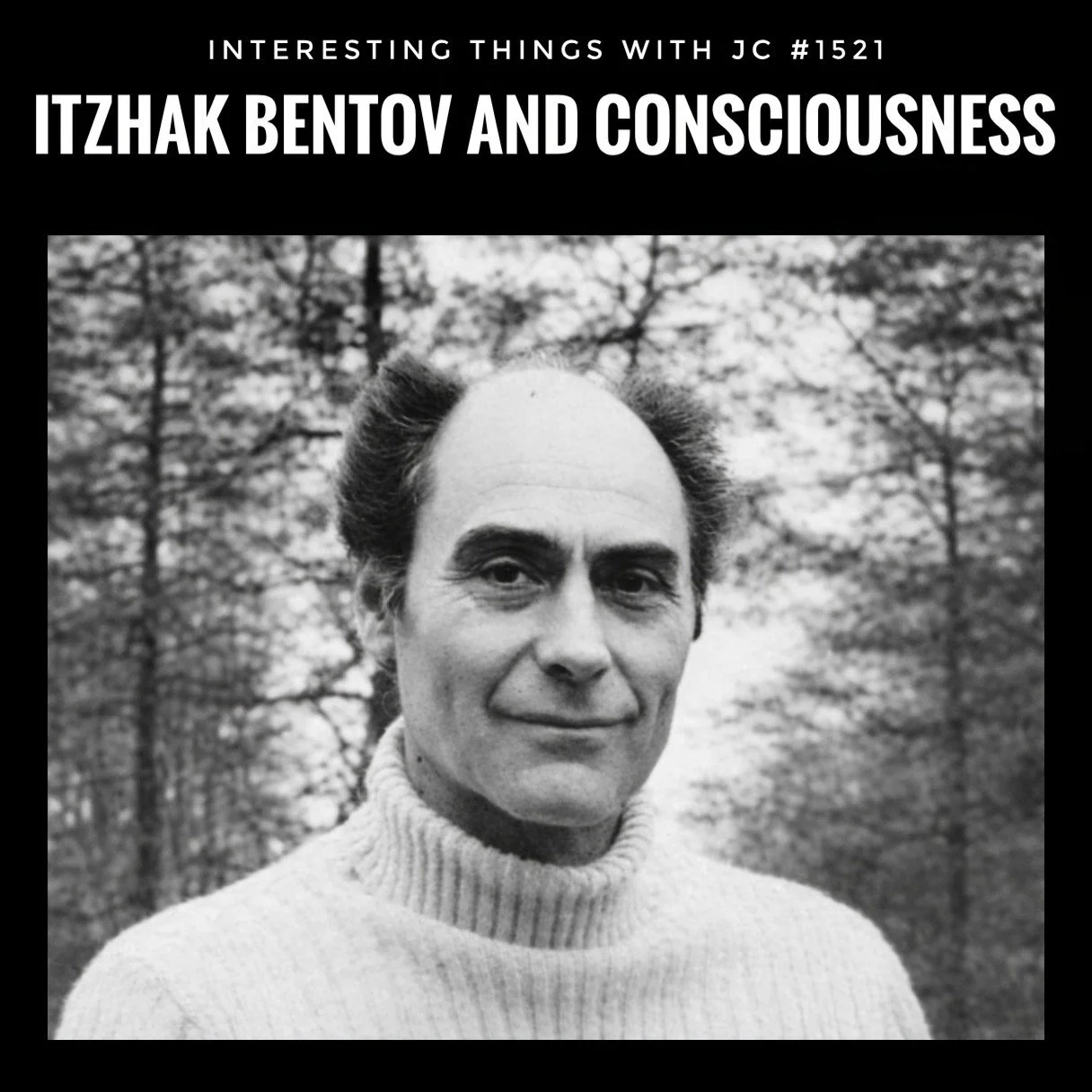
Black-and-white portrait of a middle-aged man identified as Itzhak Bentov, wearing a light-colored sweater, standing outdoors with trees in the background. Text above the image reads: “Interesting Things with JC #1521 – Itzhak Bentov and Consciousness.”
Transcript
Interesting Things with JC #1521: “Itzhak Bentov and Consciousness”
He survived the Holocaust, helped build a country from nothing, changed modern heart medicine, and then spent his nights trying to understand why consciousness exists at all.
Itzhak Bentov was born Emerich Tobiás on August 9, 1923, in the town of Humenné (HOO-men-nyeh), in what was then Czechoslovakia and is now Slovakia. His early life ended abruptly. During the Holocaust, his parents were murdered in Nazi concentration camps. Family accounts also indicate the loss of siblings, though the historical record is clearest on his parents. Bentov escaped. He was alone.
After the war, he fled to British Mandate Palestine. He lived on a kibbutz and learned by working, not studying. When Israel declared independence in 1948, the country was under international arms embargo and fighting for survival. Bentov joined the Israeli Science Corps.
He had no formal education beyond high school. No engineering degree. No university training. What he had was raw mechanical intuition. Working in improvised shops with limited materials, he helped design Israel’s first rocket. It wasn’t academic work. It was problem-solving under pressure. Build it. Make it work.
In 1954, Bentov immigrated to the United States. He became a naturalized citizen in 1962 and settled in Massachusetts. That’s where his unconventional mind made a lasting mark.
In a basement workshop beneath a Catholic church in Belmont, Massachusetts, Bentov invented the steerable cardiac catheter in 1967. At the time, heart catheters were rigid and risky. His design allowed doctors to guide them smoothly through blood vessels, reducing damage and saving lives.
That invention reshaped cardiac medicine. Bentov later co-founded Medi-Tech in 1969 with John Abele. The company was eventually acquired by Boston Scientific. Over his lifetime, Bentov earned dozens of patents, spanning pacemaker leads, EKG electrodes, biomedical tubing, industrial plastics, automotive brakes, and textile manufacturing.
All of it without a college degree.
He called himself a “nuts-and-bolts” inventor. His lab had chemistry setups, electronics benches, milling machines, and polymer tools. He believed understanding came from building, breaking, and rebuilding.
But while Bentov worked on machines that affected the heart, he became increasingly focused on something less visible.
Consciousness.
Bentov taught himself meditation the same way he taught himself engineering. He didn’t approach it as belief. He approached it as mechanics. What’s moving? What’s vibrating? What lines up?
In the 1970s, he began studying the body as a physical system. The heart doesn’t just pump blood. Blood rushing through the aorta creates tiny pressure waves that move through the body. Bentov built sensitive devices to measure those movements.
What he observed was consistent.
During deep meditation or breath-holding, Bentov found that different body systems appeared to synchronize at roughly seven cycles per second, about 7 hertz. That frequency matched alpha brain waves. It also matched known low-frequency pulsations in Earth’s magnetic field.
Bentov believed that when the body locks into this rhythm, energy use drops and awareness expands. To him, meditation wasn’t vague mysticism. It was alignment.
In his 1977 book, Stalking the Wild Pendulum: On the Mechanics of Consciousness, Bentov argued that the brain doesn’t create consciousness. Instead, it acts like a receiver, converting a broader, universal field into personal experience, the way a radio turns invisible signals into sound.
From there, his thinking moved outward, all the way to the structure of the universe.
Bentov proposed that the cosmos isn’t a one-time explosion expanding forever. He described it as a torus, a doughnut-shaped system that continuously recycles itself. Energy and matter flow outward, curve around, and return inward.
In his model, creation unfolds in repeating cycles, often described as six phases of expansion, organization, contraction, and renewal. The universe isn’t static. It’s rhythmic.
At the core of this structure, Bentov placed a paired white hole and black hole. The white hole ejects energy and matter. The black hole pulls it back in. Not a single Big Bang, but what he called a “modest continuous bang.”
Bentov tied this directly to consciousness. He described reality as holographic, meaning every part reflects the whole. Atoms mirror galaxies. Human awareness mirrors cosmic structure. Consciousness, in his view, is the unifying field that links micro-scale physics to the largest structures in existence.
These ideas were unconventional and remain unproven. Bentov never claimed otherwise. He built models, not dogma.
Some of his work later appeared in declassified CIA documents connected to the Gateway Process, a program that explored altered states of consciousness. The research drew on Bentov’s theories, though critics have pointed out that much of it lacked empirical rigor and leaned heavily on speculative frameworks. Bentov’s ideas were influential, but not universally accepted.
He continued writing and experimenting, often using simple drawings and plain metaphors. Tuning a radio. Riding a wave. Paying attention instead of forcing results.
On May 25, 1979, Itzhak Bentov was killed at age 55 in the crash of American Airlines Flight 191 in Chicago, the deadliest non-terrorism aviation disaster in U.S. history at the time. He was traveling to California, then on to Japan, to speak with scientists about the relationship between physics and consciousness.
He left behind medical inventions that saved lives and ideas that still provoke debate.
What if consciousness isn’t something we manufacture, but something we tune into?
And what if understanding the universe starts with how closely we’re willing to pay attention?
These are interesting things, with JC.
Student Worksheet
Explain how Bentov’s lack of formal education influenced his approach to invention.
Describe Bentov’s theory of the brain as a receiver rather than a generator.
Identify one scientific contribution and one speculative idea from Bentov’s life.
Creative prompt: Draw or describe Bentov’s torus model of the universe.
Teacher Guide
Estimated Time
45–60 minutes
Pre-Teaching Vocabulary Strategy
Introduce technical terms with diagrams and real-world analogies.
Anticipated Misconceptions
Speculative theories are not the same as proven science.
Meditation research does not equal mystical belief.
Discussion Prompts
Should unconventional ideas be explored even without immediate proof?
How does trauma influence creativity and inquiry?
Differentiation Strategies
ESL: Visual aids and sentence frames
IEP: Chunked reading and guided questions
Gifted: Independent research on neuroscience or cosmology
Extension Activities
Research the CIA’s Gateway Process and evaluate its scientific credibility.
Compare Bentov’s ideas with mainstream neuroscience.
Cross-Curricular Connections
Physics: Wave frequencies and resonance
Biology: Cardiovascular systems
Ethics: Boundaries of scientific speculation
Quiz
Q1. Where was Itzhak Bentov born?
A. Israel
B. United States
C. Czechoslovakia
D. Germany
Answer: C
Q2. What medical device did Bentov invent?
A. MRI scanner
B. Steerable cardiac catheter
C. Pacemaker battery
D. EEG machine
Answer: B
Q3. Bentov associated meditation with which frequency?
A. 1 Hz
B. 3 Hz
C. 7 Hz
D. 40 Hz
Answer: C
Q4. Bentov described the universe as:
A. Static
B. Linear
C. Random
D. Toroidal
Answer: D
Q5. Bentov died in which event?
A. Lab accident
B. Natural causes
C. Space launch
D. American Airlines Flight 191
Answer: D
Assessment
Open-Ended Questions
Explain how Bentov separated invention from belief.
Discuss why Bentov’s ideas remain debated today.
3–2–1 Rubric
3 = Accurate, complete, thoughtful
2 = Partial or missing detail
1 = Inaccurate or vague
Standards Alignment
NGSS HS-ETS1-2
Design and evaluate solutions to complex real-world problems.
CCSS.ELA-LITERACY.RH.11-12.2
Determine central ideas of complex informational texts.
C3 D2.His.2.9-12
Analyze change and continuity in historical contexts.
ISTE 3
Students evaluate the credibility of information sources.
UK National Curriculum (Science KS4)
Understanding scientific theories and their evidentiary limits.
IB DP Theory of Knowledge
Distinguishing belief, knowledge, and evidence.
Show Notes
This episode examines the extraordinary life of Itzhak Bentov, from Holocaust survivor and self-taught inventor to influential thinker on consciousness. Students explore how Bentov’s mechanical mindset led to life-saving medical devices and speculative models that questioned the nature of awareness and the universe. The episode encourages critical thinking about scientific rigor, creativity, and the boundaries between proven innovation and exploratory ideas.
References
Bentov, I. (1988). Stalking the wild pendulum: On the mechanics of consciousness. Destiny Books. https://www.innertraditions.com/books/stalking-the-wild-pendulum
Bentov, I. (2000). A brief tour of higher consciousness: A cosmic book on the mechanics of creation. Destiny Books. https://www.innertraditions.com/books/a-brief-tour-of-higher-consciousness
Muir, S. B.-T. (2005). The book of telling: Tracing the secrets of my father's lives. University of Nebraska Press. https://www.amazon.com/Book-Telling-Tracing-Secrets-Fathers/dp/0803216483
McDonnell, W. B. (1983). Analysis and assessment of Gateway Process. Central Intelligence Agency. https://www.cia.gov/readingroom/document/cia-rdp96-00788r001700210016-5
Bentov, I. (1977). Stalking the wild pendulum: On the mechanics of consciousness. E. P. Dutton. https://www.goodreads.com/book/show/376895.Stalking_the_Wild_Pendulum
Inner Traditions. (n.d.). Itzhak Bentov author page. https://www.innertraditions.com/author/itzhak-bentov