Interesting Things with JC #1520: "What is a Surge Wrasse Fish?" – Some animals wait for calm. This one is built for chaos. Living where waves never stop pushing back, the surge wrasse survives by timing the ocean itself and thriving where most creatures can’t.
Curriculum - Episode Anchor
Episode Title: What Is a Surge Wrasse Fish?
Episode Number: 1520
Host: JC
Audience: Grades 9–12, college intro, homeschool, lifelong learners
Subject Area: Marine Biology, Ecology, Life Science
Lesson Overview
This episode explores the surge wrasse, a reef fish adapted to one of the most physically demanding marine environments: the surge zone. Through descriptive storytelling and factual biology, students examine how anatomy, behavior, and ecological role allow this species to thrive where waves constantly crash and retreat.
Learning Objectives
By the end of this lesson, students will be able to:
Define what the surge zone is and explain why it is a challenging marine habitat.
Explain how physical adaptations help the surge wrasse survive strong wave action.
Compare initial-phase and terminal-phase coloration and roles within the species.
Analyze the ecological role of the surge wrasse in maintaining reef balance.
Key Vocabulary
Surge Zone (surj zohn) — The shallow coastal area where waves break forcefully and water movement is constant.
Wrasse (ras) — A family of reef fishes known for elongated bodies and active swimming behavior.
Initial Phase (ih-NIH-shul fayz) — The life stage of females and young wrasses, often with simpler coloration.
Terminal Phase (TUR-muh-nuhl fayz) — The dominant adult male stage marked by brighter colors and leadership behavior.
Invertebrate (in-VUR-tuh-brit) — An animal without a backbone, such as crabs, snails, or sea urchins.
Narrative Core
Open – The story begins in crashing, restless water where standing humans struggle to keep balance.
Info – The surge wrasse, Thalassoma purpureum, inhabits shallow Indo-Pacific reefs exposed to constant wave action.
Details – Specialized body shape, timing with waves, color-phase changes, and feeding on reef invertebrates define its survival strategy.
Reflection – Survival in nature often depends on adaptation, timing, and balance rather than brute strength.
Closing – These are interesting things, with JC.
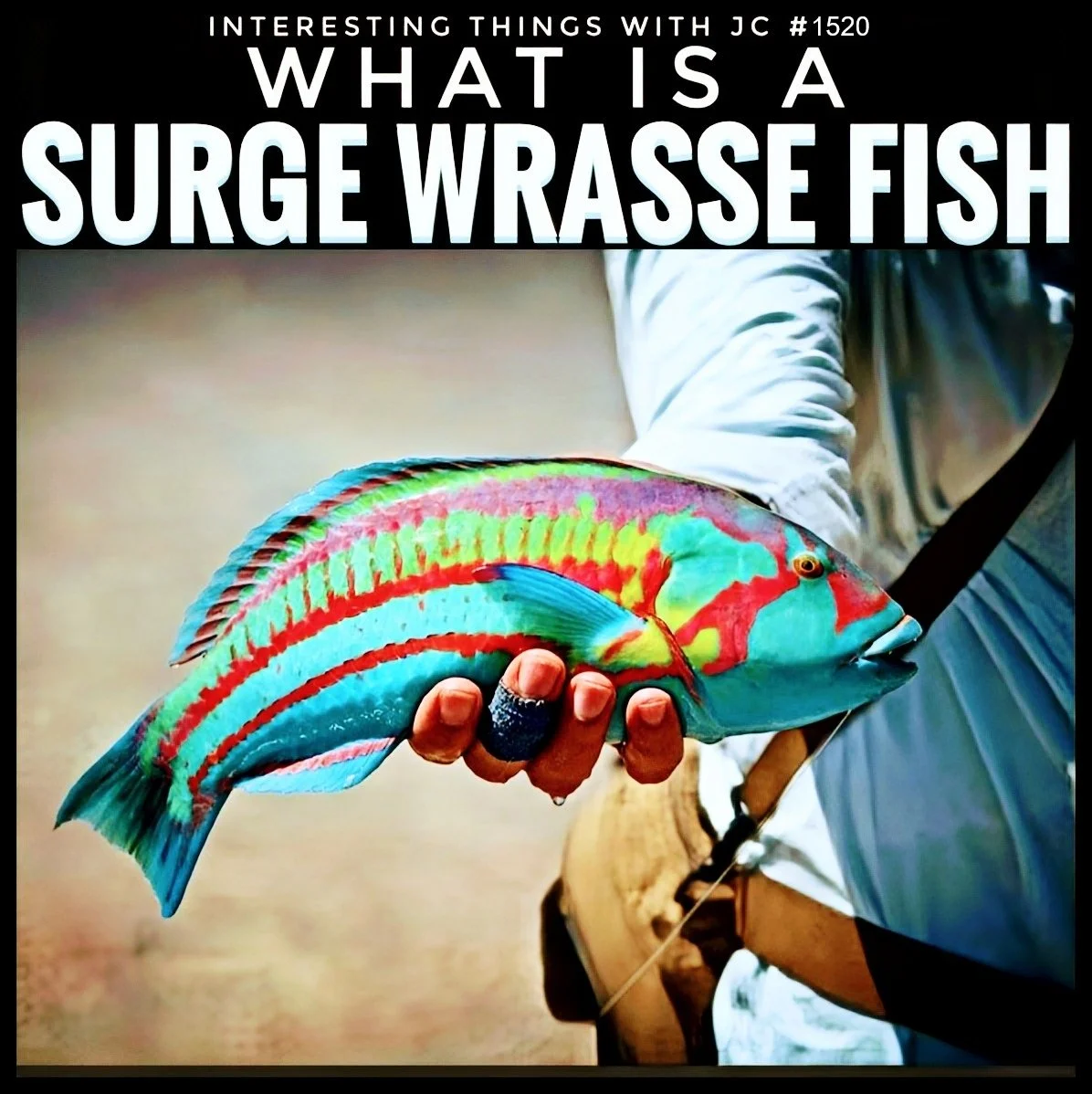
Promotional image for Interesting Things with JC episode 1519 showing a brightly colored surge wrasse fish with blue, green, and red markings being held in a person’s hand near the shoreline, with the title “What Is a Surge Wrasse Fish” displayed at the top; image used under fair use for educational and editorial purposes.
Transcript
Interesting Things with JC #1519: "What Is a Surge Wrasse Fish?"
If you’ve ever stood in the ocean where the waves just won’t quit shovin’ you around, that’s the kind of place a surge wrasse calls home. This fish doesn’t wait for calm water. It lives where the water stays rough and restless.
The surge wrasse, Thalassoma purpureum (thal-ASS-uh-muh per-PURR-ee-um), is part of the wrasse family and lives on tropical reefs across the Indo-Pacific. You’ll usually spot it along outer reef flats, reef edges, and rocky shorelines where waves hit hard all day long. They stick to shallow water, rarely deeper than about 33 feet, or 10 meters. That stretch of foamy, churning water is called the surge zone, and it’s a tough place to make a living.
They’re built for it. Long, slim bodies. Strong tails. They don’t fight the waves. They time them, moving forward with the surge and easing back when the water pulls away.
They’re also easy to spot once you know what to look for. Females and younger fish are in what’s called the initial phase. They’re usually reddish, with a clear V-shaped mark on the snout. The big dominant males are known as terminal phase males. Those are the flashy ones. Bright greenish-blue bodies, bold red stripes, and pinkish-purple markings across the face. Same species. Different role.
During the day, they’re always moving. Small groups sweep across the reef, usually led by one large male. They hunt crabs, sea urchins, brittle stars, snails, and other small invertebrates. By keeping those fast-growing animals in check, surge wrasses help keep parts of the reef from getting overcrowded. They’re not cleaners, but they help keep the balance steady.
A full-grown surge wrasse can reach about 18 inches long, or 46 centimeters, and weigh close to 2.6 pounds, around 1.2 kilograms. Big enough to catch a hook now and then, and colorful enough to catch your eye.
These are interesting things, with JC.
Student Worksheet
Explain why the surge zone is difficult for many marine animals to live in.
Describe two physical traits that help the surge wrasse survive strong waves.
Compare the appearance of initial-phase and terminal-phase surge wrasses.
Explain how feeding on invertebrates helps maintain reef balance.
Teacher Guide
Estimated Time
30–45 minutes
Pre-Teaching Vocabulary Strategy
Introduce vocabulary with images of reef zones and wrasse color phases before listening.
Anticipated Misconceptions
Students may assume calm water is always better for marine life.
Students may think color differences indicate different species.
Discussion Prompts
Why might timing movement be more effective than fighting waves?
How does the surge wrasse demonstrate ecological balance?
Differentiation Strategies
ESL: Use labeled diagrams and sentence frames.
IEP: Offer oral responses or shortened question sets.
Gifted: Research another surge-zone species and compare adaptations.
Extension Activities
Create a diagram showing wave motion and fish movement.
Write a short reflection comparing human and animal adaptation to extreme environments.
Cross-Curricular Connections
Physics: Wave energy and motion.
Environmental Science: Reef ecosystems and species balance.
Art: Coloration and visual signaling in animals.
Quiz
Q1. Where does the surge wrasse typically live?
A. Deep open ocean
B. Calm lagoons
C. Surge zones of shallow reefs
D. Freshwater rivers
Answer: C
Q2. What is the main function of the surge wrasse’s body shape?
A. Speed in open water
B. Camouflage in sand
C. Timing movement with waves
D. Digging in sediment
Answer: C
Q3. Which fish shows the brightest coloration?
A. Juveniles
B. Initial-phase females
C. Terminal-phase males
D. Larvae
Answer: C
Q4. What does the surge wrasse primarily eat?
A. Plankton
B. Seaweed
C. Small invertebrates
D. Coral polyps
Answer: C
Q5. Why is the surge wrasse important to reef ecosystems?
A. It builds reefs
B. It controls invertebrate populations
C. It cleans parasites from other fish
D. It produces oxygen
Answer: B
Assessment
Open-Ended Questions
Explain how environmental pressure shapes animal behavior.
Describe one way the surge wrasse contributes to reef health.
3–2–1 Rubric
3 = Accurate, complete, thoughtful
2 = Partial or missing detail
1 = Inaccurate or vague
Standards Alignment
NGSS HS-LS2-2
Students analyze how organisms interact within ecosystems, including predator-prey balance.
NGSS HS-LS1-4
Connects structure and function in biological systems.
CCSS.ELA-LITERACY.RST.9-10.2
Students determine central ideas of scientific texts.
UK National Curriculum KS4 Biology
Adaptation and interdependence within ecosystems.
Cambridge IGCSE Biology 0610
Relationships between organisms and their environment.
Show Notes
This episode examines the surge wrasse, a reef fish uniquely adapted to survive constant wave action in shallow tropical waters. By focusing on anatomy, behavior, and ecological role, the episode provides a clear example of how life evolves to fit extreme environments. In the classroom, it supports lessons on adaptation, ecosystems, and marine biodiversity, helping students connect physical science concepts like motion and force with biological survival strategies. The surge wrasse shows that balance, timing, and specialization are key to thriving in nature’s toughest places.
References
Froese, R., & Pauly, D. (Eds.). (2025). Thalassoma purpureum (Forsskål, 1775). FishBase. https://www.fishbase.se/summary/Thalassoma-purpureum.html
Cabanban, A., & Pollard, D. (2010). Thalassoma purpureum. The IUCN Red List of Threatened Species 2010: e.T187746A8618843. https://www.iucnredlist.org/species/187746/8618843
Bray, D. J. (2020). Thalassoma purpureum (Forsskål, 1775). Fishes of Australia. Museums Victoria. https://fishesofaustralia.net.au/home/species/288