1519: "Can Dogs Eat Bones?"
Interesting Things with JC #1519: "Can Dogs Eat Bones?" – It feels like common sense: dogs chew bones. But what used to be food is now one of the biggest risks we hand them without thinking. This episode sits right at the line between instinct and modern life.
Curriculum - Episode Anchor
Episode Title: Can Dogs Eat Bones?
Episode Number: 1519
Host: JC
Audience:
Grades 9–12, college intro, homeschool, lifelong learners
Subject Area:
Biology, Animal Science, Nutrition, Media Literacy
Lesson Overview
This episode explores the long history of dogs and bone consumption, contrasting evolutionary biology with modern food practices. Students examine how cooking alters physical structures, why veterinary guidance has changed, and how common cultural images can persist despite scientific evidence.
Measurable Learning Objectives
Define how domestication shaped early canine diets and bone consumption.
Compare cooked and raw bones in terms of structure, safety, and biological impact.
Analyze veterinary risk assessments related to dogs chewing bones.
Explain how modern food preparation practices create new health risks for animals.
Key Vocabulary
Domestication (duh-mes-ti-KAY-shun) — The process by which animals adapt to living with humans; dogs split from wolves through domestication tens of thousands of years ago.
Marrow (MAIR-oh) — Soft, fatty tissue inside bones that provides calories and nutrients.
Connective Tissue (kuh-NEK-tiv TISH-oo) — Tissue such as cartilage and tendons that once helped distribute chewing pressure in raw bones.
Splinter (SPLIN-ter) — Sharp fragments created when cooked bones snap instead of bend.
Pathogen (PATH-uh-jen) — Disease-causing bacteria like Salmonella or E. coli found in raw meat.
Narrative Core
Open: A familiar image: a dog lying in the grass, calmly chewing a bone, something most people never question.
Info: Dogs evolved alongside humans, eating scraps that included raw bones rich in nutrients when food was uncertain.
Details: Cooking fundamentally changes bone structure, making them brittle and dangerous, while modern veterinary science highlights risks unseen in the past.
Reflection: The problem is not dogs’ instincts, but how ancient biology collides with modern kitchens.
Closing: These are interesting things, with JC.
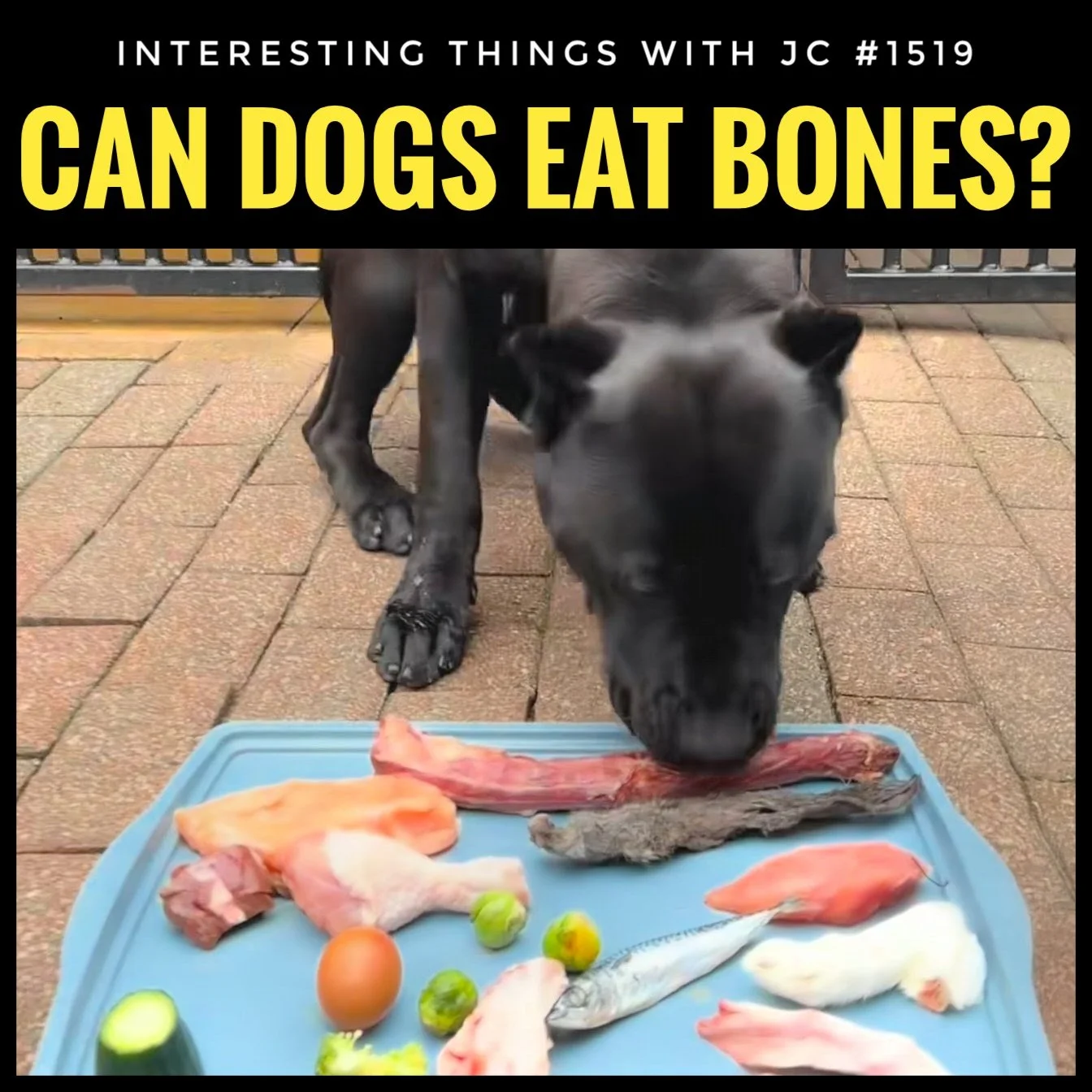
Panther, a large black dog (appears to be a Cane Corso–type), stands outdoors on a brick patio, leaning forward to sniff or eat raw meat placed on a blue tray. Panther is known on TikTok for videos about raw feeding and canine evolution–based diets, where his meals are shown as examples of ancestral-style nutrition. The scene is calm and well-lit, with various raw foods arranged neatly in front of him.
Transcript
Interesting Things with JC #1519: "Can Dogs Eat Bones?"
Picture a dog stretched out with a bone. Nothing fancy. Just grass, paws crossed, jaw working steady. Most of us grew up seeing that and never questioned it. Dog plus bone just feels right. Like the world’s in order.
For most of history, it was.
Dogs split from wolves somewhere between 15,000 and 30,000 years ago. Long before farms, towns, or recipes. Back then, dogs didn’t have kibble or chew toys. They lived close to people and ate scraps. Skin, gristle, connective tissue, bones. Bones weren’t a treat. They were food. Inside was marrow, fat, calcium, phosphorus. One marrow bone could hold a few ounces, about 85 to 140 grams, of calories that mattered when the next meal wasn’t promised.
What changed wasn’t the dog.
It was the kitchen.
Cooking changes bones. Heat pulls out moisture and weakens the structure. Cooked bones don’t bend. They snap. Chicken bones are the worst. They shatter into sharp slivers, just a few inches long, around 5 to 8 centimeters, sharp enough to cut a throat or puncture intestines. A dog’s stomach is tough, but it’s not built for splinters.
Raw bones behave differently. They keep moisture. They stay flexible. Large raw beef bones, weighing 2 to 4 pounds, about 0.9 to 1.8 kilograms, tend to wear down instead of breaking apart. Raw chicken feet are mostly cartilage and small bones that crush and fold. Raw turkey necks or legs still have meat and connective tissue attached, which spreads pressure as the dog chews.
But raw doesn’t mean harmless.
Even big bones can crack teeth. Pieces can get stuck across a jaw. Some dogs swallow before they chew, and that’s how choking or blockages happen. Raw meat also carries bacteria like Salmonella, E. coli, and Listeria. Dogs can get sick, and those germs can spread to people, especially kids, older adults, or anyone with a weakened immune system.
That’s why most veterinary groups, including the AVMA and AKC, say the risks usually outweigh the benefits. Cooked bones are a hard no. Raw bones? Many vets say skip them and use approved dental chews instead. They clean teeth, keep dogs busy, and don’t end with a late-night emergency visit.
If someone’s set on raw meaty bones, it means choosing pieces bigger than the dog’s head, supervising closely, handling them safely, and talking with a vet first. This isn’t a toss-it-and-walk-away deal.
The urge to chew isn’t the problem. It never was. Trouble starts when a prehistoric mouth meets a modern kitchen.
These are interesting things, with JC.
Student Worksheet
Why were bones an important food source for early dogs?
Explain how cooking changes the physical structure of bones.
Describe one risk associated with raw bones and one with cooked bones.
Why do modern veterinarians often recommend dental chews instead of bones?
Teacher Guide
Estimated Time
One 45–60 minute class period
Pre-Teaching Vocabulary Strategy
Use a comparison chart showing raw versus cooked bone properties.
Anticipated Misconceptions
That all bones are equally dangerous or equally safe for dogs.
Discussion Prompts
Why do cultural images persist even when science changes?
How does human technology create unintended biological risks?
Differentiation Strategies
ESL: Visual aids and simplified summaries
IEP: Shortened reading segments and guided questions
Gifted: Research current veterinary guidelines and present findings
Extension Activities
Analyze pet food marketing claims using scientific evidence.
Cross-Curricular Connections
Chemistry: Effects of heat on materials
History: Human-animal domestication
Health Science: Zoonotic disease transmission
Quiz
Q1. Why did early dogs commonly eat bones?
A. For entertainment
B. As a primary nutrient source
C. To clean their teeth
D. To store food
Answer: B
Q2. What makes cooked bones dangerous?
A. They are too large
B. They dissolve in the stomach
C. They splinter sharply
D. They lack nutrients
Answer: C
Q3. Which bacteria may be found on raw bones?
A. Influenza
B. Salmonella
C. Rabies
D. Giardia only
Answer: B
Q4. What is one risk of raw bones?
A. Loss of appetite
B. Tooth fractures
C. Vitamin deficiency
D. Hair loss
Answer: B
Q5. Why do vets often recommend dental chews?
A. They are cheaper
B. They replace meals
C. They reduce risk while cleaning teeth
D. Dogs prefer them
Answer: C
Assessment
Open-Ended Questions
Explain how modern cooking practices changed the safety of bones for dogs.
Discuss how scientific understanding can challenge long-held assumptions.
3–2–1 Rubric
3 = Accurate, complete, thoughtful
2 = Partial or missing detail
1 = Inaccurate or vague
Standards Alignment
NGSS HS-LS1-2
Students analyze how structure relates to function in biological systems.
NGSS HS-LS4-1
Evidence-based explanations of biological evolution and domestication.
CCSS.ELA-LITERACY.RI.9-10.2
Determine central ideas of informational texts.
ISTE 3
Evaluate accuracy and reliability of information sources.
UK National Curriculum Biology (Key Stage 4)
Structure and function of living organisms and adaptation.
IB Biology SL
Evolution, nutrition, and human interaction with animals.
Show Notes
This episode examines why dogs historically ate bones and why that practice has become risky in modern households. By blending evolutionary biology with veterinary science, it challenges familiar cultural images and encourages critical thinking about how human habits affect animal health. In classrooms, it supports discussions on adaptation, food science, and evaluating traditional beliefs using evidence.
References
American Kennel Club. (2024, March 26). Can dogs eat bones? Be careful before giving your pup a bone. https://www.akc.org/expert-advice/nutrition/can-dogs-eat-bones/
PetMD. (2025, March 11). Can dogs eat bones? https://www.petmd.com/dog/nutrition/can-dogs-eat-bones
VCA Animal Hospitals. (n.d.). Why bones are not safe for dogs. https://vcahospitals.com/know-your-pet/why-bones-are-not-safe-for-dogs
American Veterinary Medical Association. (n.d.). Raw or undercooked animal-source protein cat and dog diets. https://www.avma.org/resources-tools/avma-policies/raw-or-undercooked-animal-source-protein-cat-and-dog-diets