1518: "The Original Alien Soundtrack by Jerry Goldsmith"
Interesting Things with JC #1518: "The Original Alien Soundtrack by Jerry Goldsmith" - Jerry Goldsmith's original Alien score was hopeful and exploratory until Ridley Scott's cuts turned it into chilling dread. Eerie alien wind effects and lost experimental cues survive on the 2007 Intrada release. This episode uncovers Goldsmith's iconic patient terror. Thank you to the legendary Wani for inspiring this episode.
Curriculum - Episode Anchor
Episode Title: The Original Alien Soundtrack
Episode Number: 1518
Host: JC
Audience: Grades 9–12, college intro, homeschool, lifelong learners
Subject Area: Music History, Film Studies, Media Literacy, Sound Design
Lesson Overview
Students will:
Define the musical techniques used by composer Jerry Goldsmith in the 1979 score for Alien.
Compare the intended musical score with the final edited film version to evaluate artistic decisions.
Analyze the psychological and emotional impact of musical choices in film.
Explain how sound design contributes to storytelling, especially in science fiction and horror genres.
Key Vocabulary
Aleatoric (ay-lee-uh-TOR-ik) — A composition technique where performers use chance or loose instructions. In Alien, this creates controlled chaos in cues like “The Shaft.”
Echoplex (EH-koh-pleks) — A delay effect used to manipulate natural sounds, giving breath-like tones an alien quality in the score.
Motif (moh-TEEF) — A recurring musical idea; in Alien, motifs like the “space motif” use unresolved intervals to create unease.
Dissonance (DIS-uh-nuns) — Harsh or unstable harmony used for tension; Goldsmith uses it narratively rather than just for noise.
Diegetic (die-eh-JET-ik) — Sound originating within the film world; Goldsmith’s score intentionally blurs the line between diegetic and non-diegetic sound to intensify realism.
Narrative Core (Based on the PSF – relabeled)
Open:
The story begins with an auditory mystery—before viewers saw the alien, they heard it, setting the stage for tension through sound.Info:
JC explains how Jerry Goldsmith came to score Alien, despite not being the director’s first choice, and how his early vision reflected wonder, not fear.Details:
The production process altered Goldsmith’s score significantly: scenes were cut, cues shifted or replaced, and music from other films was inserted. Goldsmith’s experimental techniques (e.g., serpent horn, didgeridoo) created an organic, otherworldly atmosphere.Reflection:
Goldsmith’s score isn’t just music—it’s a narrative force showing what happens when human confidence meets cosmic indifference.Closing:
“These are interesting things, with JC.”
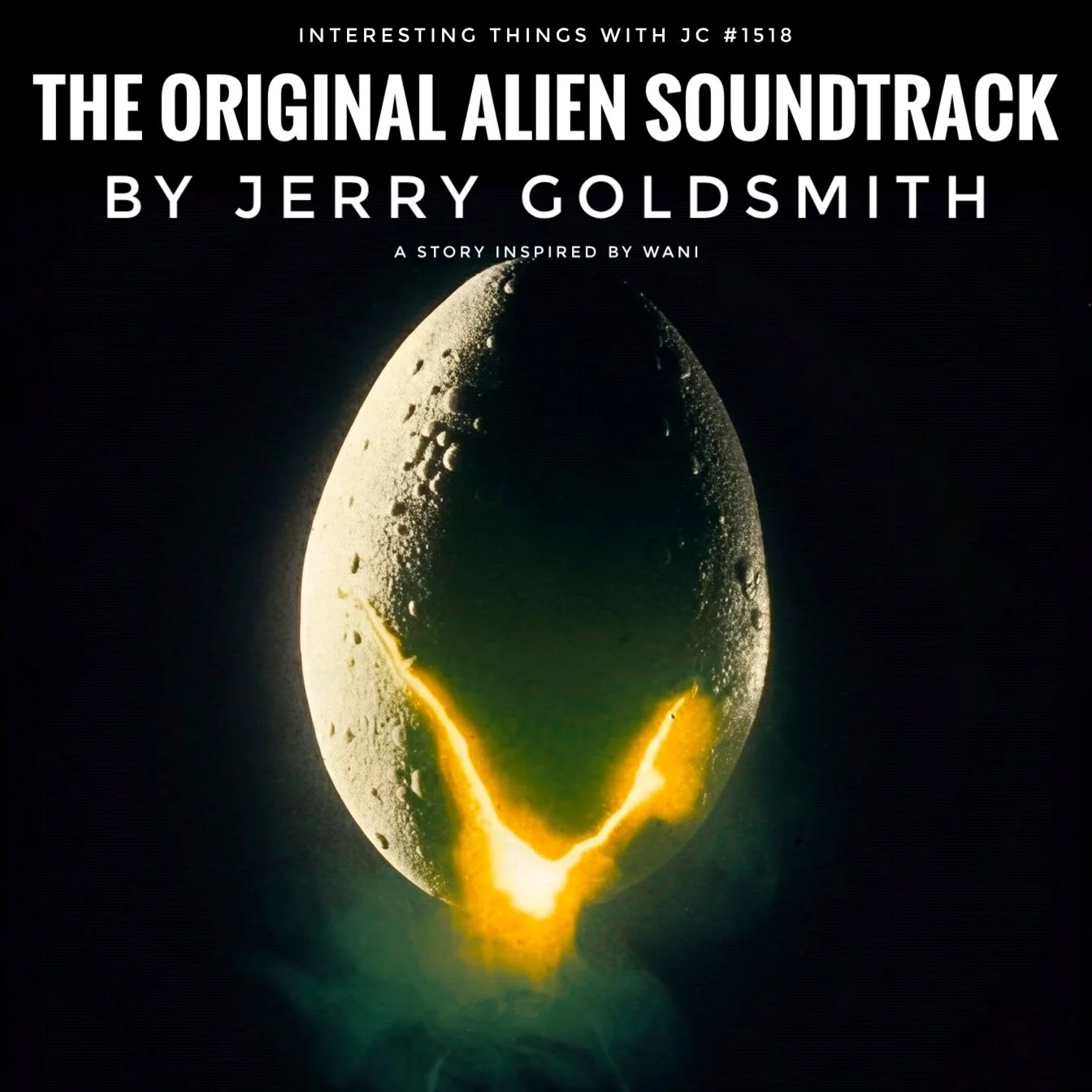
Dark sci-fi-themed image featuring a cracked, glowing egg emitting light and vapor, centered on a black background. Text reads: “The Original Alien Soundtrack by Jerry Goldsmith – Interesting Things with JC #1518.” The design evokes suspense and mystery, referencing the 1979 film Alien.
Transcript
Interesting Things with JC #1518: “The Original Alien Soundtrack”
In 1979, before audiences ever saw the creature, they heard it.
The first sensation wasn’t teeth or claws. It was sound. A breath of space. A feeling that something ancient and patient was already awake.
That sound came from Jerry Goldsmith, working at the height of his creative powers, scoring Alien, directed by Ridley Scott.
Goldsmith was not Scott’s first choice. Scott initially imagined the film scored by Japanese electronic pioneer Isao Tomita (ee-SAH-oh toh-MEE-tah), known for synthesizer-driven reinterpretations of classical music that sounded futuristic and detached from human warmth. The studio pushed back, favoring a proven orchestral voice. Other names were discussed, even John Williams, but Goldsmith was ultimately chosen as the safer, more established hand.
Goldsmith delivered a score running just over 64 minutes, spread across 23 cues, recorded with a full orchestra and an arsenal of instruments most composers would never touch. At first, he didn’t write a horror score. He wrote a score about exploration. About human beings stepping into the unknown.
You can hear it in the main theme. Three rising notes, often carried by a solo trumpet. It’s gentle. Almost hopeful. In American terms, it sounds like confidence. Like a belief that curiosity still matters.
That version of the opening is sweeping and openly romantic, and it still exists today on the Intrada release and on isolated music tracks from the film. When heard synchronized to the opening visuals as an alternate, it reveals just how warm and expansive Goldsmith’s original vision was, and how much colder and more minimal the final film became.
But that idea didn’t survive the film intact.
During post-production, Scott and editor Terry Rawlings reshaped the movie aggressively. The cut Goldsmith originally scored was reduced by roughly 11 minutes, about 660 seconds, forcing entire musical passages out of alignment. Cues no longer fit scene lengths. Rhythms no longer landed where intended. Music was shortened, relocated, or removed entirely.
Some scenes were rescored with excerpts from Goldsmith’s own 1962 film Freud. The end credits famously used music from Howard Hanson’s Symphony No. 2 instead of Goldsmith’s finale.
What remained in the film was powerful. What was left behind was something stranger, and in many ways more revealing.
Goldsmith built the score around a handful of musical ideas that slowly corrode. The so-called space motif floats without resolution, often just two notes, spaced to avoid any clear key. The effect is psychological. The ear keeps waiting for home, and it never arrives.
Then there’s the alien itself. Not a melody. A presence. Low brass growls, processed echoes, breathy moans created with instruments like serpent horn, conch shell, and didgeridoo. These sounds were routed through an Echoplex delay unit, turning physical breath into something that feels biological but unfamiliar. Not mechanical. Alive. Scott was so struck by the “alien wind” effect the first time he heard it that he repeatedly asked Goldsmith to weave it into additional cues, a request that even reshaped later revisions of the main title.
The opening chord alone tells you what kind of score this is. It stacks minor sevenths in a way that avoids gravity. No tonic. No resolution. The harmony hangs there, suspended, like debris drifting at thousands of miles per hour through a vacuum, roughly 17,000 miles per hour, or about 27,000 kilometers per hour.
Goldsmith was drawing from serious 20th-century music. Claude Debussy (duh-BYOO-see) for his whole-tone ambiguity. Krzysztof Penderecki (pen-deh-RETS-kee) for his textural violence. But Goldsmith never copied. He translated those ideas into cinematic language, using dissonance not as noise, but as narrative.
As the film progresses, the human theme fractures. The rising notes appear in minor keys. Sometimes they vanish entirely. What replaces them is rhythm. A stalking pulse in low brass, often in a lurching 6/8 pattern. It doesn’t rush. It waits.
This restraint marks a sharp contrast with Goldsmith’s other major science fiction work from the same year, Star Trek: The Motion Picture, where sweeping themes and harmonic clarity celebrate optimism and order, while Alien strips those comforts away until only uncertainty remains.
Many of the most experimental cues never made it into the final cut. “The Shaft.” “The Eggs.” “The Cupboard.” These pieces push even further into abstraction, using aleatoric string effects, where players follow loose instructions instead of strict notes, creating controlled chaos. It’s the sound of uncertainty given shape.
What survives, whether in the film or on the original recording, is a lesson in discipline. Goldsmith understood that terror isn’t loud. It’s patient. It waits until the human voice disappears.
And maybe that’s why this score still matters.
Because Alien isn’t really about a monster. It’s about what happens when confidence meets something that doesn’t care. Goldsmith’s music starts with wonder and ends with survival. Not triumph. Just survival.
In space, no one can hear you scream. But they can hear you breathe. And Jerry Goldsmith made sure we never forgot it.
These are interesting things, with JC.
Student Worksheet
What instruments did Goldsmith use to create alien sounds?
Why was Goldsmith’s original opening theme considered “hopeful”?
How did post-production changes affect the score?
Name one musical idea that Goldsmith used to suggest the alien’s presence.
In your opinion, why is silence or minimal sound sometimes more terrifying than loud noises in film?
Teacher Guide
Estimated Time: 2 class periods (45–60 minutes each)
Pre-Teaching Vocabulary Strategy:
Use short audio clips to demonstrate each key term.
Provide visuals of instruments like the serpent horn or conch shell.
Anticipated Misconceptions:
Students may think soundtracks are composed after a film is edited.
Students may assume “scary” music is loud or fast; emphasize patience and restraint in horror scoring.
Discussion Prompts:
What makes a sound feel “alien”?
How do editing decisions impact a composer’s artistic vision?
Compare Goldsmith’s approach in Alien to another sci-fi film like Star Wars or Interstellar.
Differentiation Strategies:
ESL: Provide vocabulary in audio and visual formats.
IEP: Offer sentence starters for written responses.
Gifted: Challenge students to compose or remix a short cue inspired by Alien.
Extension Activities:
Analyze a deleted cue from the Intrada release and hypothesize why it was removed.
Explore Penderecki’s influence by comparing Alien to The Shining.
Use audio software to create “alien wind” effects from human breath.
Cross-Curricular Connections:
Physics: Discuss the concept of sound in space (vacuum = no transmission of sound waves).
Psychology: Explore how unresolved harmony triggers anxiety.
Film/Media Studies: Examine editing and scoring as collaborative yet conflicting elements in filmmaking.
Quiz
Q1. What genre did Goldsmith’s original Alien score mostly resemble before changes?
A. Horror
B. Romance
C. Exploration
D. Thriller
Answer: C
Q2. What instrument is NOT mentioned as part of the alien sound palette?
A. Didgeridoo
B. Serpent horn
C. Theremin
D. Conch shell
Answer: C
Q3. What is a defining feature of the space motif?
A. Fast tempo and drums
B. Rising melody in a major key
C. Two notes avoiding any key
D. Clear melody with resolution
Answer: C
Q4. Why were some cues from the score cut or altered?
A. Goldsmith was replaced mid-film
B. The director disliked orchestral music
C. The film was shortened in post-production
D. The studio added pop songs instead
Answer: C
Q5. What replaced Goldsmith’s final cue in the end credits?
A. A John Williams piece
B. An original cue from Freud
C. A jazz improvisation
D. Howard Hanson’s Symphony No. 2
Answer: D
Assessment
How did Goldsmith’s score contribute to the emotional tone of Alien?
Describe how editing decisions reshaped the musical structure of the film.
3–2–1 Rubric:
3 – Accurate, complete, thoughtful
2 – Partial or missing detail
1 – Inaccurate or vague
Standards Alignment
Common Core (CCSS.ELA-LITERACY.RI.11-12.3):
Analyze how an author (or composer) uses rhetoric or structure to advance a purpose or point of view—students assess Goldsmith’s scoring choices as rhetorical musical devices.
C3 Framework (D2.Civ.14.9-12):
Evaluate multiple perspectives in interpreting significant artistic works—compare Goldsmith’s vision vs. studio edit.
ISTE 6a (Creative Communicator):
Students choose appropriate platforms and tools to create compositions that express understanding—optionally composing atmospheric cues.
National Core Arts Standards (MU:Re7.2.E.HSII):
Analyze the impact of musical choices on audience perception—critical in understanding Alien’s psychological sound design.
IB Music (Standard Level, Music Analysis Component):
Discuss use of musical elements and compositional devices—connects to aleatoric effects, motifs, and orchestration.
Cambridge IGCSE Music (0478, Component 1):
Identify and explain features in music from the 20th century—applies to Goldsmith’s experimental instrumentation.
Show Notes
This episode explores the original soundtrack for Ridley Scott’s Alien and how composer Jerry Goldsmith’s haunting, avant-garde score shaped the emotional experience of the film. Listeners learn how the music was conceived, reshaped, and partially replaced during editing, revealing the delicate collaboration—and conflict—between director, editor, and composer. Students will gain insight into the relationship between sound and storytelling, particularly how dissonance and unresolved harmony evoke fear and uncertainty. This episode is perfect for music, film, and media studies classes, where learners can deepen their understanding of how technical choices affect artistic impact.
References
Lysy, C. (2024, November 28). ALIEN – Jerry Goldsmith. Movie Music UK. https://moviemusicuk.us/2024/11/28/alien-jerry-goldsmith/
Ebert, R. (2017, May 16). The great unknown: The story behind Jerry Goldsmith’s score for “Alien.” RogerEbert.com. https://www.rogerebert.com/features/the-great-unknown-the-story-behind-jerry-goldsmiths-score-for-alien
Intrada Records. (n.d.). ALIEN (2 CD SET) [Product page]. https://store.intrada.com/s.nl/it.A/id.5613/.f
Bond, J. (2016, February). Alien (Goldsmith, 1979). Cue By Cue: Film Music Narratives. https://cuebycue.blogspot.com/2016/02/alien-goldsmith-1979.html
Norelli, C. N. (2017, June 6). In space you can hear a symphony: The story behind the theme for "Alien." MUBI Notebook. https://mubi.com/en/notebook/posts/in-space-you-can-hear-a-symphony-the-story-behind-the-theme-for-alien
Filmtracks. (2024, September 7). Alien (Jerry Goldsmith). https://www.filmtracks.com/titles/alien.html
Chris Siddall Music Publishing. (n.d.). Jerry Goldsmith's "ALIEN" in full score. https://chrissiddallmusic.com/products/jerry-goldsmiths-alien-in-full-score
Classic Soundtracks. (n.d.). Alien (1979): Complete Motion Picture Soundtrack [YouTube playlist]. YouTube. https://www.youtube.com/playlist?list=PLocqHZj7MJfnD-4YtzBKvxDZMjxqqkzJF