Interesting Things with JC #1529: "Platypus" – It looks like a joke made of spare parts, but hides one of the most advanced sensory systems in the animal kingdom. Nature didn’t make a mistake. It made a masterpiece.
Curriculum - Episode Anchor
Episode Title: Platypus
Episode Number: 1529
Host: JC
Audience: Grades 9–12, college intro, homeschool, lifelong learners
Subject Area
Biology (zoology, evolution, sensory biology), Scientific literacy
Lesson Overview
Students investigate why the platypus is classified as a monotreme and what that reveals about mammal evolution.
Students explain how electroreception and mechanoreception help platypuses hunt in murky water.
Students evaluate how scientists handle “weird” evidence (historical skepticism, museum specimens, and modern measurement).
Students practice careful claims: distinguishing what is confirmed (venom, egg-laying, receptors) from what is still uncertain (function of UV glow).
Learning Objectives (measurable)
Define “monotreme” and explain how monotremes differ from marsupials and placental mammals.
Compare electroreception and mechanoreception in the platypus bill and describe how both support hunting.
Analyze why early European scientists suspected a hoax and connect that to how scientific skepticism works.
Explain one confirmed platypus trait and one unresolved research question, using evidence-based language.
Key Vocabulary
Monotreme (MON-uh-treem) — Egg-laying mammal group that includes platypuses and echidnas.
Electroreception (ee-LEK-troh-ri-SEP-shun) — Sensing weak electrical signals, especially useful underwater.
Mechanoreceptor (MEK-uh-noh-REE-sep-ter) — Receptor that detects touch, pressure, or motion.
Biofluorescence (BY-oh-fluh-RESS-ens) — Absorbing UV light and re-emitting it as visible light (a glow).
Venomous spur (VEN-uh-muhs spur) — A sharp structure used by male platypuses to deliver venom that can cause severe pain.
Mammary glands (MAM-uh-ree glanz) — Milk-producing glands; in monotremes, milk is delivered without nipples.
Narrative Core
Open – How the story hooks the listener.
The platypus looks “assembled,” so strange that a real specimen once seemed like a prank.
Info – Background or supporting context.
Basic traits: egg-laying mammal, aquatic lifestyle, distinctive body plan, Australia.
Details – The twist, turning point, or key facts.
Historical skepticism: scientists checked for stitches.
Venomous spurs in males; pain can be extreme.
UV glow (biofluorescence) observed in museum specimens and living animals; function unknown.
Bill sensory system: tens of thousands of electroreceptors and mechanoreceptors; hunting with eyes/ears/nose closed.
Reflection
“Strange” is not “unfinished”—it can be highly specialized and successful over deep time.
Closing
These are interesting things, with JC.
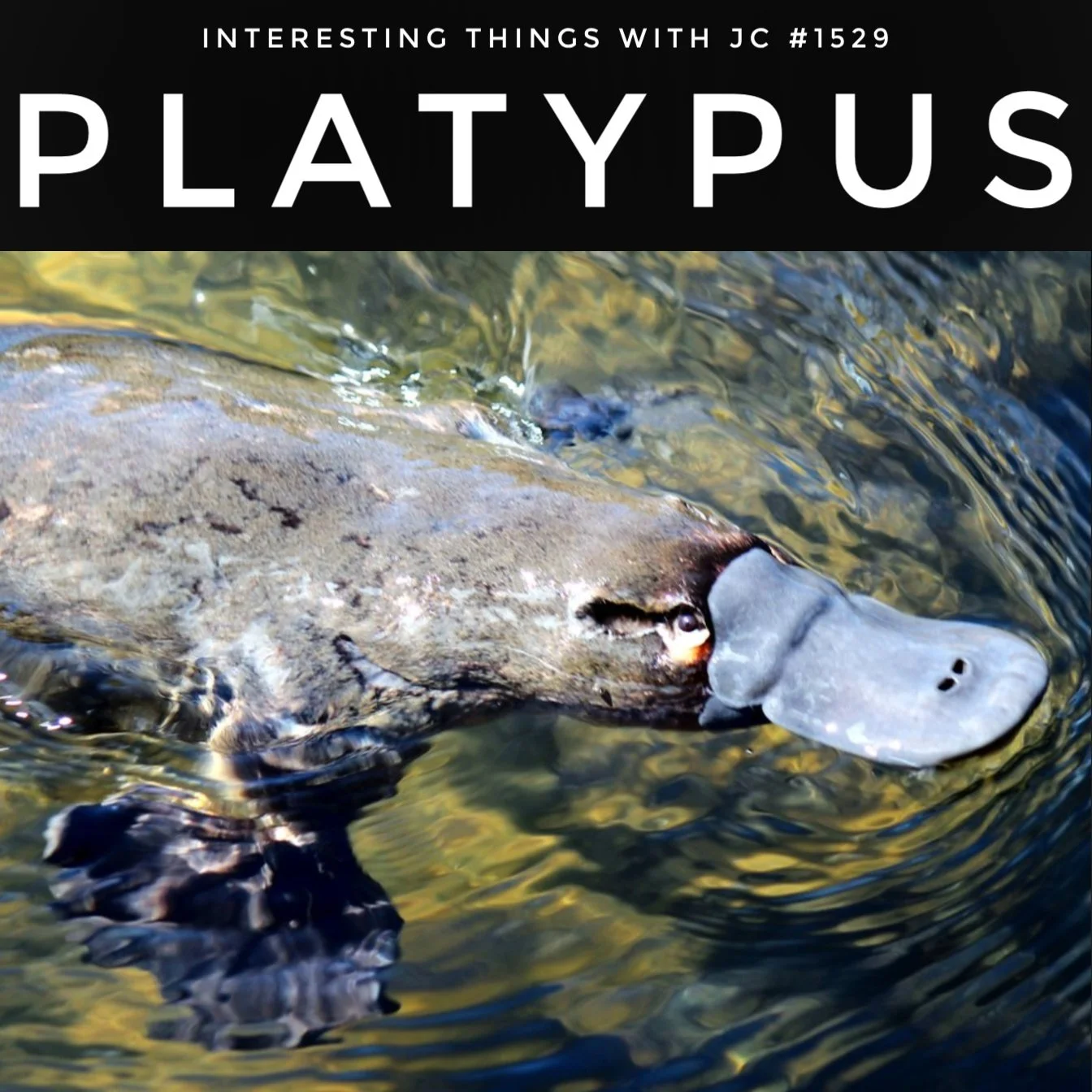
Podcast cover: a platypus swimming in rippling water beneath the title “PLATYPUS” and “Interesting Things with JC #1529.”
Transcript
Interesting Things with JC #1529: "Platypus"
If someone showed you a platypus and said it was real, you might think it was a joke. Duck bill. Beaver tail. Otter body. It looks assembled from spare parts. Yet it’s been living in Australia, unchanged in its essentials, for millions of years.
When Europeans first encountered one in 1799, scientists suspected a hoax. They examined the skin for stitches.
A grown platypus weighs about 3 to 5 pounds (1.4 to 2.3 kilograms) and measures roughly 17 to 20 inches long (43 to 50 centimeters). It lays eggs, nurses its young with milk that seeps through the skin, and males carry venomous spurs on their hind legs strong enough to cause severe pain in humans.
Then there’s what still defies easy explanation.
Under ultraviolet light, platypus fur fluoresces blue-green at wavelengths around 365 nanometers. This effect appears in both living animals and museum specimens. No clear survival advantage has been confirmed, and scientists still don’t know why it exists.
The bill, though, is anything but mysterious in function.
That soft, rubbery bill contains about 40,000 electroreceptors and 60,000 touch receptors. When a platypus dives, it closes its eyes, ears, and nostrils and hunts without sight or sound.
Every muscle movement from prey releases a faint electrical signal. The platypus detects those signals and water motion together, and its brain merges them into a precise sensory map. Researchers believe it can determine both the position and direction of prey by measuring electrical timing differences down to millionths of a second.
Platypuses split from the rest of the mammal family tree roughly 160 million years ago. They are not unfinished or accidental, but highly specialized animals from an ancient line that solved survival in a way nothing else did.
Their sensory system works so well it has lasted longer than most mammals on Earth.
The platypus is proof that nature rewards survival solutions that work, no matter how strange they appear, and they survive for as long as nature allows.
These are interesting things, with JC.
Student Worksheet
Short answer: Why did some European scientists initially suspect the platypus specimen was a hoax? What kind of evidence would change their minds?
Short answer: In your own words, describe how a platypus can find prey underwater without using sight or hearing.
Data thinking: Make a two-column chart labeled “Confirmed” vs. “Not yet explained.” Put at least three episode claims into the appropriate column and justify each choice with one sentence.
Creative prompt: Write a 6–8 sentence “field note” from the perspective of a biologist observing a hunting platypus, including at least three vocabulary words correctly.
Extension prompt: Propose one testable hypothesis for why biofluorescence might matter for a nocturnal, semi-aquatic animal. Include what data you would collect.
Teacher Guide
Estimated Time
45–60 minutes (or two 30-minute sessions)
Pre-Teaching Vocabulary Strategy
“Word parts + quick sketch” routine:
Electro- (electric) + reception (receiving)
Mechano- (motion/pressure) + receptor (receiver)
Students draw a simple bill diagram and label where each sense helps during hunting.
Anticipated Misconceptions
“Egg-laying means it’s not a mammal.”
Clarify: mammals are defined by traits including milk production; monotremes lay eggs but produce milk.
“The UV glow has a known purpose.”
Clarify: biofluorescence is documented, but function is not confirmed.
“UV wavelength is definitively 365 nm in the published work.”
Clarify: popular summaries note UV glow; published specimen photography is often reported using near-UV around 385–395 nm in setups, so treat the exact number as equipment-dependent unless a study specifies it.
“Microsecond timing is settled fact.”
Clarify: research discusses combining electrical and mechanical cues (including time-lag concepts), but students should avoid over-precision unless directly cited from a primary study.
Discussion Prompts
What makes a scientific claim “extraordinary,” and what kind of evidence matches it? (Connect to the 1799 hoax suspicion.)
How does the platypus example challenge the idea that evolution produces “progress” toward one “best” design?
Should scientists publish possible explanations for biofluorescence, or wait until evidence is stronger? Why?
Differentiation Strategies: ESL, IEP, gifted
ESL: Provide a vocabulary card set with icons (egg, milk drop, lightning bolt, hand/touch). Sentence frames: “A platypus detects prey by ____.”
IEP: Chunk the transcript into 3 sections; after each, students answer one guided question with a word bank.
Gifted: Add a short primary-source “methods critique” mini-task: students identify what measurement details they’d need (UV wavelength, filters, controls, specimen age).
Extension Activities
Lab model: Build a simple “two-sensor” detection demo (e.g., combine vibration cues + visual cues) and discuss multisensory integration.
Case study: Read a short excerpt/summary about platypus envenomation and discuss why severe pain can be adaptive without being lethal.
Research mini-poster: “One solved mystery, one unsolved mystery” about platypuses (with citations).
Cross-Curricular Connections
Physics: Electric fields in water; signal detection vs. noise.
History of science: How early museum specimens shaped classification debates.
Health sciences: Pain pathways and why some venoms resist standard analgesics.
Data literacy: Distinguishing anecdote, popular science reporting, and primary research.
Quiz
Q1. Which group does the platypus belong to?
A. Placental mammals
B. Monotremes
C. Reptiles
D. Amphibians
Answer: B
Q2. What is one confirmed function of the platypus bill?
A. Producing venom
B. Detecting weak electrical signals from prey
C. Emitting ultraviolet light
D. Storing oxygen like a lungfish
Answer: B
Q3. Which statement best reflects the current scientific status of platypus biofluorescence?
A. It is proven to help platypuses hunt.
B. It is observed under UV light, but its survival advantage is not confirmed.
C. It only occurs in museum specimens, not living animals.
D. It is caused by venom glands.
Answer: B
Q4. Why did some early European scientists suspect the platypus was fake?
A. It could not swim.
B. It lacked fur.
C. Its body looked like multiple animals stitched together.
D. It was extinct.
Answer: C
Q5. Which trait is associated with male platypuses?
A. External nipples
B. Venom-delivering hind-leg spurs
C. Feathers
D. Antlers
Answer: B
Assessment
Open-ended Question 1
Explain how the platypus can locate prey underwater using at least two different kinds of sensory information.
Open-ended Question 2
Choose one “unusual” platypus trait from the episode. Write a paragraph that separates what scientists have observed from what is still uncertain, and describe what evidence would help resolve the uncertainty.
3–2–1 Rubric (for each question)
3 = Accurate, complete, thoughtful (uses correct terms; clearly distinguishes evidence vs. speculation; strong explanation)
2 = Partial or missing detail (some correct facts but unclear explanation or missing key vocabulary)
1 = Inaccurate or vague (major errors; little evidence of understanding)
Standards Alignment
NGSS (U.S.)
HS-LS4-1 — Communicate scientific information that common ancestry and biological evolution are supported by multiple lines of evidence (connects to monotreme divergence and classification).
HS-LS4-2 — Construct explanations based on evidence for evolution by natural selection (connects to specialized sensory systems and survival success).
HS-LS1-2 — Develop and use models to illustrate hierarchical organization of interacting systems (connects to bill receptors + brain integration as a system).
Common Core State Standards (CCSS ELA/Literacy in Science, U.S.)
RST.11-12.2 — Determine central ideas of a scientific text and summarize accurately (students extract key claims from the transcript).
RST.11-12.7 — Integrate and evaluate multiple sources of information (students compare episode claims with credible references).
WHST.11-12.1 — Write arguments focused on discipline-specific content (students argue what is confirmed vs. unresolved about fluorescence).
ISTE Standards (U.S.)
ISTE 3a (Knowledge Constructor) — Plan and employ effective research strategies to locate information (students curate sources on monotremes and biofluorescence).
ISTE 3c (Knowledge Constructor) — Evaluate accuracy and credibility of sources (students contrast popular reporting with primary/credible references).
UK / International Equivalents (content-based)
UK National Curriculum (KS4 Biology: inheritance, variation, evolution) — Explains evolution and adaptation using evidence; aligns with monotremes and specialized traits.
AQA GCSE Biology: Evolution and inheritance (Topic area) — Natural selection and biodiversity; aligns with “strange but successful” adaptations.
IB DP Biology: Unity and diversity / Evolution — Uses evidence to explain diversity and evolutionary history; aligns with monotreme divergence and trait analysis.
Cambridge IGCSE Biology: Evolution and adaptation — Explains adaptation and selection; aligns with sensory biology and ecological niche.
Show Notes
This episode explores the platypus as a real-world example of how evolution can produce solutions that look “impossible” at first glance: an egg-laying mammal that produces milk, uses a uniquely sensor-packed bill to hunt by detecting weak electrical signals and water movement, and (in documented observations) shows blue-green biofluorescence under ultraviolet light—an effect scientists have not yet tied to a confirmed survival advantage. In the classroom, the platypus becomes a high-interest anchor for teaching classification (monotremes), adaptation, and how scientific knowledge changes from skepticism (early hoax suspicions) to evidence-based explanation, while also modeling careful language around open questions that are still being investigated.
References
Anich, P. S., et al. (2020). Biofluorescence in the platypus (Ornithorhynchus anatinus). Mammalia. https://www.smithsonianmag.com/smart-news/platypuses-glow-green-under-ultraviolet-light-180976196/
Australian Museum. (n.d.). The evolution of the platypus. https://australian.museum/learn/teachers/learning/platypus-evolution/
Fenner, P. J., Williamson, J. A., & Myers, D. (1992). Platypus envenomation—A painful learning experience. Medical Journal of Australia. https://pubmed.ncbi.nlm.nih.gov/1454022/
Manger, P. R., et al. (1996). Ultrastructure, number, distribution and innervation of electroreceptors in the platypus bill skin. https://pubmed.ncbi.nlm.nih.gov/8828862/
Natural History Museum (UK). (n.d.). The platypus puzzle. https://www.nhm.ac.uk/discover/the-platypus-puzzle.html
University of Western Australia. (n.d.). Platypus electroreception (PDF). https://www.uwa.edu.au/study/-/media/Faculties/Science/Docs/Platypus-electroreception.pdf