Interesting Things with JC #1530: "What Is Boom Bap?" - Before lyrics. Before hooks. Before you even know if you like the song, the beat already has you moving. Boom bap is hip hop at its simplest and strongest, just kick, snare, and space, and it still hits today.
Curriculum - Episode Anchor
Episode Title
Interesting Things with JC #1530: “What Is Boom Bap?”
Episode Number
1530
Host: JC
Audience
Grades 9–12, college intro, homeschool, lifelong learners
Subject Area
Music history, media studies, cultural history
Lesson Overview
This lesson explores boom bap as a foundational rhythmic structure in hip-hop music, emphasizing its musical mechanics, historical origins, and cultural endurance. Students analyze how simplicity, discipline, and production choices shaped a lasting sound.
Learning Objectives
Students will be able to:
Define boom bap as a rhythmic and production style in hip-hop music.
Compare boom bap production techniques with later digital hip-hop styles.
Analyze why boom bap emerged in late-1980s and early-1990s New York.
Explain how rhythm structure influences lyrical delivery and listener response.
Key Vocabulary
Boom bap (boom bap) — An onomatopoeic term describing a hip-hop drum pattern built on kick and snare.
Downbeat (down-beet) — The primary beat in a musical measure where the kick drum often lands.
Snare (snair) — A sharp, percussive drum sound emphasizing beats two and four.
Sampling (sam-plинг) — Reusing portions of existing recordings to create new music.
Loop (loop) — A repeated section of sound forming the base of a beat.
Narrative Core
Open
The episode opens with the physical reaction to sound before conscious thought, grounding boom bap as a bodily experience.
Info
Boom bap is explained as a literal imitation of drum sounds, rooted in late-20th-century hip-hop production practices.
Details
The rhythm becomes culturally fixed in the early 1990s, particularly after Return of the Boom Bap, marking a stylistic boundary.
Reflection
The endurance of boom bap lies in restraint and clarity rather than technical excess.
Closing
These are interesting things, with JC.
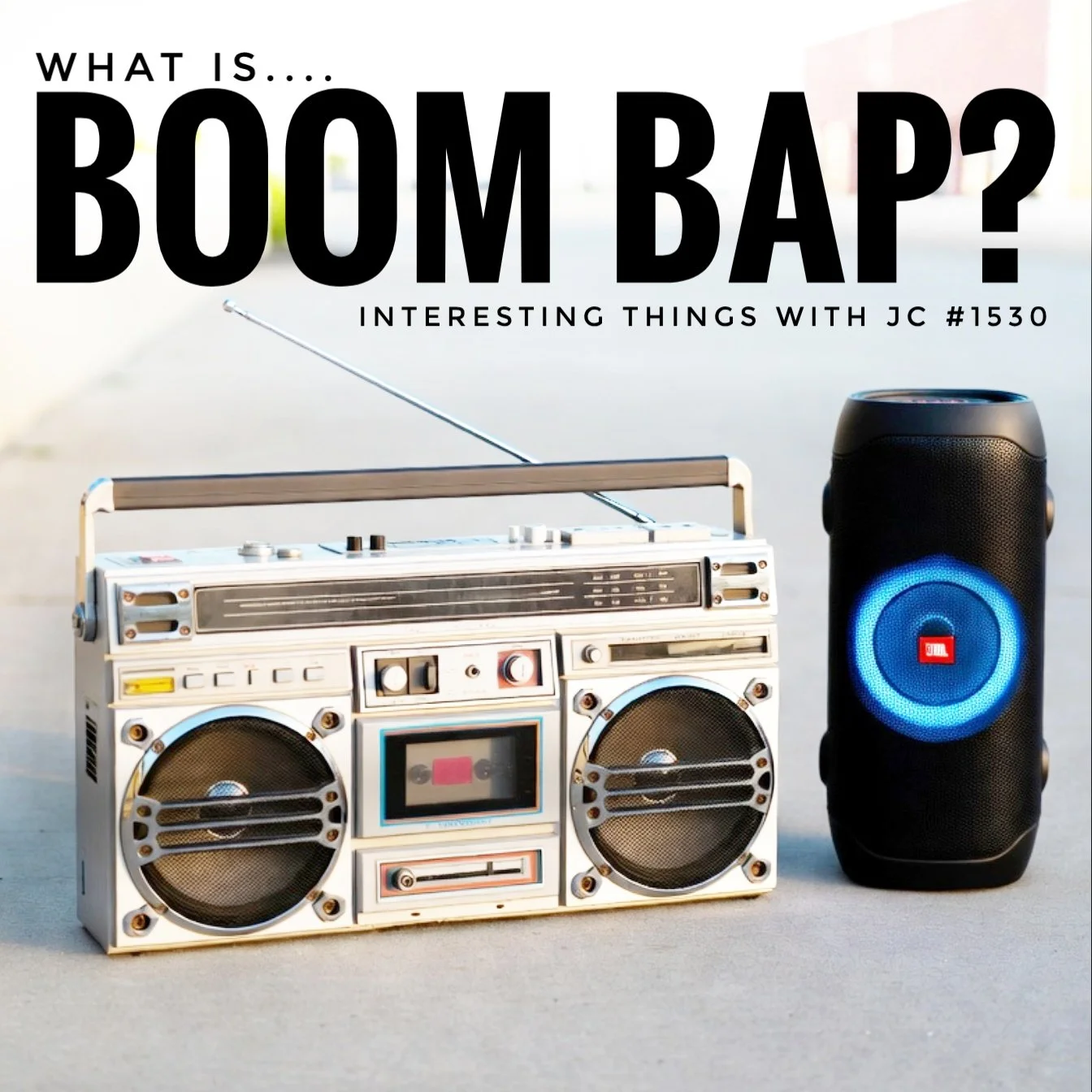
Image promoting “Interesting Things with JC #1530: What Is Boom Bap,” showing a vintage silver boombox beside a modern black portable speaker, highlighting classic and modern hip-hop sound.
Transcript
Interesting Things with JC #1530: “What Is Boom Bap?”
There’s a sound that hits before the words do. Before the hook. Before you even decide if you like the song. Your head just moves. That sound is boom bap.
Boom bap isn’t a metaphor. It’s imitation. It’s what the drums are doing. The boom is the kick drum, low and heavy, landing right on the downbeat. The bap is the snare, sharp and clean, snapping back on beats two and four. Kick. Snare. Space. That’s it. No extra talking.
That simple pattern became the backbone of hip-hop in the late 1980s and early 1990s, especially in New York. This was the era when beats weren’t built to impress machines. They were built to move people. Producers pulled sounds off vinyl records, chopped them by hand, and looped them just enough to feel alive. You could hear the dust. You could hear the room. Nothing was polished on purpose.
The phrase “boom bap” showed up on record as early as 1984, spoken out loud to mimic the drums themselves. But it locked into the culture in 1993, when KRS-One named an album Return of the Boom Bap. That wasn’t clever branding. It was a line in the sand. This is the rhythm. This is the base.
What made boom bap last wasn’t complexity. It was discipline. The kick and snare stayed front and center. The beat left room for the voice to stand tall. That’s why records from that era still sound solid today. They’re not crowded. They’re confident.
Boom bap never disappeared. It just stopped chasing attention. Every few years, someone strips the beat back down and reminds people why it worked in the first place. Artists like Drama B are doing that now, keeping the kick-snare conversation intact with a modernized feel.
Boom bap is hip-hop with nothing to hide. No disguise. No rush. Just rhythm doing its job.
These are interesting things, with JC.
Student Worksheet
Explain why boom bap is described as imitation rather than metaphor.
Describe how space is used in boom bap beats.
Why did boom bap production avoid polish?
How does boom bap support lyrical clarity?
Teacher Guide
Estimated Time
45–60 minutes
Pre-Teaching Vocabulary Strategy
Play short instrumental examples highlighting kick and snare placement.
Anticipated Misconceptions
Students may assume older music is technically inferior rather than intentionally minimalist.
Discussion Prompts
Why might simplicity be more durable than complexity in music?
Differentiation Strategies
ESL: Provide rhythm diagrams.
IEP: Allow audio responses.
Gifted: Compare rhythmic minimalism across genres.
Extension Activities
Create a four-bar boom bap rhythm using claps and desk taps.
Cross-Curricular Connections
Physics (sound waves), Sociology (urban culture), Language Arts (spoken-word rhythm)
Quiz
Q1. What does “boom” represent in boom bap?
A. Hi-hat
B. Kick drum
C. Bassline
D. Vocal cue
Answer: B
Q2. Boom bap became prominent in which era?
A. 1970s
B. Early 1980s
C. Late 1980s–early 1990s
D. 2000s
Answer: C
Q3. Why was vinyl sampling important?
A. It was cheaper
B. It created live texture
C. It reduced noise
D. It sped production
Answer: B
Q4. What album solidified the term boom bap culturally?
A. Illmatic
B. Paid in Full
C. Return of the Boom Bap
D. The Chronic
Answer: C
Q5. What is a defining trait of boom bap beats?
A. Dense layering
B. Fast tempo
C. Space for vocals
D. Electronic effects
Answer: C
Assessment
Explain how boom bap production choices affect lyrical delivery.
Analyze why boom bap continues to reappear in modern hip-hop.
3–2–1 Rubric
3 = Accurate, complete, thoughtful
2 = Partial or missing detail
1 = Inaccurate or vague
Standards Alignment
CCSS.ELA-LITERACY.RH.9-10.2
Analyze central ideas in informational texts about music history.
CCSS.ELA-LITERACY.SL.9-10.1
Participate in collaborative discussions on cultural topics.
NCAS: MU:Re7.2.HS
Analyze how musical elements convey meaning.
ISTE 3a
Evaluate digital tools used in music production.
UK National Curriculum – Music KS4
Understand stylistic conventions and historical context of music genres.
Show Notes
This episode breaks down boom bap as both a rhythmic structure and a cultural statement, showing how simplicity and discipline shaped early hip-hop’s sound. In the classroom, it offers a clear entry point into discussions of rhythm, production technology, and cultural continuity. Boom bap matters today because it demonstrates how foundational ideas persist even as tools and trends evolve.
References
Chang, J. (2005). Can’t stop won’t stop: A history of the hip-hop generation. St. Martin’s Press. https://us.macmillan.com/books/9780312425791/cantstopwontstop
Schloss, J. G. (2004). Making beats: The art of sample-based hip-hop. Wesleyan University Press. https://www.hfsbooks.com/books/making-beats-schloss/
Rose, T. (1994). Black noise: Rap music and black culture in contemporary America. Wesleyan University Press. https://www.hfsbooks.com/books/black-noise-rose/
KRS-One. (1993). Return of the boom bap [Album]. Jive Records. https://www.allmusic.com/album/return-of-the-boom-bap-mw0000618834
Drama B. (n.d.). Drama B artist profile. NoCopyrightSounds Wiki. https://nocopyrightsounds.fandom.com/wiki/Drama_B