1534: "The Henry Plant Museum"
Interesting Things with JC #1534: "The Henry Plant Museum" – A railroad tycoon built a palace not to house guests, but to sell the journey itself. Silver domes, electric lights, and ambition turned Florida into an idea you could ride toward. Sometimes the destination is just proof the plan worked.
Curriculum - Episode Anchor
Henry B. Plant Museum stands as a preserved example of how transportation, architecture, and tourism were deliberately combined during the Gilded Age to shape Florida’s economic and cultural identity.
Episode Title: The Henry Plant Museum
Episode Number: 1534
Host: JC
Audience: Grades 9–12, college intro, homeschool, lifelong learners
Subject Area: U.S. History, Architectural History, Transportation History, Cultural Geography
Lesson Overview
This lesson explores how industrial expansion, luxury tourism, and architectural spectacle intersected in late 19th-century Florida through the story of the Tampa Bay Hotel, now the Henry B. Plant Museum. Students examine how railroads shaped destinations, not just travel, and how image, technology, and marketing influenced national perceptions of place.
Learning Objectives
By the end of this lesson, students will be able to:
Define how railroad expansion influenced tourism development in the late 1800s.
Compare Moorish Revival architecture with typical Victorian American styles.
Analyze how Henry B. Plant used infrastructure and spectacle to create demand.
Explain why the Tampa Bay Hotel became historically significant beyond hospitality.
Key Vocabulary
Moorish Revival (mor-ish ri-vy-vuhl) — An architectural style using domes, arches, and decorative elements inspired by Islamic architecture, chosen to evoke exoticism and escape.
Gilded Age (gil-did ayj) — A period in U.S. history marked by rapid industrial growth, wealth concentration, and technological advancement.
Infrastructure (in-fruh-struhk-cher) — The physical systems, such as railroads and ports, that support economic activity.
Tourism Marketing (toor-iz-uhm mar-kuh-ting) — The practice of promoting destinations through image, comfort, and experience rather than necessity.
National Historic Landmark (na-shuh-nuhl hi-stor-ik land-mark) — A federal designation recognizing sites of exceptional historical importance.
Narrative Core
Open: A castle-like building rises unexpectedly along a Florida river, its silver domes signaling something entirely different from its surroundings.
Info: Built in 1891 by railroad tycoon Henry B. Plant, the Tampa Bay Hotel served as both luxury destination and advertisement for his rail and steamship empire.
Details: The hotel featured modern technologies, Moorish Revival design, and hosted historical events including military operations during the Spanish-American War.
Reflection: The building reveals how travel, technology, and imagination reshaped Florida into a national destination.
Closing: These are interesting things, with JC.
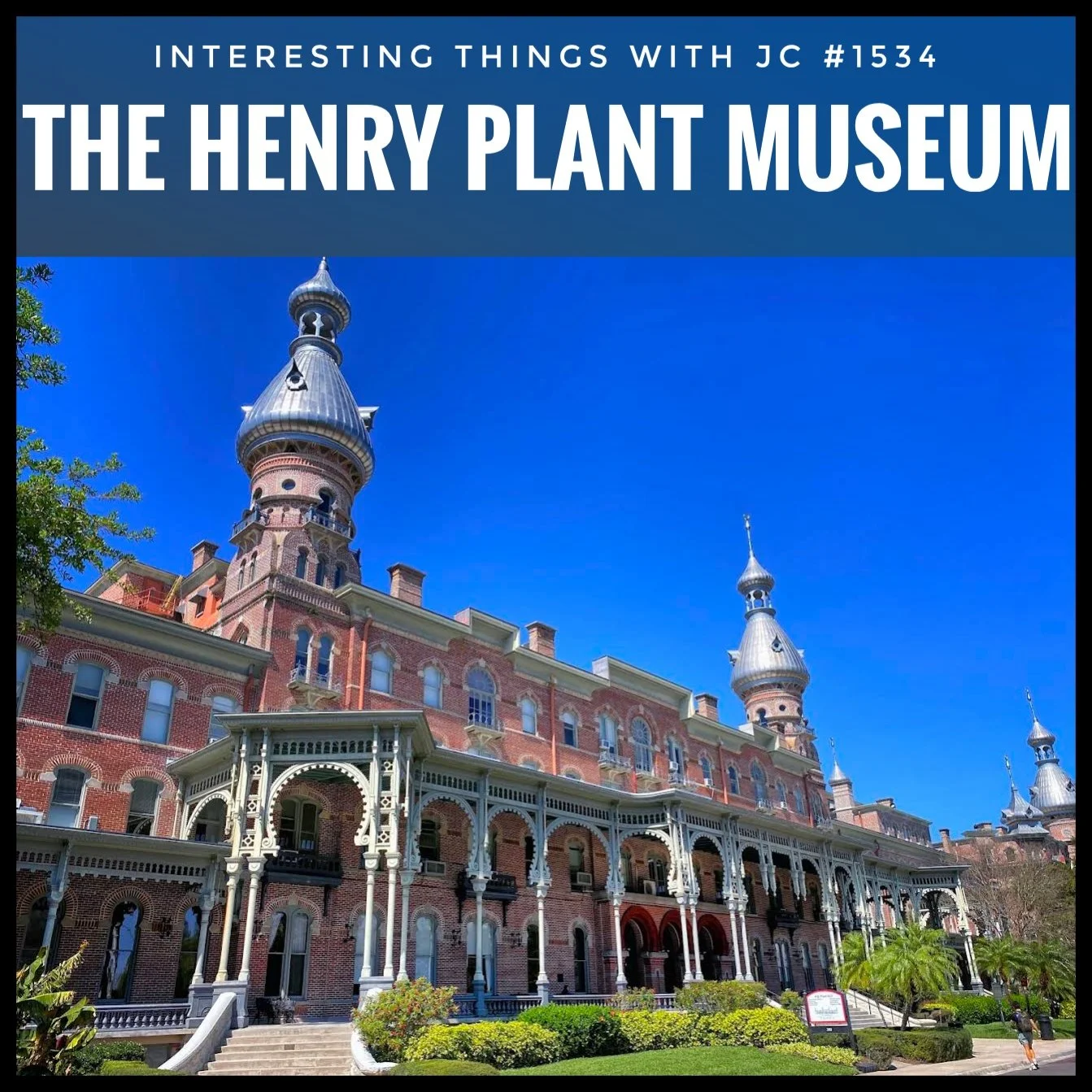
Exterior photograph of the Henry B. Plant Museum in Tampa, Florida, showing its historic red-brick façade, decorative balconies, and silver domes, presented for educational and informational use.
Transcript:
Interesting Things with JC #1534: “The Henry Plant Museum”
You could call it a castle with a train schedule.
Down in Tampa, Florida, on the banks of the Hillsborough River, stands a building that looks like it was lifted from another continent. Gleaming silver minarets. Onion domes. Horseshoe arches. But it’s no mosque. It’s the old Tampa Bay Hotel, now the Henry B. Plant Museum.
And it was built by a railroad man.
Henry B. Plant wasn’t an architect. He was a shipping clerk turned railroad and steamship tycoon. After the Civil War, he forged more than 2,100 miles of track across the Southeast, much of it stitching Florida together. By 1891, he unveiled this extravagant palace not just as a place to stay, but as the ultimate reason to ride his trains. Plant didn’t just sell tickets. He owned the rails, the ships, and the destination at the end of the line.
The hotel stretched a full quarter mile, about 1,320 feet, and held exactly 511 rooms. It was loaded with firsts. Florida’s earliest elevators, still operating today. Electric lights and telephones in every room. Private bathrooms with full-size tubs in most, almost unheard of at the time. Construction topped $3 million, roughly $90 to $100 million today. Built of concrete and steel, it was surrounded by gardens, a golf course, bowling alley, racetrack, casino, and even an indoor heated pool.
But the real hook was the look. Moorish Revival. Six silver minarets. Ornate arches and trim. Wildly out of place in Victorian Tampa, and deliberately so. The style wasn’t about historical accuracy. It was chosen because it felt foreign, warm, and far away, exactly what northern travelers wanted Florida to be. People remembered it long after they went home.
The glamour peaked in the Gilded Age, then faded. During the Spanish American War in 1898, the hotel served as military headquarters. Teddy Roosevelt and the Rough Riders passed through its halls. The hotel closed in 1930. By 1933, the University of Tampa moved in, renaming it Plant Hall. The south wing became the Henry B. Plant Museum, officially in 1974 after first operating as a municipal museum in 1941.
Inside, time slows down. Original gas chandeliers. Furniture ordered from Europe. Travel trunks from a time when reaching Florida took days, not hours. Even Henry Plant’s own desk. The museum doesn’t just show where wealthy guests slept. It shows how Florida was marketed to the nation, through climate, spectacle, technology, and ambition.
A hotel built to sell train tickets. A railroad built to sell escape. A tycoon who pulled paradise south with steel, concrete, and showmanship.
Today, the domes still gleam as a National Historic Landmark on the University of Tampa campus, recognized not just for luxury, but for reshaping tourism, transportation, and Florida’s identity. Not just a building, but a reminder that sometimes the journey itself is the product.
These are interesting things, with JC.
Student Worksheet
Explain how the hotel’s architecture was used as a marketing tool.
Describe two technological innovations featured in the hotel.
Why did Henry B. Plant build the hotel himself rather than rely on others?
How did the Spanish-American War affect the hotel’s history?
Teacher Guide
Estimated Time
One 45–60 minute class period
Pre-Teaching Vocabulary Strategy
Use image comparisons of architectural styles and a timeline of railroad expansion.
Anticipated Misconceptions
Students may assume tourism developed naturally rather than being intentionally engineered.
Discussion Prompts
Was the hotel more important as a building or as an idea?
How does transportation still shape tourism today?
Differentiation Strategies
ESL: Visual vocabulary cards and sentence frames
IEP: Guided notes and shortened readings
Gifted: Independent research on another railroad hotel
Extension Activities
Map Henry B. Plant’s rail network
Compare Plant’s strategy to modern theme parks or resorts
Cross-Curricular Connections
Economics: Supply, demand, and vertical integration
Art: Architectural symbolism
Geography: Climate and migration patterns
Quiz
Q1. Why was the Tampa Bay Hotel built?
A. To house railroad workers
B. To attract tourists to Florida
C. As a military base
D. As a university
Answer: B
Q2. What architectural style defines the hotel?
A. Gothic
B. Neoclassical
C. Moorish Revival
D. Art Deco
Answer: C
Q3. Which technology was uncommon in hotels at the time?
A. Gas lighting
B. Electric elevators
C. Fireplaces
D. Wood floors
Answer: B
Q4. What event temporarily changed the hotel’s function?
A. World War I
B. Spanish-American War
C. Great Depression
D. Civil Rights Movement
Answer: B
Q5. What is the building used for today?
A. Luxury hotel
B. Government offices
C. Museum and university hall
D. Shopping center
Answer: C
Assessment
Open-Ended Questions
Explain how Henry B. Plant used transportation to shape tourism.
Analyze why the hotel remains historically important today.
3–2–1 Rubric
3 = Accurate, complete, thoughtful
2 = Partial or missing detail
1 = Inaccurate or vague
Standards Alignment
CCSS.ELA-LITERACY.RH.9-10.2
Determine central ideas of a historical text.
C3.D2.His.4.9-12
Analyze how historical contexts shape events and innovations.
NCAS VA:Re7.2.Ia
Analyze how visual imagery influences meaning.
UK National Curriculum KS4 History
Understanding industrialization and social change.
IB MYP Individuals and Societies
Analyzing human-built environments and economic systems.
Show Notes
This episode examines the Henry B. Plant Museum as a symbol of how railroads, architecture, and ambition reshaped Florida in the late 19th century. By tracing the story of Henry B. Plant and the Tampa Bay Hotel, listeners learn how tourism was deliberately engineered through spectacle and technology. In the classroom, this episode supports lessons on industrialization, marketing, and cultural geography, helping students understand how places are designed to tell stories and sell experiences that still influence travel today.
References
Henry B. Plant Museum. (n.d.). About the museum and history. https://www.plantmuseum.com/about/history
Henry B. Plant Museum. (n.d.). Chronology of the Tampa Bay Hotel. https://www.plantmuseum.com/discover/learn/chronology
University of Tampa. (n.d.). Henry B. Plant Museum. https://www.ut.edu/about-utampa/henry-b-plant-museum
National Park Service. (n.d.). Tampa Bay Hotel (Henry B. Plant Museum). https://www.nps.gov/places/tampa-bay-hotel.htm
National Trust for Historic Preservation. (n.d.). Henry B. Plant Museum. https://savingplaces.org/places/henry-b-plant-museum
Bluffton University. (n.d.). Tampa Bay Hotel (now Plant Hall, University of Tampa). https://homepages.bluffton.edu/~sullivanm/florida/tampa/university/hotel.html
Islands Magazine. (2025). Tampa Bay Hotel: Gilded grandeur and fascinating history. https://www.islands.com/1917955/tampa-bay-hotel-gilded-grandeur-fascinating-history-stunning-century-old-florida-landmark/