1533: "What Is Returned – The Story of Thomas Westerhaus"
Interesting Things with JC #1533: "What Is Returned – The Story of Thomas Westerhaus" – One man stepped in when no one else could. He thought that moment was behind him...until life flipped, and something unexpected came back.
Curriculum - Episode Anchor
A real-world narrative of immediate action, delayed consequence, and community response, illustrating how individual choices can echo years later through human systems of memory, gratitude, and responsibility.
Episode Title: “What Is Returned – The Story of Thomas Westerhaus”
Episode Number: 1533
Host: JC
Audience: Grades 9–12, college intro, homeschool, lifelong learners
Subject Area: Civics, Ethics, Health Science, Media Literacy
Lesson Overview
This lesson uses a true narrative to explore emergency response, moral action, long-term consequence, and civic reciprocity. Students analyze how individual decisions intersect with community systems over time.
Learning Objectives
Students will be able to:
Define the concept of bystander intervention using a real-life example.
Analyze cause-and-effect relationships across extended timelines.
Explain how communities respond to acts of service and moral courage.
Compare immediate action versus delayed societal response in ethical contexts.
Key Vocabulary
Bystander Intervention (bī-stan-dər in-tər-ven-shən) — The act of stepping in to help during an emergency rather than remaining passive.
CPR (sē-pē-ār) — Cardiopulmonary resuscitation; an emergency procedure used when the heart stops beating.
Hypoxia (hī-pok-sē-ə) — A condition where the brain is deprived of adequate oxygen.
Paralysis (pə-ral-ə-səs) — Loss of muscle function in part of the body.
Reciprocity (res-ə-pros-ə-tē) — The practice of responding to an action with a corresponding return.
Narrative Core
Open: A normal afternoon suddenly disrupted by a child disappearing beneath the surface of a swimming pool.
Info: A four-year-old boy in Lawrence, Kansas is found unresponsive underwater, with minutes determining survival.
Details: Thomas Westerhaus clears a fence, enters the pool, and performs CPR without hesitation. Years later, cancer leaves him paralyzed, and the same community mobilizes to support him.
Reflection: Acts of courage may not end when the moment passes; their return can take years to arrive.
Closing: These are interesting things, with JC.
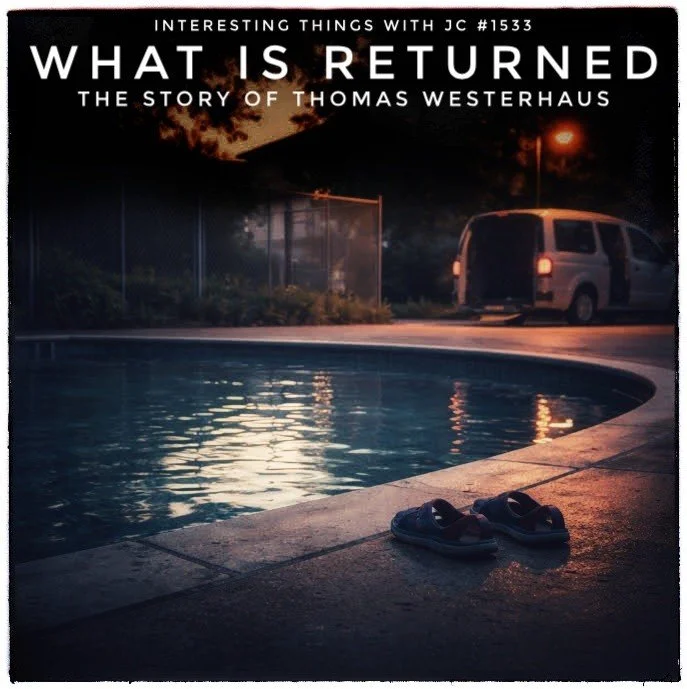
Square-format image of an empty outdoor apartment swimming pool at dusk. A pair of small children’s sandals rests on the wet pool deck in the foreground. In the background, beyond a chain-link fence, a wheelchair-accessible van is parked under a lit streetlamp. Reflections of light ripple across the pool water. Text at the top reads: “Interesting Things with JC #1533 – What Is Returned: The Story of Thomas Westerhaus.”
Transcript
Interesting Things with JC #1533: “What Is Returned – The Story of Thomas Westerhaus”
Picture a normal afternoon, nothing planned and nothing unusual, just life moving along the way it usually does.
At an apartment complex in Lawrence, Kansas, a 4 year old boy slipped out of sight and into a swimming pool. By the time anyone realized what had happened, he was underwater and unresponsive. You already know how that clock works. Brain injury can begin in about 4 minutes, and after that, survival drops fast.
Across the pool, Thomas Westerhaus saw it immediately. No uniform, no badge, just a father recognizing a moment that could not wait.
He cleared a 6 foot fence, entered the pool, pulled the child out, and started CPR right there on the deck. There was no pause and no waiting for help to arrive.
The boy survived.
There were no cameras and no crowd, just someone doing what needed to be done.
That was 2022.
Most stories would end there, but this one didn’t.
In January 2026, the name Thomas Westerhaus came up again for a very different reason. For nearly a decade, Thomas had been fighting cancer. In 2025, it spread to his spine, leaving him paralyzed from the chest down. The man who once jumped a fence in seconds now depends on a wheelchair to get through his day.
Driving is no longer simple. Leaving the house takes planning. Even showing up for his son’s school events requires help he does not yet have.
And this is where the story comes back around.
The community remembered what he had done. Neighbors and local media began raising money to help him get a wheelchair accessible van. Not out of charity, but because someone showed up once, and a town decided that mattered.
A fence once stood between a child and survival.
Today, a town stands between Thomas Westerhaus and being stuck at home.
That is what return looks like.
And sometimes, the most important part of a rescue happens years later.
These are interesting things, with JC.
Student Worksheet
Describe why immediate action was critical in this story.
Explain how time plays a role in both the rescue and the community response.
What does this story suggest about how communities remember actions?
Write a short reflection on a moment when helping did not bring an immediate reward.
Teacher Guide
Estimated Time
45–60 minutes
Pre-Teaching Vocabulary Strategy
Introduce medical and civic terms using real-world scenarios and brief discussion.
Anticipated Misconceptions
Heroism always involves recognition.
Community support is automatic rather than intentional.
Discussion Prompts
What motivates someone to act without instruction?
Should communities feel obligated to return acts of service?
Differentiation Strategies
ESL: Provide vocabulary sentence frames.
IEP: Allow oral responses or visual mapping.
Gifted: Extend analysis to ethical philosophy.
Extension Activities
Research CPR training requirements.
Interview local first responders.
Cross-Curricular Connections
Health Science: Emergency medicine basics
Sociology: Community memory
Ethics: Moral responsibility
Quiz
Q1. What immediate danger did the child face?
A. Dehydration
B. Hypoxia
C. Infection
D. Shock
Answer: B
Q2. Why was CPR critical?
A. It cooled the body
B. It restored circulation
C. It reduced pain
D. It prevented injury
Answer: B
Q3. What changed in 2025?
A. The rescue was publicized
B. Thomas moved
C. Cancer spread to his spine
D. The family relocated
Answer: C
Q4. Why did the community raise money?
A. Media pressure
B. Legal obligation
C. Reciprocity
D. Insurance
Answer: C
Q5. What theme best fits the episode?
A. Fame
B. Luck
C. Return
D. Competition
Answer: C
Assessment
Explain how this story demonstrates long-term cause and effect.
Analyze the ethical significance of acting without expectation of reward.
3–2–1 Rubric
3 = Accurate, complete, thoughtful
2 = Partial or missing detail
1 = Inaccurate or vague
Common Core State Standards – English Language Arts
CCSS.ELA-LITERACY.RI.9-10.2
Determine a central idea of a text and analyze its development over the course of the text, including how it emerges and is shaped by specific details.
Connection: Students analyze how the episode’s central theme of delayed reciprocity and moral action develops across multiple time periods and narrative moments.
CCSS.ELA-LITERACY.RI.9-10.3
Analyze how the author unfolds an analysis or series of events, including the order in which the points are made and how they are introduced and developed.
Connection: Students examine the episode’s nonlinear structure spanning 2022–2026, identifying cause-and-effect relationships between immediate action and long-term outcomes.
CCSS.ELA-LITERACY.RI.11-12.7
Integrate and evaluate multiple sources of information presented in different media or formats to address a question or solve a problem.
Connection: Students corroborate the narrative using news reporting, peer-reviewed medical literature, and public health data to assess accuracy and reliability.
C3 Framework for Social Studies – Civics
C3.D2.Civ.2.9-12
Analyze the role of citizens in civic life, including personal responsibilities and participation beyond formal political institutions.
Connection: Students examine bystander intervention and community response as forms of civic engagement independent of government authority.
C3.D2.Civ.10.9-12
Analyze the impact and appropriate roles of personal interests, motivations, and perspectives on civic participation.
Connection: Students evaluate the motivations behind individual action and collective reciprocity within a community context.
Next Generation Science Standards – Life Sciences
HS-LS1-2
Develop and use a model to illustrate the hierarchical organization of interacting systems that provide specific functions within multicellular organisms.
Connection: Students analyze respiratory and circulatory system failure during drowning and the physiological consequences of hypoxia.
HS-LS1-3
Plan and conduct an investigation to provide evidence that feedback mechanisms maintain homeostasis.
Connection: Students apply this standard to CPR as an external intervention that temporarily restores oxygenation and circulation when homeostasis fails.
National Health Education Standards (NHES)
NHES Standard 1
Comprehend concepts related to health promotion and disease prevention.
Connection: Students understand drowning risk factors, emergency response principles, and long-term health outcomes following hypoxic injury.
NHES Standard 3
Demonstrate the ability to access valid information and products and services to enhance health.
Connection: Students evaluate CPR guidance, emergency protocols, and public health resources for credibility and practical application.
ISTE Standards for Students
ISTE 3b
Evaluate the accuracy, perspective, credibility, and relevance of information from digital sources.
Connection: Students critically assess firsthand narrative against verified journalistic, medical, and public health sources.
ISTE 7c
Use digital tools to broaden perspectives and enrich learning.
Connection: Students integrate multimedia reporting, research databases, and medical literature to deepen understanding.
Advanced Coursework and Career Pathway Alignment
AP English Language and Composition
Students analyze how rhetorical choices, structure, and evidence shape meaning in a real-world nonfiction narrative, with emphasis on synthesis across multiple sources.
IB Diploma Programme – Language & Literature (SL/HL)
Students examine how narrative structure, perspective, and context influence meaning in non-literary texts, and evaluate how global and local contexts shape interpretation.
CTE Health Science Pathway
Students connect human anatomy, emergency response, and patient outcomes to real-world scenarios involving trauma, hypoxia, and long-term disability, reinforcing career-ready competencies in health and medical sciences.
Show Notes
This episode explores a real act of lifesaving intervention and the delayed but meaningful return of community support years later. It highlights emergency response, ethical decision-making, and civic reciprocity. In classrooms, it opens discussion on moral courage, health science realities, and how societies remember actions long after the moment has passed.
References
GoFundMe. (2026). Help hero Thomas gain mobility with a wheelchair van.
https://www.gofundme.com/f/help-hero-thomas-gain-mobility-with-a-wheelchair-vanByrd, K. (2026, January 12). Cancer leaves hero who saved drowning boy paralyzed, community asked to help. KCTV5 News.
https://www.kctv5.com/2026/01/13/cancer-leaves-local-hero-who-saved-drowning-boy-paralyzed-community-asked-step-up/Byrd, K. (2026, January 13). Cancer leaves hero who saved drowning boy paralyzed, community asked to help. WIBW News.
https://www.wibw.com/2026/01/13/cancer-leaves-hero-who-saved-drowning-boy-paralyzed-community-asked-help/FOX4KC. (2026, January 13). More than three years ago, Thomas Westerhaus saved a four-year-old child from drowning; now he’s asking for help. X (formerly Twitter).
https://x.com/fox4kc/status/2011763041008840732American Heart Association. CPR facts and statistics. https://cpr.heart.org/en/resources/cpr-facts-and-stats
American Red Cross. (2024). Responding to aquatic emergencies. https://www.redcross.org/get-help/how-to-prepare-for-emergencies/types-of-emergencies/water-safety.html?srsltid=AfmBOopuCtBYep6qPqPD8po8sF35Hc9MJr0Vl3gf0UIy21nmph6JPNB6
Centers for Disease Control and Prevention. Drowning facts. https://www.cdc.gov/drowning/data-research/facts/index.html
Centers for Disease Control and Prevention. Unintentional drowning: Get the facts (CDC Fact Sheet). U.S. Department of Health and Human Services. https://stacks.cdc.gov/view/cdc/51852
Orlowski, J. P., & Szpilman, D. (2016). Drowning: Rescue, resuscitation, and reanimation. Open Access Emergency Medicine, 8, 47–60. https://pmc.ncbi.nlm.nih.gov/articles/PMC4951968/
National Heart, Lung, and Blood Institute. (2024). Disparities found in survival benefits for people receiving bystander CPR after cardiac arrest. U.S. Department of Health and Human Services.
https://www.nhlbi.nih.gov/news/2024/disparities-found-survival-benefits-people-receiving-bystander-cpr-cardiac-arrest