1535: "Why We Remember - MLK Day"
Interesting Things with JC #1535: "Why We Remember - MLK Day" – Martin Luther King Jr. Day did not emerge automatically after his death. It followed fifteen years of congressional debate, failed votes, and sustained public discussion over how the nation would commemorate his legacy.
Curriculum - Episode Anchor
Martin Luther King Jr. Day exists not as a gift, but as the result of sustained resistance, political struggle, and public pressure over more than fifteen years.
Episode Title: Why We Remember - MLK Day
Episode Number: 1535
Host: JC
Audience: Grades 9–12, college intro, homeschool, lifelong learners
Subject Area: U.S. History, Civics, Media Literacy
Lesson Overview
This episode examines the long, contested path to the creation of Martin Luther King Jr. Day, highlighting how public memory, political resistance, and civic action shape national holidays. Students explore how historical narratives are formed, challenged, and preserved through law, culture, and collective action.
Learning Objectives
Students will be able to:
Define the historical events that led to the creation of Martin Luther King Jr. Day.
Analyze the political and social resistance to establishing the holiday.
Explain the role of public activism, culture, and legislation in shaping national memory.
Compare public perception of holidays with the historical realities behind them.
Key Vocabulary
Martin Luther King Jr. (MAR-tin LOO-ther king) — A civil rights leader whose legacy became the focus of a national debate over commemoration.
Filibuster (FIL-uh-bus-ter) — A Senate tactic used to delay or block legislation through extended debate.
Federal Holiday (FED-er-uhl HOL-uh-day) — A nationally recognized day established by Congress and signed into law by the president.
Assassination (uh-sass-uh-NAY-shun) — The targeted killing of a prominent individual for political or ideological reasons.
National Day of Service (NASH-uh-nuhl DAY of SUR-vis) — A designated day encouraging civic engagement and community service.
Narrative Core
Open: The episode begins by challenging the common perception of MLK Day as simply a long weekend, immediately reframing it as a hard-fought national decision.
Info: Listeners are introduced to King’s early life, name change, and the dangers he faced long before his assassination.
Details: The story details the stabbing in Harlem, repeated arrests, the introduction of the holiday bill, fierce political opposition, cultural pressure from musicians and activists, and the eventual passage of the law.
Reflection: The episode reflects on how resistance persisted even after federal approval and how memory is shaped by struggle rather than comfort.
Closing: These are interesting things, with JC.
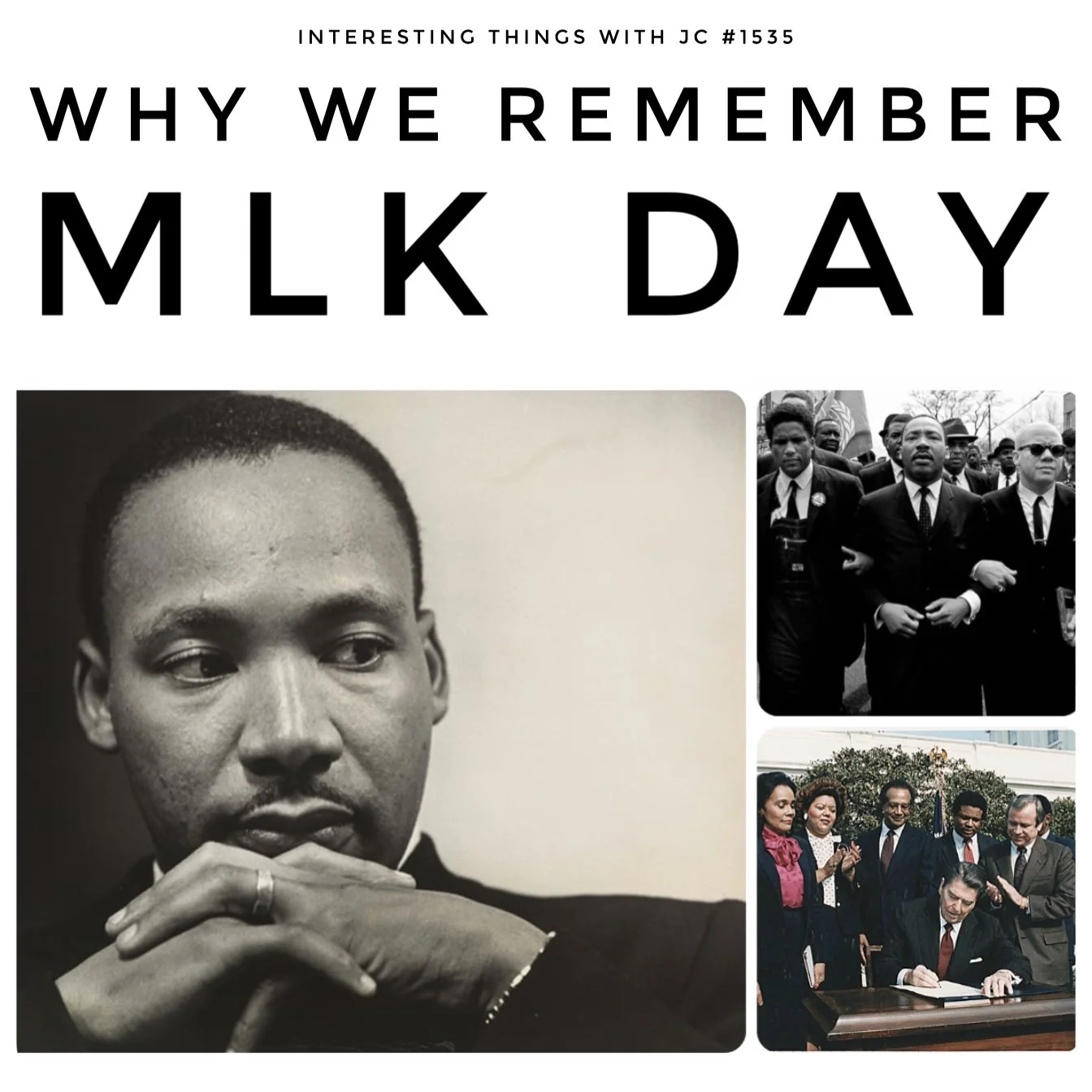
“Podcast cover image titled ‘Why We Remember MLK Day’ with the heading ‘Interesting Things with JC #1535.’ The main image shows a black-and-white portrait of Martin Luther King Jr. resting his chin on his hands in a thoughtful pose. To the right are two smaller historical photos: one shows King walking arm-in-arm with other civil rights leaders during a march, and the other shows President Ronald Reagan signing the law establishing Martin Luther King Jr. Day, surrounded by supporters. The overall design is clean and high-contrast, emphasizing reflection, history, and remembrance.”
Transcript
Interesting Things with JC #1535: "Why We Remember MLK Day"
Most people see Martin Luther King Jr. Day as a long weekend in January. What usually gets lost is how hard this country fought not to create it.
Martin Luther King Jr. wasn’t born with that name. He entered the world on January 15, 1929, in Atlanta, as Michael King Jr. In 1934, his father changed both their names after returning from Germany (JER-muh-nee), inspired by the reformer Martin Luther. The legal paperwork didn’t catch up until July 23, 1957, long after King was already a national figure.
Danger followed him early. On September 20, 1958, while signing Stride Toward Freedom in Harlem, King was stabbed in the chest with a letter opener about 7 inches long (17.8 centimeters). The blade stopped just short of his aorta. Doctors warned that a single cough could have killed him. From his hospital bed, King publicly forgave the woman who attacked him and went back to work.
By the time he was assassinated on April 4, 1968, King had been arrested 29 times. Four days later, Congressman John Conyers introduced a bill to make King’s birthday a federal holiday. That bill would sit for 15 years.
The opposition was fierce. Critics said a private citizen didn’t deserve a holiday. Others claimed it would cost too much. In 1979, the bill failed in the House by just five votes. What kept it alive were people outside Washington: labor unions, churches, and more than 6 million petition signatures. In 1980, Stevie Wonder added pressure with his song Happy Birthday, turning concerts into rallies.
In 1983, the fight turned ugly. Senator Jesse Helms launched a 16-day filibuster, pushing a 300-page packet pulled from FBI files. Senator Daniel Patrick Moynihan dropped it on the Senate floor and called it filth. The votes came anyway. The House passed the bill 338 to 90. The Senate followed, 78 to 22. President Ronald Reagan signed it into law on November 2, 1983. The first federal observance came in January 1986.
Even then, states resisted. Arizona lost the Super Bowl over it. South Carolina didn’t grant state workers a paid holiday until 2000.
In 1994, the holiday became the only federal one named a National Day of Service. Coretta Scott King pushed that idea forward. This wasn’t meant to be a day off. It was meant to be a day on.
The holiday exists because resistance finally broke. Remembering King means remembering the jail cells, the blade near his heart, the smears, and the years of delay. And it leaves one question behind. What are you willing to do with the day?
These are interesting things, with JC.
Student Worksheet
Why did it take 15 years for Martin Luther King Jr. Day to become a federal holiday?
What arguments were used by opponents of the holiday?
How did musicians and public petitions influence Congress?
Why is MLK Day also called a National Day of Service?
What does the episode suggest about how societies choose what to remember?
Teacher Guide
Estimated Time
One 45–60 minute class period
Pre-Teaching Vocabulary Strategy
Introduce key terms using a timeline graphic of events from 1929 to 1994.
Anticipated Misconceptions
That MLK Day was created quickly after King’s assassination
That all states immediately accepted the holiday
Discussion Prompts
Why do you think some people resisted honoring King?
How does public pressure change government action?
Differentiation Strategies
ESL: Provide sentence starters for discussion
IEP: Allow oral responses instead of written
Gifted: Research another contested national holiday
Extension Activities
Create a civic action plan for a modern cause
Analyze song lyrics used as protest tools
Cross-Curricular Connections
Sociology: Collective memory
Music: Protest songs
Ethics: Forgiveness and nonviolence
Quiz
Q1. What was Martin Luther King Jr.’s birth name?
A. Martin King Sr.
B. Michael King Jr.
C. Martin Luther King
D. John King
Answer: B
Q2. How long did it take for the holiday bill to pass?
A. 5 years
B. 10 years
C. 15 years
D. 20 years
Answer: C
Q3. Who introduced the holiday bill?
A. Jesse Helms
B. Ronald Reagan
C. Daniel Patrick Moynihan
D. John Conyers
Answer: D
Q4. What cultural force helped pressure lawmakers?
A. Television ads
B. Court rulings
C. Music and concerts
D. Newspapers
Answer: C
Q5. What makes MLK Day unique among federal holidays?
A. It is in January
B. It honors a president
C. It is a National Day of Service
D. It is state-run
Answer: C
Assessment
Open-Ended Questions
Explain why remembering the struggle behind MLK Day is important.
Analyze how public action influenced federal legislation.
3–2–1 Rubric
3 = Accurate, complete, thoughtful
2 = Partial or missing detail
1 = Inaccurate or vague
Standards Alignment
CCSS.ELA-LITERACY.RH.9-10.2
Students determine central ideas of historical texts.
C3.D2.Civ.5.9-12
Students analyze the role of citizens in influencing government policy.
ISTE.3.1
Students evaluate information from multiple sources.
UK National Curriculum History KS4
Understanding how political power and protest shape historical outcomes.
IB MYP Individuals and Societies
Examining civic participation and governance.
Show Notes
This episode explores the overlooked struggle behind the creation of Martin Luther King Jr. Day, revealing how political opposition, public activism, and cultural influence shaped a national holiday. By tracing King’s life, the resistance to honoring him, and the eventual transformation of the holiday into a National Day of Service, the episode encourages students to question how history is remembered and who decides. The story underscores the importance of civic engagement and challenges listeners to consider their own role in preserving democratic values today.
References
U.S. Congress. (1983). H.R. 3706 (98th Congress): Martin Luther King Jr. Federal Holiday. https://www.congress.gov/bill/98th-congress/house-bill/3706
U.S. House of Representatives, Office of the Historian. (n.d.). Martin Luther King, Jr. National Holiday. https://history.house.gov/Records-and-Research/Listing/c_041/
U.S. Census Bureau. (2024). Martin Luther King Jr. Day: The only federal holiday designated as a National Day of Service. https://www.census.gov/library/stories/2024/01/mlk-day.html
U.S. Government Publishing Office. (2024). Martin Luther King Jr. Day. https://www.govinfo.gov/features/MLK-Day-2024
National Park Service. (n.d.). Martin Luther King Jr. Day. https://www.nps.gov/subjects/npscelebrates/mlk-day.htm