1536: "Getting Stuck on the Highway in a Blizzard"
Interesting Things with JC #1536: "Getting Stuck on the Highway in a Blizzard" – You’re just trying to get home…then the sky vanishes. No road, no help, just cold. What happens next isn’t in any manual. It’s in the people beside you.
Curriculum - Episode Anchor
A real-world survival story showing how extreme weather can overwhelm modern infrastructure and how human cooperation matters when systems fail.
Episode Title: Getting Stuck on the Highway in a Blizzard
Episode Number: 1536
Host: JC
Audience: Grades 9–12, college intro, homeschool, lifelong learners
Subject Area: Earth Science, Human Geography, Civics, Media Literacy
Lesson Overview
This episode examines the February 2011 blizzard that immobilized traffic along Chicago’s Lake Shore Drive, using firsthand-style narrative to explore extreme weather, emergency response limits, and human behavior under stress. Students analyze how environmental conditions, infrastructure design, and individual choices intersect during natural hazards.
3–4 measurable learning objectives using action verbs:
Define
Define a blizzard and identify the meteorological conditions that characterize extreme winter storms.
Compare
Compare modern weather forecasting and warning systems with real-world limitations once a storm is underway.
Analyze
Analyze how infrastructure bottlenecks and human decision-making contributed to the Lake Shore Drive gridlock.
Explain
Explain how informal cooperation and mutual aid can emerge during emergencies when formal systems are overwhelmed.
Key Vocabulary
Blizzard (BLIZ-erd) — A severe snowstorm with strong winds and low visibility; the 2011 storm met blizzard criteria with high winds and heavy snowfall.
Wind Chill (WIND chil) — A measure of how cold it feels when wind removes heat from exposed skin; wind chill dropped below −20°F during the storm.
Infrastructure (IN-fruh-struhk-cher) — The basic physical systems of a city, such as roads and transit, which failed to function during the blizzard.
Visibility (viz-uh-BIL-uh-tee) — The distance one can see; drivers could not see more than five feet ahead.
Mutual Aid (MYOO-choo-uhl AID) — Voluntary cooperation among individuals; stranded motorists shared food, warmth, and assistance.
Narrative Core
Open: A routine drive home turns into disorientation as the sky darkens, wind rises, and the road disappears into white.
Info: A fast-moving blizzard hits Chicago in February 2011, dumping over 21 inches of snow with powerful winds and dangerous wind chills.
Details: Hundreds of vehicles become trapped on Lake Shore Drive. People spend the night in cars, a city bus becomes an improvised shelter, and firefighters walk the highway checking on survivors.
Reflection: Technology and planning have limits. In the absence of movement or quick rescue, ordinary people rely on one another.
Closing: These are interesting things, with JC.
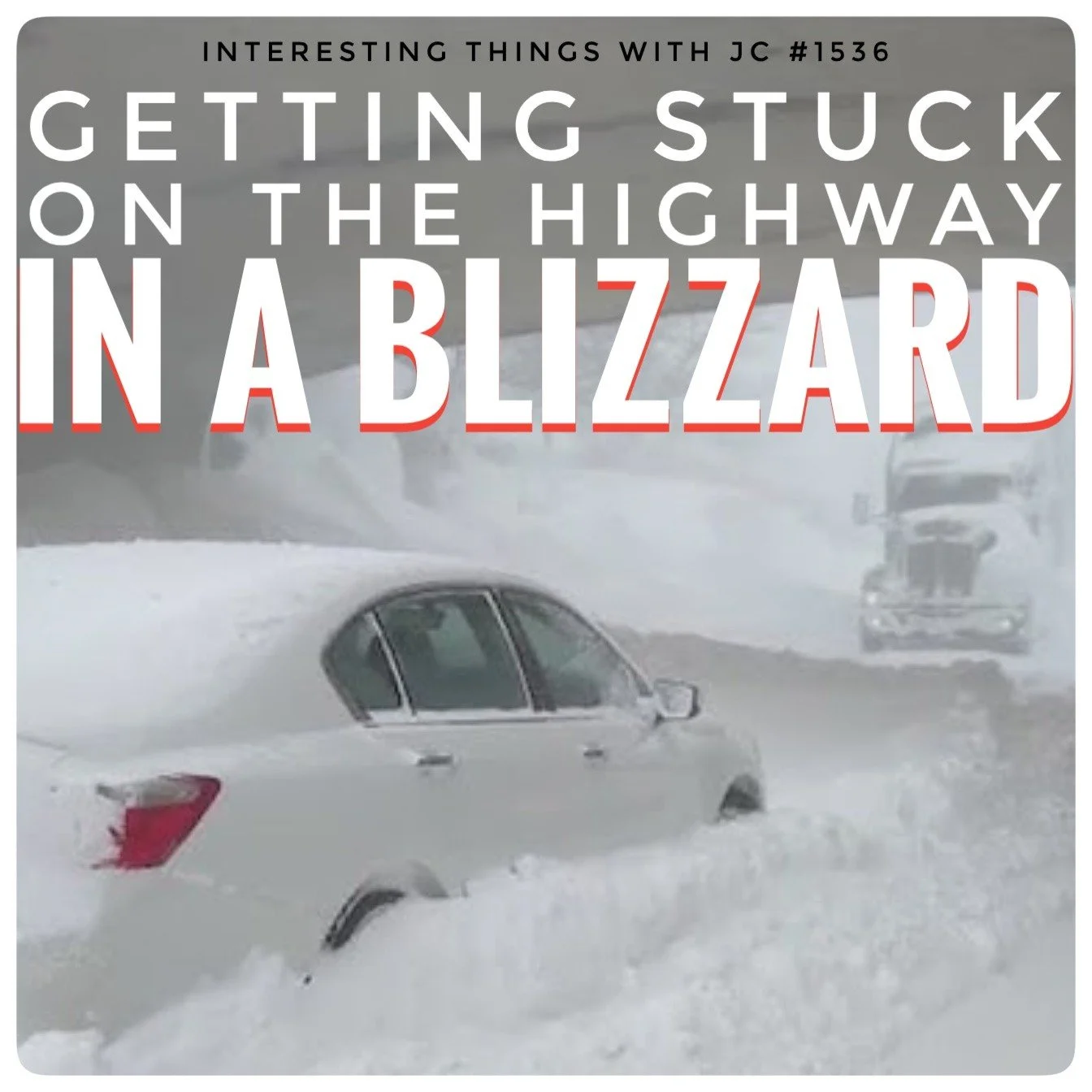
Podcast cover showing a car buried in snow during a blizzard, titled “Getting Stuck on the Highway in a Blizzard,” Interesting Things with JC #1536.
Transcript
Interesting Things with JC #1536: "Getting Stuck on the Highway in a Blizzard"
You’re driving home, trying to beat the weather. Sky’s turning gray. Wind’s picking up. Then it’s white. Everything’s gone. You can’t see five feet (1.5 meters) ahead. No lines, no road, just snow.
That’s what hit Chicago in February 2011. A blizzard rolled in fast and heavy, dropping over 21 inches (53.3 centimeters) of snow in less than a day. Winds gusted up to 60 miles per hour (96.6 kilometers per hour), and wind chill dropped below minus 20 Fahrenheit (minus 29 Celsius). Hundreds of people got stuck on Lake Shore Drive. Cars spun out, stalled, blocked plows. Nobody could move.
People were trapped in their cars overnight. Some ran out of gas trying to stay warm. One city bus turned into a shelter. A guy named Eddie, the driver, kept his heat on as long as he could, with dozens of strangers on board. Firefighters walked the highway, knocking on windows, checking for folks who might’ve passed out from the cold.
The city told everyone to stay in their cars. Help was coming. But roads were jammed, and emergency crews couldn’t get through. This wasn’t 1967’s record storm, but it showed something else. Even with radar, apps, and alerts, none of that matters once you’re already out there.
The real story? People helped each other. No orders, no headlines. Just decent folks sharing food, giving blankets, checking on the car next door.
Nature’s got a way of reminding us who’s in charge. We build our roads and routines. But when the snow comes fast, all that’s gone. What’s left is how we treat the person stuck next to us.
These are interesting things, with JC.
Student Worksheet
Describe two weather conditions that made driving impossible during the blizzard.
Explain why snowplows were unable to clear Lake Shore Drive.
What actions did stranded people take to help one another?
Write a short paragraph on how you would prepare differently after hearing this story.
Teacher Guide
Estimated Time
One 45–60 minute class period
Pre-Teaching Vocabulary Strategy
Use weather maps and photos to introduce blizzard and wind chill concepts before listening.
Anticipated Misconceptions
Belief that modern technology can prevent all weather-related emergencies
Confusion between snowfall amount and blizzard conditions
Discussion Prompts
Should drivers have stayed home despite forecasts?
What responsibilities do cities have during sudden extreme weather?
Differentiation Strategies
ESL: Provide vocabulary sentence frames
IEP: Offer audio replay and guided notes
Gifted: Analyze another historical storm for comparison
Extension Activities
Create an emergency preparedness checklist for winter travel
Research how cities redesign infrastructure after disasters
Cross-Curricular Connections
Physics: Heat loss and wind chill
Sociology: Group behavior in emergencies
Civics: Role of local government in disaster response
Quiz
Q1. What made visibility nearly zero during the storm?
A. Rain and fog
B. Heavy snow and strong winds
C. Ice on windshields
D. Nighttime darkness
Answer: B
Q2. Why did cars block snowplows?
A. Plows were too small
B. Drivers abandoned vehicles
C. Cars stalled and spun out
D. Plows arrived too late
Answer: C
Q3. How did some people stay warm overnight?
A. Running engines continuously
B. Building fires
C. Walking home
D. Sheltering in stores
Answer: A
Q4. What unexpected shelter helped many people?
A. A police station
B. A highway tunnel
C. A city bus
D. A restaurant
Answer: C
Q5. What is the central lesson of the episode?
A. Technology always fails
B. Nature is unpredictable
C. Cooperation matters in crises
D. Cities should ban driving
Answer: C
Assessment
Open-Ended Questions
Explain how infrastructure design contributed to the crisis.
Discuss one example of human cooperation from the episode and why it mattered.
3–2–1 Rubric
3 = Accurate, complete, thoughtful
2 = Partial or missing detail
1 = Inaccurate or vague
Standards Alignment
NGSS HS-ESS2-1
Analyze Earth systems processes such as severe weather events.
CCSS.ELA-LITERACY.RI.9-10.2
Determine central ideas of informational texts.
C3 D2.Geo.8.9-12
Evaluate how human activities and infrastructure are affected by natural hazards.
ISTE 3a
Evaluate the accuracy and usefulness of digital information such as weather alerts.
UK National Curriculum Geography KS4
Understanding natural hazards and human responses.
IB MYP Individuals and Societies
Analyzing interactions between humans and environments.
Show Notes
This episode recounts the February 2011 Chicago blizzard that trapped hundreds of motorists on Lake Shore Drive, illustrating how quickly extreme weather can overwhelm modern cities. Through vivid storytelling, it highlights both the limits of forecasting and infrastructure and the power of spontaneous human cooperation. In classrooms, the story supports discussions on weather science, emergency preparedness, and civic responsibility, all of which remain relevant as extreme weather events become more frequent.
References
Chicago Blizzard 2011: Looking back on Snowmageddon (ABC Chicago) — details on snowfall amounts, vehicles stranded on Lake Shore Drive, and historical context.
Major Winter Storm to Hit Chicago on Anniversary of One of Its Worst Blizzards on Record (Weather.com) — overview of the Groundhog Day Blizzard, storm totals, and impacts on flights and travel. https://weather.com/storms/winter/news/2021-01-30-chicago-groundhog-blizzard-2011
January 31–February 2, 2011 Historic Blizzard (National Weather Service) — official summary of snowfall totals, wind speeds, and storm characteristics from the NWS Chicago office.