1537: "Heavy Whipping Cream”
Interesting Things with JC #1537: "Heavy Whipping Cream" – It started as milk fat floating to the top...and wound up as the backbone of béarnaise, biscuits, and every holiday pie. The red carton has a backstory.
Curriculum - Episode Anchor
Episode Title: Heavy Whipping Cream
Episode Number: #1537
Host: JC
Audience: Grades 9–12, college intro, homeschool, lifelong learners
Subject Area: Food Science, Chemistry, History of Technology, Agricultural Studies
Lesson Overview
Students will:
Define key terms related to dairy production, emulsification, and historical food preservation.
Compare traditional cream separation methods to modern centrifugal separation.
Analyze the impact of technological innovations (e.g., the De Laval separator) on food systems.
Explain the relationship between butterfat content and the physical properties of cream (e.g., whipping).
Key Vocabulary
Butterfat (BUH-ter-fat) — The natural fat found in milk, responsible for the richness and texture of cream. Cream must contain at least 36% butterfat to whip properly.
Emulsification (ih-MUHL-sih-fih-KAY-shun) — A process where fat is dispersed in a liquid; essential in whipped cream and sauces.
Centrifuge (SEN-trih-fyooj) — A machine that spins rapidly to separate substances by density; used to separate cream from milk.
Pasteurization (PAS-chur-ih-ZAY-shun) — A heat treatment that kills bacteria in dairy and other food products, extending shelf life.
Béarnaise (bare-NAZE) — A rich sauce made from butter, egg yolks, and herbs, showcasing heavy cream’s use in culinary chemistry.
Narrative Core
Open: A common grocery store item—heavy whipping cream—is revealed to have a much deeper origin story rooted in dairy tradition.
Info: Early cream was manually skimmed from milk and used fresh or churned into butter. It spoiled quickly without refrigeration.
Details: In 1878, Gustaf de Laval invented a cream separator, revolutionizing dairy processing. By the 1920s, "whipping cream" became a kitchen staple.
Reflection: Technological advances like home refrigeration transformed cream into a purposeful ingredient, not a leftover.
Closing: These are interesting things, with JC.
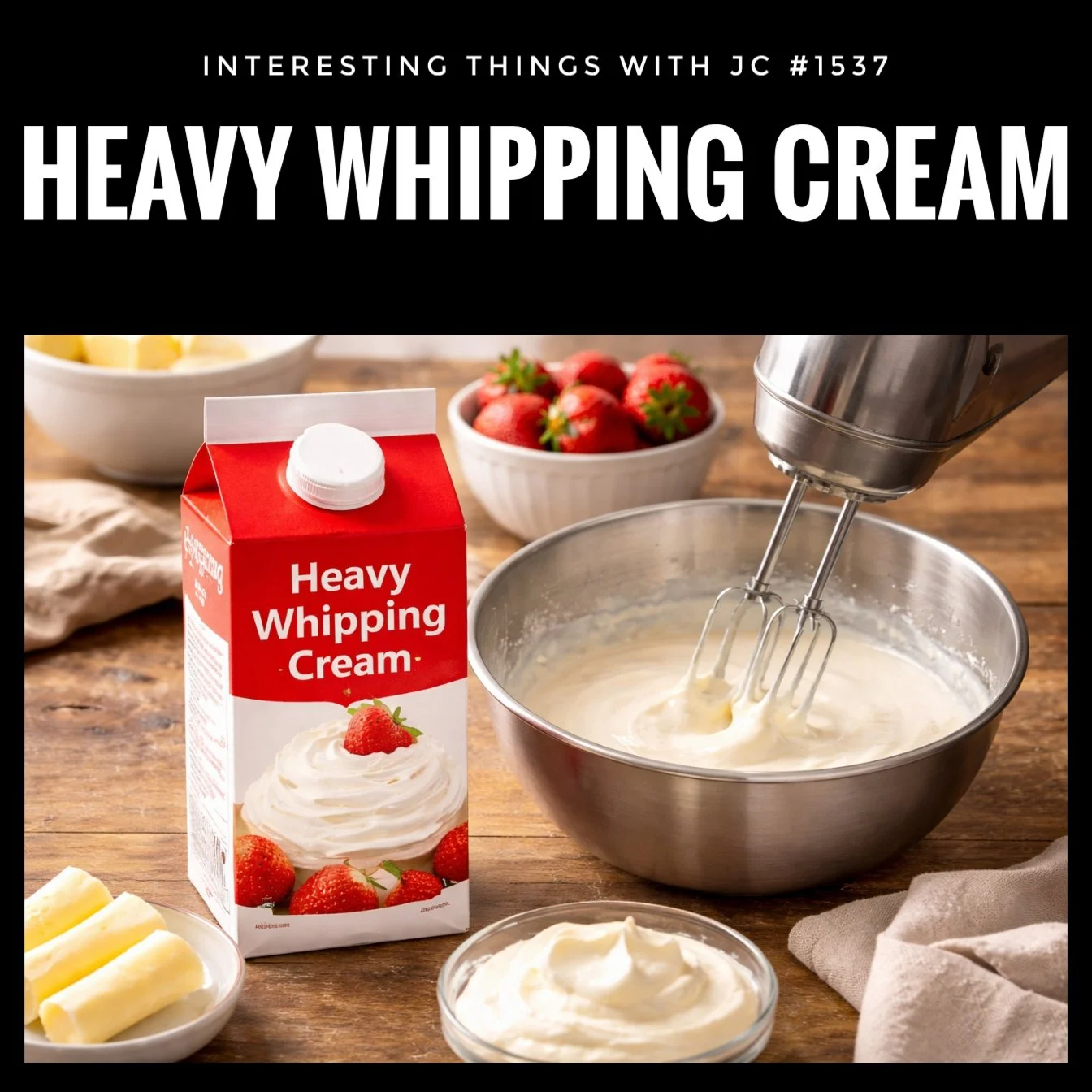
Promotional image for “Interesting Things with JC #1537: Heavy Whipping Cream,” showing a red carton of heavy whipping cream on a wooden table beside a metal mixing bowl with cream being whipped by an electric mixer, surrounded by strawberries, butter, and a small bowl of whipped cream.
Transcript
Interesting Things with JC #1537: "Heavy Whipping Cream"
Most folks don’t think much about it. Just a red carton in the fridge aisle. But heavy whipping cream didn’t start fancy. It came from what was left after milking a cow and letting the milk sit. The fat floated to the top. That was cream. The thick stuff. The good stuff.
Back then, folks skimmed it off by hand, used it fresh, or churned it into butter. What they didn’t use could spoil fast. No fridges. No standard anything. Just luck and cold weather.
Then in 1878, a Swedish inventor named Gustaf de Laval (GOO-stahf duh luh-VAHL) built a machine that spun milk fast. It separated cream by force. Now you could get exactly what you needed. That’s when things changed.
By the 1920s, “whipping cream” hit kitchens across America. It had to be at least 36 percent butterfat to whip. Any less and it wouldn’t hold. Beat it with a whisk, and it puffed up into soft peaks. It wasn’t just tasty. It was chemistry.
Then came home refrigeration. By the 1940s, cream could last longer, ship farther, and show up in more recipes. It got into pies, soups, and sauces. Heavy cream wasn’t just a leftover anymore. It was an ingredient on purpose.
Today, most cartons are still just cream. No sugar. Maybe a little thickener. That’s it. And that same fat content, 36 percent or more, makes it whip, mix, and hold better than anything else.
It started as a byproduct. Now it’s the secret to everything from biscuits to béarnaise (bare-NAZE). That little red carton? It took farms, science, and refrigeration to put it in your hands.
These are interesting things, with JC.
Student Worksheet
What process causes cream to rise to the top of milk when it sits?
Who invented the centrifugal cream separator, and what year was it created?
What butterfat percentage is required for cream to whip properly?
Explain how refrigeration changed the role of cream in cooking.
Choose one modern food item (like béarnaise or biscuits) and describe how heavy cream plays a role in its preparation.
Teacher Guide
Estimated Time:
45–60 minutes
Pre-Teaching Vocabulary Strategy:
Use a K-W-L chart to preview terms like "butterfat" and "centrifuge."
Demonstrate emulsification with a simple oil-water experiment.
Anticipated Misconceptions:
Students may believe whipping cream always contains sugar.
Confusion between butterfat content and thickness.
Some may assume cream was always an intentional product, not a byproduct.
Discussion Prompts:
Why was cream once considered a "leftover"?
How did Gustaf de Laval's invention change dairy production?
In what ways does food science impact what we eat today?
Differentiation Strategies:
ESL: Use labeled visuals for dairy processing.
IEP: Provide sentence starters for written responses.
Gifted: Explore additional dairy chemistry topics (e.g., casein proteins or foaming agents).
Extension Activities:
Make homemade butter from heavy cream to observe physical change.
Investigate other byproducts in agriculture and their modern uses.
Cross-Curricular Connections:
Chemistry: Emulsions and colloids.
History: Agricultural innovation in the late 19th century.
Economics: How refrigeration affected food markets and transportation.
Quiz
Q1. What component makes up at least 36% of whipping cream?
A. Water
B. Butterfat
C. Sugar
D. Protein
Answer: B
Q2. Who invented the machine that revolutionized cream separation?
A. Louis Pasteur
B. Gustaf de Laval
C. Jonas Salk
D. Carl Linnaeus
Answer: B
Q3. What happens to milk fat if you let milk sit undisturbed?
A. It spoils immediately
B. It sinks
C. It floats to the top
D. It evaporates
Answer: C
Q4. In what decade did refrigeration become common in homes?
A. 1890s
B. 1920s
C. 1940s
D. 1970s
Answer: C
Q5. Which of the following is NOT usually an ingredient in heavy cream?
A. Cream
B. Sugar
C. Thickener (occasionally)
D. Butterfat
Answer: B
Assessment
Describe how the invention of the centrifugal cream separator impacted both farms and consumers.
Analyze how chemistry and technology intersect in the transformation of a simple dairy byproduct into a staple ingredient.
3–2–1 Rubric:
3 = Accurate, complete, thoughtful
2 = Partial or missing detail
1 = Inaccurate or vague
Standards Alignment
U.S. Standards
NGSS HS-PS1-3: Apply scientific principles to design a process for separating mixtures.
Related to cream separation using centrifuges.
CCSS.ELA-LITERACY.RST.9-10.2: Determine central ideas of a scientific text.
Linked to understanding historical and scientific significance of cream processing.
C3.D2.His.2.9-12: Analyze change and continuity in historical developments.
Connected to changes in dairy production over time.
CTE-AGC11.3.3: Explain food preservation and processing methods.
Explores refrigeration and pasteurization’s role in dairy safety.
UK National Curriculum Equivalents
KS4 Science: Working Scientifically — Interpret and evaluate scientific evidence.
AQA GCSE Food Preparation and Nutrition 3.4.1 — Understand the functional and chemical properties of food.
IB MYP Sciences (Criterion B)
Inquiring and Designing — Investigate scientific developments in food production and processing.
Cambridge IGCSE Chemistry (0620)
Section 4: Physical changes — Understand the physical basis of changes like emulsification and whipping.
Show Notes
In this fascinating episode, JC uncovers the rich story behind a humble kitchen staple—heavy whipping cream. Listeners learn how cream was once a byproduct of traditional milk processing, manually skimmed off and prone to spoilage without refrigeration. Everything changed in 1878 when Swedish engineer Gustaf de Laval invented the centrifugal cream separator, transforming cream into a precision ingredient. By the 1920s, it became a household term, and with the rise of home refrigeration in the 1940s, it took its place in recipes across America. With a butterfat content of 36% or more, this once-overlooked fat has become central to everything from soft peaks in desserts to velvety sauces like béarnaise. This episode helps students connect food science, chemistry, and historical innovation, showing how a small detail in the fridge is rooted in big scientific changes.
References
U.S. Food & Drug Administration. (2024). Code of Federal Regulations: Title 21—Food and drugs. https://www.ecfr.gov
Encyclopædia Britannica. (n.d.). Cream (dairy product). https://www.britannica.com/topic/cream-dairy-product
U.S. Department of Agriculture, Agricultural Research Service. (n.d.). FoodData Central: Cream, fluid, heavy whipping. https://fdc.nal.usda.gov