1538: "Dundurn Castle Hamilton"
Interesting Things with JC #1538: "Dundurn Castle Hamilton" – It looks like a castle, but it was built for strategy. Beneath the limestone mansion lies a hidden tunnel…and a man preparing for more than just dinner guests.
Curriculum - Episode Anchor
Episode Title: Dundurn Castle Hamilton
Episode Number: 1538
Host: JC
Audience: Grades 9–12, college intro, homeschool, lifelong learners
Subject Area: History, Architecture, Civics, Canadian Studies, Historical Inquiry
Lesson Overview
By the end of this lesson, students will be able to:
Define the historical significance of Dundurn Castle in the context of pre-Confederation Canada.
Compare 19th-century architectural and technological innovations to modern equivalents.
Analyze Sir Allan MacNab’s strategic use of architecture as political and military positioning.
Explain how historical preservation efforts shape modern understanding of national identity.
Key Vocabulary
Limestone (ˈlaɪmˌstoʊn) — A sedimentary rock used in construction; Dundurn Castle was made from limestone, emphasizing its durability and visual prominence.
Upper Canada (ˈʌpər ˈkænədə) — A historical British colony that became Ontario; Dundurn Castle was built during this colonial period.
Premier (ˈpriːmiər) — The head of government in a Canadian province; Sir Allan MacNab held this role before Confederation.
Icehouse (ˈaɪsˌhaʊs) — A structure used to store ice and preserve food before refrigeration; found on the Dundurn estate.
Confederation (kənˌfɛdəˈreɪʃən) — The process by which Canada became a self-governing federation in 1867, five years after MacNab’s death.
Narrative Core
Open – The episode opens by clarifying that Dundurn Castle isn’t actually a castle, creating a curiosity hook.
Info – Provides historical context: the 1830s colonial structure, MacNab’s background as lawyer, soldier, Premier.
Details – Describes the estate’s innovations: indoor plumbing, gas lighting, servant tunnels, and the mystery tunnel.
Reflection – Explores the broader purpose of the mansion as a center for strategy and survival in a fragile country.
Closing – "These are interesting things, with JC."
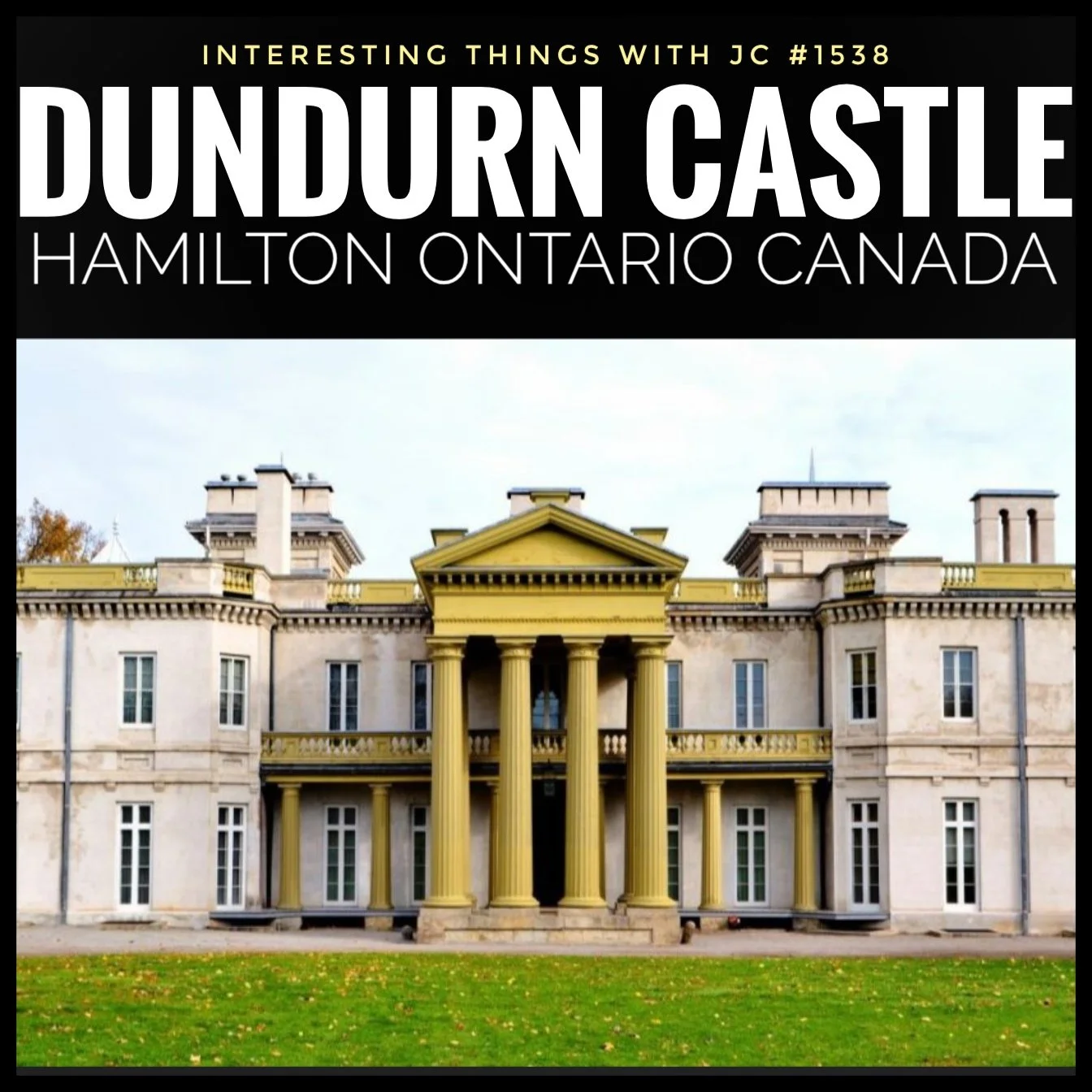
Promotional image for “Interesting Things with JC” episode 1538 featuring Dundurn Castle in Hamilton, Ontario, Canada. The image shows a symmetrical 19th-century limestone mansion with a central columned portico, pale stone walls, tall rectangular windows, and a green lawn in the foreground. Bold white text at the top reads “Dundurn Castle” with smaller text above and below identifying the podcast episode and location.
Transcript
Interesting Things with JC #1538: "Dundurn Castle Hamilton"
It’s called Dundurn Castle, but it’s not really a castle. It’s a limestone mansion on a hill in Hamilton, Ontario. Built in the 1830s, back when Canada wasn’t even Canada yet, just Upper and Lower Canada. And the man behind it, Sir Allan MacNab (pronounced Mack-Nab), wasn’t royalty. He was a lawyer, a soldier, and eventually Premier. He also had a taste for strategy.
MacNab bought a rundown farmhouse and turned it into a 72-room estate, 18,000 square feet (1,672 square meters), complete with indoor plumbing and gas lighting. In 1835, that was practically science fiction. It had servant staircases, a bell system, even a deep-rooted icehouse to keep food cold before refrigeration. He wasn’t just building a house. He was building a headquarters.
From that hill, he could see the bay, and maybe more importantly, be seen. He hosted military officers, politicians, British dignitaries. But he also planned. And years later, in 1977, workers uncovered something hidden: a sealed-off tunnel, about 120 feet (36.5 meters) long, running underground toward the water. No records. No blueprint. Just there. Some say it was for smuggling, others for escape. Either way, it was deliberate.
MacNab wasn’t building a monument. He was preparing for whatever might come. Rebellion. Collapse. War. He knew the country was fragile, and he planned accordingly.
After his death in 1862, the house fell into debt and was mostly stripped bare. But in 1967, the city restored it to what it looked like in 1855. And if you visit today, you’ll still see the same layout, the same garden plots, the same hillside where drills were once run.
These are interesting things, with JC.
Student Worksheet
What architectural innovations made Dundurn Castle advanced for its time in the 1830s?
Why might Sir Allan MacNab have built a tunnel beneath the estate?
In what ways did MacNab use Dundurn Castle as more than just a residence?
What happened to the estate after MacNab’s death in 1862?
Imagine you’re a journalist in 1977 when the tunnel was found. Write a headline and short lead for your newspaper article.
Teacher Guide
Estimated Time
1–2 class periods (45–60 minutes each)
Pre-Teaching Vocabulary Strategy
Use visual and contextual clues to pre-teach "Upper Canada," "limestone," and "icehouse" via historical photos, short articles, or labeled diagrams.
Anticipated Misconceptions
Students may think “castle” implies medieval royalty or fortification.
Some may not grasp Canada’s pre-Confederation structure or MacNab's historical role.
Discussion Prompts
What does Dundurn Castle tell us about leadership and legacy?
How do buildings reflect the values and fears of the people who build them?
Why preserve historical homes like Dundurn in modern Canada?
Differentiation Strategies
ESL: Use bilingual visuals of architectural terms and a labeled map of 1830s Canada.
IEP: Scaffold timeline creation of events from MacNab’s life and Dundurn’s history.
Gifted: Research and debate the ethical implications of restoring vs. modernizing heritage properties.
Extension Activities
Compare Dundurn Castle with American counterparts like Monticello or the Biltmore Estate.
Create a digital tour of Dundurn Castle using presentation software or VR platforms.
Cross-Curricular Connections
Civics: Role of early Canadian leaders and governance systems.
Architecture: Structural design and engineering innovations.
Geography: Strategic location choices in settlement planning.
Quiz
Q1. What material is Dundurn Castle primarily built from?
A. Brick
B. Limestone
C. Granite
D. Wood
Answer: B
Q2. What position did Sir Allan MacNab eventually hold?
A. Governor General
B. Mayor of Hamilton
C. Premier
D. Member of Parliament
Answer: C
Q3. What surprising structure was discovered in 1977?
A. Underground kitchen
B. Vaulted ceiling
C. Secret passage to the garden
D. Tunnel to the water
Answer: D
Q4. When was Dundurn Castle restored to its 1855 appearance?
A. 1835
B. 1862
C. 1967
D. 1977
Answer: C
Q5. Which of the following innovations was found in Dundurn Castle in the 1830s?
A. Wi-Fi
B. Indoor plumbing
C. Electric elevators
D. Air conditioning
Answer: B
Assessment
Explain how Sir Allan MacNab’s political and military background influenced the design of Dundurn Castle.
Evaluate the role of historical preservation in helping us understand national identity using Dundurn Castle as an example.
Rubric
3 = Accurate, complete, thoughtful
2 = Partial or missing detail
1 = Inaccurate or vague
Standards Alignment
U.S. Standards:
CCSS.ELA-LITERACY.RI.9-10.3 – Analyze how the author unfolds an analysis or series of ideas or events.
C3.D2.His.1.9-12 – Evaluate how historical events and developments were shaped by unique circumstances.
CCSS.ELA-LITERACY.WHST.9-10.2 – Write informative/explanatory texts, including narration of historical events.
CTE.AC.CT.1.2 (Architecture & Construction) – Explain the importance of historical building design elements.
International Equivalents:
UK (OCR GCSE History A J410/11) – The impact of political power and architectural change over time.
Cambridge IGCSE History (0470/0977) – Understanding of 19th-century global developments and their local impacts.
IB MYP Individuals and Societies (MYP Year 5) – Evaluate the impact of strategic planning in historical contexts.
Show Notes
In this episode, JC explores the story of Dundurn Castle in Hamilton, Ontario—an imposing limestone mansion built in the 1830s by Sir Allan MacNab. Though not a true castle, it served as a strategic headquarters during a time of colonial uncertainty in Canada. Featuring gas lighting, indoor plumbing, servant tunnels, and a secret underground passage, the estate reveals the intricate balance between luxury, power, and preparedness. MacNab’s role as a military leader and Premier shaped the site’s purpose as both a residence and a defensive stronghold. Its later restoration in 1967 allows modern visitors to glimpse a preserved piece of pre-Confederation Canadian history. This episode is a vivid starting point for lessons on leadership, architecture, and national identity.
References
City of Hamilton. (n.d.). Dundurn National Historic Site. https://www.hamilton.ca/things-do/hamilton-civic-museums/dundurn-national-historic-site
Government of Canada. (n.d.). Dundurn Castle National Historic Site of Canada. Parks Canada. https://www.pc.gc.ca/apps/dfhd/page_nhs_eng.aspx?id=380
Destination Ontario. (n.d.). Dundurn Castle. https://www.destinationontario.com/en-ca/attractions/dundurn-castle