1539: "Soviet Volga Transmitters"
Interesting Things with JC #1539: "Soviet Volga Transmitters" – They weren’t just towers...they were weapons. Buzzing across continents. Whispering secrets. And some of them never turned off.
Curriculum - Episode Anchor
Episode Title: Soviet Volga Transmitters
Episode Number: 1539
Host: JC
Audience: Grades 9–12, college intro, homeschool, lifelong learners
Subject Area: Cold War History, Communications Technology, Media Studies, Intelligence and Surveillance
Lesson Overview
Students will:
Define the role of shortwave radio technology in the Soviet Union's global communication efforts.
Compare the functions and purposes of Western and Soviet broadcasting during the Cold War.
Analyze the possible meanings and implications of mysterious signals like UVB-76.
Explain how Cold War-era communication infrastructure impacted global geopolitics and surveillance.
Key Vocabulary
Shortwave (SHORT-wayv) — A radio frequency band used to broadcast signals over long distances. "Shortwave frequencies were used to reach audiences across the globe during the Cold War."
Propaganda (prah-puh-GAN-duh) — Biased information used to promote a political cause. "Radio Moscow was a vehicle for Soviet propaganda in many languages."
Kilowatt (KILL-oh-waht) — A unit of power measurement. "Soviet transmitters at Radio Center 5 operated at hundreds of kilowatts—far stronger than typical stations."
Morse Code (MORSS kohd) — A system of transmitting text using sequences of dots and dashes. "Odd bursts of Morse code were heard from some of the Soviet transmitters."
Atmospheric Bounce (AT-muhs-FEER-ik BOUNCE) — A phenomenon where radio signals reflect off the Earth’s ionosphere to travel long distances. "Shortwave signals could bounce off the atmosphere and be heard around the world."
Narrative Core
Open – The episode hooks listeners by describing the eerie physical feeling of being near Radio Center 5’s massive towers and the hum they emitted.
Info – Provides historical context on the function of Radio Center 5, the power of the transmitters, and the scale of Soviet communication during the Cold War.
Details – Introduces the strange mystery of UVB-76, an unexplained signal with buzzing, Morse code, and occasional voice interruptions, hinting at espionage or jamming tactics.
Reflection – Explores the idea that communication is not always about volume—sometimes, power hums in subtle, persistent ways.
Closing – “These are interesting things, with JC.”
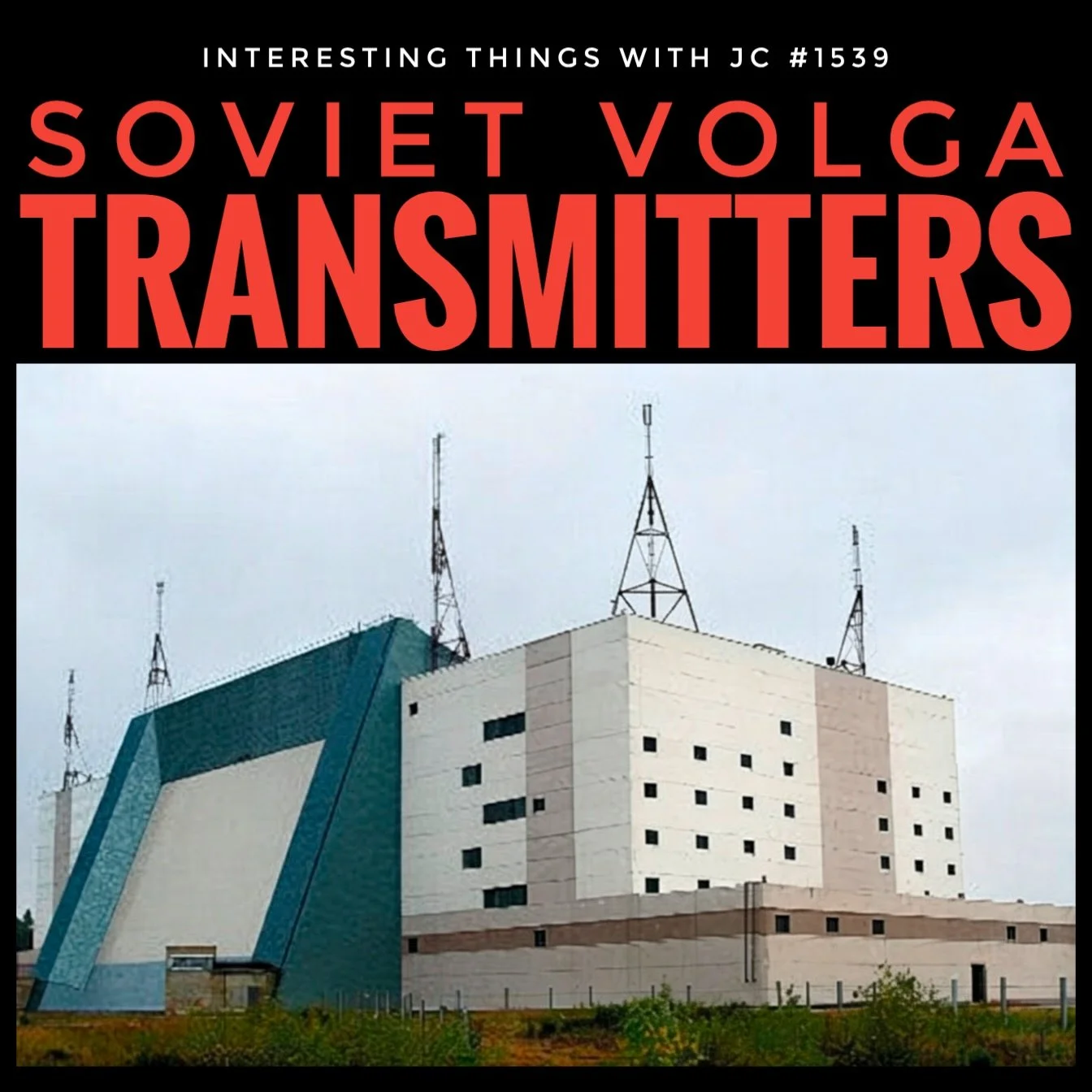
Promotional image for Interesting Things with JC episode 1539 titled “Soviet Volga Transmitters,” showing a large Soviet-era concrete radio transmission building with angular architecture and multiple antenna towers rising from the roof, set in an open field under an overcast sky.
Transcript
Interesting Things with JC #1539: "Soviet Volga Transmitters"
In the flatlands near Kaliningrad (kah-LEE-neen-grad), there used to be a place called Radio Center 5. Built in 1967, it was one of the Soviet Union’s biggest shortwave broadcast sites. If you were nearby, you could feel the hum in your bones. These weren’t normal radio towers. They stood over 700 feet tall (213 meters) and sent signals across the globe.
The Soviets had more than two dozen transmitters there, most pushing out 100 to 500 kilowatts. That’s about 80 times more power than a typical U.S. FM station. These signals weren’t just for music. This was Radio Moscow, beaming Soviet news and propaganda in dozens of languages to every continent.
But then things got strange. In the 1970s and ‘80s, people started picking up odd signals—clicks, beeps, bursts of Morse code. One station, known only as UVB-76, sent out a constant buzz every few seconds. Now and then, a voice would cut in to read numbers or Russian names. Then the buzz would come back.
To this day, no one knows exactly what those messages meant. Some think they were codes for spies. Others think they were meant to jam Western stations. What’s clear is these towers weren’t just for talking. They were built to control the conversation.
Most of those towers are silent now, rusting away in the fields…monuments to a collapsed communist state and the fading terror of its propaganda. But shortwave’s a funny thing. It bounces off the atmosphere and keeps going. Even now, you can sometimes hear a buzz or a whisper on those old frequencies.
Because not all power makes noise. Sometimes, it just hums.
These are interesting things, with JC.
Student Worksheet
What was the primary purpose of the Soviet shortwave transmitters at Radio Center 5?
How does the power output of the Soviet transmitters compare to a typical U.S. FM station?
What kinds of strange signals did listeners begin picking up in the 1970s and 1980s?
What are two possible theories about the purpose of the UVB-76 signal?
Why might shortwave transmissions still be detectable today, even after the towers have been deactivated?
Teacher Guide
Estimated Time:
45–60 minutes
Pre-Teaching Vocabulary Strategy:
Use a vocabulary carousel or station rotation for students to hear, define, and connect the five core terms to Cold War contexts before listening.
Anticipated Misconceptions:
Students may assume all Cold War espionage was digital or cinematic. Clarify the analog nature of radio surveillance.
Confusion may arise between "shortwave" and common FM/AM radio.
Discussion Prompts:
What does the use of such powerful communication infrastructure reveal about the Soviet Union’s global ambitions?
How might secrecy and uncertainty (like UVB-76) be tools of power?
Why is understanding Cold War media relevant to today’s discussions about information control?
Differentiation Strategies:
ESL: Provide vocabulary in both English and students’ home language where applicable.
IEP: Break down the narrative core into visual storyboards.
Gifted: Challenge students to research and present a 3-minute TED-style talk on UVB-76 theories.
Extension Activities:
Use an SDR (Software-Defined Radio) tool to scan shortwave frequencies today and report findings.
Build a model of how shortwave signals bounce off the atmosphere using mirrors or lasers.
Create a Cold War timeline featuring key propaganda outlets from both sides.
Cross-Curricular Connections:
Physics: Electromagnetic wave transmission, frequency, and atmospheric refraction.
History: Soviet Cold War tactics and international broadcasting.
Computer Science: Encryption and information theory basics.
Quiz
What was Radio Center 5 mainly used for?
A. Satellite communication
B. Shortwave radio broadcasting
C. Weather data collection
D. Television signals
Answer: BHow tall were the radio towers at Radio Center 5?
A. 100 feet
B. 350 feet
C. Over 700 feet
D. Exactly 500 feet
Answer: CWhat was UVB-76 known for broadcasting?
A. Classical music
B. News reports
C. Buzzing sounds and coded messages
D. Political speeches
Answer: CWhat made Soviet radio transmissions more powerful than U.S. FM stations?
A. Better speakers
B. Use of satellite technology
C. Transmission power of 100–500 kilowatts
D. Longer broadcast hours
Answer: CWhat is one reason shortwave signals can still be heard today?
A. They use modern digital methods
B. They bounce off the atmosphere
C. The transmitters were never turned off
D. They’re powered by solar flares
Answer: B
Assessment
Why do you think the Soviets invested so heavily in shortwave broadcasting? Support your answer with specific examples from the episode.
What do the strange, unexplained signals of UVB-76 suggest about how power and communication intersect in times of political tension?
3–2–1 Rubric:
3 = Accurate, complete, thoughtful
2 = Partial or missing detail
1 = Inaccurate or vague
Standards Alignment
CCSS.ELA-LITERACY.RI.9–10.2
Students determine and trace the development of central ideas related to state-controlled broadcasting, propaganda, and information power, using historical narrative and technical description as evidence.
CCSS.ELA-LITERACY.RH.11–12.3
Students evaluate multiple explanations of historical events and phenomena—such as the function of number stations and signal interference—by assessing claims, sourcing, and corroborating evidence.
CCSS.ELA-LITERACY.WHST.9–12.2
Students write explanatory texts that examine technical and historical processes, including how shortwave transmission works and how it was used strategically during the Cold War.
C3.D2.His.5.9–12
Students analyze how historical contexts shape the creation, use, and interpretation of sources, particularly state-run media and covert communication systems.
C3.D2.His.14.9–12
Students analyze the multiple causes and effects of Cold War communication strategies, including propaganda broadcasting, psychological influence, and information denial.
NGSS HS-PS4-2
Students use models to describe how electromagnetic radiation—including radio waves—interacts with Earth’s atmosphere, enabling long-distance shortwave communication.
NGSS HS-PS4-5
Students communicate technical information about how devices use electromagnetic waves to transmit and receive information, applying these principles to Soviet-era broadcast infrastructure.
ISTE 3.3.b
Students evaluate the accuracy, perspective, credibility, and intent of information sources, comparing analog Cold War broadcasting systems with modern digital media environments.
CTE Information Technology – Communication Systems Pathway
Students examine foundational concepts of broadcast infrastructure, signal transmission, and system reliability within historical and technical contexts.
ACRL Information Literacy Framework – Authority Is Constructed and Contextual
Students recognize how authority in information sources is shaped by political, historical, and technological conditions, using state-run broadcasting as a case study.
UK National Curriculum (History – Key Stage 4)
Students analyze Cold War-era international relations, including the use of media and communication technologies as instruments of influence and control.
AQA GCSE History – Conflict and Tension Between East and West, 1945–1972
Students examine broadcasting and propaganda as strategic tools within Cold War power dynamics.
Cambridge IGCSE History (0470) – The Cold War, 1945–1991
Students evaluate the role of mass media and communication technology in shaping international perceptions and geopolitical tension.
IB MYP Individuals and Societies (History)
Students investigate how technological systems influence power, governance, and global interaction through historically grounded case studies.
Show Notes
In this episode of Interesting Things with JC, listeners are drawn into the mysterious world of Soviet shortwave transmitters, particularly the powerful Radio Center 5 near Kaliningrad. JC explores how the Soviets used enormous towers to project their worldview across the globe via Radio Moscow, with signals powerful enough to reach every continent. More intriguing are the unexplained signals from UVB-76—a buzzing radio station suspected to be a Cold War relic still transmitting cryptic messages today. For classrooms, this episode serves as a portal into Cold War communication strategies, Soviet technological ambition, and the strange persistence of analog signals in the digital age. It provokes rich discussions on media, power, surveillance, and the eerie legacy of broadcast infrastructure.
References
Moltke, H. (2021). The Buzzer: UVB-76 and the Ghosts of the Soviet Airwaves. Retrieved from https://www.wired.com/2011/09/ff_uvb76/
Grokipedia. (n.d.). Bolshakovo transmitting station. https://grokipedia.com/page/bolshakovo_transmitting_station
Priyom.org. (n.d.). The Buzzer. https://priyom.org/military-stations/russia/the-buzzer
Wikipedia contributors. (2026). UVB-76. In Wikipedia, The Free Encyclopedia. https://en.wikipedia.org/wiki/UVB-76
Mediumwave.info. (2024, January 21). Russia and more…. https://mediumwave.info/2024/01/21/russia-and-more-2/
Blogspot. (2011, December 6). Radio is the real king of the castle. https://mt-shortwave.blogspot.com/2011/12/radio-is-real-king-of-castle.html