Interesting Things with JC #1546: "Emotional Invalidation" – When someone tells you your feelings don’t matter, it doesn’t erase the pain, it adds another layer. One that lingers longer than anyone expects.
Curriculum - Episode Anchor
Episode Title: "Emotional Invalidation"
Episode Number: #1546
Host: JC
Audience: Grades 9–12, college intro, homeschool, lifelong learners
Subject Area: Psychology, Health Education, Social-Emotional Learning (SEL), Communication Studies
Lesson Overview
Students will:
Define emotional invalidation and its various forms using examples from interpersonal relationships.
Compare emotional invalidation with emotional validation in terms of psychological outcomes.
Analyze how early emotional experiences influence emotional regulation and self-concept.
Explain the long-term effects of emotional invalidation on mental health and relational dynamics.
Key Vocabulary
Emotional Invalidation (/ih-moh-shuh-nl in-val-uh-day-shun/) — When someone's feelings are dismissed, minimized, or ignored. For example, telling someone “You’re too sensitive” invalidates their experience.
Gaslighting (/gas-lahy-ting/) — A manipulative tactic where someone tries to make another person doubt their perception of reality. Often a loud form of invalidation.
Rumination (/roo-muh-nay-shun/) — Repetitively thinking about distressing situations or feelings. Often a response to unprocessed emotional invalidation.
Emotional Regulation (/ih-moh-shuh-nl reg-yuh-lay-shun/) — The ability to manage and respond to emotional experiences in healthy ways.
Validation (/val-uh-day-shun/) — Acknowledging someone’s feelings as real and understandable, even without agreeing with them.
Narrative Core
Open — Begins with the unsettling feeling of “nothingness,” not due to numbness, but from emotional dismissal.
Info — Introduces emotional invalidation, giving everyday examples like “That’s not a big deal” or laughing when someone shares.
Details — Cites psychological studies showing how invalidation affects stress, anxiety, and emotional development across ages.
Reflection — Emphasizes how invalidation harms relationships and self-perception, sometimes more than the original issue.
Closing — “These are interesting things, with JC.”
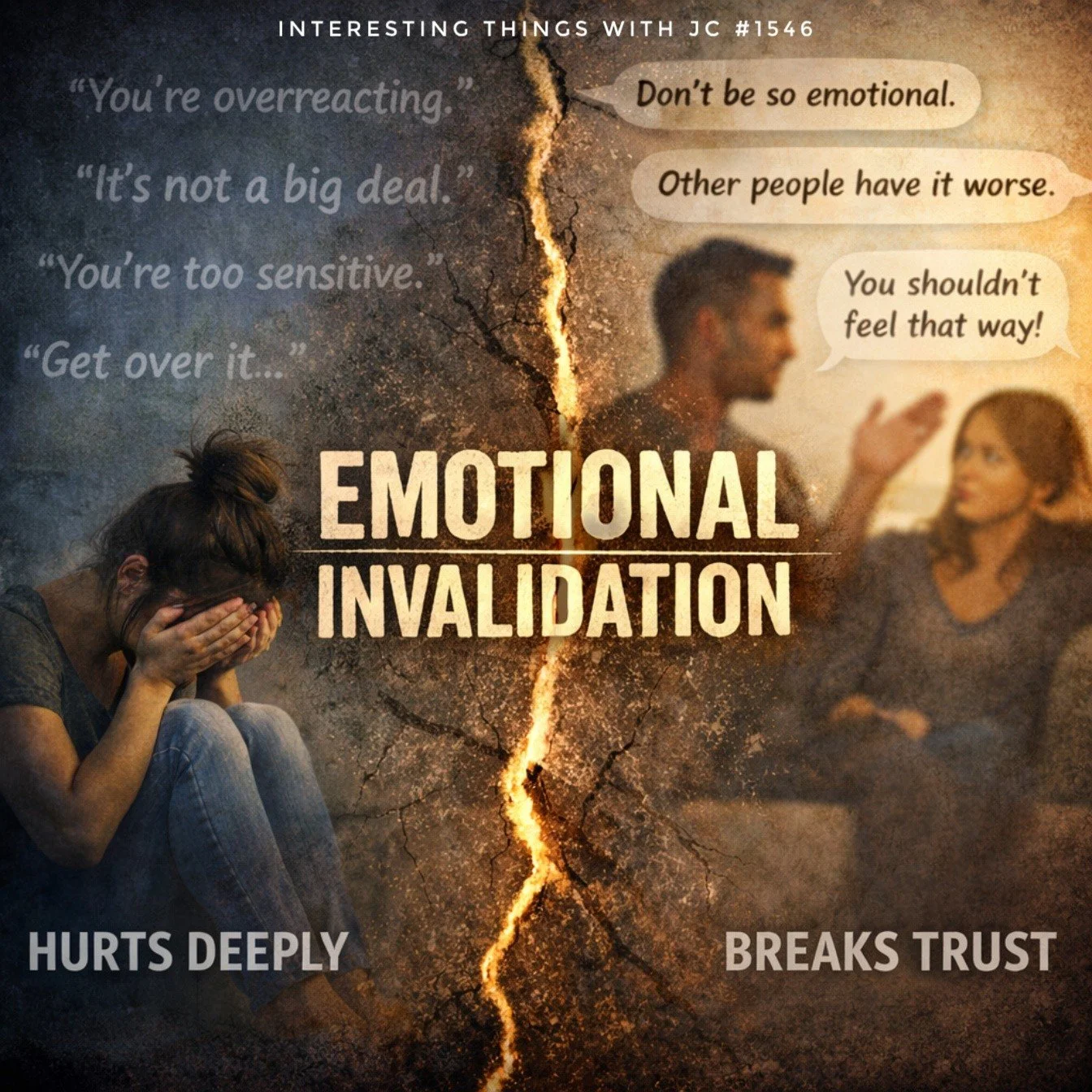
Promotional image for “Interesting Things with JC #1546: Emotional Invalidation,” illustrating how dismissive phrases like “You’re too sensitive” or “You shouldn’t feel that way” can cause emotional harm, break trust, and deepen distress.
Transcript
Interesting Things with JC #1546: "Emotional Invalidation"
Sometimes, the worst thing you can feel… is nothing at all.
Not because you’re numb, but because someone told you what you do feel doesn’t count.
Maybe they said, “You’re too sensitive.”
Or, “That’s not a big deal.”
Maybe they laughed when you opened up, or just changed the subject.
That’s emotional invalidation. And it’s more common than most people realize.
At its core, it’s the act of brushing off someone’s emotional reality. It can be loud, like gaslighting, or quiet, like a shrug or a sigh. It happens in families, friendships, workplaces, even marriages. Sometimes it’s on purpose. Other times, it’s just a habit someone learned growing up.
But the damage is real.
Psychologists have studied it for decades. When people feel invalidated, especially repeatedly, they report higher stress levels, more anxiety, and less ability to regulate their own emotions.
It erodes trust in relationships. It makes it harder to be vulnerable. And over time, it teaches a dangerous idea: that your emotions are wrong.
In kids, that lesson can turn into chronic shame, low self-esteem, or even identity confusion. In adults, it often shows up as rumination, getting stuck in cycles of overthinking, overexplaining, or just shutting down entirely.
What’s more, research shows that emotional invalidation doesn’t calm people down. It actually escalates emotion. Makes it louder. Stronger. Harder to manage. Validating responses, on the other hand, do the opposite. They help the nervous system regulate.
This isn’t about agreeing with someone. It’s about letting them feel what they feel, without turning it into a debate.
Because when someone says, “You shouldn’t feel that way,” they’re not solving a problem.
They’re creating a second one.
And for the person on the receiving end, that second wound, the one where their feelings get dismissed, often hurts more than the original pain ever did.
These are interesting things, with JC
Student Worksheet
What is emotional invalidation, and how might it show up in everyday conversations?
According to the episode, how does invalidation affect children differently than adults?
What are some common phrases that might unintentionally invalidate someone’s feelings?
Why doesn’t emotional invalidation calm people down, according to research?
Think of a time when someone validated your feelings. How did it impact your response?
Teacher Guide
Estimated Time
45–60 minutes (standard class period)
Pre-Teaching Vocabulary Strategy
Use word maps and personal connection examples for key terms like “rumination” and “validation.”
Include think-pair-share prompts to explore emotional language.
Anticipated Misconceptions
Students may confuse validation with agreement.
Some may believe invalidation only happens in abusive contexts; clarify that it can also occur unintentionally.
Discussion Prompts
Why is emotional validation important in relationships?
Can you disagree with someone while still validating how they feel?
How does culture or upbringing shape our emotional expression?
Differentiation Strategies
ESL: Provide sentence frames for discussing emotions and relationships.
IEP: Use visuals and simplified definitions for terms like “gaslighting.”
Gifted: Challenge students to write a short fictional dialogue showing both invalidating and validating responses.
Extension Activities
Analyze characters from literature or film for instances of emotional invalidation (e.g., The Catcher in the Rye or Inside Out).
Have students keep an emotion journal for a week, noting moments of validation/invalidation.
Cross-Curricular Connections
Psychology: Emotional development and cognitive-behavioral theory.
Health Education: Mental wellness and self-awareness skills.
Sociology: Emotional norms in families or cultures.
English Language Arts: Character analysis and dialogue evaluation.
Quiz
Q1. What is emotional invalidation?
A. Supporting someone’s feelings
B. Ignoring or minimizing someone’s emotional experience
C. Helping someone regulate their emotions
D. Expressing strong emotions
Answer: B
Q2. Which of the following is an example of invalidation?
A. “I hear you.”
B. “That makes sense.”
C. “You shouldn’t feel that way.”
D. “I understand.”
Answer: C
Q3. What emotional outcome is linked to repeated invalidation in childhood?
A. Higher self-esteem
B. Identity confusion
C. Better coping skills
D. Improved emotional regulation
Answer: B
Q4. Emotional invalidation tends to:
A. Calm people down
B. Have no impact
C. Escalate emotions
D. Encourage better communication
Answer: C
Q5. Which of the following best describes validation?
A. Pretending someone is right
B. Avoiding their feelings
C. Agreeing no matter what
D. Acknowledging feelings without debate
Answer: D
Assessment
In your own words, explain why emotional invalidation can be harmful. Include one real-world example.
Compare emotional invalidation and emotional validation in terms of their effects on relationships.
3–2–1 Rubric
3 = Accurate, complete, thoughtful
2 = Partial or missing detail
1 = Inaccurate or vague
Standards Alignment
Common Core ELA (CCSS.ELA-LITERACY.RI.9-10.1)
Cite strong textual evidence — Students reference the transcript to support analysis of emotional concepts.
C3 Framework for Social Studies (D2.Psych.2.9-12)
Analyze the impact of emotions on behavior — This lesson focuses on emotional regulation and its social consequences.
ISTE Standard for Students (1.7a)
Use empathy to guide behavior and digital interaction — Students reflect on how to validate others’ emotions appropriately.
CTE: Education and Training Pathway (EDT02.02.01)
Describe child and adolescent developmental issues — Focus on the psychological outcomes of emotional invalidation.
IB DP Psychology (Core - Biological and Cognitive Approaches)
Understand emotion and cognition interaction — This episode supports understanding of emotional regulation.
UK AQA GCSE Psychology (Topic: Memory and Emotion)
Describe the effects of emotion on behavior — Reinforces evidence-based emotional responses.
Show Notes
In this powerful and reflective episode, JC explores the often-overlooked concept of emotional invalidation, what it is, why it happens, and how deeply it affects people across all ages and relationships. Listeners learn how phrases as simple as “you’re too sensitive” can shape lifelong emotional patterns, leading to increased anxiety, reduced trust, and emotional shutdown. With research-backed insights, this episode sheds light on how validation, not agreement, supports regulation and emotional health. A vital episode for teens, educators, and caregivers alike, this lesson prompts self-reflection and deepens understanding of emotional intelligence and relational dynamics.
References
Zielinski, M. J., Veilleux, J. C., Fradley, M. F., & Skinner, K. D. (2022). Perceived emotion invalidation predicts daily affect and stressors. Anxiety, Stress, & Coping, 36(2), 214–228. https://pmc.ncbi.nlm.nih.gov/articles/PMC9357853/
Kuo, J. R., Fitzpatrick, S., Ip, J., & Uliaszek, A. (2022). The who and what of validation: An experimental examination of validation and invalidation of specific emotions and the moderating effect of emotion dysregulation. Borderline Personality Disorder and Emotion Dysregulation, 9, 15. https://pmc.ncbi.nlm.nih.gov/articles/PMC9116024/
Zielinski, M. J., & Veilleux, J. C. (2018). The perceived invalidation of emotion scale (PIES): Development and psychometric properties of a novel measure of current emotion invalidation. Psychological Assessment, 30(11), 1454–1467. https://pmc.ncbi.nlm.nih.gov/articles/PMC6212305/
Keng, S.-L., & Soh, C. Y. (2018). Association between childhood invalidation and borderline personality symptoms: Self-construal and conformity as moderating factors. Borderline Personality Disorder and Emotion Dysregulation, 5, 19. https://pmc.ncbi.nlm.nih.gov/articles/PMC6284292/
National Education Alliance for Borderline Personality Disorder. (2016). Validation skills: Teaching notes (Family Connections Module 5) [PDF]. https://www.borderlinepersonalitydisorder.org/wp-content/uploads/2011/08/2016.12-Family-Connections-Module-5-TN-Validation-PDF.pdf