1545: "The Eltanin Antenna"
Interesting Things with JC #1545: "The Eltanin Antenna" – In 1964, a deep-sea camera caught something standing straight up on the ocean floor. Not floating. Not drifting. Just... there. What it turned out to be still surprises people today.
Curriculum - Episode Anchor
Episode Title: The Eltanin Antenna
Episode Number: 1545
Host: JC
Audience: Grades 9–12, college intro, homeschool, lifelong learners
Subject Area: Marine Biology, Oceanography, History of Science, Media Literacy
Lesson Overview
Students will:
Define key terms related to deep-sea biology and ocean exploration.
Compare biological and artificial structures based on form and function.
Analyze the role of scientific evidence in shaping explanations.
Explain how limited data can lead to speculation and scientific mystery.
Key Vocabulary
Drake Passage (DRAYK PASS-ij) — The turbulent body of water between South America and Antarctica, known for extreme sea conditions.
Chondrocladia concrescens (kon-droh-KLAY-dee-uh kon-kress-ENZ) — A rare carnivorous sponge species adapted to deep-sea environments.
Deep-sea pressure — At depths of around 12,800 feet, pressure exceeds 5,600 psi, significantly impacting biological and mechanical function.
Symmetry — The balanced and proportionate arrangement of parts; in this context, the branching pattern of the sponge resembled deliberate design.
Artificial vs. Biological structures — Distinction between manmade and natural formations, especially in unfamiliar environments.
Narrative Core
Open – A mysterious object is discovered on the ocean floor, standing upright and symmetrical, raising questions about its origin.
Info – Taken in 1964 by the U.S. research vessel Eltanin using deep-sea photographic equipment in the Drake Passage.
Details – The object appeared artificial due to its form and symmetry but was later identified as a rare sponge species.
Reflection – The story highlights how unfamiliar lifeforms can be mistaken for artificial constructs, reminding us how little we know about Earth’s deep oceans.
Closing – "These are interesting things, with JC."
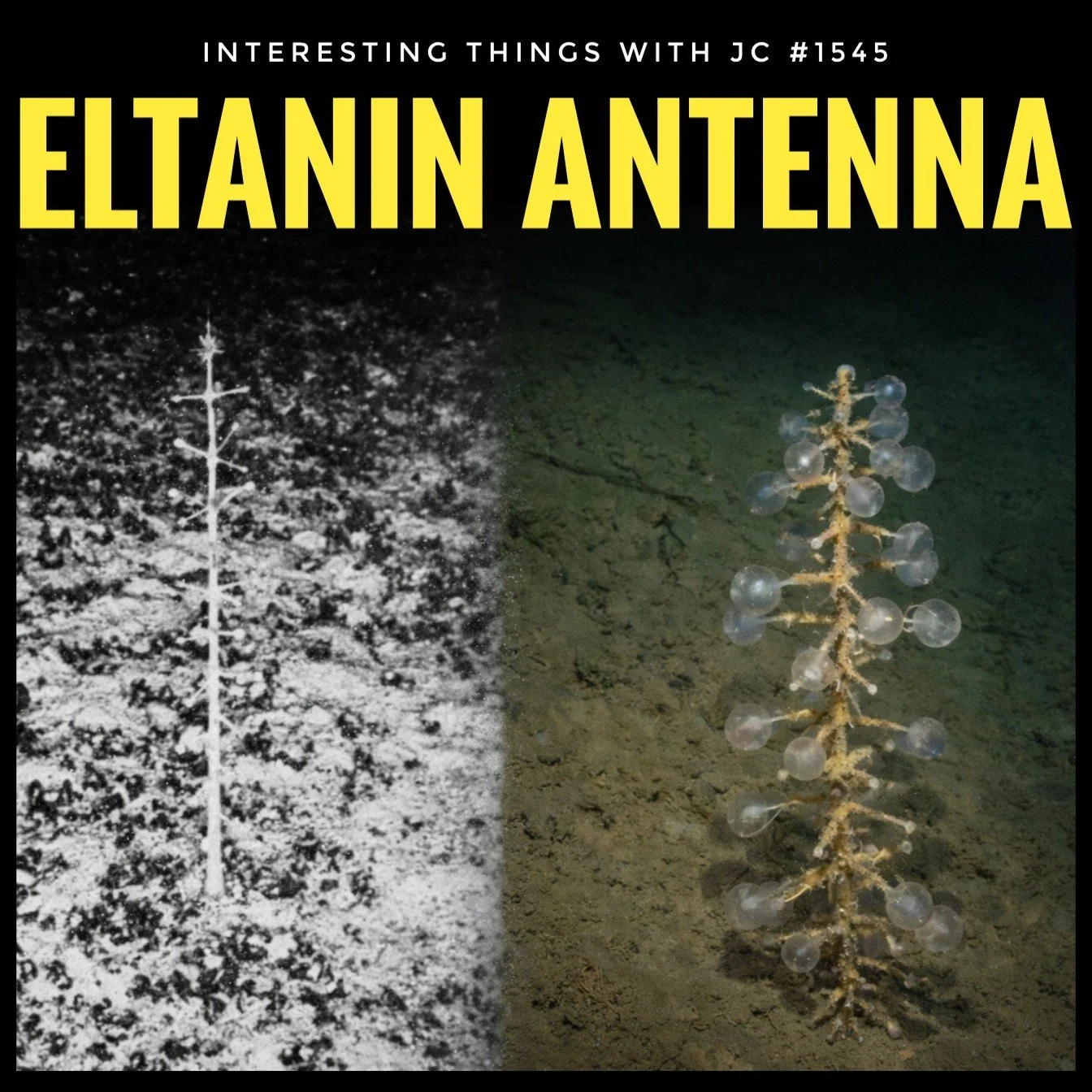
Square cover graphic for “Interesting Things with JC #1545” titled “ELTANIN ANTENNA” in large yellow letters across the top, with smaller white text above it. The image is split vertically: on the left, a grainy black and white deep sea photo shows a tall, thin, pole like object standing upright on the seafloor with short branch like crossbars; on the right, a color underwater photo shows a similar upright, twig like stalk with many small offshoots and clear, bubble like spheres attached, resting on dark muddy seabed.
Transcript
Interesting Things with JC #1545: "The Eltanin Antenna"
In August of 1964, a camera was lowered into the deep ocean south of South America. When the film came back up, one photograph didn’t make sense at first glance. It showed something standing straight up from the seafloor. Not leaning. Not drifting. Upright. Rigid. And casting a shadow.
The image was taken on August 29, 1964, by the U.S. research ship Eltanin (EL-tuh-nin) while operating in the Drake Passage (DRAYK PASS-ij), the violent stretch of water between South America and Antarctica. The camera was at a depth of about 12,800 feet, roughly 2.4 miles, or 3,904 meters below the surface. Down there, pressure exceeds 5,600 pounds per square inch. It’s a place where very little is expected to look clean, orderly, or vertical.
But this object did.
It rose from the seabed like a pole. Near the top were evenly spaced branches, arranged with a symmetry that looked deliberate. The lighting showed a sharp shadow, meaning it wasn’t floating in the water. Whatever it was, it was anchored. To many who later saw the image, it looked like an antenna. Something manufactured. Something placed there.
At the time, deep-sea photography was still crude. The Eltanin expedition, run by the U.S. Navy with civilian scientists, was surveying parts of the Southern Ocean no human had ever seen. There was no live feed. No way to move the camera for a second angle. No chance to go back. One grainy photograph was all they had.
That single frame lingered. Some thought it might be lost equipment. Others wondered if it was artificial. The shape didn’t match the sea life most people were familiar with, and at that depth there were no reference points for size or movement.
The explanation, when it finally settled, was grounded in biology.
The object was identified as Chondrocladia concrescens (kon-droh-KLAY-dee-uh kon-kress-ENZ), a rare carnivorous deep-sea sponge. Unlike most sponges, which filter water, this species anchors itself to the seafloor with a long stalk and extends branching arms to trap tiny drifting prey in the nutrient-poor deep. In the stillness of that environment, it can stand perfectly upright and motionless.
On grainy black-and-white film, those arms looked mechanical. The stalk looked metallic. Without motion or scale, a living organism took on the appearance of a machine.
Even so, a few details still give people pause. The near-perfect symmetry. The fact that it appears alone, with no others visible nearby. Those traits don’t line up neatly with how sponges are usually seen, and while they don’t overturn the science, they leave just enough unanswered space to explain why a single photograph taken nearly two and a half miles down is still talked about more than sixty years later.
The Eltanin antenna wasn’t hidden technology. It was life, adapted to extreme depth, mistaken for something built because it came from a place we barely understood. Even now, most of the ocean floor remains unseen. And every so often, it reminds us that the unknown doesn’t always mean artificial. Sometimes it simply means unfamiliar.
These are interesting things, with JC.
Student Worksheet
What was unusual about the object photographed by the Eltanin in 1964?
Describe the location and depth where the Eltanin antenna was found.
Why did some people originally believe the object might be artificial?
What biological organism was eventually identified in the image?
In your own words, explain why deep-sea exploration still leads to mystery and speculation.
Teacher Guide
Estimated Time
1–2 class periods (45–90 minutes)
Pre-Teaching Vocabulary Strategy
Use image-based flashcards of deep-sea species and oceanographic terms
Pronounce and break down complex scientific terms together
Anticipated Misconceptions
Students may think sponges can’t be carnivorous
Students might confuse artificial symmetry with intentional design
Students may assume deep-sea exploration is common or straightforward
Discussion Prompts
Why do we often interpret unfamiliar natural things as artificial?
What does this episode teach us about the limits of our knowledge?
How does one photo affect scientific and public imagination for decades?
Differentiation Strategies
ESL: Visual diagrams of the sponge and seafloor
IEP: Sentence starters and scaffolded worksheet options
Gifted: Research additional deep-sea species mistaken for manmade objects
Extension Activities
Write a science fiction story based on a misunderstood deep-sea object
Explore the evolution of deep-sea exploration tech from the 1960s to now
Compare interpretations of the Eltanin photo in scientific vs. conspiracy circles
Cross-Curricular Connections
Physics: Pressure and buoyancy at extreme ocean depths
History of Science: 1960s Cold War-era exploration
Media Literacy: How media frames mystery vs. science
Quiz
Q1. What vessel captured the image known as the "Eltanin Antenna"?
A. Atlantis
B. Eltanin
C. Beagle
D. Challenger
Answer: B
Q2. In what region of the ocean was the object found?
A. Mariana Trench
B. North Atlantic
C. Drake Passage
D. Gulf of Mexico
Answer: C
Q3. At what depth was the object located?
A. 1,200 feet
B. 5,000 meters
C. 12,800 feet
D. 6,000 meters
Answer: C
Q4. What organism was the object eventually identified as?
A. Coral
B. Sea Pen
C. Chondrocladia concrescens
D. Mechanical debris
Answer: C
Q5. What characteristic made the object appear artificial?
A. Its color
B. Its weight
C. Its symmetry and upright position
D. Its location near a shipwreck
Answer: C
Assessment
Describe how the appearance of Chondrocladia concrescens led people to believe it was an artificial structure.
Explain why deep-sea exploration can still result in scientific mystery even with modern technology.
3–2–1 Rubric
3 = Accurate, complete, thoughtful
2 = Partial or missing detail
1 = Inaccurate or vague
Standards Alignment
Common Core – ELA
CCSS.ELA-LITERACY.RST.9-10.3 – Students follow a description of complex scientific procedures from the episode.
CCSS.ELA-LITERACY.RI.11-12.7 – Students evaluate explanations based on a visual source (the photograph).
Next Generation Science Standards (NGSS)
HS-LS4-5 – Evaluate evidence supporting claims about environmental conditions and species adaptations.
HS-ESS2-6 – Develop a quantitative model to describe cycling of materials such as water and nutrients.
C3 Social Studies
D2.Civ.12.9-12 – Analyze how people perceive and interpret information (science vs. conspiracy).
ISTE Standards
ISTE 3a – Students plan and employ effective research strategies.
ISTE 7a – Students use digital tools to explore real-world issues, like unexplored ocean ecosystems.
UK National Curriculum (Science KS4)
Biology: Ecology – Understanding of biodiversity and adaptations in extreme environments.
IB MYP Science Criterion B
Inquiring and Designing – Formulate testable explanations based on single-source evidence (like the Eltanin photo).
Show Notes
This episode of Interesting Things with JC explores the mystery of the “Eltanin Antenna,” a strange object photographed at the bottom of the ocean in 1964. Initially suspected to be artificial due to its symmetry and upright form, it was later identified as a rare carnivorous sponge: Chondrocladia concrescens. The episode offers a compelling case study in how limited data—one photo, no second angles—can fuel both scientific inquiry and public speculation. It underscores the importance of evidence in explaining unknown phenomena and encourages learners to recognize that not all mysteries are unsolved, just unfamiliar. In the classroom, it provides a rich blend of marine biology, critical thinking, and scientific history.
References
McClain, C. (2024, January 28). Alien antenna on deep sea floor. Deep Sea News. https://deepseanews.com/2024/01/alien-antenna-on-deep-sea-floor/
Smithsonian Institution Archives. (1964). Eltanin cruise 15: Data report, October 1, 1964–December 4, 1964. https://siarchives.si.edu/collections/fbr_item_modsi275
Goodell, H. G. (1964). Annotated record of the detailed examination of Mn deposits from R/V Eltanin Cruise 5 stations [Data set]. PANGAEA. https://doi.org/10.1594/PANGAEA.864599
Hestetun, J. T., Pomponi, S. A., & Rapp, H. T. (2016). The cladorhizid fauna (Porifera, Poecilosclerida) of the Caribbean and adjacent waters. Zootaxa, 4175(6), 521–538. https://repository.library.noaa.gov/view/noaa/64842/noaa_64842_DS1.pdf
Ise, Y., & Vacelet, J. (2010). New carnivorous sponges of the genus Abyssocladia (Demospongiae, Poecilosclerida, Cladorhizidae). Zoological Science, 27(11), 888–894. https://bioone.org/journals/zoological-science/volume-27/issue-11/zsj.27.888/New-Carnivorous-Sponges-of-the-Genus-Abyssocladia-Demospongiae-Poecilosclerida-Cladorhizidae/10.2108/zsj.27.888.pdf