1544: "Vivipary"
Interesting Things with JC #1544: "Vivipary" – In places where waiting means failure, some seeds skip the pause. A story of tropical tides, living strategies, and survival that starts midair.
Curriculum - Episode Anchor
Episode Title: Vivipary
Episode Number: 1544
Host: JC
Audience: Grades 9–12, college intro, homeschool, lifelong learners
Subject Area: Biology, Botany, Environmental Science
Lesson Overview
Students will explore the concept of vivipary as a plant reproductive strategy, using the example of mangrove trees, and analyze how this adaptation helps plants survive in challenging environments.
Learning Objectives:
Define vivipary and explain how it differs from typical plant germination.
Compare vivipary in mangroves to examples seen in common fruits such as tomatoes and peppers.
Analyze how environmental pressures influence plant reproductive adaptations.
Explain the significance of vivipary in the survival of mangrove species in coastal ecosystems.
Key Vocabulary
Vivipary (/ˈvɪv.əˌper.i/) — A reproductive strategy where seeds begin to germinate while still attached to the parent plant. Example: “Mangroves use vivipary to ensure their offspring survive the harsh coastal environment.”
Mangrove (/ˈmænˌɡroʊv/) — A tree or shrub that grows in coastal saline or brackish water. Example: “Red mangroves thrive at the edge of tropical oceans.”
Rhizophora mangle (/raɪˈzɒfərə ˈmæŋɡəl/) — The scientific name of the red mangrove species exhibiting vivipary.
Dormancy (/ˈdɔːr.mən.si/) — A period in which a seed temporarily stops growing, usually waiting for ideal conditions. Example: “Vivipary bypasses seed dormancy.”
Adaptation (/ˌæd.æpˈteɪ.ʃən/) — A trait that helps an organism survive in its environment. Example: “Vivipary is an adaptation to coastal flooding and salt exposure.”
Narrative Core
Open: The episode begins by describing the typical seed planting process to contrast it with an unusual reproductive strategy.
Info: It sets up the environmental challenges faced by seeds in tropical coastal zones—frequent flooding, poor aeration, and high salinity.
Details: It introduces vivipary and uses the red mangrove (Rhizophora mangle) as a primary example, detailing how seeds sprout while still attached.
Reflection: The episode draws parallels to household examples (e.g., tomatoes with sprouting seeds) and frames vivipary as a trade-off between patience and certainty.
Closing: “These are interesting things, with JC.”
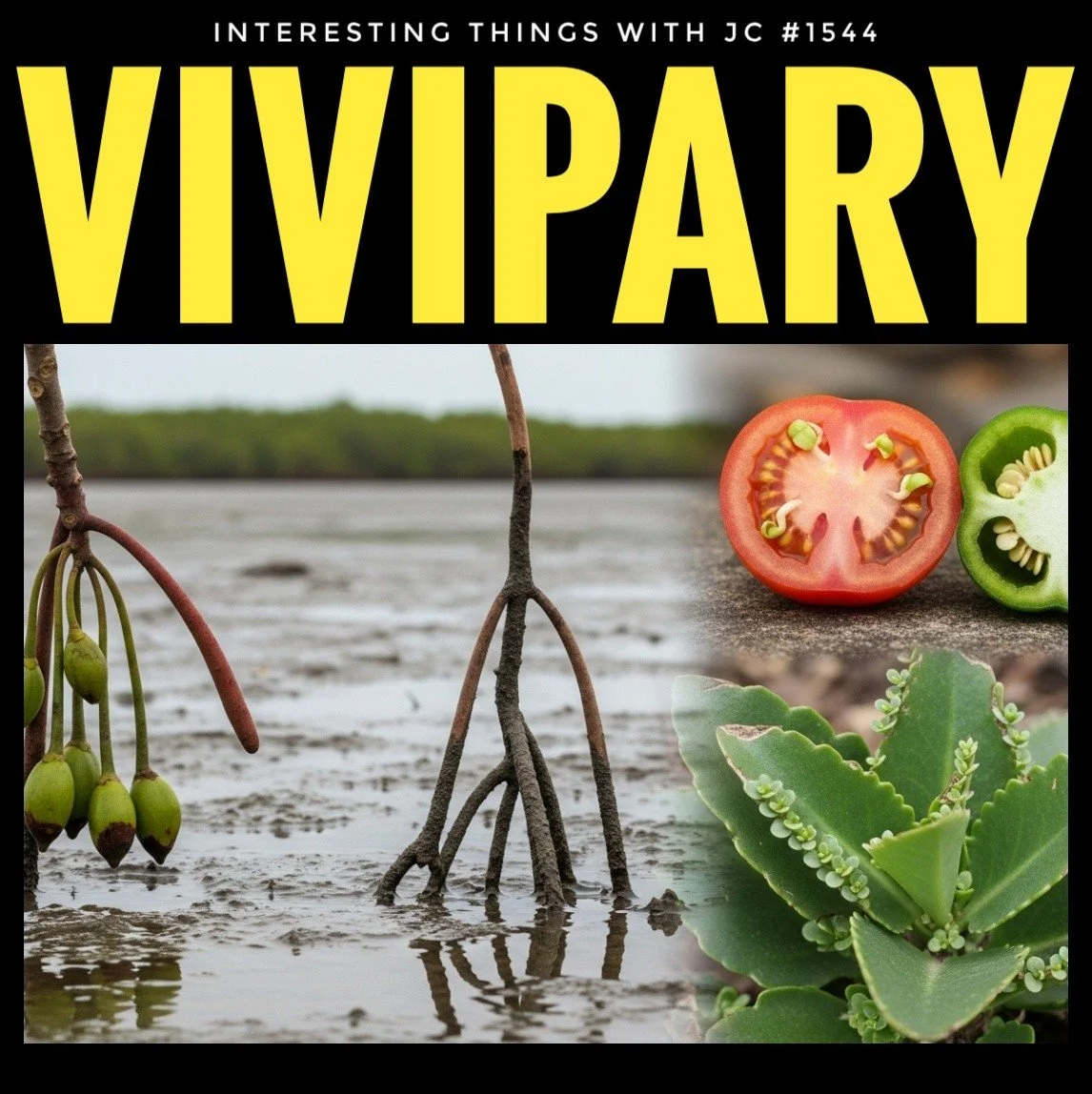
Collage showing vivipary in mangroves, tomatoes, and a succulent plant; episode title "Vivipary – Interesting Things with JC #1544" in bold yellow text.
Transcript
Interesting Things with JC #1544: “Vivipary”
If you’ve ever planted a seed, you know how it usually works. You put it in the ground. You water it. Then you wait. Sometimes for days. Sometimes for weeks. That pause is built into how most plants survive.
But not all of them.
There are places where waiting doesn’t work. Along tropical coastlines, the ground can disappear under water twice a day. The soil is thick mud with very little air. Salt seeps into everything. A seed that falls there and hesitates usually never gets started.
So some plants don’t hesitate at all.
That process is called vivipary. It means the seed begins growing while it’s still attached to the parent plant. There’s no drying out. No dormancy. Growth starts right away.
The clearest example lives at the edge of the ocean. Mangroves grow where land and sea overlap. A normal seed dropped there would rot or float away. Mangroves solved that problem by changing the order of events.
In the red mangrove, Rhizophora mangle (ry-ZOF-or-uh MAN-gull), the seed actually sprouts while it’s still hanging from the branch. Over several months, it grows into a long, narrow piece, usually about 12 to 16 inches long, roughly 30 to 40 centimeters.
When it finally drops, it doesn’t behave like a seed. It behaves like a small plant.
Some fall straight down and stick into the mud. Others float away with the tides, sometimes for miles, until they tip upright and take root. Either way, they arrive ready.
You’ve probably seen something similar at home. A tomato or pepper with seeds sprouting inside the fruit. That’s vivipary too, but in those cases it’s usually stress, not strategy.
For mangroves, it’s survival.
Vivipary trades patience for certainty. These plants don’t wait for perfect conditions. They show up prepared. In places where hesitation means failure, that makes all the difference.
These are interesting things, with JC.
Student Worksheet
What environmental conditions make vivipary a successful strategy for mangroves?
How does vivipary differ from traditional seed dormancy?
Why would a normal seed likely fail in a mangrove’s environment?
Describe how mangrove propagules travel and take root.
What is the difference between vivipary caused by stress (in tomatoes) and vivipary as a strategy (in mangroves)?
Teacher Guide
Estimated Time:
45–60 minutes
Pre-Teaching Vocabulary Strategy:
Use visual aids and real-world examples (photos of mangroves and viviparous fruits like sprouted tomatoes). Introduce key terms using a Frayer Model.
Anticipated Misconceptions:
Students may think vivipary is a rare mutation rather than an evolved trait.
Confusion between vivipary and typical seed germination timing.
Discussion Prompts:
How does vivipary reflect plant adaptation to extreme environments?
What lessons about resilience can be learned from the mangrove’s strategy?
Can you think of other examples in nature where “starting early” is an advantage?
Differentiation Strategies:
ESL: Use labeled diagrams and bilingual glossaries.
IEP: Chunk information into small segments with frequent comprehension checks.
Gifted: Encourage research into other viviparous species or related reproductive strategies in plants and animals.
Extension Activities:
Build a model of a mangrove propagule and simulate how it moves through water and roots.
Conduct a home experiment sprouting seeds under stress conditions.
Cross-Curricular Connections:
Physics: Buoyancy and fluid dynamics of propagules.
Geography: Coastal ecosystems and tidal zones.
Ethics: Human impacts on mangrove habitats and their role in coastal protection.
Quiz
What is vivipary?
A. When a plant grows faster than normal
B. When a seed germinates after falling to the ground
C. When a seed begins growing while still attached to the parent
D. When a fruit ripens without seeds
Answer: CWhich environment is most associated with mangrove vivipary?
A. Deserts
B. Rainforests
C. Tropical coastlines
D. Alpine tundra
Answer: CWhy would a typical seed fail in a mangrove environment?
A. The ground is too dry
B. There are too many predators
C. The soil lacks oxygen and is flooded
D. There is no sunlight
Answer: CWhat is the name of the mangrove species mentioned in the episode?
A. Salicornia europea
B. Rhizophora mangle
C. Ficus benjamina
D. Pinus sylvestris
Answer: BWhat causes vivipary in household fruits like tomatoes?
A. Genetic mutation
B. Stress or overripening
C. Natural habitat
D. Excess fertilizer
Answer: B
Assessment
Open-Ended Questions:
How does vivipary benefit mangrove species living in tidal zones?
In what ways might human activity threaten plant species that depend on vivipary?
3–2–1 Rubric:
3: Accurate, complete, thoughtful responses with supporting detail
2: Partial or missing key detail, needs clarification
1: Inaccurate or vague understanding, lacks clarity or examples
Standards Alignment
Next Generation Science Standards (NGSS):
HS-LS2-6 — Evaluate the impact of environmental changes on organisms.
Vivipary is studied as an adaptive response to environmental stress.HS-LS1-4 — Use a model to illustrate the role of feedback in maintaining homeostasis.
Illustrates how vivipary bypasses dormancy feedback loops.HS-LS4-4 — Construct an explanation based on evidence for how natural selection leads to adaptation.
Vivipary serves as evidence of evolutionary adaptation.
Common Core State Standards (CCSS):
CCSS.ELA-LITERACY.RST.9-10.2 — Determine the central ideas of a scientific text.
CCSS.ELA-LITERACY.RST.11-12.4 — Determine the meaning of domain-specific vocabulary.
International Equivalents:
UK AQA Biology (8461): 4.6.3 Reproduction — Describes adaptations in plant reproduction.
Cambridge IGCSE Biology (0610): 2.7 — Focus on germination and reproductive strategies.
IB Biology (SL/HL): Topic 5.2 Natural Selection — Identifies adaptive traits in changing environments.
Show Notes
In this episode of Interesting Things with JC, listeners explore the unusual but fascinating strategy of vivipary, where seeds begin growing while still attached to the parent plant. Focusing on the red mangrove (Rhizophora mangle), the episode highlights how plants can adapt to extreme environmental challenges such as coastal flooding, mud, and high salinity. By bypassing dormancy and beginning life as a small plant rather than a seed, mangroves dramatically increase their chance of survival in unstable terrain. This topic ties directly to biology and environmental science curricula and helps students understand how reproductive adaptations evolve in response to habitat pressure. Its real-world significance is underscored by the growing concern for coastal ecosystems and the critical role mangroves play in protecting shorelines.
References
Tomlinson, P. B. (2016). The Botany of Mangroves. Cambridge University Press. https://www.cambridge.org/core/books/botany-of-mangroves/36A4F5E38510D0161443DB770E81BB7F
Duke, N. C. (1992). Mangrove floristics and biogeography. In Tropical Mangrove Ecosystems. American Geophysical Union. https://agupubs.onlinelibrary.wiley.com/doi/10.1029/CE041p0063
Scholander, P. F., Hammel, H. T., Hemmingsen, E. A., & Garey, W. (1962). Salt balance in mangroves. Plant Physiology, 37(5), 722–729. https://www.scirp.org/reference/referencespapers?referenceid=1034436
Nguyen, H. T., & Yanagihara, S. (2020). Vivipary and stress-induced germination in crops. Plants, 9(9), 1213. https://www.mdpi.com/2223-7747/9/9/1213
Miles, C. A. (n.d.). Vivipary in Tomato Fruit. Washington State University Mount Vernon NWREC. Retrieved January 27, 2026, from https://mtvernon.wsu.edu/path_team/tomato-vivipary-1l/
Russell, M. (2023, August 11). Vivipary: Why Seeds Sprout Inside Fruit. Empress of Dirt. Retrieved January 27, 2026, from https://empressofdirt.net/vivipary/