1806: "Andy Green Breaks the Land Speed Record"
Interesting Things with JC #1806:
"Andy Green Breaks the Land Speed Record"
Andy Green drives ThrustSSC faster than sound, but misses the official record deadline by 49.5 seconds. Two days later, he returns to Nevada's Black Rock Desert for another attempt.
INTERESTING THINGS WITH JC · OPEN EDUCATIONAL CURRICULUM · EPISODE #1806
Curriculum - Episode Anchor
Episode Title: Andy Green Breaks the Land Speed Record
Episode Number: 1806
Original Air Date: October 15, 2026
Historical Event: October 15, 1997
Host and Creator: JC
Series: Interesting Things with JC
Audience: Grades 9–12, introductory college, homeschool, lifelong learners
Subject Areas: Physics, engineering, transportation history, mathematics, scientific measurement
Lesson Duration: 45–60 minutes
Instructional Format: Audio-first, inquiry-based learning
Central Inquiry: How did Andy Green and the ThrustSSC engineering team overcome the physical challenges of supersonic travel to establish a land speed record that remains unbeaten?
Historical Anchor: On October 15, 1997, Royal Air Force pilot Andy Green drove ThrustSSC across Nevada's Black Rock Desert, establishing an officially recognized two-way average speed of 763.035 mph (1,227.985 km/h). The jet-powered vehicle became the first to establish an officially recognized supersonic land speed record.
Lesson Overview
Essential Question: What engineering, physical, and procedural challenges must be overcome to travel faster than sound while remaining on the ground?
Lesson Description
Students investigate the engineering and historical significance of ThrustSSC, the British jet-powered vehicle that broke the sound barrier on land in 1997. Through the episode, primary-source research, mathematical analysis, and structured discussion, students examine aerodynamic stability, jet propulsion, Mach numbers, scientific measurement, and record verification.
The lesson distinguishes between achieving an extraordinary speed and establishing an officially recognized record. Students also evaluate how engineering teams respond to failure under demanding operational conditions.
Learning Objectives
By the end of this lesson, students will be able to:
Identify Andy Green, Richard Noble, ThrustSSC, and the historical circumstances surrounding the 1997 record.
Explain the relationship between Mach number, local speed of sound, and supersonic motion.
Describe the functions of jet propulsion, solid-metal wheels, aerodynamic design, and rear-wheel steering.
Calculate average speed and convert between miles per hour, kilometers per hour, and meters per second.
Explain why official land speed records require measurements in opposing directions.
Evaluate how engineering design, human judgment, and testing contributed to the achievement.
Distinguish documented historical evidence from approximations and unsupported claims.
Success Criteria
Students demonstrate mastery when they can accurately explain the record, complete the speed calculations, identify at least three engineering challenges, and support their conclusions with reliable sources.
Key Vocabulary
Land Speed Record: The highest officially recognized speed achieved by a land vehicle under applicable record rules.
ThrustSSC (Thrust SuperSonic Car): The British twin-jet vehicle driven by Andy Green to the 1997 record.
Supersonic: Motion faster than the local speed of sound.
Mach Number (mahk): The ratio of an object's speed to the speed of sound in the surrounding medium.
Mach 1: A speed equal to the local speed of sound.
Transonic: A flight or movement regime in which airflow around an object includes both subsonic and supersonic regions.
Shock Wave: A thin region of abrupt changes in pressure, temperature, and density produced in compressible flow.
Sonic Boom: An audible pressure disturbance produced by shock waves associated with supersonic motion.
Turbofan Engine: A jet engine that generates thrust by accelerating air, using a gas turbine and fan.
Thrust: A force that propels an object forward, commonly measured in pounds-force or newtons.
Aerodynamic Stability: The tendency of a moving object to maintain or recover a controlled orientation under aerodynamic forces.
Rear-Wheel Steering: A steering arrangement in which the rear wheels change direction to control the vehicle's path.
Average Speed: Total distance traveled divided by elapsed time; in the record context, the mean of two measured run speeds under the applicable rules.
FIA (Fédération Internationale de l'Automobile, fay-day-rah-SYOHN an-tair-nah-syoh-NAHL duh loh-toh-moh-BEEL): The international motorsport governing body responsible for recognizing specified world land speed records.
Primary Source: Evidence originating from the time of an event or from a direct participant, such as a contemporary technical report or official record.
Narrative Core
Open — A Record That Nearly Counted
On October 13, 1997, Andy Green achieved an officially timed supersonic run in ThrustSSC. However, the team exceeded the required turnaround period by approximately 49.5 seconds. The achievement demonstrated that the vehicle could exceed the speed of sound, but it did not establish the intended two-way supersonic record.
Info — The Vehicle and Its Designers
ThrustSSC was developed by a British engineering team led by Richard Noble, who had previously established a land speed record in 1983. Its engineering contributors included Jeremy Bliss, Ron Ayres, and Glynne Bowsher.
The vehicle measured approximately 54 ft (16.5 m) long and weighed about 10.5 long tons, or 10.7 metric tonnes. Two Rolls-Royce Spey turbofan engines supplied approximately 50,000 pounds-force (223 kN) of thrust.
Details — Engineering Beyond the Sound Barrier
ThrustSSC faced several interconnected challenges:
Propulsion: Generating enough thrust to overcome drag at extreme speeds.
Wheel integrity: Using solid metal wheels capable of surviving forces that conventional pneumatic tires could not withstand.
Aerodynamics: Managing changing pressure distributions and shock waves near Mach 1.
Directional control: Maintaining the vehicle's path using rear-wheel steering and careful driver inputs.
Deceleration: Bringing a heavy, fast-moving vehicle to a controlled stop after each run.
The team also had to perform inspections and prepare the vehicle for a return run within the required time.
Reflection — Speed Versus Verified Achievement
On October 15, Green completed measured-mile runs averaging 759.333 mph and 766.609 mph. Their mean was 763.035 mph, approximately Mach 1.02 under the prevailing conditions.
The difference between October 13 and October 15 demonstrates that a technical achievement and a formally verified record are not always the same thing.
Closing — An Engineering Benchmark
ThrustSSC established a new standard for ground transportation engineering. Its achievement required far more than engine power: it depended on stability, materials, precision measurement, human control, and a coordinated engineering team.
As of October 2026, the record remains unbeaten.
Transcript
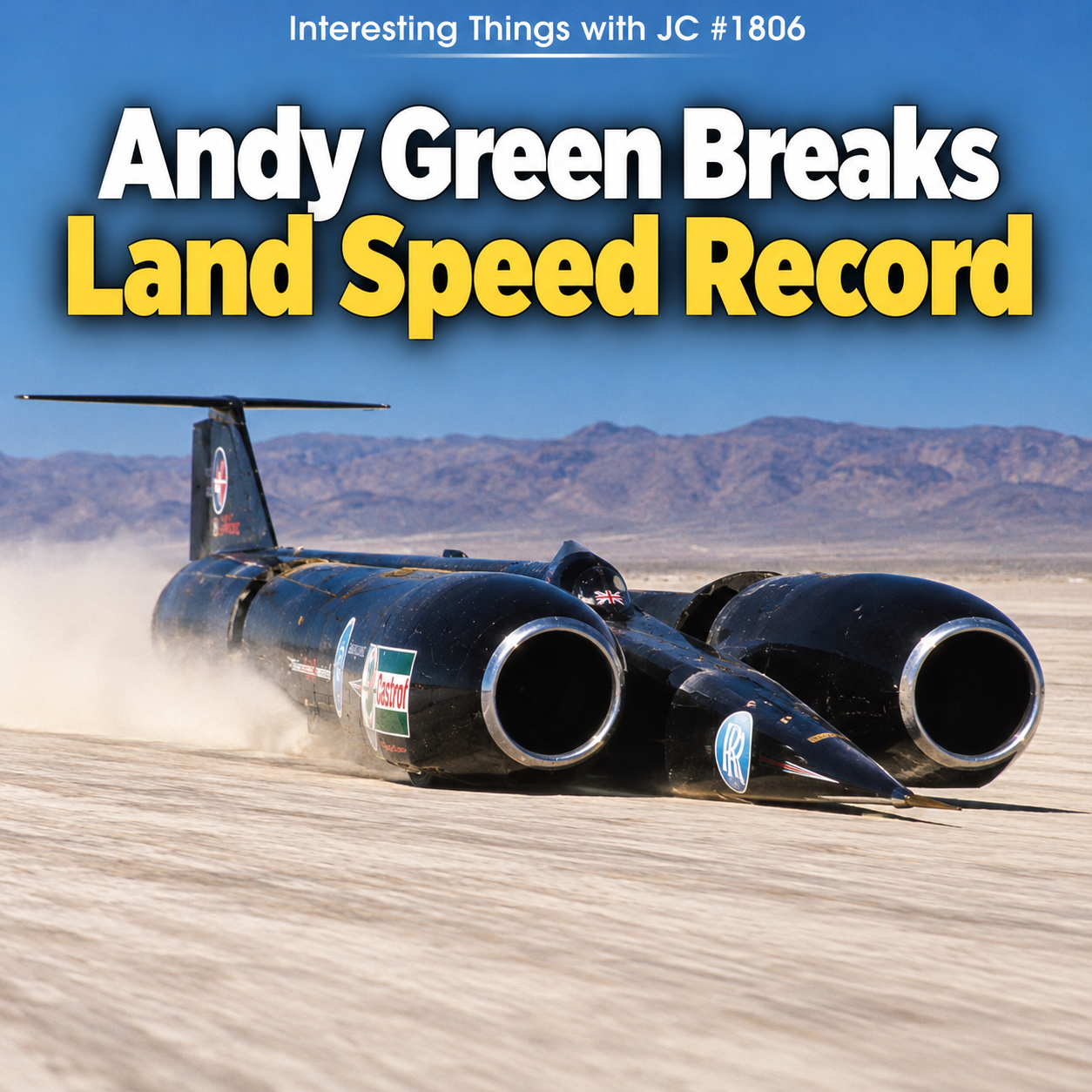
Square podcast cover art for Interesting Things with JC, episode #1806, titled “Andy Green Breaks Land Speed Record.” A photographic-style recreation depicts a black, twin-jet ThrustSSC-inspired land speed vehicle racing across Nevada’s Black Rock Desert, trailing dust against distant mountains beneath a blue sky. Small text at the top reads “Interesting Things with JC #1806.” Large white and gold lettering displays the episode title. The lower third contains no additional text. The artwork commemorates Andy Green’s historic October 15, 1997, achievement of the first officially recognized supersonic land speed record, averaging 763.035 miles per hour. The vehicle image is an artistic recreation, not an original photograph of the event.
Interesting Things with JC #1806:
"Andy Green Breaks the Land Speed Record"
On October 13, 1997, British fighter pilot Andy Green drove a jet-powered car faster than the speed of sound across Nevada's Black Rock Desert. But a braking parachute problem delayed his return run, and he missed the official one-hour deadline by just 49.5 seconds.
Two days later, on October 15th…he tried again.
Green was a Royal Air Force pilot driving ThrustSSC, a 54-foot-long machine weighing approximately 10.5 tons. It was developed under British engineer Richard Noble, who had established an earlier land speed record in 1983.
ThrustSSC carried two Rolls-Royce Spey turbofan engines producing approximately 50,000 pounds of thrust. Instead of rubber tires, it used solid aluminum-alloy wheels, with steering controlled through its rear wheels.
As ThrustSSC approached Mach 1, shock waves developed around its body, changing aerodynamic pressures. Green reported instability beginning around Mach 0.85, requiring rapid, precise steering corrections to remain on the painted guide line.
At more than 700 miles per hour, even a slight deviation could become catastrophic.
On October 15, Green's first timed run averaged 759.333 miles per hour. His crew then had one hour to inspect the vehicle, turn it around, and prepare for another supersonic crossing.
The second run reached 766.609 miles per hour, producing an official two-way average of 763.035 miles per hour, or 1,227.985 kilometers per hour.
That was approximately Mach 1.02, the first officially recognized supersonic land speed record.
The shock waves produced sonic booms across the desert, and Green accomplished the feat exactly 50 years and one day after Chuck Yeager first broke the sound barrier in an aircraft.
At that speed, ThrustSSC traveled the length of an entire American football field, including both end zones, in approximately one second.
Nearly 29 years later, Green's record remains unbeaten. The original machine is preserved at England's Coventry Transport Museum.
It was built to break the sound barrier, and on October 15, 1997, it did exactly that, without ever leaving the ground.
These are interesting things, with JC.
Transcript Accuracy Note: The official speed was a two-run average. The speed of sound depends on atmospheric conditions, so Mach 1 is not a fixed miles-per-hour value. The football-field comparison is rounded: a 120-yard (109.7 m) field takes approximately 0.97 seconds to traverse at the record speed. The transcript is reproduced as the episode's final supplied broadcast copy.
Student Worksheet
Name: ____________________ Date: ____________________ Class: ____________________
Instructions: Listen to Episode #1806, review the vocabulary, and complete the following activities. Use complete sentences for written explanations. Show calculations, units, and reasoning where required.
Part A — Listening Comprehension
Who was Andy Green, and what was his role in the ThrustSSC project?
What happened on October 13, 1997, that prevented the team from establishing the intended official record?
What was Richard Noble's connection to an earlier land speed record?
Identify two features that distinguished ThrustSSC from a conventional automobile.
What was the official speed established on October 15, 1997, in both mph and km/h?
Part B — Physics and Engineering
Explain what Mach 1 represents and why its numerical speed can vary.
Describe how shock waves and aerodynamic forces can affect a vehicle approaching supersonic speed.
Why were solid metal wheels appropriate for ThrustSSC?
Explain why maintaining directional stability was particularly important at speeds exceeding 700 mph.
Identify two different systems or procedures used to control the vehicle during or after a run.
Part C — Mathematical Applications
Use the following documented measurements:
First measured-mile run: 759.333 mph
Second measured-mile run: 766.609 mph
Official two-way average: 763.035 mph
Conversion factor: 1 mph = 0.44704 m/s
American football field, including end zones: 120 yards = 360 ft = 109.728 m
Calculate the arithmetic mean of the two recorded run speeds. Round to three decimal places.
Convert 763.035 mph into meters per second. Round to two decimal places.
At the official record speed, calculate how long ThrustSSC would take to travel 109.728 meters, assuming constant speed.
Calculate the difference between the two recorded run speeds in mph.
Calculate the distance traveled in five seconds at 763.035 mph. Express your answer in meters and feet.
Part D — Historical Evidence and Interpretation
Why was exceeding the speed of sound on October 13 not sufficient to establish the intended two-way record?
What additional information does the FIA record provide beyond a newspaper headline?
Explain how the ThrustSSC team's contemporary reports can function as primary sources.
Why should researchers distinguish the maximum speed reached during a run from the officially recognized two-way average?
Compare the roles of Andy Green and the engineering team. Why were both necessary?
Part E — Reflection
Which challenge was most critical to the record: propulsion, aerodynamic stability, materials, or driver control? Support your answer with at least two facts.
How does ThrustSSC illustrate the relationship between scientific theory, experimental testing, and engineering design?
What does the October 13 attempt reveal about the difference between technological success and formal record verification?
Difficulty Scaling
Level 1 — Foundational: Complete Parts A and B using the transcript and vocabulary.
Level 2 — Applied: Complete Parts A through D, including calculations and source evaluation.
Level 3 — Advanced: Complete all sections and develop a 250–350-word evidence-based explanation of the most important engineering limitation faced by ThrustSSC.
Student Output: Submit written answers, clearly labeled calculations, and a source-supported reflection appropriate to the assigned level.
Academic Integrity Guidance: Cite sources for historical and technical claims. Distinguish direct evidence from interpretation. Show original mathematical work and acknowledge any digital tools used.
Teacher Guide
Quick Start: Play the episode once without interruption. Ask students to identify the engineering problem, the failed record attempt, and the final achievement. Replay selected portions before beginning mathematical and source-analysis activities.
Pacing Guide — Audio First
0–5 minutes — Opening Inquiry: Ask students whether a vehicle can exceed the speed of sound without flying. Collect initial explanations.
5–10 minutes — Episode Listening: Play Episode #1806 and have students record three facts and one question.
10–18 minutes — Historical Discussion: Establish the October 13 and October 15 chronology. Distinguish a supersonic run from an official two-way record.
18–30 minutes — Engineering Analysis: Discuss thrust, aerodynamic stability, metal wheels, and steering.
30–42 minutes — Mathematics: Students complete calculations 11–15 individually or in pairs.
42–50 minutes — Source Evaluation: Compare contemporary team reports with the FIA's official record.
50–60 minutes — Reflection and Assessment: Complete a selected written response, exit ticket, or quiz.
Materials
Episode #1806 audio and transcript
Student worksheet
Calculator
Internet access or printed copies of the identified primary sources
Paper or digital response document
Optional: Photographs of the authentic ThrustSSC vehicle
Teacher Background
ThrustSSC's engines produced forward thrust by accelerating air and exhaust gases. At high speeds, aerodynamic drag and stability became critical engineering constraints.
The speed of sound varies with atmospheric temperature and the properties of the medium. A vehicle's Mach number must therefore be calculated using the local speed of sound rather than a universal mph threshold.
Official land speed records require controlled measurement and compliance with procedural rules. In 1997, ThrustSSC had to complete qualifying runs in opposite directions within the prescribed time limit.
Mathematical Answer Key
Question — Mean Speed
Calculation: (759.333 + 766.609) ÷ 2 = 762.971 mph
Answer: 762.971 mph.
Important Instructional Distinction: The arithmetic mean of the two displayed run speeds is 762.971 mph, whereas the FIA's official published record is 763.035 mph. Students should not be marked incorrect for obtaining 762.971 mph. The difference requires examining the underlying timing and measurement data rather than assuming the published figures reproduce the official result. The FIA's certified record remains authoritative.
Question — Metric Conversion
Calculation: 763.035 mph × 0.44704 = 341.11 m/s
Answer: Approximately 341.11 meters per second.
Question — Football Field Traversal
Calculation: 109.728 meters ÷ 341.11 meters per second = 0.322 seconds
Answer: Approximately 0.32 seconds, or about one-third of a second.
Important Correction: An American football field, including both end zones, measures 120 yards (360 feet or 109.728 meters). At 763.035 mph, ThrustSSC would cover that distance in approximately one-third of a second, not one second. This corrects the comparison in the episode transcript.
Question — Difference Between Runs
Calculation: 766.609 mph − 759.333 mph = 7.276 mph
Answer: 7.276 mph.
Question — Distance in Five Seconds
Step 1 — Convert Speed: 763.035 mph × 0.44704 = 341.11 m/s
Step 2 — Calculate Distance: 341.11 m/s × 5 seconds = 1,705.55 meters
Step 3 — Convert to Feet: 1,705.55 meters × 3.28084 = 5,595.64 feet
Answer: Approximately 1,706 meters (5,596 feet), or 1.06 miles, traveled in five seconds.
Comprehension Answer Key
Green was a Royal Air Force pilot who drove ThrustSSC.
The team exceeded the required turnaround time by approximately 49.5 seconds.
Noble drove Thrust2 to a land speed record in 1983.
Accept twin turbofan engines, solid-metal wheels, or rear-wheel steering.
763.035 mph or 1,227.985 km/h.
Mach 1 is the local speed of sound, which changes with atmospheric conditions.
Shock waves alter pressure distributions and can affect stability.
Solid wheels avoided limitations associated with pneumatic tires at extreme rotational speeds.
Small directional changes can produce serious consequences at very high speeds.
Accept rear-wheel steering, braking systems, parachutes, or operational control procedures.
Analysis and Reflection Guidance
Questions 16–19: Look for clear distinctions between physical achievement, measurement, documentation, and official recognition.
Question 20: Students should identify Green's driving and control responsibilities alongside the engineering team's design, testing, maintenance, and operational responsibilities.
Questions 21–23: Accept different conclusions when supported by accurate scientific reasoning and documented evidence.
Common Misconceptions
Misconception: Mach 1 always equals 767 mph. Correction: The speed of sound depends on local atmospheric conditions.
Misconception: The record was established by one exceptionally fast run. Correction: The official record depended on qualifying runs in opposing directions.
Misconception: Greater engine power automatically guarantees greater speed. Correction: Drag, stability, materials, and operational constraints can limit performance.
Misconception: ThrustSSC was a conventional automobile with powerful engines. Correction: It was a specialized jet-powered record vehicle.
Misconception: A sonic boom occurs only once when an object crosses Mach 1. Correction: A supersonic object continuously generates shock waves while moving faster than sound.
Differentiation
Additional Support: Provide a labeled vehicle photograph, simplified vocabulary, and partially completed calculations.
Advanced Learners: Introduce compressible-flow concepts, aerodynamic loading, and uncertainty in measurement.
English Learners: Preteach scientific vocabulary and allow labeled diagrams before extended written responses.
Students Requiring Accessibility Support: Supply the transcript, screen-reader-compatible text, and additional time for calculations.
Homeschool Adaptation: Combine the episode with a source comparison and a short engineering design challenge.
Formative Checkpoints
Can students explain why October 13 did not produce the official record?
Can students distinguish thrust from speed?
Can students correctly describe Mach 1?
Can students explain why opposing-direction runs are required?
Can students identify a primary source supporting the achievement?
Extension Activities
Investigate the evolution of land speed records from 1935 through 1997.
Compare ThrustSSC with Chuck Yeager's Bell X-1.
Research why engineers used rear-wheel steering.
Examine the limitations of rubber tires at extreme speeds.
Develop a conceptual design for a stable high-speed ground vehicle, identifying at least three engineering constraints.
Quiz
Instructions: Answer all questions. Select the best answer for multiple-choice items and use complete sentences for short responses.
Multiple Choice
1. On what date did Andy Green establish the official supersonic land speed record?
A. October 13, 1997
B. October 14, 1997
C. October 15, 1997
D. October 15, 1983
2. What powered ThrustSSC?
A. Electric motors
B. Two turbofan engines
C. A single piston engine
D. A rocket motor
3. What does Mach 1 represent?
A. The speed of light
B. 1,000 mph under all conditions
C. The local speed of sound
D. The maximum speed of an aircraft
4. Why did the October 13 attempt fail to establish the intended official record?
A. The vehicle did not exceed 500 mph
B. The driver was disqualified
C. The turnaround exceeded the time limit
D. The vehicle had no official timing equipment
5. What was ThrustSSC's official two-way average?
A. 633.468 mph
B. 714.144 mph
C. 759.333 mph
D. 763.035 mph
6. Which organization recognizes the outright world land speed record?
A. NASA
B. FIA
C. UNESCO
D. FAA
7. What type of wheels did ThrustSSC use?
A. Conventional rubber tires
B. Solid aluminum-alloy wheels
C. Wooden wheels
D. Pneumatic aircraft tires
8. Which engineering concern becomes especially significant near Mach 1?
A. Shock-wave-related aerodynamic changes
B. Loss of gravitational force
C. Elimination of air resistance
D. Disappearance of friction
Short Answer
9. Explain why the two-run procedure provides a stronger basis for an official speed record than a single run.
10. Identify two engineering features that helped ThrustSSC operate at extreme speed and explain their purposes.
Quiz Answer Key
C
B
C
C
D
B
B
A
Two opposing runs help reduce the influence of wind and directional conditions while demonstrating repeatable performance under the applicable rules.
Accept two accurate features with appropriate explanations, such as solid-metal wheels, rear-wheel steering, twin turbofan engines, or aerodynamic design.
Scoring: 10 points total, one point per question. For Question 10, award 0.5 points for each correctly explained feature.
Assessment
Assessment Type: Written analysis, applied mathematics, and historical source evaluation Total Available: 20 points
Criterion 1 — Historical Accuracy: 4 Points
4: Accurately explains the chronology, people, vehicle, and record.
3: Mostly accurate with minor omissions.
2: Partial understanding or multiple factual errors.
1: Minimal understanding.
0: No relevant evidence.
Criterion 2 — Scientific Understanding: 4 Points
4: Correctly explains Mach number, thrust, shock waves, and stability.
3: Explains most concepts accurately.
2: Demonstrates partial understanding.
1: Major conceptual errors.
0: No relevant explanation.
Criterion 3 — Mathematical Reasoning: 4 Points
4: Correct calculations, units, and clearly shown reasoning.
3: Minor computational or unit errors.
2: Partial calculations with some correct methods.
1: Limited mathematical accuracy.
0: No meaningful calculations.
Criterion 4 — Evidence and Source Evaluation: 4 Points
4: Uses reliable sources and distinguishes official records from other claims.
3: Uses appropriate evidence with minor weaknesses.
2: Limited source support or incomplete evaluation.
1: Unsupported claims dominate.
0: No evidence provided.
Criterion 5 — Communication and Analysis: 4 Points
4: Clear, organized, accurate, and supported reasoning.
3: Generally clear with minor weaknesses.
2: Partially developed or inconsistently organized.
1: Minimal explanation.
0: No meaningful response.
Performance Levels
18–20 points: Advanced mastery
15–17 points: Proficient
11–14 points: Developing
0–10 points: Additional support required
Summative Assessment Prompt
Explain how Andy Green and the ThrustSSC engineering team established the first officially recognized supersonic land speed record. Your response must include the October 13 and October 15 events, at least three engineering challenges, one accurate mathematical calculation, and evidence from at least two reliable sources.
Expected Length: 300–500 words for Grades 9–12; 500–750 words for introductory college.
Standards Alignment
NGSS — Science and Engineering Practices
Developing and Using Models: Students explain how aerodynamic forces, thrust, and steering interact in a high-speed vehicle.
Using Mathematics and Computational Thinking: Students calculate speed, distance, and elapsed time using authentic measurements.
Analyzing and Interpreting Data: Students compare documented speeds and identify differences between reported measurements and official results.
Constructing Explanations and Designing Solutions: Students explain how engineering choices addressed operational constraints.
Engaging in Argument from Evidence: Students support claims about the most significant engineering challenge using reliable sources.
NGSS — High School Performance Expectations
HS-PS2-1 — Motion and Stability: Forces and Interactions: Students apply quantitative relationships involving motion and force. The episode supports introductory analysis, although full alignment requires additional instruction on Newton's second law.
HS-ETS1-1 — Engineering Design: Students analyze criteria and constraints in a complex engineering challenge.
HS-ETS1-3 — Engineering Design: Students evaluate competing solutions using prioritized criteria and tradeoffs.
Common Core State Standards — Reading
CCSS.ELA-LITERACY.RST.9-10.1: Cite specific textual evidence to support scientific and technical analysis.
CCSS.ELA-LITERACY.RST.9-10.3: Follow multistep technical procedures and analyze results.
CCSS.ELA-LITERACY.RST.11-12.7: Integrate and evaluate information presented in diverse formats.
CCSS.ELA-LITERACY.RH.11-12.1: Cite specific textual evidence to support analysis of primary and secondary historical sources.
Common Core State Standards — Writing
CCSS.ELA-LITERACY.WHST.9-10.2: Write informative or explanatory texts about technical subjects.
CCSS.ELA-LITERACY.WHST.11-12.7: Conduct research projects to answer focused questions.
CCSS.ELA-LITERACY.WHST.11-12.9: Draw evidence from informational texts to support analysis and research.
Common Core State Standards — Mathematics
CCSS.MATH.CONTENT.HSN.Q.A.1: Use units to understand problems and guide solutions.
CCSS.MATH.CONTENT.HSN.Q.A.2: Define appropriate quantities for descriptive modeling.
CCSS.MATH.CONTENT.HSN.Q.A.3: Choose an appropriate level of accuracy when reporting measurements.
C3 Framework — Social Studies
D2.His.1.9-12: Evaluate how historical events are shaped by circumstances and context.
D2.His.9.9-12: Analyze relationships among historical events and developments.
D3.1.9-12: Gather relevant information from multiple sources while evaluating credibility and usefulness.
D4.1.9-12: Construct arguments using claims and evidence.
ISTE Standards for Students
1.3 Knowledge Constructor: Students evaluate the credibility and accuracy of digital sources.
1.5 Computational Thinker: Students use data and mathematical reasoning to investigate a real-world technical problem.
1.6 Creative Communicator: Students present accurate scientific explanations using appropriate digital or written formats.
Career and Technical Education Connections
Engineering and Technology: Design constraints, systems integration, performance testing, and risk management.
Transportation Systems: Vehicle dynamics, propulsion, control systems, and braking.
Applied Mathematics: Unit conversion, speed calculations, precision, and measurement.
Technical Communication: Documenting engineering evidence and explaining complex systems.
Bloom's Taxonomy
Remember: Identify historical facts and technical vocabulary.
Understand: Explain supersonic motion and record procedures.
Apply: Calculate speed, time, and distance.
Analyze: Compare the failed and successful attempts.
Evaluate: Assess engineering decisions and historical evidence.
Create: Propose a conceptual high-speed vehicle design or evidence-based technical explanation.
Universal Design for Learning — UDL
Multiple Means of Engagement: Historical inquiry, engineering problems, and student-selected reflection topics.
Multiple Means of Representation: Audio, transcript, numerical measurements, vocabulary, and authentic photographs.
Multiple Means of Action and Expression: Written analysis, calculations, oral explanations, or accessible digital submissions.
International Curriculum Connections
UK National Curriculum — Physics: Forces, motion, speed, and engineering applications.
International Baccalaureate — Physics: Motion, forces, energy, measurement, and uncertainty.
Cambridge International — Physics: Speed calculations, forces, experimental evidence, and quantitative reasoning.
Alignment Note: These are instructional connections, not claims that listening to the episode alone satisfies every listed standard. Full alignment depends on the assigned activities, assessments, and demonstrated student performance.
Show Notes
Episode: Interesting Things with JC #1806 Title: Andy Green Breaks the Land Speed Record Air Date: October 15, 2026
Episode Summary
On October 15, 1997, Royal Air Force pilot Andy Green drove ThrustSSC to an officially recognized two-way average of 763.035 mph (1,227.985 km/h), establishing the first supersonic land speed record. The achievement followed an October 13 attempt that exceeded the required turnaround period by approximately 49.5 seconds.
The episode examines the vehicle's twin jet engines, solid-metal wheels, rear-wheel steering, aerodynamic challenges, and the extraordinary demands of controlling a ground vehicle near Mach 1.
Historical and Technical Facts
Driver: Andy Green
Project Leader: Richard Noble
Vehicle: ThrustSSC
Location: Black Rock Desert, Nevada, United States
Record Date: October 15, 1997
Official Record: 763.035 mph (1,227.985 km/h)
Approximate Mach Number: 1.02
Vehicle Length: 54 ft (16.5 m)
Propulsion: Two Rolls-Royce Spey turbofan engines
Approximate Combined Thrust: 50,000 lbf (223 kN)
Record Status: Unbroken as of October 2026
Educational Applications
Physics, engineering design, transportation history, mathematics, scientific measurement, source evaluation, and technology development.
Listen, Watch, and Learn
RSS, MP3, and Free Open Curriculum: https://JimConnors.net
Classroom Use and Attribution
This curriculum accompanies Interesting Things with JC, independently researched, written, produced, and distributed by JC.
Free educational use is permitted with attribution. Commercial resale or unauthorized redistribution is not permitted.
Suggested Attribution: Interesting Things with JC, Episode #1806, "Andy Green Breaks the Land Speed Record."
References
Fédération Internationale de l'Automobile. (n.d.). FIA world land speed records. https://api.fia.com/fia-world-land-speed-records
Guinness World Records. (n.d.). First supersonic car. https://www.guinnessworldrecords.com/world-records/737760-first-supersonic-car
ThrustSSC Team. (1997, October 15). Thrustbrief 45: Battle for Mach 1 on land. https://www.thrustssc.com/thrustssc/Press_Pack/Black_Rock-Thrustbrief_45.html
ThrustSSC Team. (1997, October 15). Black Rock Desert, Nevada, USA: Project status. https://www.thrustssc.com/Latest_News/Status-19971015.html
ThrustSSC Team. (n.d.). Chapter 9: Going for the sound barrier. https://thrustssc.com/Story_To_Date/Chapter_9.html
ThrustSSC Team. (n.d.). The ThrustSSC runs database. https://thrustssc.com/Runs_Database/Runs_Database.html
Coventry Transport Museum. (n.d.). ThrustSSC. https://www.transport-museum.com/visiting/thrustssc.aspx
Primary Source Priorities
FIA: Official record recognition, speed, and historical comparisons.
ThrustSSC Team: Contemporary run reports, chronology, vehicle development, and operational challenges.
Coventry Transport Museum: Vehicle specifications, design history, and preservation.
Guinness World Records: Independent summary of the supersonic achievement.
Research and Verification Note: Students should distinguish officially certified measurements from reported individual run speeds, engineering estimates, and rounded educational comparisons. Where published figures differ, students should identify the source, measurement definition, and calculation method before drawing conclusions.