1807: "Creedence Clearwater Revival"
Interesting Things with JC #1807:
"Creedence Clearwater Revival"
On October 16, 1972, Creedence Clearwater Revival announced its breakup after releasing 7 studio albums in just 4 years. The California band had scored 9 Billboard Top 10 hits without a number one, while growing disagreements over songwriting and creative control divided its members.
Curriculum - Episode Anchor
Episode Title: Creedence Clearwater Revival
Episode Number: 1807
Host: JC
Release Date: October 16, 2026
Audience: Grades 9–12, introductory college, homeschool, lifelong learners
Subject Area: American History, Music History, English Language Arts, Media Literacy, Intellectual Property, Business and Economics
Instructional Duration: 45–50 minutes
Audio Duration: Approximately 3 minutes
Instructional Approach: Audio-first, evidence-based historical inquiry
Central Topic: The rise, commercial success, internal disagreements, and breakup of Creedence Clearwater Revival (CCR).
Lesson Overview
Essential Question: How can a musical group achieve extraordinary commercial success while experiencing internal conflicts that ultimately end its collaboration?
Learning Objectives
Students will be able to:
Identify the origins, members, musical influences, and major accomplishments of Creedence Clearwater Revival.
Explain how songwriting, creative control, and collaboration influenced the band's development and breakup.
Interpret Billboard chart performance and distinguish commercial success from reaching number one.
Examine the relationship between musical compositions, publishing rights, and long-term intellectual property ownership.
Success Criteria
Students demonstrate mastery when they can accurately construct a timeline of at least five events, explain two causes of the band's breakup, interpret its chart statistics, and distinguish songwriting ownership from ownership of a sound recording.
Student Relevance: Popular music provides a practical example of how teamwork, individual talent, leadership, and financial agreements interact in creative industries.
Real-World Connection: Musicians, podcasters, filmmakers, and digital creators routinely negotiate ownership, attribution, royalties, and creative authority.
Workforce Reality: Music producers, recording engineers, artists, publishers, and entertainment attorneys work within agreements that determine who creates, distributes, controls, and receives compensation for creative work.
Prior Knowledge: No music-reading ability or familiarity with CCR is required.
Key Vocabulary
Creedence Clearwater Revival (KREE-dens KLEER-waw-ter ree-VY-vul): American rock band known for combining blues, country, and rock influences.
Swamp Rock (swomp rok): Rock music influenced by Southern blues, roots music, country, and regional imagery.
Billboard Hot 100 (BIL-bord hot wun HUN-dred): U.S. chart ranking popular songs using changing combinations of sales, radio activity, and, in later decades, streaming.
Songwriting (SAWNG-ry-ting): Creating the musical and lyrical elements of a composition.
Creative Control (kree-AY-tiv kun-TROHL): Authority over artistic decisions such as arrangements, repertoire, recording, and production.
Publishing Rights (PUB-li-shing ryts): Rights and economic interests associated with the underlying musical composition.
Master Recording (MAS-ter ree-KOR-ding): The original recorded performance from which distributed recordings are derived.
Royalties (ROY-ul-teez): Payments generated by specified uses of protected creative works.
Woodstock (WOOD-stok): Major 1969 music festival held in Bethel, New York, associated with late-1960s popular culture.
Collaboration (kuh-lab-uh-RAY-shun): Working together toward a shared outcome while coordinating responsibilities and decisions.
Narrative Core
Open
Four musicians from California developed a sound strongly associated with the American South. Their recordings became major hits, yet the band never reached number one on the Billboard Hot 100.
Info
The group began in 1959 and adopted the name Creedence Clearwater Revival in 1967. John Fogerty became its principal songwriter and lead vocalist. The band developed a recognizable sound built around blues, country, and rock and roll.
Details
Between 1968 and 1970, CCR released six studio albums. Nine singles reached the Billboard Top 10, with five peaking at number two.
The band also performed at Woodstock in 1969, although its appearance was omitted from the original concert film and soundtrack.
Internal disagreements intensified over creative control and songwriting. Tom Fogerty quit in 1971, and the remaining trio released Mardi Gras in 1972.
Reflection
The band's commercial achievements did not resolve disagreements about decision-making, recognition, and ownership. Its history demonstrates that successful creative output and stable professional relationships are separate accomplishments.
Closing
The band announced its breakup on October 16, 1972. John Fogerty later recovered a majority interest in the publishing rights to his CCR compositions in 2023.
These are interesting things, with JC.
Transcript
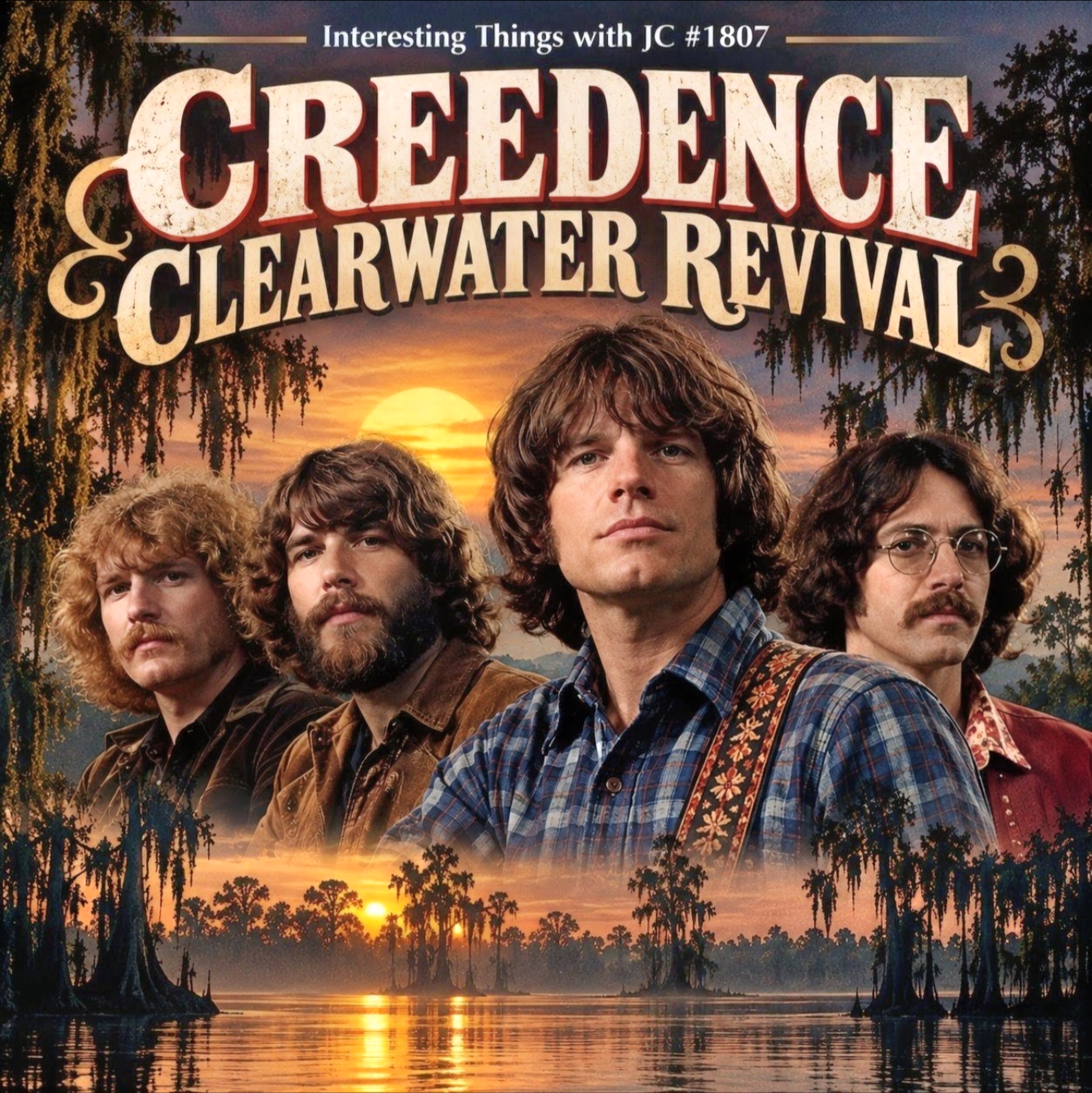
Square podcast cover art for Interesting Things with JC, episode #1807, titled “Creedence Clearwater Revival.” The vintage-style illustration depicts four members of the American rock band, with John Fogerty prominently centered, against a Louisiana-inspired swamp landscape at sunset. Warm orange and gold skies illuminate cypress trees, hanging Spanish moss, and reflections across still water. Small white lettering at the top reads “Interesting Things with JC #1807,” while the band's name appears in large, distressed gold lettering across the upper portion. The artwork reflects CCR's distinctive swamp-rock sound and Southern musical influences, despite the band's California origins. The lower third contains no text.
Interesting Things with JC #1807:
"Creedence Clearwater Revival"
Creedence Clearwater Revival sounded like four musicians from the Louisiana bayou. In reality, they were California kids who became rock stars without ever reaching number one on the Billboard Hot 100.
Their story began in 1959, when John Fogerty, Stu Cook, and Doug Clifford played together in California. John's older brother Tom later joined.
After recording as the Blue Velvets and the Golliwogs, they became Creedence Clearwater Revival (CCR) in 1967. Creedence came from a friend named Credence Newball. Clearwater recalled an Olympia beer advertisement, and Revival meant a fresh start.
John Fogerty developed their swamp-rock sound, blending Southern blues, country, and rock and roll. Despite the Louisiana imagery, none of them came from the South.
Between 1968 and 1970, “CCR” released 6 studio albums, including 3 in 1969 alone. Hits included "Proud Mary," "Bad Moon Rising," and "Fortunate Son."
They scored 9 Billboard Top 10 singles, with 5 reaching number two, but never number one.
At Woodstock in August 1969, they played after the Grateful Dead's lengthy performance, after midnight. “CCR” was absent from the original concert film and soundtrack. Their full set was released in 2019.
Behind that success, tensions grew. John wrote most of the songs, sang lead, and controlled the recordings. His bandmates wanted more influence.
Tom Fogerty quit the band in 1971. The remaining trio divided songwriting and lead vocals on their final album, Mardi Gras, but critics were unimpressed. They later disputed whose idea it was.
On October 16, 1972, Creedence Clearwater Revival announced its breakup.
Their 7 studio albums had taken just 4 years to release, but disputes over contracts and ownership continued for decades.
In 2023, John Fogerty regained majority ownership of the publishing rights to his Creedence songs, more than 50 years after the breakup.
The original four never performed together again. Their music outlasted the disagreements that ended the band.
These are interesting things, with JC.
Student Worksheet
Student Name: ____________________ Date: ____________________ Class: ____________________
Part A — Listening Comprehension
Answer in complete sentences.
In which state did the original musicians begin playing together?
What year did the group adopt the name Creedence Clearwater Revival?
Identify three musical styles that influenced the band's sound.
How many studio albums did CCR release between 1968 and 1970?
What was unusual about the band's Billboard Hot 100 record?
Why did CCR's Woodstock appearance become a lesser-known part of the festival's history?
Part B — Chronological Reasoning
Place the following events in chronological order, then add the correct year to each.
John Fogerty recovers a majority publishing interest.
Creedence Clearwater Revival announces its breakup.
The musicians begin playing together.
CCR performs at Woodstock.
Tom Fogerty quits the band.
The group adopts the name Creedence Clearwater Revival.
Student Output: Six correctly sequenced events, with a year assigned to each.
Part C — Data Interpretation
Use the following documented statistics:
Total Studio Albums: 7 Albums Released Between 1968 and 1970: 6 Billboard Hot 100 Top 10 Singles: 9 Singles Peaking at Number 2: 5 Singles Reaching Number 1: 0
What percentage of CCR's studio albums were released between 1968 and 1970? Round to one decimal place.
What percentage of its Top 10 singles peaked at number two?
Why would it be inaccurate to describe CCR as commercially unsuccessful simply because the group never reached number one?
What additional information would you need to evaluate the band's total commercial success?
Part D — Historical Analysis
Explain how John Fogerty's central songwriting role may have contributed both to the band's success and to internal disagreements.
Compare artistic leadership with collaborative decision-making. Identify one potential advantage and one disadvantage of each.
Explain why the ownership of a musical composition may be economically different from ownership of its recorded performance.
Part E — Reflection
Write 100–150 words responding to this question:
Can a creative team be commercially successful while experiencing serious internal problems? Use at least two facts from the episode to support your answer.
Difficulty Scaling
Level 1 — Foundational: Identify key people, dates, and accomplishments.
Level 2 — Intermediate: Interpret statistics and explain historical cause-and-effect relationships.
Level 3 — Advanced: Evaluate creative control, intellectual property, and competing perspectives using additional evidence.
Student Output: Completed comprehension responses, chronological sequence, numerical calculations, analytical answers, and written reflection.
Academic Integrity Guidance: Use your own wording, distinguish historical facts from interpretation, and identify any additional sources consulted. Do not present unverified claims about personal motives as established facts.
Teacher Guide
Quick Start: Play episode #1807 without interruption. Ask students to identify the band's most surprising achievement and one internal problem. Replay selected passages before the historical analysis activity.
Pacing Guide — Audio First
0–5 minutes — Bell Ringer: Students respond to the question, "Does a song need to reach number one to be considered successful?"
5–9 minutes — First Listening: Play the episode. Students record three facts and one question.
9–14 minutes — Vocabulary and Clarification: Review swamp rock, Billboard Hot 100, publishing rights, and creative control.
14–24 minutes — Worksheet: Students complete Parts A, B, and C.
24–34 minutes — Historical Analysis: Small groups examine the relationship between Fogerty's leadership and the band's disagreements.
34–43 minutes — Assessment: Students complete the quiz and one analytical response.
43–50 minutes — Reflection and Exit Ticket: Discuss how creative ownership can affect long-term professional relationships.
Audio Guidance and Fallback
Play the recording once for overall understanding and a second time for evidence collection.
If audio equipment is unavailable, distribute the full transcript and conduct a guided reading.
Do not require students to recognize songs by ear to demonstrate historical understanding.
Time-on-Task: 45–50 minutes, with an optional 20-minute research extension.
Materials
Episode #1807 audio or transcript
Student worksheet
Writing materials or digital document
Calculator for percentages
Optional access to music-history archives and copyright educational resources
Vocabulary Preparation
Introduce the difference between a musical composition and a sound recording before discussing Fogerty's publishing rights. Explain that a songwriter and recording artist can be the same person while the legal rights associated with each work remain distinct.
Common Misconceptions
CCR came from Louisiana: The musicians developed their sound in California.
CCR never had major hits: Nine singles reached the Billboard Top 10.
A number-two single is a commercial failure: Chart position is only one measure of success.
John Fogerty owned every CCR recording after 2023: His 2023 transaction concerned a majority interest in the publishing rights to his compositions, not blanket ownership of the master recordings.
Tom Fogerty died when he left the group: He quit in 1971 and died in 1990.
One musician's account establishes every cause of the breakup: Members have offered differing accounts of their disagreements.
Discussion Prompts
Why might a band benefit from having one principal songwriter?
When can concentrated creative authority become a source of conflict?
What does CCR's chart record reveal about measuring musical success?
How might a recording contract influence an artist's career decades after a group dissolves?
Why should historians compare different participants' recollections?
Formative Checkpoints
Students identify at least four historically accurate events.
Students distinguish chart performance from overall commercial success.
Students calculate percentages correctly and explain their meaning.
Students distinguish documented events from interpretations of musicians' motives.
Differentiation
Additional Support: Provide a partially completed timeline and vocabulary definitions.
Advanced Learners: Compare firsthand interviews from different CCR members and identify agreements and contradictions.
English Learners: Preteach musical and legal terminology, allow paired discussion, and provide sentence starters.
Accessibility: Supply a readable transcript, permit written or oral responses, and allow additional processing time.
Assessment Differentiation
Foundational: Four factual responses and one paragraph.
Standard: Complete worksheet, quiz, and written analysis.
Advanced: Add a 250-word comparison of primary and secondary historical sources.
Time Flexibility
25-Minute Version: Audio, comprehension questions, one data calculation, and exit ticket.
50-Minute Version: Complete standard lesson.
75-Minute Version: Add source comparison and copyright analysis.
Substitute Readiness: The transcript, worksheet, quiz, answer key, and assessment instructions are self-contained. No musical performance or specialized equipment is required.
Engagement Strategy: Present the band's five number-two singles before revealing that it never reached number one. Ask students what the statistic does and does not establish.
Extensions
Research how music charts were compiled in 1969 and compare those methods with current charts.
Investigate how radio airplay influenced the popularity of rock music.
Compare CCR's recording schedule with that of another major rock group.
Examine the legal distinction between songwriting, music publishing, and sound recording ownership.
Cross-Curricular Connections
History: Popular music and American society during the late 1960s.
Mathematics: Percentages, rankings, and statistical interpretation.
Economics: Intellectual property and revenue distribution.
English Language Arts: Historical argumentation and source evaluation.
Music: Blues, country, and rock influences.
Social-Emotional Learning
Discuss communication, collaboration, leadership, and conflict resolution without assigning psychological diagnoses or unsupported motives to historical figures.
Skill Emphasis: Chronological reasoning, quantitative literacy, evidence evaluation, cause-and-effect analysis, and intellectual property literacy.
Answer Key — Student Worksheet
Part A
California.
Southern blues, country, and rock and roll.
Six studio albums.
Nine Top 10 singles, including five number-two hits, but no number-one Hot 100 single.
The performance was omitted from the original concert film and soundtrack.
Part B
1959 — The musicians begin playing together.
1967 — The group adopts its final name.
1969 — CCR performs at Woodstock.
1971 — Tom Fogerty quits.
1972 — CCR announces its breakup.
2023 — John Fogerty recovers a majority publishing interest.
Part C
6 ÷ 7 × 100 = 85.7%.
5 ÷ 9 × 100 = 55.6%.
The group achieved repeated high chart placements and substantial commercial recognition despite never reaching number one.
Album sales, certifications, concert attendance, radio airplay, international chart performance, and long-term listening figures.
Part D — Expected Responses
Fogerty's songwriting and recording leadership helped establish a recognizable sound, while unequal creative influence contributed to tensions.
Centralized leadership can improve consistency and speed but reduce participation. Shared decision-making can increase representation but may create disagreements or slow production.
Composition rights concern the underlying song, while sound recording rights concern a particular recorded performance. Different parties can own or administer each.
Part E — Evaluation Guidance
Strong responses distinguish commercial results from internal relationships and support the argument with two or more accurate facts.
Quiz
Instructions: Select the best answer for each question. Each question is worth 2 points.
1. Where did the musicians who formed CCR begin playing together?
A. Louisiana
B. California
C. Tennessee
D. Mississippi
2. What was unusual about CCR's Billboard Hot 100 performance?
A. None of its songs reached the Top 10.
B. All of its albums reached number one.
C. Nine singles reached the Top 10, but none reached number one.
D. The band released only one commercially successful single.
3. Which event occurred in 1969?
A. John Fogerty recovered publishing rights.
B. CCR announced its breakup.
C. Tom Fogerty quit the band.
D. CCR performed at Woodstock.
4. What contributed to disagreements within the band?
A. Disputes over songwriting and creative control
B. A decision to stop recording rock music in 1968
C. The inability to secure a recording contract
D. A disagreement over moving the band to Louisiana
5. What did John Fogerty regain in 2023?
A. Ownership of the Woodstock festival
B. A majority interest in the publishing rights to his CCR songs
C. Ownership of every CCR master recording
D. The original band's recording equipment
Assessment
Part A — Written Analysis
Answer both questions using complete sentences and specific historical evidence.
Explain how Creedence Clearwater Revival could produce a remarkable series of hit records while experiencing disagreements that contributed to its breakup. Include at least three historical facts.
Explain the difference between publishing rights and master recording rights. Why might that distinction matter to a songwriter decades after a recording is released?
Part B — Assessment Rubric
Total Possible: 20 Points
Each of the following five criteria is worth 4 points.
Historical Accuracy — 4 points: Correct dates, people, events, and outcomes.
Evidence — 4 points: Specific, relevant facts support the response.
Analysis — 4 points: Explains relationships, causes, or consequences rather than simply listing events.
Conceptual Understanding — 4 points: Accurately explains musical collaboration or intellectual property.
Clarity and Organization — 4 points: Logical, readable responses with appropriate terminology.
Performance Scale — Applied to Each Criterion
4 — Exemplary: Accurate, complete, specific, and well supported.
3 — Proficient: Mostly complete and accurate, with minor omissions.
2 — Developing: Partial understanding or limited supporting evidence.
1 — Beginning: Minimal understanding or substantial inaccuracies.
0 — Not Demonstrated: Missing, irrelevant, or unsupported response.
Overall Performance Interpretation
18–20: Advanced mastery
15–17: Proficient
11–14: Developing
0–10: Additional instruction recommended
Part C — Exit Ticket
Complete all three statements.
One surprising fact about CCR was...
One reason the band experienced conflict was...
One question I still have about creative ownership is...
Academic Integrity: Students must distinguish facts from interpretations, cite outside research, and produce original responses.
Standards Alignment
CCSS — English Language Arts
CCSS.ELA-LITERACY.RH.9-10.1 — Cite Specific Textual Evidence: Students cite evidence from the transcript to explain CCR's development and breakup.
CCSS.ELA-LITERACY.RH.11-12.3 — Evaluate Various Explanations for Actions or Events: Students evaluate explanations of the band's breakup and distinguish evidence from interpretation.
CCSS.ELA-LITERACY.WHST.9-10.1 — Write Arguments Focused on Discipline-Specific Content: Students construct evidence-based arguments about creative control and commercial success.
CCSS.ELA-LITERACY.SL.9-10.1 — Collaborative Discussions: Students participate in structured discussions about leadership, artistic authority, and conflict.
C3 Framework — Social Studies
D2.His.1.9-12 — Evaluate How Historical Events and Developments Were Shaped by Unique Circumstances: Students connect the band's recording career to the music industry of the late 1960s.
D2.His.4.9-12 — Analyze Complex and Interacting Factors That Influenced Historical Events: Students explain how artistic, interpersonal, and contractual factors contributed to the breakup.
D2.His.9.9-12 — Analyze the Relationship Between Historical Sources and the Secondary Interpretations Made from Them: Students compare musicians' recollections with historical accounts.
D2.Eco.2.9-12 — Use Marginal Benefits and Marginal Costs to Construct an Argument for or Against an Approach or Solution to an Economic Issue: Students assess tradeoffs between centralized creative control and shared decision-making.
ISTE — Student Standards
1.3.b — Evaluate Information: Students assess the credibility, accuracy, and relevance of sources about CCR.
1.6.c — Communicate Complex Ideas: Students communicate historical findings using clear explanations and supporting evidence.
NGSS — Science and Engineering Practices
Cross-Disciplinary Practice Connection: Analyzing and Interpreting Data.
Students calculate percentages from the band's documented chart and album statistics, then distinguish numerical findings from broader conclusions. This is a transferable data-analysis practice, not a claim that the music-history lesson fulfills a specific NGSS performance expectation.
Career and Technical Education
Arts, Audio/Video Technology, and Communications Career Cluster
Analyze responsibilities associated with songwriting, production, performance, and publishing.
Explain how contractual arrangements influence ownership and compensation.
Evaluate collaborative decision-making in creative production.
Career Readiness Competencies
Critical Thinking: Evaluate competing explanations of historical events.
Communication: Present supported conclusions clearly.
Collaboration: Identify advantages and limitations of different leadership structures.
Financial Literacy: Explain how intellectual property can generate long-term revenue.
Professional Responsibility: Distinguish verified evidence from speculation.
UK National Curriculum — Key Stages 3–4
Music: Recognize musical traditions, influences, and historical developments in popular music.
History: Evaluate sources and construct explanations of historical change.
English: Develop critical reading, discussion, and evidence-based writing skills.
International Baccalaureate — Middle Years Programme
Individuals and Societies: Investigate historical contexts, cultural influence, and economic relationships.
Language and Literature: Analyze information, evaluate claims, and communicate supported interpretations.
Arts: Examine artistic identity, creative processes, and collaboration.
Homeschool and Lifelong Learning
Construct a historical timeline using verifiable events.
Practice interpreting quantitative evidence.
Evaluate the relationship between creative work and legal ownership.
Apply lessons about collaboration and intellectual property to contemporary creative professions.
Show Notes
Creedence Clearwater Revival became one of America's most successful rock groups despite a recording career that lasted only a few years. Formed by musicians from California, the band developed a distinctive sound influenced by Southern blues, country, and rock and roll. Its nine Billboard Top 10 singles, Woodstock performance, and extraordinary album production provide opportunities to explore American popular music during the late 1960s. The group's breakup in 1972 and John Fogerty's later disputes over publishing rights also introduce important questions about collaboration, leadership, artistic ownership, and the economics of creative work. This lesson combines historical investigation, quantitative reasoning, source evaluation, and intellectual property literacy for secondary and introductory college classrooms.
References
Rock & Roll Hall of Fame. (1993). Creedence Clearwater Revival. https://rockhall.com/inductees/creedence-clearwater-revival/
Encyclopaedia Britannica. (n.d.). Creedence Clearwater Revival. https://www.britannica.com/topic/Creedence-Clearwater-Revival
AllMusic. (n.d.). Creedence Clearwater Revival: Biography, songs, and albums. https://www.allmusic.com/artist/creedence-clearwater-revival-mn0000131627
Educational Use: Free classroom use with attribution. No resale or unauthorized commercial redistribution.