1808: "The Assistant That Knows What Not to Share"
Interesting Things with JC #1808:
"The Assistant That Knows What Not to Share"
Shortly before Meta launched its Muse AI agent, researchers discovered serious vulnerabilities in the systems meant to keep agents isolated. Meta says the flaws were fixed, but agents that can manage accounts, send messages, and act on behalf of users introduce a larger question about how much access they should receive.
Curriculum - Episode Anchor
Podcast: Interesting Things with JC
Episode Number: 1808
Episode Title: The Assistant That Knows What Not to Share
Host: JC
Release Date: October 17, 2026
Audience: Grades 9–12, introductory college, homeschool, lifelong learners
Subject Areas: Computer Science, Cybersecurity, Digital Literacy, Artificial Intelligence, Ethics, Civics, Information Technology
Audio Duration: Approximately 4 minutes, depending on delivery
Instructional Duration: 45–50 minutes
Instructional Approach: Audio-first, evidence-based inquiry, applied cybersecurity reasoning
Central Question: How can AI agents perform useful tasks while limiting their access to personal information and controlling what they share with others?
Essential Understanding
An AI agent's ability to perform tasks depends partly on the authority it receives. Effective security requires controlling that authority, limiting unnecessary access, and distinguishing information an agent may use from information it may disclose.
Core Instructional Distinction
Established practice: Least privilege, access controls, credential protection, system isolation, and data minimization.
Documented case: Meta's Muse AI agent and its approach to protecting connected accounts and agent environments.
Emerging possibility: AI agents serving as privacy intermediaries that disclose only the information required for a transaction.
Important limitation: The episode's future scenarios are not claims that current consumer AI agents universally provide these capabilities.
Lesson Overview
Lesson Purpose
Students investigate the transition from conversational AI assistants to AI agents capable of taking actions on behalf of users. They examine why permissions become more consequential when software can modify information, communicate with others, or interact with connected accounts.
The lesson then introduces the principle of least privilege and explores how selective disclosure could reduce unnecessary sharing of personal information.
Learning Objectives
By the end of the lesson, students will be able to:
Distinguish a conversational AI assistant from an AI agent that can take actions.
Explain why access permissions affect cybersecurity and personal privacy.
Define least privilege and apply it to a realistic digital task.
Differentiate between reading information and modifying or transmitting it.
Analyze the relationship between agent isolation, credential security, and authorization.
Explain selective disclosure using a practical identity-verification example.
Evaluate which claims describe existing technology and which describe possible future developments.
Design a limited-permission AI workflow and justify its safeguards.
Guiding Questions
What changes when an AI system can act instead of merely answer?
Why is reading information different from changing or sending it?
How can software complete a task without receiving access to unrelated information?
Could AI eventually reduce the amount of personal information shared online?
Evidence of Learning
Students demonstrate understanding through a permission-design worksheet, source-based analysis, short quiz, and written assessment.
Key Vocabulary
AI Agent (AY-eye AY-jent): Software using artificial intelligence to pursue tasks through tools, applications, or other systems, sometimes with limited autonomy.
Conversational AI (kon-ver-SAY-shuh-nul AY-eye): An AI system primarily designed to respond to questions, instructions, or dialogue.
Authorization (aw-thuh-rih-ZAY-shun): The process of determining which resources or actions a user or system is permitted to access.
Authentication (aw-then-tih-KAY-shun): The process of verifying an identity or credential.
Least Privilege (LEEST PRIV-uh-lij): A security principle that limits access to what is necessary for an authorized task.
Access Control (AK-sess kun-TROHL): A mechanism that restricts who or what can view, change, or use a resource.
Credential (krih-DEN-shul): Information or a digital mechanism used to establish identity or obtain access, such as a password or authentication token.
Virtual Machine (VER-choo-ul muh-SHEEN): A software-defined computing environment that operates with its own allocated resources and isolation mechanisms.
Isolation (eye-suh-LAY-shun): Separating computing environments or resources to reduce unauthorized interaction.
Data Minimization (DAY-tuh min-uh-muh-ZAY-shun): Limiting the collection, use, or disclosure of personal information to what is necessary for a defined purpose.
Selective Disclosure (suh-LEK-tiv dis-KLOH-zher): Revealing particular verified information without unnecessarily revealing other information.
Derived Attribute (duh-RYVD AT-rih-byoot): Information calculated from another attribute, such as whether someone meets an age threshold without revealing their birth date.
Privacy Intermediary (PRY-vuh-see in-ter-MEE-dee-air-ee): A proposed role for a trusted system that manages information exchanges between an individual and other services.
Vocabulary Application
Students should distinguish authentication from authorization. Confirming who someone is does not automatically establish what that person, or an AI acting for them, should be allowed to do.
Narrative Core
Part A — From Answers to Actions
Traditional conversational AI primarily responds to user prompts. AI agents extend this relationship by interacting with tools and external services.
An agent might examine a calendar, find available appointments, complete a reservation, or prepare communications. These capabilities can reduce repetitive digital work, but they also require access to systems that contain personal information.
Key Concept: Greater capability often requires greater access, making permission design increasingly important.
Part B — The Security Challenge
Meta's Muse provides a contemporary example of an AI agent operating through a dedicated computing environment.
Meta describes architectural safeguards intended to separate the agent's working environment from sensitive system resources. Public reporting has also raised concerns about vulnerabilities affecting agent isolation.
The educational significance is not that all AI agents are inherently unsafe. It is that systems acting on behalf of users require carefully designed boundaries, testing, and oversight.
Key Concept: Isolation reduces exposure, but no single security measure guarantees complete protection.
Part C — Knowledge Versus Authority
An AI system may possess information without being authorized to modify it or transmit it.
For example:
Read access: Examine a calendar entry.
Write access: Change or delete a calendar entry.
Communication authority: Send a message to another person.
Transaction authority: Authorize a purchase or financial action.
These permissions have different consequences and should not automatically be granted together.
Key Concept: The ability to access information is distinct from the authority to act on it.
Part D — Least Privilege
Least privilege limits software to the permissions required for a particular task.
An AI agent making a dinner reservation may need access to an available time, the user's name, and a reservation service. It does not necessarily need access to unrelated photographs, financial records, or private correspondence.
Security improves when permissions are appropriately scoped, monitored, and revoked when no longer necessary.
Key Concept: A useful agent does not require unrestricted access.
Part E — Selective Disclosure
Selective disclosure addresses a related but different question: how much information must be revealed to another party?
An online service verifying that someone meets an age requirement may need only a trustworthy yes-or-no response rather than the person's complete date of birth.
NIST's digital identity guidance discusses derived attribute values and selective disclosure as privacy-enhancing approaches.
Key Concept: Verification can sometimes occur without revealing the underlying personal information.
Part F — The Emerging Possibility
A future personal AI agent could potentially combine limited internal permissions with carefully controlled external disclosures.
Such a system might help users complete transactions while reducing unnecessary transfers of personal data.
This possibility depends on reliable identity infrastructure, trustworthy authorization, secure implementation, user oversight, and acceptance by participating services.
Key Concept: Privacy-preserving AI is a design possibility, not an automatic consequence of making agents more capable.
Transcript
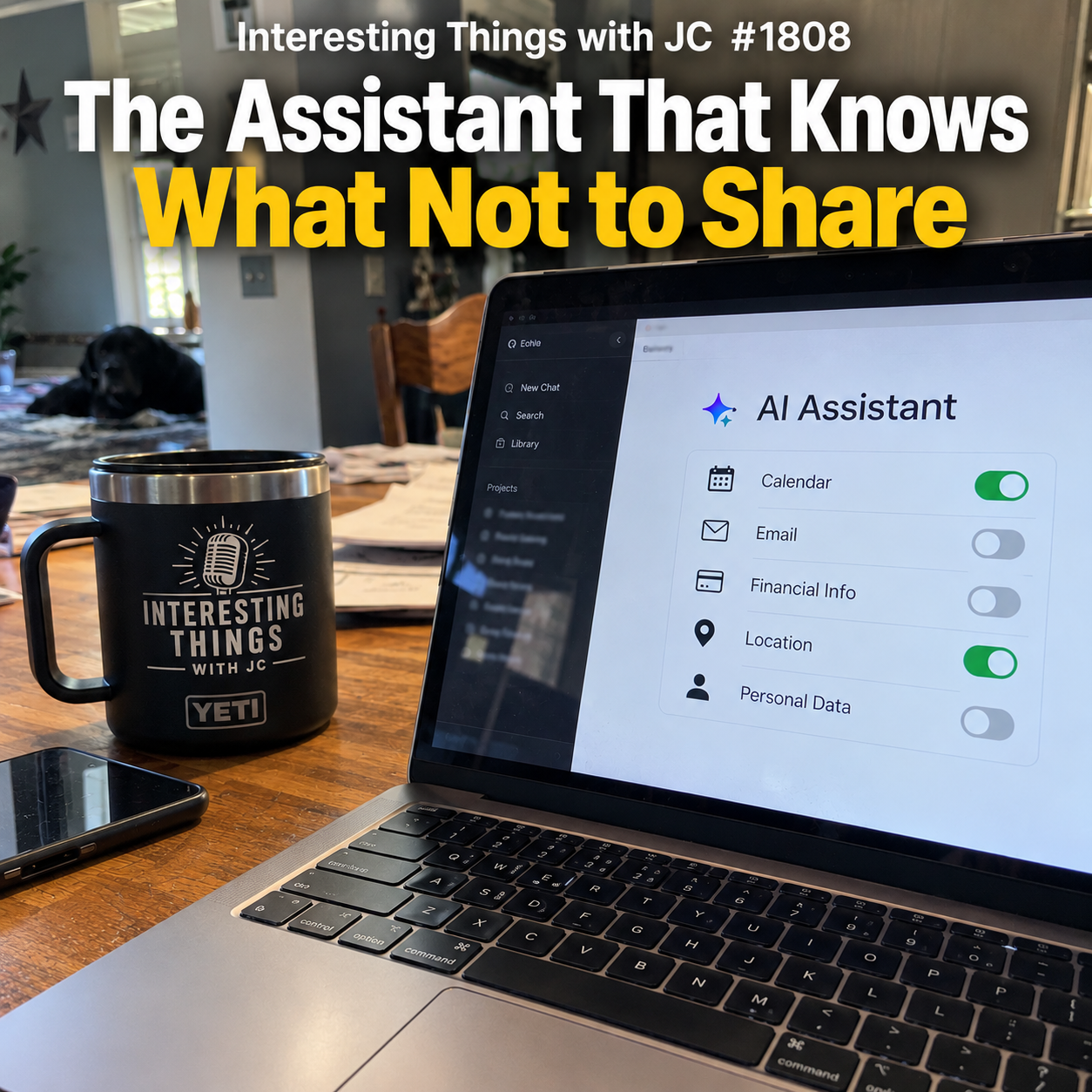
Square podcast cover art for Interesting Things with JC, episode #1808, “The Assistant That Knows What Not to Share.” A realistic home setting shows an open laptop displaying AI Assistant privacy permissions, with calendar and location access enabled and email, financial information, and personal data restricted. A black YETI mug featuring the Interesting Things with JC microphone logo sits beside a smartphone on a wooden table. A black dog rests in the background. The episode title appears prominently across the upper portion in white and yellow lettering.
Interesting Things with JC #1808:
"The Assistant That Knows What Not to Share"
AI assistants used to answer questions, but a new generation is being built to take action. These AI agents can navigate websites, send messages, make reservations, manage accounts, and continue working after you walk away. With enough access, they can handle the tedious digital work that normally requires jumping between apps, calendars, and websites, making them considerably more useful than a chatbot waiting for another question.
That usefulness, however, introduces a security challenge because the more an agent can do, the more important its permissions become. Shortly before Meta launched its AI agent, Muse, serious vulnerabilities were discovered in the virtual machines designed to isolate individual agents and protect sensitive internal systems. Meta says those flaws were fixed before release, but the incident illustrates a larger problem facing personal AI.
The risk is not simply what an AI knows about you, but what it is allowed to do with that information. Reading your calendar is one level of trust, while changing appointments is another. The same distinction applies to reading an email versus sending one, or viewing financial information versus moving money. Once software can act on our behalf, controlling its authority becomes just as important as protecting the information it receives.
Fortunately, security engineers already have a principle for addressing this problem. It's called least privilege, meaning software receives only the permissions necessary to complete a particular task. Muse uses protections intended to keep account credentials separated from the agent itself, along with additional controls around sensitive actions. An agent booking dinner, for example, may need your name, location, calendar, and reservation account, but it has no reason to access your tax records, photographs, or years of private messages.
That same principle opens the door to something more interesting. Rather than simply protecting the information an agent receives, future systems could limit what other companies learn about us. Payment systems already demonstrate part of this idea. A merchant can receive confirmation that a purchase was authorized without gaining access to your entire financial history. A trusted AI agent could eventually extend that approach to other transactions, confirming that someone meets an age requirement without revealing a full date of birth, or providing a hotel only the personal details necessary to reserve a room. These capabilities would require appropriate verification systems, and today's agents do not yet offer them universally.
For decades, using the internet has meant distributing pieces of our personal information across websites, retailers, airlines, banks, and countless databases. A carefully designed personal agent could eventually change that relationship by serving as an intermediary, controlling not only what it can access, but what information actually needs to leave our possession.
The most useful AI assistant may not be the one that knows everything about you, but the one smart enough to know what not to share.
These are interesting things, with JC.
Student Worksheet
Name: __________________________
Date: __________________________
Class: __________________________
Part A — Listening Comprehension
Answer in complete sentences.
What distinguishes an AI agent from a conversational chatbot?
Identify three activities an AI agent might perform.
Why do additional capabilities create new security responsibilities?
What security concern did the Muse example illustrate?
Explain the difference between reading an email and sending one.
Define least privilege in your own words.
Part B — Permission Analysis
Scenario: A student uses an AI agent to schedule a meeting with a college admissions counselor. The agent can access a calendar, email account, contact information, financial records, and photographs.
Which information is reasonably necessary to schedule the meeting?
Which permissions should the student avoid granting?
Should the agent be allowed to send the scheduling email without confirmation? Explain your reasoning.
What should happen to temporary permissions after the meeting is scheduled?
Part C — Selective Disclosure
Scenario: An online service must verify that a user is at least 18 years old.
Explain why the service might not need the user's complete birth date.
Describe how a trustworthy verification system could communicate the required information.
Identify one potential privacy benefit.
Identify one technical or organizational challenge that must be solved before such a system can be trusted.
Part D — Evidence and Future Claims
Classify each statement as Established Principle, Documented Product Claim, or Future Possibility.
Software should receive only the permissions necessary for its task.
Meta describes isolation and credential-protection mechanisms for Muse.
A future AI agent could help limit personal information disclosed to a hotel.
Derived attributes can support verification without revealing complete underlying attributes.
Part E — Reflection
Which is more important for a personal AI agent: the information it knows or the actions it is authorized to perform? Defend your answer.
Under what conditions would you trust an AI agent to perform tasks involving personal information?
Difficulty Scaling
Level 1 — Foundational: Identify required permissions and explain basic security terms.
Level 2 — Applied: Design a limited-permission workflow with appropriate user confirmation.
Level 3 — Advanced: Evaluate how authorization, identity verification, selective disclosure, and accountability interact.
Student Output: Completed responses, a proposed permission policy, and a 150–200-word evidence-based reflection.
Academic Integrity Guidance: Students may use published references and classroom notes, but must explain concepts in their own words. Any use of generative AI to prepare responses should follow classroom disclosure rules.
Teacher Guide
Quick Start: Play the episode once without interruption. Ask students to identify the moment when the story shifts from security risk to a possible privacy benefit.
Pacing Guide — Audio First
0–5 minutes — Opening Prompt: Ask students what an AI assistant would need to access to make a dinner reservation.
5–10 minutes — Audio Listening: Play episode #1808 and have students identify three important concepts.
10–17 minutes — Guided Discussion: Compare knowledge, permission, and authority.
17–27 minutes — Worksheet Application: Students complete Parts A and B.
27–37 minutes — Privacy Design Exercise: Students complete Parts C and D and justify their decisions.
37–45 minutes — Quiz: Administer the knowledge check.
45–50 minutes — Exit Reflection: Students answer the central question in two or three sentences.
Materials
Episode #1808 audio
Transcript
Student worksheet
Internet access for optional reference review
Writing materials or digital classroom platform
Teaching Notes
Clarify the distinction: Accessing information does not imply permission to change or disclose it.
Avoid overgeneralization: AI agents differ in architecture, capabilities, and safeguards.
Explain the case study: Muse illustrates the importance of agent isolation and access controls, not proof that every agent has the same vulnerabilities.
Separate present and future: Selective disclosure is an established identity-design technique; universal implementation through consumer AI agents remains a prospective application.
Emphasize accountability: User confirmation, monitoring, revocation, and auditability complement least privilege.
Discussion Prompts
Should an AI agent be allowed to read an email account but prohibited from sending messages?
Why might access granted for one task become inappropriate for another?
Could an agent that protects privacy from outside companies still create privacy risks for its own operator?
What safeguards would be necessary before an agent could complete a financial transaction?
Formative Checkpoints
Students accurately distinguish authentication from authorization.
Students identify unnecessary permissions in the scheduling scenario.
Students explain selective disclosure without claiming it guarantees anonymity.
Students recognize the difference between product documentation and independent security verification.
Differentiation
Additional Support: Provide a short glossary and model one permission decision.
English Learners: Pair technical vocabulary with everyday examples and allow oral explanations.
Advanced Learners: Require a workflow addressing temporary credentials, permission expiration, logging, and user consent.
Homeschool Adaptation: Use a household calendar or fictional reservation example.
Introductory College: Compare identity assertions, delegated authorization, and the security implications of persistent agent access.
Answer Key — Student Worksheet
An AI agent can use tools or systems to carry out tasks, while conversational AI primarily responds to prompts.
Examples include scheduling, sending messages, making reservations, or managing connected accounts.
Additional capabilities create more opportunities for unauthorized or unintended actions.
The importance of isolating agent environments and protecting sensitive resources.
Reading requires access to information; sending adds authority to communicate externally.
Granting only the access required for an authorized task.
Calendar availability, appropriate contact details, and scheduling communications.
Unrelated financial records, photographs, and other unnecessary information.
Accept reasoned answers; confirmation is especially appropriate before externally visible actions.
Permissions should be reduced or revoked when no longer needed.
The service may need only confirmation that the threshold is met.
A trusted provider could return a verified age-threshold assertion.
Reduced exposure of birth dates or other unnecessary identity information.
Examples include reliable verification, system compatibility, security, and trust.
Established Principle.
Documented Product Claim.
Future Possibility.
Established Principle.
Accept arguments recognizing that both information and authority matter, with evidence supporting the distinction.
Answers should address limited permissions, transparency, verification, oversight, and accountability.
Quiz
Instructions: Select the best answer unless otherwise indicated.
What most clearly distinguishes an AI agent from a conventional chatbot?
A. It always operates without internet access.
B. It can use tools to perform actions on behalf of a user.
C. It cannot access personal information.
D. It always makes correct decisions.What does least privilege require?
A. Giving software unrestricted access.
B. Removing all user permissions.
C. Granting only the permissions necessary for a task.
D. Allowing software to select its own permanent privileges.Which action generally requires greater authority?
A. Reading a calendar entry.
B. Displaying a public webpage.
C. Changing a scheduled appointment.
D. Explaining a definition.Why are isolated computing environments useful?
A. They guarantee that software contains no vulnerabilities.
B. They can reduce unauthorized interactions between environments.
C. They eliminate the need for access controls.
D. They prevent all user mistakes.What is selective disclosure?
A. Publishing all personal information.
B. Revealing only particular information required for a purpose.
C. Allowing every website to collect the same data.
D. Removing identity verification entirely.Which example best demonstrates a derived attribute?
A. Sending a complete birth certificate.
B. Revealing a full date of birth.
C. Confirming that a user is at least 18 without revealing their birth date.
D. Providing every field in a personal profile.True or False: An AI agent that can read financial information should automatically be permitted to transfer money.
True or False: Selective disclosure is an established technical concept, even though its proposed use by future personal AI agents is not universally available today.
Short Answer: Give one example of information an AI reservation agent should not need.
Short Answer: Explain why controlling an AI agent's permissions is important even if the agent is designed to be helpful.
Quiz Answer Key
B — AI agents can interact with tools and perform tasks.
C — Least privilege limits access to what is necessary.
C — Modifying an appointment requires additional authority.
B — Isolation helps establish security boundaries.
B — Selective disclosure limits unnecessary information release.
C — The age-threshold result is derived from an underlying attribute.
False — Read and transaction permissions are distinct.
True — The underlying technique exists independently of universal AI-agent deployment.
Example: Tax records, unrelated photographs, or private messages.
Expected Response: Permission limits reduce the potential consequences of mistakes, misuse, or security failures.
Assessment
Performance Task — Design a Privacy-Conscious AI Agent
Scenario
A company is developing an AI agent that helps customers reserve hotel rooms. The agent can interact with calendars, hotel booking systems, payment services, and identity-verification providers.
Students must design a permission and information-sharing policy that allows the agent to complete a reservation without unnecessarily exposing personal information.
Required Components
Task Definition: Explain what the agent must accomplish.
Necessary Permissions: Identify which resources and actions are required.
Restricted Permissions: Identify unrelated information the agent should not access.
User Confirmation: Explain which actions should require approval.
Information Disclosure: Identify what the hotel needs to receive.
Privacy Improvement: Describe one possible selective-disclosure mechanism.
Risk Analysis: Identify one security or operational failure and propose a safeguard.
Evidence: Support the design using at least two assigned references.
Assessment Rubric — 20 Points
1. Conceptual Accuracy — 4 Points
4: Correctly distinguishes agents, permissions, authorization, and disclosure.
3: Mostly accurate with minor omissions.
2: Partial understanding or unclear distinctions.
1: Significant conceptual errors.
0: No relevant explanation.
2. Least-Privilege Design — 4 Points
4: Clearly limits permissions to task-specific needs and explains restrictions.
3: Appropriate permissions with limited justification.
2: Some unnecessary access remains.
1: Major permissions are unjustified.
0: No workable permission design.
3. Privacy and Disclosure — 4 Points
4: Clearly separates internal access from external disclosure and proposes a plausible privacy improvement.
3: Identifies appropriate disclosure limits.
2: Provides incomplete privacy reasoning.
1: Confuses access with disclosure.
0: Does not address privacy.
4. Evidence and Reasoning — 4 Points
4: Uses at least two credible sources accurately and distinguishes established capabilities from future proposals.
3: Uses relevant evidence with minor weaknesses.
2: Limited evidence or unclear support.
1: Unsupported claims predominate.
0: No evidence.
5. Communication and Organization — 4 Points
4: Clear, organized, complete, and technically appropriate.
3: Understandable with minor organizational issues.
2: Some unclear or incomplete explanations.
1: Difficult to follow.
0: No meaningful submission.
Total: 20 points
Suggested Performance Levels
18–20: Advanced understanding
15–17: Proficient understanding
11–14: Developing understanding
0–10: Additional instruction recommended
Assessment Integrity
Students must not enter real passwords, financial details, identification documents, or other sensitive personal information into classroom AI tools. All examples should use fictional identities and accounts.
Standards Alignment
Alignment Note: The following standards and frameworks are selected for their direct relationship to digital systems, informational evidence, ethical reasoning, and technology design. Alignment describes instructional opportunities, not certification or endorsement by the issuing organizations.
ISTE Standards for Students
1.2.a — Digital Footprint: Students examine how information disclosed across digital services contributes to privacy exposure.
1.2.d — Digital Privacy: Students evaluate personal-data safeguards and the consequences of granting software permissions.
1.3.b — Evaluate Information: Students assess the credibility of technical claims and distinguish documentation from speculation.
1.5.a — Problem Definitions: Students define a permission-design problem and identify relevant constraints.
1.5.d — Algorithmic Thinking: Students describe how a task can be divided into authorized steps and decision points.
CCSS — English Language Arts, Grades 9–10
CCSS.ELA-LITERACY.RI.9-10.1 — Cite Strong and Thorough Textual Evidence: Students support claims about AI security with the transcript and technical references.
CCSS.ELA-LITERACY.RI.9-10.8 — Delineate and Evaluate an Argument: Students identify the episode's central claim and evaluate supporting evidence.
CCSS.ELA-LITERACY.W.9-10.1 — Write Arguments: Students justify permission choices with logical reasoning.
CCSS.ELA-LITERACY.W.9-10.8 — Gather Relevant Information: Students select and cite credible information from authoritative sources.
CCSS.ELA-LITERACY.SL.9-10.1 — Collaborative Discussions: Students evaluate competing security and privacy priorities.
CCSS — English Language Arts, Grades 11–12
CCSS.ELA-LITERACY.RI.11-12.1 — Cite Strong and Thorough Textual Evidence: Students examine explicit claims and reasonable inferences.
CCSS.ELA-LITERACY.RI.11-12.7 — Integrate and Evaluate Multiple Sources: Students compare a narrative explanation with technical guidance.
CCSS.ELA-LITERACY.W.11-12.1 — Write Arguments: Students defend a security design using relevant evidence.
CCSS.ELA-LITERACY.SL.11-12.1 — Collaborative Discussions: Students deliberate over the appropriate limits of delegated AI authority.
NGSS — Science and Engineering Practices
Asking Questions and Defining Problems: Students identify problems arising from unnecessary permissions.
Developing and Using Models: Students create conceptual models of agent access and information disclosure.
Constructing Explanations and Designing Solutions: Students justify security safeguards.
Engaging in Argument from Evidence: Students evaluate whether proposed privacy benefits are technically supported.
Obtaining, Evaluating, and Communicating Information: Students compare technical publications and explain their findings.
NGSS Applicability: These are cross-disciplinary science and engineering practices. The lesson does not claim direct alignment to a specific NGSS disciplinary performance expectation.
C3 Framework — Civics
D2.Civ.10.9-12 — Public Policies and Consequences: Students consider how digital identity and privacy protections affect individuals and institutions.
D3.1.9-12 — Gathering and Evaluating Sources: Students assess the relevance and credibility of cybersecurity documentation.
D3.2.9-12 — Using Evidence: Students construct evidence-based explanations of technical and ethical choices.
ACRL Framework for Information Literacy
Authority Is Constructed and Contextual: Students distinguish official product claims, technical standards, and independent reporting.
Information Creation as a Process: Students examine the differences between podcast storytelling and technical documentation.
Research as Inquiry: Students develop questions about permission scope, trust, and accountability.
Searching as Strategic Exploration: Students locate and compare authoritative information on identity and access management.
Bloom's Revised Taxonomy
Remember: Define least privilege and selective disclosure.
Understand: Explain how AI agents differ from chatbots.
Apply: Select permissions for a defined task.
Analyze: Distinguish access, authorization, and disclosure.
Evaluate: Judge whether safeguards adequately address identified risks.
Create: Design a privacy-conscious agent workflow.
Universal Design for Learning — UDL
Engagement: Use familiar digital tasks and authentic decision-making scenarios.
Representation: Provide audio, transcript, vocabulary, and concrete examples.
Action and Expression: Allow written, oral, or diagram-based explanations where appropriate.
Accessibility: Present content with semantic headings, readable text, descriptive links, and clearly labeled activities.
Career and Technical Education — CTE Connections
Cybersecurity: Identity and access management, authorization, and system isolation.
Information Technology: Software permissions, connected services, and data handling.
Software Development: Secure-by-design workflows and task-specific permissions.
Digital Product Design: Privacy-conscious interfaces, user consent, and confirmation mechanisms.
International Curriculum Connections
UK National Curriculum — Computing: Computer systems, digital security, privacy, and responsible technology use.
International Baccalaureate — Digital Society: Technology, identity, privacy, ethics, and the effects of digital systems.
Cambridge International — Computer Science: Security, access control, data protection, and system design.
International Alignment Note: These connections are thematic and should be mapped to the applicable local course specification before formal standards reporting.
Show Notes
AI agents are becoming capable of performing tasks across websites, accounts, and connected services. These capabilities introduce a security challenge: an assistant that can act on a user's behalf must have carefully controlled permissions.
Using Meta's Muse as a contemporary example, episode #1808 examines the principle of least privilege and explores a potential future in which personal AI agents help reduce unnecessary disclosure of private information.
AI agents can interact with digital services and take actions beyond ordinary conversational responses.
An agent's permissions determine what information and operations it can access.
Least privilege limits unnecessary authority.
Reading information, modifying information, and transmitting information require different forms of permission.
Selective disclosure can reduce the amount of personal information revealed during verification.
Future AI agents could potentially act as privacy intermediaries, but that outcome depends on secure design and supporting infrastructure.
Important Clarification
The episode does not establish that current AI agents universally support privacy-preserving identity verification or selective disclosure. Those examples describe possible future applications of existing security and identity principles.
Suggested Classroom Discussion
Should personal AI agents be designed to complete as many tasks as possible, or should they prioritize strict limits on what they can access and disclose?
Interesting Things with JC, episode #1808, "The Assistant That Knows What Not to Share," hosted by JC. Educational classroom use with attribution is permitted in perpetuity; resale or unauthorized commercial redistribution is not permitted.
References
Meta AI Research. (2026). Security and safety for AI agents: Our approach with Muse. https://research.meta.ai/blog/security-and-safety-for-ai-agents-our-approach-with-muse
Open Worldwide Application Security Project. (2025a, February 17). Agentic AI: Threats and mitigations. https://genai.owasp.org/resource/agentic-ai-threats-and-mitigations/
Open Worldwide Application Security Project. (2025b, July 27). Securing agentic applications guide 1.0. https://genai.owasp.org/resource/securing-agentic-applications-guide-1-0/
World Wide Web Consortium. (2025, May 15). Verifiable credentials data model v2.0. https://www.w3.org/TR/2025/REC-vc-data-model-2.0-20250515/