1809: "Physics - Newton’s 1st and 2nd Laws"
Interesting Things with JC #1809:
"Physics - Newton’s 1st and 2nd Laws"
A playing card shoots sideways while the coin resting on it drops into a glass. Pull the card slowly, and the coin may move with it. The same physics governs passengers in braking cars and the acceleration of loaded shopping carts.
Curriculum - Episode Anchor
Episode Title: Physics - Newton’s 1st and 2nd Laws
Episode Number: 1809
Host: JC
Series: Interesting Things with JC
Release Date: October 18, 2026
Audience: Grades 9–12, introductory college, homeschool, lifelong learners
Subject Area: Physics, Physical Science, Mathematics, Engineering, Scientific Inquiry
Instructional Duration: 45–50 minutes
Audio Duration: Approximately 3 minutes
Instructional Approach: Audio-first, evidence-based scientific inquiry
Central Topic: Newton's first and second laws of motion, inertia, net force, mass, acceleration, and practical applications.
Lesson Overview
Lesson Purpose
Students investigate how forces influence the motion of objects through Newton's first and second laws. Using the episode's coin-and-card demonstration, vehicle braking example, and shopping-cart calculations, students distinguish inertia from acceleration and apply quantitative reasoning to everyday motion.
Essential Question: How do net force and mass determine whether an object's motion changes and how quickly that change occurs?
Learning Objectives
By the end of the lesson, students will be able to:
Explain Newton's first law and distinguish inertia from the effects of unbalanced forces.
Identify forces acting on objects and determine when the net force is zero.
Apply Newton's second law, \(F_{\text{net}}=ma\), to calculate force, mass, and acceleration.
Interpret experimental observations and explain how changing mass or net force affects acceleration.
Success Criteria
Students demonstrate mastery when they can:
Accurately explain why the coin falls into the glass when the card is rapidly removed.
Identify the role of seat belts in changing a passenger's motion.
Calculate acceleration using appropriate SI units.
Predict and justify how doubling mass or net force changes acceleration.
Student Relevance: These principles explain everyday experiences involving shopping carts, bicycles, vehicle braking, sports equipment, and moving objects.
Real-World Connection: Vehicle safety systems, industrial machinery, transportation engineering, and robotics depend on controlling forces and acceleration.
Workforce Reality: Automotive engineers, mechanical engineers, transportation safety specialists, and robotics technicians routinely apply Newtonian mechanics to predict motion and evaluate equipment performance.
Key Vocabulary
Newton's First Law (NOO-tunz): An object remains at rest or moves at constant velocity unless acted upon by a nonzero net external force.
Inertia (in-UR-shuh): The tendency of matter to resist changes in velocity. Mass measures an object's inertia.
Newton's Second Law: The relationship between net force, mass, and acceleration, expressed as \(F_{\text{net}}=ma\) for constant mass.
Net Force: The vector sum of all external forces acting on an object.
Mass: A measure of inertia, expressed in kilograms (kg) in the SI system.
Acceleration (ak-sel-uh-RAY-shun): The rate at which velocity changes with time, measured in meters per second squared (m/s²).
Velocity (vuh-LOSS-uh-tee): Speed together with direction.
Friction (FRIK-shun): A contact force that opposes relative motion or the tendency toward relative motion between surfaces.
Newton (NOO-tun), N: The SI unit of force. One newton accelerates a mass of one kilogram at one meter per second squared.
Gravity (GRAV-uh-tee): The attractive interaction between masses; near Earth's surface, it produces a downward acceleration of approximately 9.81 m/s² for freely falling objects.
Narrative Core
Open
A coin rests on a playing card positioned over a glass. When the card is flicked sideways, the coin drops into the glass. When the card is pulled slowly, the coin may move with it.
The difference provides an observable introduction to inertia and the effects of friction.
Info
In 1687, Isaac Newton published Philosophiæ Naturalis Principia Mathematica, establishing three laws of motion.
Newton's first law describes motion when the net external force is zero. An object at rest remains at rest, while an object already moving continues at constant velocity.
Inertia describes the resistance of an object to changes in that motion.
Details
The coin-and-card demonstration illustrates how friction and the duration of contact affect the coin's sideways movement.
A rapid flick allows little time for friction to accelerate the coin horizontally. Once the card moves away, gravity accelerates the unsupported coin downward.
A slower pull permits friction to act over a longer interval, potentially moving the coin along with the card.
Newton's second law quantifies the effects of net force:
A shopping cart with a total mass of 10 kg (22 lb) experiencing a net forward force of 20 N accelerates at 2 m/s².
Increasing its mass to 20 kg (44 lb) while maintaining the same net force reduces its acceleration to 1 m/s².
Reflection
The first law identifies what happens when the net force is zero. The second law predicts the acceleration produced by a nonzero net force.
These principles also explain why passengers continue moving forward when vehicles brake and why greater mass requires greater net force to produce the same acceleration.
Closing
These are interesting things, with JC.
Transcript
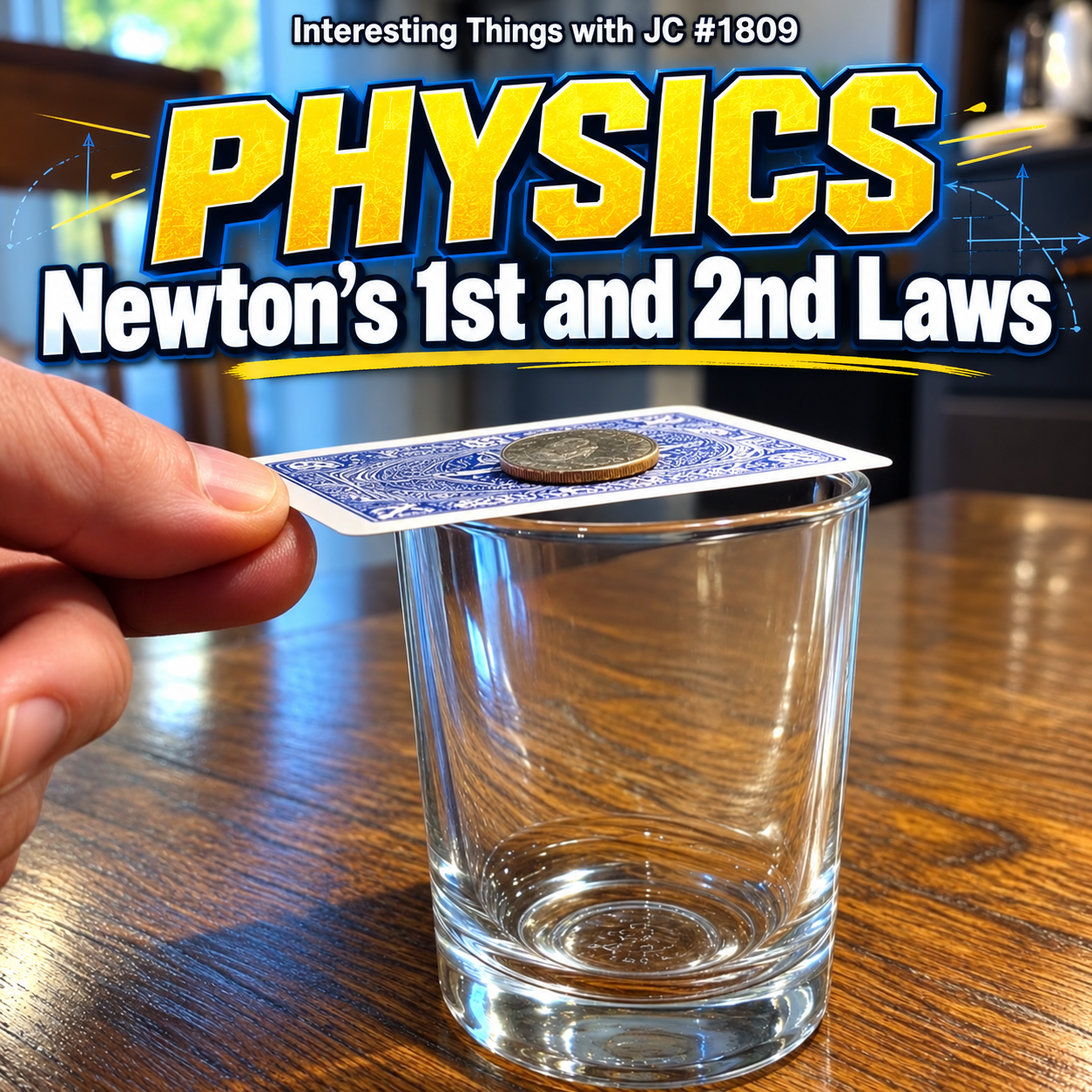
Square podcast cover art for Interesting Things with JC, episode #1809, “Physics – Newton’s 1st and 2nd Laws.” A close-up, realistic photograph shows a hand holding a blue-backed playing card horizontally over a clear drinking glass, with a coin resting on the card. The demonstration illustrates Newton’s first law of motion and inertia. A wooden tabletop and softly blurred home interior appear in the background. At the top, small white text reads “Interesting Things with JC #1809.” Below, large yellow and white lettering reads “Physics – Newton’s 1st and 2nd Laws.” The lower third contains no text.
Interesting Things with JC #1809:
"Physics: Newton’s 1st and 2nd Laws"
Place a coin on a playing card resting across the mouth of a glass. Flick the card sideways, and the coin drops into the glass. Pull the card slowly instead, and the coin may travel with it.
In 1687, Isaac Newton described the rules behind both results. His first law says an object at rest stays at rest, and a moving object continues at constant velocity, unless a net external force changes its motion. That resistance to a change in motion is inertia.
When you flick the card, friction acts on the coin for only a brief moment, giving it little sideways speed. When the card slides away, the coin loses its support and gravity accelerates it downward. Pull slowly, and friction has time to accelerate the coin sideways.
It's also why your body keeps moving forward when a car brakes. The seat belt supplies the force that slows your body with the car.
But what determines how quickly something speeds up or slows down? Newton's second law connects three quantities: net force, mass, and acceleration. Force equals mass times acceleration.
Picture an empty shopping cart with a total mass of 10 kilograms, about 22 pounds. On a level floor, a net forward force of 20 newtons gives it an acceleration of 2 meters per second squared. That means its speed increases by about 4.5 miles per hour every second.
Now load the cart until its total mass reaches 20 kilograms, about 44 pounds. Apply the same net force, and its acceleration falls to 1 meter per second squared. Double the mass, half the acceleration. To get the original acceleration back, you would need twice the net force.
The coin, the passenger, and the shopping cart don't follow separate rules. The first law tells us what happens when net force is zero. The second tells us exactly how motion changes when it isn't.
These are interesting things, with JC.
Student Worksheet
Student Name: __________________________ Date: __________________________ Class: __________________________
Instructions: Listen to episode #1809. Answer the questions using evidence from the narration, observations from the classroom demonstration, and appropriate calculations. Show mathematical reasoning and include units.
Part A — Comprehension
State Newton's first law in your own words.
Define inertia and explain how mass relates to it.
What happens to the coin when the playing card is rapidly flicked away?
Why might the coin move with the card when it is pulled slowly?
What force does a seat belt exert on a passenger during sudden braking, and what effect does that force have?
Part B — Mathematical Application
Use:
\[ F_{\text{net}}=ma \]
6. A shopping cart has a total mass of 10 kg and experiences a net horizontal force of 20 N. Calculate its acceleration.
7. The cart's total mass increases to 20 kg while the net force remains 20 N. Calculate its new acceleration.
8. A 25 kg cart accelerates at 3 m/s². Calculate the required net force.
9. A 40 kg cart experiences a net forward force of 100 N. Calculate its acceleration.
10. A 15 kg object accelerates at 4 m/s². What net force is required to produce the same acceleration if its mass doubles?
Part C — Analysis
11. Explain why doubling mass while maintaining constant net force reduces acceleration by half.
12. Describe a situation in which an object moves even though the net force acting on it is zero.
13. A moving bicycle slows after the rider stops pedaling. Does this violate Newton's first law? Explain.
14. Two objects experience identical net forces but have different masses. Predict which experiences greater acceleration and explain why.
Part D — Reflection
15. Explain how Newton's first and second laws work together to describe the motion of a passenger during vehicle braking.
16. Identify one example from everyday life not discussed in the episode. Explain how both laws apply to it.
Difficulty Scaling
Level 1 — Foundational: Complete questions 1–7 using vocabulary and numerical substitution.
Level 2 — Proficient: Complete questions 1–14, including written explanations.
Level 3 — Advanced: Complete all questions and develop an additional numerical example involving changing mass or net force.
Student Output: Submit written responses, calculations with units, and at least one explanation connecting observed motion to a specific force.
Academic Integrity Guidance: Use your own explanations and show all calculations. Identify outside sources if used. Calculators are permitted unless the teacher specifies otherwise.
Teacher Guide
Quick Start: Play the episode once without interruption. Ask students to predict the outcome of the coin-and-card demonstration before performing it. Use the observation to introduce Newton's first law, then transition to calculations involving the second law.
Pacing Guide — Audio First
0–5 minutes: Bell ringer and prediction.
5–8 minutes: Play the episode.
8–15 minutes: Demonstrate inertia using the coin and card.
15–23 minutes: Discuss Newton's first law, friction, and net force.
23–33 minutes: Model second-law calculations.
33–43 minutes: Independent worksheet practice.
43–48 minutes: Discussion, formative assessment, and exit ticket.
Bell Ringer
Ask students:
"A shopping cart is rolling across a level floor. If all horizontal forces acting on it suddenly became zero, would it immediately stop?"
Expected Response: No. It would continue at constant velocity unless a nonzero net force changed its motion.
Audio Guidance and Fallback
Play the approximately three-minute recording before introducing equations.
Encourage students to identify the three physical examples used in the narration.
If audio is unavailable, read the complete transcript aloud.
For students requiring additional processing time, provide the transcript before listening.
Time-on-Task: Approximately 48 minutes, with flexibility for a 45–50-minute instructional period.
Materials
Episode audio or transcript
Playing card or smooth index card
Coin
Stable, wide-mouthed drinking glass or transparent plastic cup
Calculator
Student worksheet
Pencil and paper
Optional small cart and removable masses
Vocabulary Preparation
Introduce inertia, net force, acceleration, and mass before the quantitative portion of the lesson.
Distinguish speed from velocity, emphasizing that velocity includes direction.
Classroom Demonstration — Coin and Card
Place a stable glass or cup on a level surface.
Position a playing card across its opening.
Center a coin over the opening.
Flick the card sharply in a horizontal direction without striking the glass.
Observe the coin's movement.
Repeat using a slow, controlled pull.
Compare results and discuss the duration of frictional contact.
Safety: Use a stable cup, preferably plastic, and keep the demonstration away from table edges. Do not use sharp or heavy objects.
Scientific Clarification: A rapid flick does not eliminate friction. It generally reduces the time during which friction can produce sideways motion. The exact result depends on surface conditions and how the card is moved.
Common Misconceptions
- Misconception: Objects require a continuous net force to remain in motion. Correction: Constant velocity requires zero net force, not necessarily zero individual forces.
- Misconception: Inertia is a force. Correction: Inertia is a property of matter, measured by mass.
- Misconception: Heavier objects always move more slowly. Correction: Acceleration depends on both mass and net force.
- Misconception: A stationary object experiences no forces. Correction: Forces may act on an object while balancing to produce zero net force.
- Misconception: Force and acceleration are interchangeable. Correction: Net force produces acceleration according to the object's mass.
Discussion Prompts
Why does a rapidly removed card produce less horizontal movement of the coin?
How does a seat belt change the motion of a passenger?
Why must the total mass of a loaded shopping cart be considered?
Can an object accelerate while maintaining constant speed?
How do friction and net force influence the movement of real shopping carts?
Formative Checkpoints
Checkpoint 1: Students correctly define inertia.
Checkpoint 2: Students identify forces acting on the coin.
Checkpoint 3: Students distinguish balanced from unbalanced forces.
Checkpoint 4: Students calculate acceleration with appropriate units.
Checkpoint 5: Students explain the inverse relationship between mass and acceleration when net force is constant.
Differentiation
Additional Support: Provide equation templates and partially completed calculations.
Advanced Learners: Introduce two-dimensional force components and vector addition.
English Learners: Pair vocabulary with demonstrations and labeled diagrams.
Students with Visual Impairments: Describe demonstrations verbally and provide tactile or accessible representations.
Students with Hearing Impairments: Supply the complete transcript and written demonstration instructions.
Assessment Differentiation
Allow oral explanations where appropriate.
Permit calculators and formula references.
Evaluate conceptual reasoning separately from arithmetic accuracy when accommodations require it.
Offer an additional application problem to advanced learners.
Time Flexibility
30-minute version: Audio, demonstration, two calculations, and exit ticket.
45–50-minute version: Complete the full lesson.
60-minute version: Add a controlled cart-and-mass investigation.
Substitute Readiness
All necessary content appears in the transcript, worksheet, and answer key. The demonstration may be replaced with a teacher-led discussion of predicted outcomes if materials are unavailable.
Engagement Strategy
Ask students to predict each demonstration result before revealing it. Require them to explain the observation using a named force or physical principle.
Extensions
Measure the acceleration of a small cart under different applied forces.
Compare mass and weight using Earth's gravitational acceleration.
Investigate stopping distance and the influence of initial vehicle speed.
Construct force diagrams for the coin, passenger, and shopping cart.
Cross-Curricular Connections
Mathematics: Algebraic rearrangement, proportional reasoning, and unit conversion.
Engineering: Force analysis and mechanical design.
Transportation Safety: Passenger restraint systems and braking forces.
History of Science: Newton's 1687 publication and the development of classical mechanics.
Social-Emotional Learning Connection
Emphasize collaboration, evidence-based disagreement, careful observation, and responsible laboratory behavior.
Skill Emphasis
Scientific reasoning, mathematical modeling, observation, prediction, communication, and evidence evaluation.
Answer Key — Student Worksheet
Comprehension
An object maintains rest or constant velocity unless a nonzero net external force changes its motion.
Inertia is resistance to changes in velocity; greater mass means greater inertia.
The card moves away while the coin acquires relatively little horizontal velocity and falls into the glass.
Friction acts over a longer period and may accelerate the coin horizontally.
The seat belt exerts a force that decelerates the passenger.
Mathematical Application
\(a=20/10=\mathbf{2\ m/s^2}\)
\(a=20/20=\mathbf{1\ m/s^2}\)
\(F=25\times3=\mathbf{75\ N}\)
\(a=100/40=\mathbf{2.5\ m/s^2}\)
Doubled mass = 30 kg; \(F=30\times4=\mathbf{120\ N}\)
Analysis
Since \(a=F_{\text{net}}/m\), doubling mass with unchanged net force halves acceleration.
An ideal object moving at constant velocity in a straight line with zero net force.
No. Resistive forces, including friction and air resistance, produce a net force opposing its motion.
The lower-mass object experiences greater acceleration because acceleration is inversely proportional to mass for a given net force.
Reflection
A passenger initially continues moving because of inertia. The seat belt supplies the force required to produce deceleration, consistent with the second law.
Answers vary. A valid example must accurately identify constant-velocity behavior or balanced forces and explain acceleration resulting from a nonzero net force.
Quiz Answer Key: 1-B, 2-C, 3-A, 4-D, 5-B.
Quiz
Instructions: Select the best answer for each question.
1. Which statement correctly describes Newton's first law?
A. All moving objects eventually stop without external forces. B. Objects maintain rest or constant velocity unless acted upon by a nonzero net external force. C. Force always equals velocity multiplied by mass. D. Heavier objects cannot accelerate.
2. What property describes an object's resistance to changes in motion?
A. Velocity B. Friction C. Inertia D. Acceleration
3. A 12 kg object experiences a net force of 36 N. What is its acceleration?
A. 3 m/s² B. 24 m/s² C. 48 m/s² D. 432 m/s²
4. If an object's mass doubles while the net force remains constant, its acceleration will:
A. Double B. Remain unchanged C. Quadruple D. Decrease by half
5. Why does a coin usually fall into a glass when the card beneath it is rapidly flicked away?
A. Gravity stops acting on the coin temporarily. B. Friction acts for too little time to give the coin much horizontal velocity. C. The coin loses its mass. D. The card pushes the coin downward with a large force.
Assessment
Open-Ended Assessment Questions
1. Explain the coin-and-card demonstration using Newton's first law, friction, gravity, and inertia. Describe why the outcome may change when the card is pulled slowly.
2. A 30 kg cart experiences a net horizontal force of 90 N. Calculate its acceleration. Then determine its acceleration if its mass increases to 45 kg while the net force remains unchanged. Explain the relationship between mass and acceleration.
Expected Mathematical Results
Initial acceleration: \(90/30=3\ m/s^2\)
Increased-mass acceleration: \(90/45=2\ m/s^2\)
Assessment Rubric — 3–2–1 Scale
3 — Proficient: Scientifically accurate explanation, correct force relationships, accurate calculations, appropriate units, and clear reasoning.
2 — Developing: Generally correct understanding with minor calculation, terminology, or explanation errors.
1 — Beginning: Significant conceptual errors, incomplete calculations, or insufficient explanation of forces and motion.
Scoring Guidance
Score each open-ended response separately.
Maximum Score: 6 points.
Performance Interpretation
6 points: Strong mastery
4–5 points: Developing to proficient understanding
2–3 points: Additional instruction recommended
Exit Ticket
Before leaving, students must answer:
What happens to an object's velocity when net force is zero?
How does doubling mass affect acceleration when net force remains constant?
Give one practical example of Newton's second law.
Evidence of Mastery: Students accurately distinguish constant velocity from acceleration and explain how net force and mass interact.
Standards Alignment
NGSS — Next Generation Science Standards
HS-PS2-1 — Motion and Stability: Forces and Interactions: Students analyze data to support the mathematical relationship among net force, mass, and acceleration. The shopping-cart calculations directly reinforce this performance expectation.
Science and Engineering Practice — Using Mathematics and Computational Thinking: Students calculate acceleration and apply proportional reasoning to changes in mass and force.
Crosscutting Concept — Cause and Effect: Students explain how forces produce changes in motion and how different experimental conditions affect outcomes.
CCSS — Mathematics
HSA-CED.A.4 — Rearrange Formulas: Students rearrange \(F_{\text{net}}=ma\) to solve for force, mass, or acceleration.
HSN-Q.A.1 — Use Units to Understand Problems: Students interpret kilograms, newtons, and meters per second squared and apply consistent units.
HSN-Q.A.3 — Choose a Level of Accuracy Appropriate to Limitations on Measurement: Students distinguish exact mathematical relationships from approximate experimental measurements.
CCSS — English Language Arts
CCSS.ELA-LITERACY.RST.9-10.3: Students follow a multistep scientific procedure, analyze observations, and identify relevant conditions.
CCSS.ELA-LITERACY.RST.9-10.7: Students translate between verbal explanations, mathematical expressions, and visual representations of physical motion.
CCSS.ELA-LITERACY.WHST.9-10.2: Students produce explanatory writing using accurate scientific terminology and evidence.
ISTE — International Society for Technology in Education
1.5 Computational Thinker: Students apply numerical modeling and logical reasoning to analyze changes in motion.
1.3 Knowledge Constructor: Students evaluate scientific explanations using reliable evidence and experimental observations.
C3 Framework — Inquiry Skills
D2.Sci.1.9-12 — Inquiry Connection: Students construct testable questions, analyze observations, and evaluate explanations using evidence. This is a cross-disciplinary inquiry connection, not a separate C3 science standard.
D4.2.9-12 — Construct Explanations and Arguments: Students use evidence and reasoning to communicate conclusions about observed physical behavior.
CTE — Career and Technical Education
Engineering and Technology Applications: Students apply force analysis, quantitative reasoning, and physical modeling to transportation and mechanical systems.
Technical Problem Solving: Students identify variables, calculate outcomes, and evaluate how design conditions affect performance.
UK National Curriculum
Key Stage 4 — Physics, Forces: Students apply Newton's laws, calculate resultant forces, and explain acceleration.
Key Stage 4 — Working Scientifically: Students interpret experimental results, apply mathematical relationships, and evaluate physical explanations.
International Baccalaureate
MYP Sciences — Knowing and Understanding: Students explain scientific principles and apply mathematical relationships.
MYP Sciences — Inquiring and Designing: Students develop questions and identify variables in demonstrations of motion.
MYP Sciences — Processing and Evaluating: Students interpret observations and assess whether evidence supports predictions.
Career Readiness Competencies
Quantitative reasoning and mathematical accuracy
Scientific communication and technical vocabulary
Evidence-based decision-making
Mechanical and engineering problem-solving
Safe and responsible experimental practices
Homeschool and Lifelong Learning
The lesson supports independent investigation using readily available materials, with adaptable mathematical difficulty and direct connections to transportation, household objects, and everyday movement.
Show Notes
Newton's first and second laws explain how objects maintain motion and how net forces produce acceleration. In this episode, a coin-and-card demonstration introduces inertia, while a braking vehicle and a shopping cart illustrate how forces change motion. Students explore the relationship between force, mass, and acceleration through practical observations and calculations. The accompanying open curriculum includes vocabulary, classroom activities, mathematical exercises, assessment materials, and connections to engineering and transportation safety.
References
Primary Historical Source
Newton, I. (1687). Philosophiæ naturalis principia mathematica. Royal Society. https://doi.org/10.5479/sil.52126.39088015634981
Physics and Scientific Instruction
OpenStax. (2016). 5.2 Newton's first law. In University physics volume 1. Rice University. https://openstax.org/books/university-physics-volume-1/pages/5-2-newtons-first-law
OpenStax. (2016). 5.3 Newton's second law. In University physics volume 1. Rice University. https://openstax.org/books/university-physics-volume-1/pages/5-3-newtons-second-law
OpenStax. (2016). 6.2 Friction. In University physics volume 1. Rice University. https://openstax.org/books/university-physics-volume-1/pages/6-2-friction
OpenStax. (2016). 3.4 Motion with constant acceleration. In University physics volume 1. Rice University. https://openstax.org/books/university-physics-volume-1/pages/3-4-motion-with-constant-acceleration
Educational Use and Attribution - © 2026 Jim Connors LLC. Interesting Things with JC™. Educational materials may be used for noncommercial classroom and homeschool instruction with appropriate attribution in perpetuity royalty free. Commercial redistribution or resale requires permission.