1810: "How Deep is the Mariana Trench"
Interesting Things with JC #1810: "How Deep is the Mariana Trench"
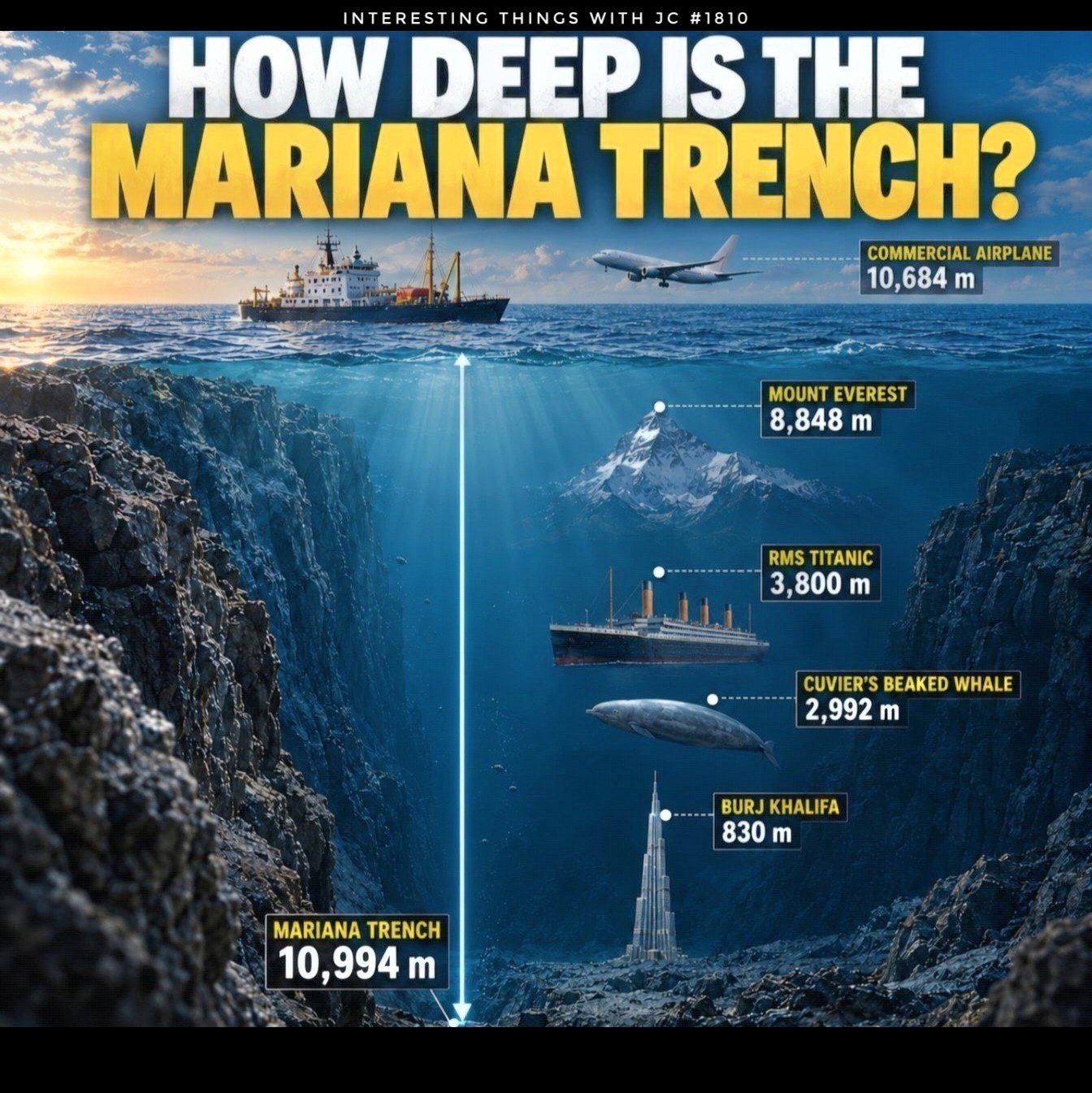
Challenger Deep reaches nearly 36,000 feet beneath the Pacific Ocean, more than three times the depth of the Titanic wreck. In 1960, two explorers reached the bottom, but a fractured window threatened their ability to leave the vessel after surfacing.
Curriculum - Episode Anchor
Series: Interesting Things with JC
Episode Number: 1810
Episode Title: How Deep is the Mariana Trench
Host: JC Release Date: October 18, 2026
Audience: Grades 9–12, introductory college, homeschool, lifelong learners
Subject Areas: Earth Science, Oceanography, Physical Science, Geography, Engineering, Marine Biology, History of Exploration
Instructional Duration: 50 minutes
Audio Duration: Approximately 3 minutes
Instructional Approach: Audio-first, evidence-based scientific inquiry
Central Question: How deep is Challenger Deep, what makes its environment so extreme, and how have humans and other organisms reached or survived there?
Lesson Overview
Challenger Deep, in the Mariana Trench of the western Pacific Ocean, is the deepest known location in Earth's oceans. Its depth approaches 11,000 meters, or approximately 36,000 feet. At this depth, water pressure exceeds 1,000 times atmospheric pressure at sea level.
Students investigate ocean depth using measurable comparisons, examine the engineering challenges of deep-sea exploration, and explore how plate tectonics produces ocean trenches. The lesson also introduces biological adaptations that allow organisms to survive in environments without sunlight.
Learning Objectives
By the end of the lesson, students will be able to:
Locate the Mariana Trench and Challenger Deep geographically.
Explain ocean depth using U.S. customary and metric measurements.
Calculate approximate differences between Challenger Deep, the Titanic wreck, and Mount Everest.
Describe how water pressure increases with depth.
Explain the relationship between subduction and ocean trench formation.
Identify the engineering features that protected the crew of Trieste.
Describe adaptations that support life in the hadal ocean.
Distinguish established scientific measurements from approximations and historical accounts.
Essential Questions
How can familiar landmarks help us understand unfamiliar ocean depths?
Why does increasing depth create major engineering challenges?
What causes deep-ocean trenches?
How can organisms survive without sunlight at extreme pressure?
What can the history of deep-sea exploration teach us about scientific investigation?
Prior Knowledge: Basic measurement, ratios, Earth's structure, gravity, and pressure.
Instructional Outcome: Students will produce an evidence-based explanation combining quantitative comparisons, plate tectonics, exploration history, and deep-sea biology.
Key Vocabulary
Mariana Trench (mair-ee-AH-nuh): A deep oceanic trench in the western Pacific, formed at a convergent plate boundary.
Challenger Deep: The deepest known area of the global ocean, located within the Mariana Trench.
Hadal Zone (HAY-dul): The ocean depth region extending approximately 6,000 to 11,000 meters, including deep trenches.
Hydrostatic Pressure (hy-droh-STAT-ik PRESH-er): Pressure exerted by a fluid due to the weight of the fluid above a location.
Atmosphere: A unit of pressure approximately equal to average air pressure at sea level.
Subduction (sub-DUK-shun): The movement of one tectonic plate beneath another at a convergent boundary.
Pacific Plate: A major tectonic plate underlying much of the Pacific Ocean.
Mariana Plate: A smaller tectonic plate associated with the Mariana island arc and trench system.
Bathyscaphe (BATH-ih-skaf): A specialized deep-diving submersible designed to reach extreme ocean depths.
Trieste (tree-EST): The bathyscaphe used by Jacques Piccard and Don Walsh to reach Challenger Deep in 1960.
Jacques Piccard (zhahk pee-KAR): Swiss ocean explorer and engineer who participated in the first crewed descent to Challenger Deep.
Amphipods (AM-fih-podz): Small crustaceans, some of which inhabit the deepest parts of the ocean.
Ballast: Weight carried by a vessel that can be released to increase buoyancy and initiate ascent.
Buoyancy (BOY-un-see): The upward force exerted by a fluid on an immersed object.
Piezophile (pee-EZ-oh-file): An organism adapted to, or thriving under, high-pressure conditions.
Narrative Core
Opening — Establishing Scale
The episode begins by comparing the depth of the Titanic wreck with Challenger Deep. The contrast provides a familiar reference for understanding an otherwise difficult-to-imagine distance.
Information — Earth's Deepest Known Ocean Location
Challenger Deep is introduced through approximate depth measurements, its western Pacific location, and the comparison with Mount Everest.
Details — Pressure and Exploration
The narrative connects extreme pressure to engineering limitations before examining the January 23, 1960, Trieste expedition. The fractured access-passage window demonstrates the practical risks of deep-ocean exploration.
Later expeditions by James Cameron and Victor Vescovo establish the continuing development of deep-sea technology.
Scientific Explanation — Geological Origins and Life
Subduction explains the trench's formation. Amphipods demonstrate that extreme depth does not prevent biological activity.
Reflection — The Limits of Exploration
The closing observation distinguishes physical inaccessibility from scientific understanding: the deepest ocean is inhabited, yet many aspects of its environment remain incompletely understood.
Central Scientific Understanding: Ocean depth results from geological processes, creates predictable physical conditions, demands specialized engineering, and supports highly adapted ecosystems.
Transcript
Podcast cover art for Interesting Things with JC, episode #1810, “How Deep is the Mariana Trench,” depicting the immense darkness and depth of the Pacific Ocean’s Mariana Trench, the deepest known ocean region on Earth.
Interesting Things with JC #1810:
"How Deep is the Mariana Trench"
The Titanic rests approximately 12,500 feet, or 2.4 miles, beneath the Atlantic Ocean. Challenger Deep in the Mariana Trench (mair-ee-AH-nuh) reaches nearly 36,000 feet, or 6.8 miles. From the Titanic's depth, you'd have another 4.4 miles to descend.
Located in the western Pacific, Challenger Deep is the deepest known part of Earth's oceans, nearly 11,000 meters below sea level.
Mount Everest rises 29,032 feet, or 8,849 meters, above sea level. Set it on the bottom of Challenger Deep, and more than a mile of water would still cover its summit.
Down there, pressure exceeds 16,000 pounds per square inch, more than a thousand times the pressure at sea level. An ordinary submarine couldn't withstand it.
But on January 23, 1960, Jacques Piccard (zhahk pee-KAR) and U.S. Navy Lieutenant Don Walsh made the descent aboard Trieste (tree-EST), protected inside a thick steel sphere. Nearly five hours later, they reached the seafloor.
During the descent, a loud crack had shaken the craft. At the bottom, they discovered that a Plexiglas window in the flooded entrance passage had fractured. The crew's pressure sphere remained intact, but the damaged window could prevent them from exiting after surfacing.
They spent about 20 minutes at the bottom, then released ballast and began their ascent. Once surfaced, they carefully drained the entrance passage and emerged safely.
In 2012, filmmaker James Cameron completed the first solo descent. Later expeditions led by Victor Vescovo (VES-koh-voh) collected samples and studied the seafloor.
The trench formed where the Pacific Plate sinks beneath the Mariana Plate, a process called subduction (sub-DUK-shun).
And the bottom isn't empty. Tiny shrimp-like crustaceans called amphipods (AM-fih-podz) live at these extreme depths, surviving without sunlight under pressure that would crush ordinary vessels.
The deepest known place in the ocean is not beyond life's reach. It's beyond much of our understanding.
These are interesting things, with JC.
Student Worksheet
Instructions: Listen to the episode once without interruption. On the second listening, record key measurements, historical details, and scientific explanations. Complete all calculations with units.
Comprehension
Where is Challenger Deep located, and approximately how deep is it?
Approximately how much deeper is Challenger Deep than the Titanic wreck?
What happens if Mount Everest is hypothetically placed on the bottom of Challenger Deep?
Who reached Challenger Deep on January 23, 1960, and what vessel did they use?
What part of Trieste was damaged, and why was the damage concerning?
Quantitative Reasoning
Using 36,000 feet for Challenger Deep and 12,500 feet for the Titanic wreck, calculate the depth difference in feet.
Convert the difference from Question 6 into miles using 5,280 feet per mile. Round to two decimal places.
Using 36,000 feet for Challenger Deep and 29,032 feet for Mount Everest, calculate how much water would remain above Everest's summit.
Convert the result from Question 8 into meters using 1 foot = 0.3048 meters.
Estimate the pressure at 10,900 meters using \(P=P_0+\rho gh\), where seawater density is 1,025 kg/m³, gravitational acceleration is 9.81 m/s², and atmospheric pressure is 101,325 Pa. Express the result in megapascals.
Analysis
Explain why pressure increases with ocean depth.
Describe how subduction creates deep-ocean trenches.
Explain why the Trieste crew's pressure sphere remained safe even though another window fractured.
Identify two adaptations that might help organisms survive in the hadal zone. Explain how each could be useful.
Reflection
Why might scientists continue exploring Challenger Deep even after humans have reached its bottom?
What is the difference between observing an organism in an extreme environment and fully understanding how it survives there?
Difficulty Scaling
Level 1 — Foundational: Complete Questions 1–7, 11, and 15 with guided notes.
Level 2 — Proficient: Complete all questions with calculations and evidence-based explanations.
Level 3 — Advanced: Add an investigation of pressure-resistant vessel design or a documented hadal organism's adaptations.
Student Output: One completed worksheet and a 150–200-word scientific explanation incorporating at least three numerical facts and two scientific concepts.
Academic Integrity Guidance: Cite any additional research. Distinguish personal calculations from externally reported measurements. Do not present inferred biological adaptations as experimentally established findings.
Teacher Guide
Quick Start: Begin with the audio episode before introducing diagrams or written explanations. Encourage students to estimate the trench's depth before revealing the actual measurement.
Pacing Guide — Audio First
0–5 minutes: Ask students to estimate the deepest point in the ocean and compare it with familiar landmarks.
5–9 minutes: Play the episode without interruption. Students identify three surprising facts.
9–15 minutes: Replay selected portions and discuss vocabulary, depth measurements, and historical details.
15–25 minutes: Students complete depth comparisons and pressure calculations.
25–35 minutes: Explain subduction and examine how deep-sea vessels withstand pressure.
35–43 minutes: Students complete comprehension and analysis questions.
43–48 minutes: Administer the quiz.
48–50 minutes: Collect exit tickets answering the central question.
Materials
Episode audio and transcript
Student worksheet and calculator
Physical or digital map of the Pacific Ocean
Diagram of an oceanic subduction zone
Diagram or photograph of the Trieste bathyscaphe
Scientific calculator or spreadsheet for optional pressure calculations
Teacher Background
Challenger Deep is not a perfectly flat location with one universally fixed depth. Reported measurements vary with survey location, instruments, and corrections. Approximately 10,900–11,000 meters is suitable for this lesson.
The hydrostatic pressure equation provides an estimate using constant seawater density. Actual deep-ocean calculations can account for density variation and compressibility.
The Titanic and Mount Everest comparisons use rounded values to communicate scale. They are teaching models rather than precise descriptions of how physical objects could be placed in the trench.
Answer Key — Student Worksheet
Western Pacific Ocean, within the Mariana Trench; approximately 11,000 meters or nearly 36,000 feet.
Approximately 23,500 feet, or 4.45 miles.
More than a mile of water would remain above its summit.
Jacques Piccard and Don Walsh aboard Trieste.
A Plexiglas window in the flooded access passage fractured, raising concerns about safely exiting the craft after surfacing.
36,000 − 12,500 = 23,500 feet.
23,500 ÷ 5,280 = 4.45 miles.
36,000 − 29,032 = 6,968 feet.
6,968 × 0.3048 = 2,123.85 meters.
\(P=101325+(1025)(9.81)(10900)\approx109.7\text{ MPa}\), approximately 15,900 psi. The precise result depends on assumptions and depth.
The weight of the overlying water increases with depth, creating greater pressure.
One tectonic plate descends beneath another, creating a deep depression near the plate boundary.
The fractured window was outside the sealed pressure-resistant crew sphere.
Accept supported examples such as pressure-compatible proteins, specialized cell membranes, and biochemical adaptations. Require students to identify the organism or explain that the adaptation is a hypothesis.
To map the seafloor, examine geological processes, study organisms, collect samples, and improve scientific measurements.
Observation establishes that an organism is present; understanding survival requires evidence about its physiology, ecology, and adaptations.
Formative Checkpoints
Students distinguish depth below sea level from elevation above sea level.
Students include units in calculations.
Students explain that pressure increases with depth rather than simply stating that the water is heavy.
Students identify subduction as the geological cause of the trench.
Students distinguish the flooded access passage from the sealed crew sphere.
Students recognize that hadal organisms do not depend directly on sunlight at their depth, although food can originate in sunlit surface waters.
Common Misconceptions
The Mariana Trench is the deepest point everywhere along its length: Challenger Deep is a particularly deep area within the trench.
The depth is known to the exact foot: Oceanographic measurements have uncertainties and may differ.
No sunlight means no life: Deep-sea organisms use food and energy delivered through ocean ecosystems or local chemical processes.
Pressure crushes every object equally: Pressure-resistant structures and organisms adapted to ambient pressure behave differently.
The Trieste pressure sphere cracked: The documented fracture occurred in an outer access-passage window, not the crew sphere.
Differentiation
Additional Support: Supply a labeled diagram, conversion reference, and partially completed calculation examples.
Advanced Learners: Investigate seawater compressibility, pressure-hull design, or uncertainty in bathymetric surveys.
English Learners: Preteach vocabulary using pronunciation guides, diagrams, and paired explanations.
Accessible Instruction: Provide a text transcript, readable equations, verbal descriptions of diagrams, and alternatives to purely visual assignments.
Discussion Prompts
Why might a submarine designed for ordinary naval operations fail at Challenger Deep?
What evidence would engineers need before declaring a deep-sea vessel safe?
How does discovering life in an extreme environment change scientific questions about habitability?
Extension Activity
Students design a conceptual unmanned ocean probe. They must describe its pressure-resistant components, measurement instruments, method of collecting data, and approach to returning information to researchers.
Quiz
Instructions: Select the best answer for Questions 1–6. Answer Questions 7–10 in complete sentences or calculations.
Challenger Deep is located in which ocean?
A. Atlantic
B. Pacific
C. Indian
D. Arctic
Approximately how deep is Challenger Deep?
A. 1,000 meters
B. 3,800 meters
C. 11,000 meters
D. 20,000 meters
Which geological process primarily explains the formation of the Mariana Trench?
A. Glacial erosion
B. River deposition
C. Subduction
D. Volcanic weathering
Who made the first crewed descent to Challenger Deep?
A. James Cameron and Victor Vescovo
B. Jacques Piccard and Don Walsh
C. Robert Ballard and Jacques Cousteau
D. Don Walsh and James Cameron
What happened to Trieste during its 1960 descent?
A. Its pressure sphere collapsed
B. Its propulsion system exploded
C. A window in its flooded entrance passage fractured
D. Its ballast could not be released
Amphipods are:
A. Marine mammals
B. Crustaceans
C. Deep-sea plants
D. Submersible vehicles
Explain why pressure at Challenger Deep is much greater than at sea level.
Calculate the difference between 36,000 feet and 29,032 feet.
Explain one way engineers protect people inside deep-diving submersibles.
Describe why finding amphipods at extreme depths is scientifically important.
Answer Key
B — Pacific.
C — Approximately 11,000 meters.
C — Subduction.
B — Jacques Piccard and Don Walsh.
C — A fractured window in the flooded entrance passage.
B — Crustaceans.
Greater depth means a taller column of overlying water and therefore greater hydrostatic pressure.
6,968 feet.
Accept a pressure-resistant hull, suitable materials, carefully engineered seals, or other supported features.
Their presence demonstrates that animals can inhabit extreme high-pressure environments without sunlight, motivating further investigation of their adaptations and food sources.
Assessment
Assessment Components
Student Worksheet: 40%
Quiz: 30%
Scientific Explanation: 20%
Discussion and Exit Ticket: 10%
Analytic Rubric
Scientific Accuracy — 30 points
Exemplary (27–30): All major scientific claims are accurate, precise, and supported.
Proficient (23–26): Accurate explanations with minor omissions.
Developing (18–22): Partial understanding or notable imprecision.
Beginning (0–17): Major conceptual errors or insufficient evidence.
Quantitative Reasoning — 25 points
Exemplary (23–25): Correct calculations, units, rounding, and explanations.
Proficient (19–22): Mostly correct calculations with minor errors.
Developing (15–18): Inconsistent methods or missing units.
Beginning (0–14): Incorrect or incomplete calculations.
Evidence and Reasoning — 25 points
Exemplary (23–25): Connects evidence to clear conclusions and recognizes uncertainty.
Proficient (19–22): Uses relevant evidence with generally sound reasoning.
Developing (15–18): Limited supporting evidence or incomplete reasoning.
Beginning (0–14): Unsupported or inaccurate conclusions.
Communication — 20 points
Exemplary (18–20): Clear, organized, scientifically appropriate explanations.
Proficient (15–17): Understandable with minor clarity issues.
Developing (12–14): Uneven organization or imprecise terminology.
Beginning (0–11): Difficult to follow or substantially incomplete.
Performance Expectations
90–100: Advanced mastery
80–89: Proficient mastery
70–79: Developing mastery
Below 70: Additional instruction recommended
Assessment Integrity: Evaluate scientific understanding rather than memorization alone. Accept equivalent units and justified rounding. Do not penalize students for using a credible published Challenger Deep measurement different from the episode's rounded figure.
Standards Alignment
Next Generation Science Standards (NGSS)
HS-ESS2-1 — Earth's Systems: Students develop a model explaining how plate interactions form ocean-floor features, including trenches.
HS-ESS2-3 — Earth's Systems: Students connect tectonic plate motion to Earth's internal processes and mantle convection.
HS-ETS1-2 — Engineering Design: Students divide the problem of reaching Challenger Deep into smaller engineering challenges involving pressure resistance, buoyancy, and crew safety.
Science and Engineering Practice — Using Mathematics and Computational Thinking: Students calculate depth differences, convert units, and estimate hydrostatic pressure.
Crosscutting Concept — Structure and Function: Students explain how the pressure-resistant sphere's design supports deep-ocean exploration.
Common Core State Standards — Reading
CCSS.ELA-LITERACY.RST.9-10.1 — Cite specific textual evidence: Students use transcript evidence to support scientific explanations.
CCSS.ELA-LITERACY.RST.9-10.7 — Translate quantitative or technical information: Students interpret numerical depth comparisons and represent them in calculations or diagrams.
CCSS.ELA-LITERACY.RST.11-12.9 — Synthesize information from a range of sources: Students compare the episode with scientific and historical references.
Common Core State Standards — Writing
CCSS.ELA-LITERACY.WHST.9-10.2 — Write informative/explanatory texts: Students prepare a scientific explanation of Challenger Deep.
CCSS.ELA-LITERACY.WHST.11-12.9 — Draw evidence from informational texts: Students incorporate reliable scientific evidence into written conclusions.
C3 Framework — Geography
D2.Geo.2.9-12 — Use maps, satellite images, photographs, and other representations: Students identify Challenger Deep and examine its geographic context.
D2.Geo.4.9-12 — Analyze relationships between physical and human systems: Students consider how extreme physical conditions influence exploration technologies.
ISTE Standards for Students
1.3 — Knowledge Constructor: Students evaluate and organize scientific sources to develop accurate explanations.
1.5 — Computational Thinker: Students use quantitative models and calculations to investigate ocean depth and pressure.
Bloom's Taxonomy
Remember: Identify Challenger Deep, Trieste, and subduction.
Understand: Explain why pressure increases with depth.
Apply: Calculate depth differences and hydrostatic pressure.
Analyze: Distinguish vessel damage from pressure-sphere failure.
Evaluate: Assess the reliability of different ocean-depth measurements.
Create: Design and justify a conceptual deep-ocean research probe.
Universal Design for Learning (UDL)
Engagement: Use familiar comparisons, exploration history, and student-generated questions.
Representation: Present audio, transcript, diagrams, maps, and numerical examples.
Action and Expression: Permit written, oral, diagrammatic, or accessible digital explanations while preserving common scientific criteria.
International Curriculum Connections
UK National Curriculum — Key Stage 4 Science: Forces and pressure, Earth's structure, ecosystems, and scientific methods.
International Baccalaureate — Sciences: Systems, models, evidence, interactions, and the relationship between science and technology.
Cambridge IGCSE — Geography and Physics: Plate tectonics, pressure, density, and physical environments.
Alignment Note: These are instructional connections, not claims that a single 50-minute lesson fully satisfies every standard. NGSS connections are supported by the published performance expectations.
Show Notes
Episode: Interesting Things with JC #1810 Title: How Deep is the Mariana Trench Host: JC Release Date: October 18, 2026
Episode Description
Challenger Deep, the deepest known part of Earth's oceans, reaches nearly 36,000 feet beneath the Pacific. That's deeper than Mount Everest is tall.
In 1960, Jacques Piccard and Don Walsh became the first people to reach the bottom aboard Trieste. Their expedition revealed both the remarkable possibilities and the dangers of deep-sea engineering.
This episode explores the trench's depth, extraordinary water pressure, geological formation, and the organisms that survive in one of Earth's most extreme environments.
Key Scientific Facts
Depth: Approximately 10,935 meters, or 35,876 feet, according to a published modern estimate.
Location: Western Pacific Ocean, within the Mariana Trench.
Formation: Subduction of the Pacific Plate beneath the Mariana Plate region.
First Crewed Descent: January 23, 1960, by Jacques Piccard and Don Walsh.
First Solo Crewed Descent: James Cameron, 2012.
Marine Life: Includes amphipods adapted to extreme pressure and darkness.
Research Context: A peer-reviewed 2021 study reported a maximum observed depth of 10,935 meters, with an uncertainty of ±6 meters at the 95% confidence level.
Educational Applications
Earth science and plate tectonics
Oceanography and marine ecosystems
Pressure, density, and applied mathematics
Engineering design and materials science
History of scientific exploration
Educational Access - Classroom Permissions: Free educational use with attribution. No resale or unauthorized commercial redistribution.
References
Scientific Research and Oceanography
Greenaway, S. F., Sullivan, K. D., Umfress, S. H., Beittel, A. B., & Wagner, K. D. (2021). Revised depth of the Challenger Deep from submersible transects; Including a general method for precise, pressure-derived depths in the ocean. Deep Sea Research Part I: Oceanographic Research Papers, 178, 103644. https://doi.org/10.1016/j.dsr.2021.103644
National Oceanic and Atmospheric Administration. (2024, August 21). How deep is the ocean? NOAA Ocean Exploration. https://oceanexplorer.noaa.gov/ocean-fact/ocean-depth/
National Oceanic and Atmospheric Administration. (n.d.). How deep is the ocean? National Ocean Service. https://oceanservice.noaa.gov/facts/oceandepth.html
National Oceanic and Atmospheric Administration. (2020, September 29). What is the “deep” ocean? NOAA Ocean Exploration. https://oceanexplorer.noaa.gov/ocean-fact/deep-ocean/
National Oceanic and Atmospheric Administration, Fisheries. (n.d.). Mariana Trench Marine National Monument. https://www.fisheries.noaa.gov/pacific-islands/habitat-conservation/mariana-trench-marine-national-monument
Historical Exploration
National Oceanic and Atmospheric Administration. (n.d.). Soundings, sea-bottom, and geophysics. NOAA Ocean Exploration. https://oceanexplorer.noaa.gov/history/quotes-soundings/
Naval History and Heritage Command. (2023). Navy history matters. U.S. Navy. https://www.history.navy.mil/news-and-events/news/2023/nhm-011023.html
National Academies Press. (2003). The silent landscape: The scientific voyage of HMS Challenger. https://www.nationalacademies.org/read/10725/chapter/12
Educational Standards
NGSS Lead States. (2013). Next generation science standards: For states, by states. National Academies Press. https://www.nationalacademies.org/read/18290
National Governors Association Center for Best Practices, & Council of Chief State School Officers. (2010). Common Core State Standards. https://www.thecorestandards.org/
National Council for the Social Studies. (2013). The college, career, and civic life (C3) framework for social studies state standards. https://www.socialstudies.org/standards/c3
International Society for Technology in Education. (n.d.). ISTE standards: For students. https://iste.org/standards/students
CAST. (2024). Universal design for learning guidelines version 3.0. https://udlguidelines.cast.org/
Attribution
Interesting Things with JC educational curriculum is provided for classroom, homeschool, and individual learning use with appropriate attribution. Commercial resale is not permitted without authorization.