1811: "Newton’s 3rd Law and Friction"
Interesting Things with JC #1811: "Newton’s 3rd Law & Friction"
Your foot pushes backward against the ground when you walk, but on ice, that same movement can send you sliding. Vehicle tires depend on a similar interaction for traction, while rockets follow Newton's third law without needing contact with the ground.
Curriculum - Episode Anchor
Episode Title: Newton’s 3rd Law & Friction
Episode Number: 1811
Host: JC
Series: Interesting Things with JC
Release Date: October 20, 2026
Audience: Grades 9–12, introductory college, homeschool, lifelong learners
Subject Area: Physics, Physical Science, Engineering, Applied Mathematics, Transportation Technology
Instructional Duration: 45–50 minutes
Audio Duration: Approximately 3 minutes
Instructional Approach: Audio-first, evidence-based scientific inquiry
Central Topic: Newton's third law of motion, action-reaction force pairs, static friction, vehicle traction, braking, and rocket propulsion.
Lesson Overview
This lesson examines how forces act between interacting objects and how friction enables controlled movement. Students investigate familiar examples involving walking, automobile tires, and rockets to distinguish Newton's third law from the particular forces responsible for motion.
The lesson progresses from qualitative explanations to force identification, mathematical relationships, and practical engineering applications.
Essential Question: How can Newton's third law explain walking, vehicle movement, and rocket propulsion when the physical interactions are different?
Learning Objectives
By the end of the lesson, students will be able to:
Identify Newton's third-law force pairs and explain why they act on different objects.
Distinguish static friction from kinetic friction and explain their roles in walking, traction, and braking.
Apply Newton's third law to describe how a vehicle accelerates and how a rocket produces thrust.
Analyze real-world motion using force diagrams, evidence, and introductory calculations.
Success Criteria
Students demonstrate proficiency when they can:
Correctly identify both objects in an action-reaction pair.
Explain why equal and opposite forces do not necessarily prevent acceleration.
Distinguish between frictional traction and rocket propulsion.
Use \(F=ma\) and an introductory friction model appropriately.
Support a scientific explanation with evidence and reasoning.
Student Relevance
Walking across ice, riding in a vehicle, and observing a rocket launch involve forces students can recognize and investigate. Understanding these interactions improves scientific reasoning about motion, safety, and technology.
Real-World Connection
Engineers use friction and force analysis when designing vehicle tires, braking systems, footwear, mobility equipment, and propulsion systems.
Workforce Reality
Mechanical engineers, automotive technicians, aerospace engineers, transportation safety specialists, and materials scientists apply these principles when evaluating performance, efficiency, and safety.
Key Vocabulary
Newton's Third Law (NOO-tunz): For every force one object exerts on another, the second object exerts an equal-magnitude, opposite-direction force on the first.
Action-Reaction Pair (AK-shun ree-AK-shun): Two forces arising from one interaction, acting on different objects.
Force: A push or pull caused by an interaction, measured in newtons (N).
Static Friction (STAT-ik FRIK-shun): Friction that prevents relative sliding between contacting surfaces.
Kinetic Friction (kih-NET-ik FRIK-shun): Friction acting when two contacting surfaces slide relative to one another.
Traction (TRAK-shun): The ability to transmit forces through contact with a surface without unwanted slipping.
Normal Force (NOR-mul): A contact force perpendicular to a surface.
Net Force: The vector sum of all forces acting on one object.
Thrust: A propulsive force, such as the force exerted on a rocket as it expels exhaust.
Coefficient of Friction (koh-ih-FISH-unt): A dimensionless quantity used to model friction between particular surfaces under specified conditions.
Narrative Core
Open — Familiar Motion
A person takes a step on dry pavement and moves forward. The same movement on ice can produce a slip. The applied movement appears similar, but the resulting motion differs.
Info — Newton's Third Law
Isaac Newton's third law describes forces between interacting objects. When one object exerts a force on another, the second exerts an equal and opposite force on the first.
The forces act on separate objects and therefore do not cancel in the force balance of either individual object.
Details — Friction and Traction
During ordinary walking, a shoe pushes backward against the ground while static friction from the ground acts forward on the shoe.
Powered vehicle tires operate through a comparable contact interaction. During acceleration, the tire pushes backward on the road, and the road pushes forward on the tire.
During braking, the direction of the horizontal road force on the tire generally reverses. If the tire continues rolling without sliding, static friction remains involved.
When the required frictional force exceeds what the surfaces can provide, slipping occurs.
Reflection — Propulsion Without Ground Contact
Rocket propulsion follows Newton's third law without depending on friction with a road or other external surface.
A rocket expels exhaust backward. The rocket and expelled material exert opposite forces on one another, allowing the rocket to accelerate in space.
The distinction illustrates how one physical law applies to different kinds of interactions.
Closing — Return to the Sidewalk
The third law remains valid whether a person walks securely or slips on ice. What changes is the available friction and the resulting motion.
These are interesting things, with JC.
Transcript
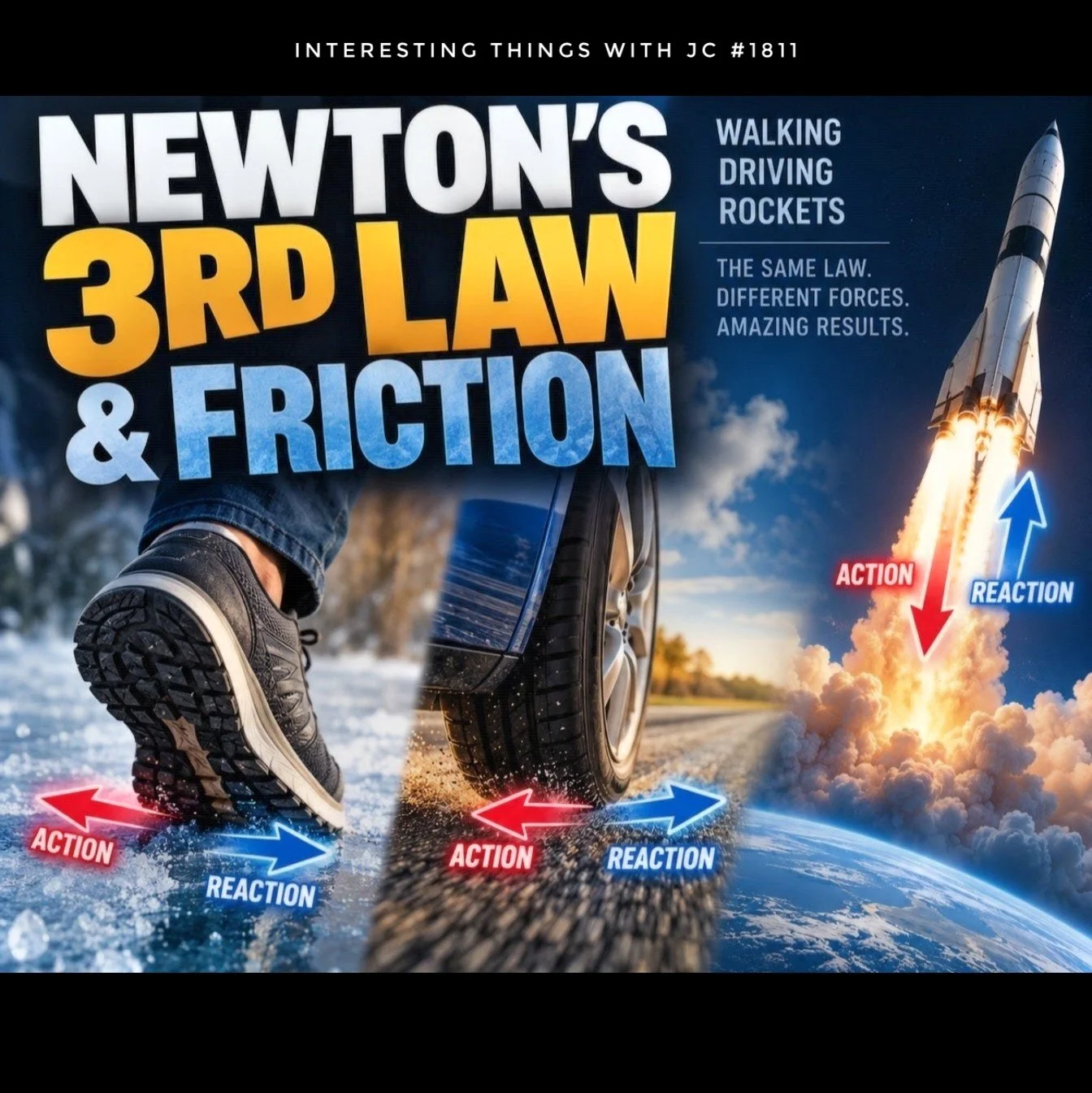
Educational podcast cover art for Interesting Things with JC, episode #1811, “Newton’s 3rd Law & Friction.” A sneaker contacts an icy surface, a car drives along a roadway, and a rocket launches into space. Red “ACTION” and blue “REACTION” arrows illustrate opposing forces. Bold lettering displays the episode title, with Interesting Things with JC branding and an Earth icon along the bottom.
Interesting Things with JC #1811:
"Newton’s 3rd Law & Friction"
Take a step forward, and your foot pushes backward against the ground. On dry pavement, you move ahead. On ice, your foot might slide out from under you, even though you're making the same movement.
In 1687, Isaac Newton published his three laws of motion. His third law states that when one object exerts a force on another, the second exerts an equal force in the opposite direction on the first.
These forces act on different objects, so they don't cancel each other out.
When you walk, your foot pushes backward against the ground, and the ground pushes forward against your foot. That forward force comes from static friction, which prevents your shoe from slipping.
Friction resists sliding, or the tendency to slide, between surfaces in contact. On ice, less friction is generally available, making it harder to maintain your footing.
The same principle moves a truck down the highway. Its powered tires push backward against the pavement, while the pavement pushes the tires forward. During braking, the road exerts a backward frictional force on the tires, slowing the vehicle.
In both situations, tires can maintain traction without sliding. But when the force demanded exceeds available friction, the tires can slip, reducing control.
Now consider a rocket. It follows Newton's third law too, but unlike walking or driving, it doesn't depend on friction with the ground.
A rocket engine accelerates exhaust gases backward. Those gases exert an equal and opposite force on the rocket, propelling it forward. Because the interaction occurs between the rocket and its exhaust, propulsion works even in the vacuum of space.
The connection is the same law operating through different forces. Friction provides traction for walking and driving, while rockets produce thrust by expelling mass.
And that slippery sidewalk? Newton's third law still applies. It's the available friction that changes.
These are interesting things, with JC.
Student Worksheet
Student Instructions
Listen to episode #1811. Use the transcript as supporting evidence, identify the interacting objects, and explain the physical mechanisms responsible for motion. Complete all three parts using full sentences where appropriate.
Part A — Comprehension
State Newton's third law in your own words.
When walking forward, what direction does your foot push against the ground?
What force does the ground exert on your foot?
Why are icy surfaces more likely to cause slipping?
What happens when a vehicle's tires demand more friction than the road can provide?
Part B — Analysis
A truck accelerates forward on dry pavement. Identify the two objects in the relevant third-law force pair and describe both forces.
A driver applies the brakes while the tires continue rolling without sliding. Explain how friction slows the vehicle.
A rocket travels through the vacuum of space. Identify the action-reaction pair responsible for its propulsion.
A student claims that equal and opposite forces always cancel, preventing movement. Explain why this is incorrect.
Compare walking, vehicle acceleration, and rocket propulsion. Identify one physical law shared by all three and one important difference.
Part C — Applied Physics
Use the following simplified model to calculate maximum static friction.
Formula:
Maximum Static Friction = Coefficient of Static Friction × Normal Force
Where:
Maximum Static Friction (N): The greatest frictional force available before the contacting surfaces begin to slide, measured in newtons.
Coefficient of Static Friction: A dimensionless number representing the frictional characteristics of two contacting surfaces.
Normal Force (N): The force exerted perpendicular to the contact surface, measured in newtons.
Assumptions: The surface is level, aerodynamic effects are ignored, and friction is modeled using a constant coefficient of static friction.
Scenario 1 — Dry Pavement
A vehicle has a mass of 1,500 kg (approximately 3,307 lb). Assume its total normal force is 14,700 N and the effective static friction coefficient is 0.80.
Calculate the maximum available frictional force.
Explain what the calculated value represents.
Scenario 2 — Icy Pavement
The same vehicle travels on a surface with an assumed effective static friction coefficient of 0.15.
Calculate the maximum available frictional force.
Compare the two results.
Explain how the difference affects acceleration, braking, and vehicle control.
Part D — Reflection
Why can a rocket accelerate without pushing against the atmosphere?
Explain why Newton's third law remains valid when a person slips on ice.
Identify one occupation that applies these principles and describe a practical engineering decision influenced by friction or force interactions.
Difficulty Scaling
Level 1 — Foundational: Identify force directions and interacting objects using labeled sketches.
Level 2 — Applied: Explain traction, braking, and propulsion using scientific vocabulary.
Level 3 — Advanced: Complete friction calculations and analyze how changes in surface conditions affect maximum available force.
Student Output: Written responses to questions 1–18, calculations with units, and at least two labeled force diagrams.
Academic Integrity Guidance: Students may consult the episode transcript, class notes, and assigned references. Explanations must be written in their own words, with calculations showing the process used.
Teacher Guide
Quick Start
Play the episode once without interruption. Ask students to identify three situations involving motion. Replay selected portions as needed, then introduce force pairs and the distinction between static and kinetic friction.
Pacing Guide — Audio First
0–5 minutes: Bell ringer and prior-knowledge activation.
5–9 minutes: Episode playback and immediate observations.
9–17 minutes: Third-law force pairs and teacher modeling.
17–27 minutes: Walking, vehicle traction, and rocket analysis.
27–38 minutes: Worksheet calculations and evidence-based discussion.
38–45 minutes: Quiz and exit ticket.
45–50 minutes: Review and extension, if time permits.
Bell Ringer
Ask students:
"Why might the same shoes work well on dry pavement but slip on ice?"
Collect explanations without correcting them immediately. Revisit the question after instruction.
Audio Guidance and Fallback
First playback: Students identify the physical situations presented.
Second playback: Students record interacting objects and force directions.
Fallback: Provide the full transcript for silent or teacher-led reading.
Accessibility: Supply written vocabulary, transcript access, and verbal descriptions of force diagrams.
Time-on-Task: Approximately 45 minutes, with an optional five-minute extension.
Materials
Episode audio and transcript.
Student worksheet and writing materials.
Calculator.
Whiteboard or digital display.
Optional toy vehicle, rubber-soled shoe, and smooth plastic surface.
Vocabulary Preparation
Introduce Newton's third law, static friction, kinetic friction, traction, normal force, and thrust. Emphasize that third-law force pairs act on different objects.
Common Misconceptions
- Misconception: Equal and opposite forces always cancel. Correction: Third-law partners act on different objects. Only forces acting on the same object can be combined to determine that object's net force.
- Misconception: Friction always opposes an object's overall movement. Correction: Friction opposes relative sliding or its tendency at the contact. Static friction can act forward on a walking person or accelerating tire.
- Misconception: Rolling tires always experience kinetic friction. Correction: A tire rolling without slipping can transmit horizontal forces through static friction.
- Misconception: Rockets push against air to move forward. Correction: Rockets produce thrust by accelerating expelled material backward.
- Misconception: A larger third-law force must exist on the heavier object. Correction: Third-law forces are equal in magnitude regardless of the objects' masses.
Discussion Prompts
Why is identifying both interacting objects necessary when applying Newton's third law?
How can static friction accelerate a person or vehicle?
Why can a rocket function in space when a car cannot drive without a supporting surface?
How do engineers account for changing road conditions when designing braking systems?
Formative Checkpoints
Students correctly label the objects receiving each third-law force.
Students distinguish forces acting on the same object from forces acting on different objects.
Students identify static friction during rolling without slipping.
Students explain why rocket propulsion does not require atmospheric contact.
Students include correct units in numerical answers.
Differentiation
Additional Support: Provide partially labeled force diagrams and sentence starters.
Advanced Learners: Introduce \(F_{\text{net}}=ma\), analyze maximum braking acceleration, and discuss the limitations of a constant friction coefficient.
English Learners: Pair vocabulary with arrows, diagrams, and concrete examples.
Students Requiring Accessibility Supports: Offer transcript-based participation, additional response time, and verbal or typed answers.
Assessment Differentiation
Students may demonstrate understanding through written explanations, oral responses, or annotated force diagrams. Maintain the same scientific accuracy requirements across formats.
Time Flexibility
30-minute lesson: Audio, guided force-pair discussion, and selected worksheet questions.
45-minute lesson: Complete the core instructional sequence.
60-minute lesson: Include additional force diagrams and quantitative acceleration problems.
Substitute Readiness
The transcript, vocabulary, worksheet, and quiz support instruction without specialized equipment. A substitute can conduct the lesson using the provided answer key.
Engagement Strategy
Have students predict whether a rocket can accelerate in space before the relevant audio segment. Ask them to explain their prediction after listening.
Extensions
Investigate how tire tread and surface conditions affect traction.
Compare anti-lock braking systems with locked-wheel braking.
Construct and analyze a balloon rocket.
Draw separate free-body diagrams for a tire, roadway, rocket, and expelled gas.
Cross-Curricular Connections
Mathematics: Proportional reasoning, coefficients, multiplication, and acceleration.
Engineering: Tire design, braking performance, propulsion.
Technology: Vehicle traction control and anti-lock braking systems.
History of Science: Newton's 1687 publication and the development of classical mechanics.
Social-Emotional Learning Connection
Collaborative analysis emphasizes listening, evidence-based disagreement, and revising an explanation when new evidence becomes available.
Skill Emphasis
Scientific reasoning, quantitative literacy, evidence evaluation, technical communication, and engineering problem-solving.
Answer Key — Student Worksheet
Interacting objects exert equal-magnitude, opposite-direction forces on each other.
Backward.
A forward static frictional force.
Less friction is generally available, making slipping more likely.
The tires may slip, reducing traction and control.
The powered tire pushes backward on the road; the road pushes forward on the tire.
The road exerts a backward frictional force on the tire, slowing the vehicle.
The rocket pushes exhaust backward; the exhaust exerts a forward force on the rocket.
Third-law forces act on different objects and cannot cancel in one object's net-force calculation.
All three obey Newton's third law. Walking and driving use surface contact and friction; rockets expel mass to generate thrust.
Applied Calculations
11. Dry Pavement
Coefficient of Static Friction: 0.80 Normal Force: 14,700 N
Formula: Maximum Static Friction = Coefficient of Static Friction × Normal Force
Calculation: 0.80 × 14,700 = 11,760 N
Answer: 11,760 newtons (N)
12. Explanation
The calculated value represents the maximum available static frictional force between the tires and dry pavement under the simplified model's assumptions.
13. Icy Pavement
Coefficient of Static Friction: 0.15 Normal Force: 14,700 N
Formula: Maximum Static Friction = Coefficient of Static Friction × Normal Force
Calculation: 0.15 × 14,700 = 2,205 N
Answer: 2,205 newtons (N)
Dry pavement provides approximately 5.33 times the maximum available frictional force in this simplified example.
Lower available friction limits the forces that can be transmitted through the tires, reducing maximum acceleration and braking capability.
A rocket accelerates by expelling mass backward, producing a forward reaction force.
The interaction forces remain equal and opposite, but reduced available friction can allow sliding.
Accept accurate occupational examples with a clear explanation of an engineering decision.
Instructional Caution: The friction coefficients are hypothetical teaching values, not certified tire performance ratings. Actual traction depends on tire properties, surface conditions, temperature, loading, and other factors.
Quiz
Instructions: Select the best answer for each question.
1. Newton's third law states that:
A. An object at rest must remain at rest. B. Acceleration equals force divided by mass. C. Interacting objects exert equal and opposite forces on each other. D. Friction always acts opposite an object's direction of travel.
2. When a person walks forward without slipping, the ground exerts which horizontal force on the person's foot?
A. Forward static friction. B. Backward static friction. C. Forward gravitational force. D. Backward normal force.
3. Which statement correctly describes a tire rolling without slipping during braking?
A. Friction must be absent. B. The road can exert backward static friction on the tire. C. The tire must experience kinetic friction. D. The tire and road cannot exert forces on each other.
4. Why can a rocket accelerate in a vacuum?
A. Space contains enough air for propulsion. B. Gravity pushes the rocket forward. C. The rocket pushes against empty space. D. The rocket expels mass backward and experiences a forward reaction force.
5. What happens when the required frictional force exceeds the maximum available static friction?
A. Newton's third law stops applying. B. The normal force becomes zero. C. Sliding may begin. D. The coefficient of friction must increase.
Assessment
Open-Ended Assessment
1. Explain how Newton's third law and static friction work together when a person walks forward. Identify both interacting objects, both forces, and the effect of reduced friction on ice.
2. Compare a truck accelerating on pavement with a rocket accelerating in space. Explain the force interactions involved and why one depends on road traction while the other does not.
Assessment Rubric — 3–2–1
3 — Proficient: Scientifically accurate explanation; correct force-pair identification; clear distinction between friction and thrust; appropriate terminology and supporting evidence.
2 — Developing: Mostly correct explanation with minor omissions or imprecise terminology; demonstrates partial understanding of force interactions.
1 — Beginning: Significant conceptual errors, incorrect force-pair identification, or insufficient explanation of the physical mechanisms.
Scoring Guidance
Score each open-ended response from 1 to 3 points, for a total of 6 points.
Exit Ticket
Complete the following statements:
Newton's third-law force pairs act on ______ objects.
Static friction helps a person walk because ______.
A rocket can accelerate in space because ______.
Evidence of Mastery
Students demonstrate mastery by identifying interacting objects correctly, distinguishing static friction from sliding friction, and explaining rocket propulsion without relying on atmospheric contact.
Standards Alignment
NGSS — Next Generation Science Standards
HS-PS2-1 — Motion and Stability: Forces and Interactions: Students analyze force relationships and use Newton's second law in an extension to explain acceleration under different friction conditions.
HS-PS2-3 — Motion and Stability: Forces and Interactions: Students evaluate how frictional interactions affect collision-related safety and the effectiveness of protective design solutions.
Science and Engineering Practice — Developing and Using Models: Students construct and interpret force diagrams to represent physical interactions.
Crosscutting Concept — Cause and Effect: Students explain how surface conditions and force interactions influence motion.
CCSS — Common Core State Standards
CCSS.ELA-LITERACY.RST.9-10.3: Students follow a multistep scientific procedure when calculating maximum static friction.
CCSS.ELA-LITERACY.RST.9-10.7: Students translate scientific explanations into force diagrams and interpret relationships between verbal and visual representations.
CCSS.ELA-LITERACY.WHST.9-10.2: Students write explanatory responses using accurate scientific terminology.
CCSS.MATH.CONTENT.HSN.Q.A.1: Students use units consistently in physical calculations and interpret numerical results.
ISTE — Technology and Applied Learning
ISTE 1.5 — Computational Thinker: Students use quantitative models to analyze traction and compare changing conditions.
ISTE 1.3 — Knowledge Constructor: Students examine evidence and distinguish reliable scientific explanations from common misconceptions.
C3 Framework — Inquiry Skills
D2.His.1.9-12: Students examine Newton's historical contribution to the development of classical mechanics.
D3.1.9-12: Students evaluate the credibility and relevance of evidence when investigating scientific explanations.
D4.2.9-12: Students construct explanations supported by evidence and clear reasoning.
Career and Technical Education
Engineering and Technology: Students explain how forces influence traction, braking performance, and propulsion system design.
Transportation Systems: Students apply friction principles to vehicle control and road safety.
Applied Mathematics: Students calculate maximum frictional forces using specified coefficients and normal forces.
UK National Curriculum
Key Stage 4 — Physics, Forces: Students apply Newton's laws to motion, interactions, and braking.
Key Stage 4 — Working Scientifically: Students use models, calculations, and evidence to explain physical phenomena.
International Baccalaureate
MYP Sciences — Knowing and Understanding: Students explain forces, motion, and interactions using appropriate scientific knowledge.
MYP Sciences — Inquiring and Designing: Students propose investigations involving friction and surface conditions.
DP Physics — Mechanics: Students apply force analysis and Newtonian principles to motion and propulsion.
Career Readiness Competencies
Critical Thinking: Identify physical mechanisms and distinguish related concepts.
Problem-Solving: Calculate frictional limits and interpret practical consequences.
Communication: Explain technical concepts clearly using evidence.
Quantitative Reasoning: Apply formulas, units, and comparisons accurately.
Homeschool and Lifelong Learning
Foundational: Explain action-reaction forces through everyday examples.
Intermediate: Investigate traction and braking using physical models.
Advanced: Analyze forces mathematically and compare engineering applications.
Show Notes
In episode #1811 of Interesting Things with JC, students explore Newton's third law of motion and the role of friction in everyday movement. Beginning with a foot pushing against the ground, the episode examines how static friction enables walking and vehicle traction, why slippery surfaces reduce control, and how rockets accelerate without pushing against the atmosphere. The accompanying curriculum develops scientific reasoning, force identification, quantitative problem-solving, and engineering literacy through real-world examples, guided calculations, and classroom discussion.
References
OpenStax. (2016). 5.5 Newton's third law. University Physics Volume 1. https://openstax.org/books/university-physics-volume-1/pages/5-5-newtons-third-law
OpenStax. (2016). 6.2 Friction. University Physics Volume 1. https://openstax.org/books/university-physics-volume-1/pages/6-2-friction
OpenStax. (2016). 5.3 Newton's second law. University Physics Volume 1. https://openstax.org/books/university-physics-volume-1/pages/5-3-newtons-second-law
OpenStax. (2016). 9.7 Rocket propulsion. University Physics Volume 1. https://openstax.org/books/university-physics-volume-1/pages/9-7-rocket-propulsion
National Aeronautics and Space Administration. (n.d.). Newton's laws of motion. Glenn Research Center. https://www1.grc.nasa.gov/beginners-guide-to-aeronautics/newtons-laws-of-motion/
Source Note: These references identify established physics resources. Their current live accessibility has not been independently checked in this response.
Classroom Use: This curriculum is intended for free educational use with attribution to Interesting Things with JC and JimConnors LLC. Resale or commercial redistribution is not authorized.