1812: "John Atkinson Grimshaw"
Interesting Things with JC #1812: "John Atkinson Grimshaw"
His parents reportedly threw his paints into the fire, but John Atkinson Grimshaw abandoned his railway job to become an artist. He later painted Victorian streets with such remarkable realism that some of his works used actual photographs beneath the paint.
Curriculum - Episode Anchor
Episode Title: John Atkinson Grimshaw
Episode Number: 1812
Series: Interesting Things with JC
Host: JC
Release Date: October 21, 2026
Audience: Grades 9–12, introductory college, homeschool, lifelong learners
Subject Area: Art History, British History, Visual Arts, Photography, Media Literacy, Industrialization, English Language Arts
Instructional Duration: 45–50 minutes
Audio Duration: Approximately 3 minutes
Instructional Approach: Audio-first, evidence-based historical and visual inquiry
Central Topic: The life and artistic techniques of John Atkinson Grimshaw (1836–1893), with emphasis on Victorian urban landscapes, moonlight, artificial illumination, photography, and artistic independence.
Essential Question: How did John Atkinson Grimshaw use light, observation, and photographic techniques to represent the changing visual environment of Victorian Britain?
Supporting Questions
What personal and economic circumstances shaped Grimshaw's career?
How did industrialization and gas lighting change the appearance of British cities?
What distinguishes an original painting from an image created using photographic reference?
How can students distinguish documented historical facts from biographical anecdotes?
Lesson Overview
Lesson Purpose
This lesson introduces students to Victorian painter John Atkinson Grimshaw, whose atmospheric landscapes and urban scenes offer a useful intersection of artistic practice, technological change, and social history. Students examine how an artist represented nighttime environments during an era when artificial illumination was transforming cities.
Rather than treating paintings solely as decorative objects, students investigate them as visual evidence. They learn to distinguish what an artwork directly shows from what historical research is needed to establish.
Learning Objectives
By the end of the lesson, students will be able to:
Identify significant events in Grimshaw's life, including his transition from railway employment to professional painting in 1861.
Describe at least three visual characteristics of his nocturnal paintings.
Explain how gaslight, moonlight, reflections, and atmospheric conditions affect the perception of depth and space.
Analyze the relationship between photography and painting in selected 19th-century artistic practices.
Evaluate the evidentiary strength of a historical anecdote, museum collection record, and artwork description.
Construct a short, evidence-based interpretation of a Grimshaw painting using accurate visual vocabulary.
Historical Context
Grimshaw was born in Leeds in 1836, during a period of rapid industrial and urban development in Britain. Railway expansion, commercial growth, and urban lighting were changing both everyday life and the physical appearance of cities.
Although his early work emphasized flowers, birds, and landscapes, Grimshaw became particularly associated with moonlit roads, waterfronts, and urban settings. His paintings combine carefully controlled detail with atmospheric effects that can make familiar environments appear quiet, mysterious, or suspended in time.
Big Idea
An artwork can preserve evidence of how a historical environment looked while also revealing the artist's selective choices about composition, lighting, and emotional effect.
Evidence and Interpretation
Students should distinguish three categories:
Direct visual evidence: Details visible within a painting, such as reflected light, architecture, figures, or trees.
Documentary evidence: Dated records, exhibition catalogues, collection entries, correspondence, and historical accounts.
Interpretation: Reasoned conclusions about mood, meaning, artistic intention, or historical significance.
A painting may reliably depict architectural features without establishing that every element was reproduced exactly as it appeared in reality.
Key Vocabulary
John Atkinson Grimshaw (GRIM-shaw): British Victorian painter best known for atmospheric landscapes and moonlit urban scenes.
Victorian era: Period associated with Queen Victoria's reign in Britain, from 1837 to 1901.
Nocturne (NOK-turn): In visual art, a composition emphasizing nighttime conditions, atmosphere, and subdued illumination.
Gaslight: Artificial illumination produced by burning gas, widely used in 19th-century urban environments.
Atmosphere: The visual effect of air, mist, fog, humidity, and lighting conditions on the appearance of a scene.
Reflection: Light redirected from a surface, such as wet pavement or water.
Contrast: Difference between light and dark areas, colors, or other visual elements.
Composition: The arrangement of objects, shapes, spaces, and visual emphasis within an artwork.
Photographic reference: A photograph used by an artist to guide the representation of a subject.
Mixed media: Artwork incorporating more than one material or technique.
Oil painting: Painting created using pigments suspended in a drying oil.
Provenance (PROV-uh-nuhns): The documented history of an artwork's ownership and custody.
Primary source: Evidence originating from the period, person, or event under investigation.
Secondary source: An interpretation or account developed using primary sources and other evidence.
Royal Academy: British institution associated with artistic education, exhibitions, and the promotion of visual arts.
Narrative Core
Opening — An Unconventional Beginning
John Atkinson Grimshaw reportedly faced strong opposition to his artistic ambitions from his parents. A historical account describes his paints being thrown into a fire. This anecdote introduces the tension between an expected occupation and a career in art.
Students should recognize that the story is reported in historical writing but is not equivalent to a surviving eyewitness statement. This distinction is important when evaluating biographical evidence.
Development — From Railway Clerk to Painter
Grimshaw worked as a railway clerk before leaving that employment in 1861 to pursue painting professionally. His wife, Frances, supported the decision.
His early subjects included flowers, birds, and landscapes. These works demonstrated his attention to detail, a characteristic that would remain important as his subject matter changed.
Artistic Development — Painting the Night
Grimshaw increasingly represented moonlit streets, harbors, and urban environments. His paintings frequently combine cool ambient light with warmer illumination from windows and gas lamps.
Reflections on wet surfaces create visual continuity between a light source and its surroundings. Carefully arranged trees, buildings, roads, and distant figures guide the viewer's attention through the composition.
Students should observe that an artist can suggest depth without reproducing every visual feature at equal sharpness.
Technique — Photography and Painting
Grimshaw's use of photography is especially relevant to the history of visual technology. Documented works described as oil on photographs establish that he sometimes painted directly over photographic images.
This practice demonstrates that photography and painting were not necessarily competing methods. An artist could use the structural detail of a photograph while modifying color, atmosphere, and emphasis through paint.
It is important not to assume that every Grimshaw painting was photographically based. Individual artworks require individual evidence.
Career — Success and Financial Uncertainty
Grimshaw occupied Knostrop Old Hall near Leeds and maintained a residence at Scarborough for a period. Financial difficulties later affected his circumstances.
His work reached collectors and exhibition audiences, including the Royal Academy. He produced subjects beyond nighttime landscapes, demonstrating a broader artistic range than his most recognizable paintings suggest.
Closing — Seeing Victorian Britain Through Art
Grimshaw died in 1893. His paintings remain in museum collections, including Leeds Art Gallery, Scarborough Art Gallery, and Madrid's Museo Nacional Thyssen-Bornemisza.
His work provides a productive starting point for investigating Victorian visual culture, the relationship between technology and artistic practice, and the difference between recording a scene and interpreting it.
Core Historical Understanding
Grimshaw's significance lies not simply in painting nighttime scenes, but in the distinctive combination of observational detail, atmospheric lighting, urban subject matter, and occasionally photographic foundations.
Transcript
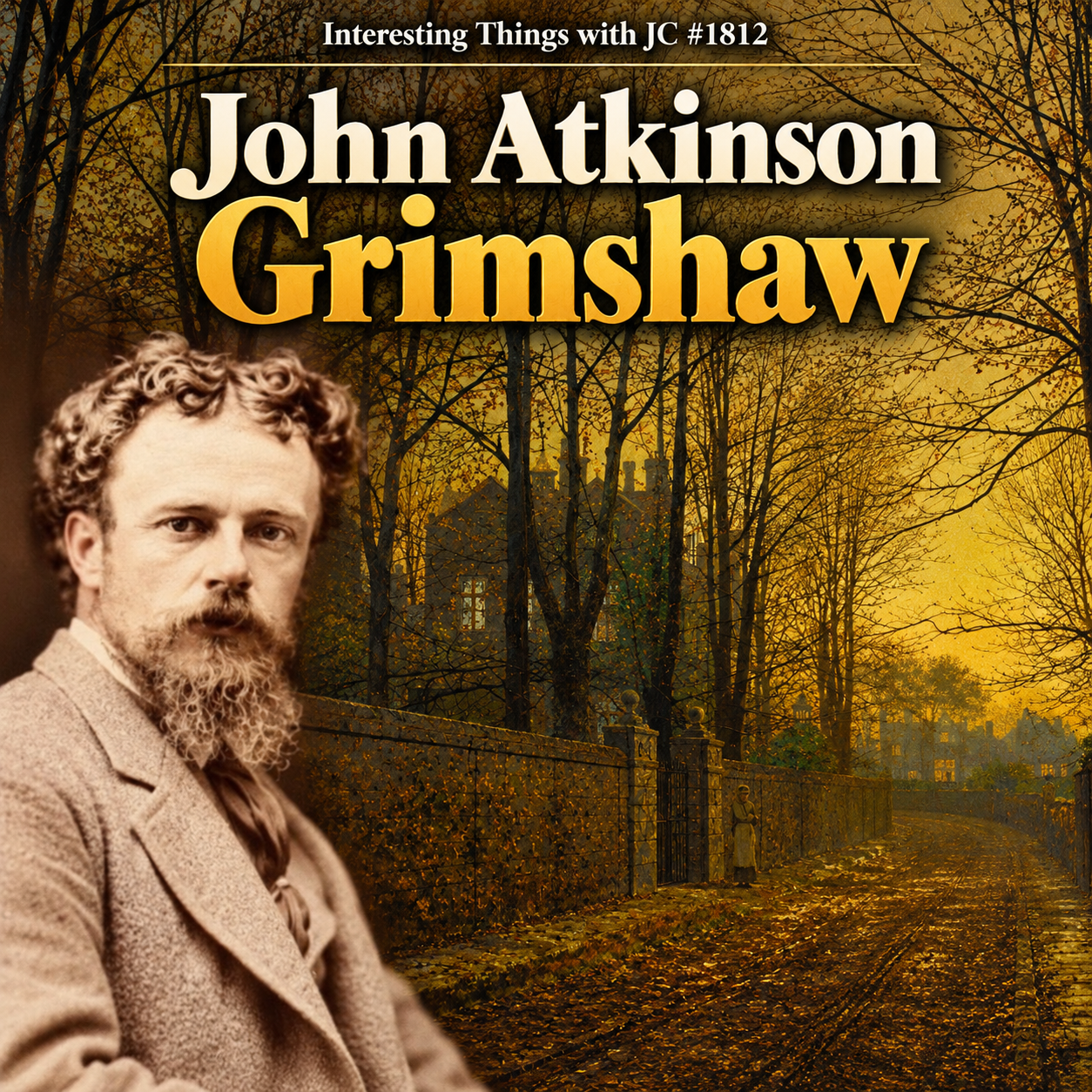
Interesting Things with JC #1812:
"John Atkinson Grimshaw"
His parents reportedly threw his paints into the fire, hoping to discourage his artistic ambitions. But John Atkinson Grimshaw (GRIM-shaw) continued painting, eventually becoming one of Victorian England's most distinctive artists.
Born in Leeds, England, in 1836, Grimshaw worked as a railway clerk while teaching himself to paint. In 1861, supported by his wife Frances, he left his secure employment to become a professional artist.
His earliest paintings featured flowers, birds, and carefully observed landscapes. Over time, he became fascinated with something more difficult to capture: the appearance of cities after dark.
Grimshaw painted moonlit streets, foggy harbors, and waterfronts illuminated by gas lamps. Wet cobblestones reflected warm artificial light against the cooler glow of the moon, creating remarkable depth.
His techniques were sometimes unconventional. Grimshaw occasionally painted directly over photographs, using their architectural detail as a foundation for carefully controlled color and light. His finished paintings could appear almost photographic, with individual brushstrokes barely visible.
Success allowed him to occupy Knostrop Old Hall (NOSS-trup), a 17th-century house near Leeds. He later maintained a coastal residence at Scarborough, but financial difficulties in 1879 forced him to give it up.
He also worked in London, where he encountered American painter James McNeill Whistler, another artist known for atmospheric nighttime scenes.
Although Grimshaw exhibited at the Royal Academy, private collectors provided an important market for his work. Beyond moonlit landscapes, he painted portraits, elaborate interiors, and mythological subjects. Several of his children also became artists.
Grimshaw died in 1893, aged 57.
Today, his paintings are held by Leeds Art Gallery, Scarborough Art Gallery, and Madrid's Thyssen-Bornemisza Museum, although individual works are not always displayed.
More than a century later, the familiar reflection of a streetlight on rain-soaked pavement still resembles the world Grimshaw painted.
These are interesting things, with JC.
Student Worksheet
Student Name: __________________________ Date: __________________________ Class: __________________________
Instructions: Listen to the episode, examine a documented Grimshaw artwork, and answer the questions using evidence from the audio, the artwork, or an identified historical source. Clearly distinguish observation from interpretation.
Part A — Listening Comprehension
In what city and year was John Atkinson Grimshaw born?
What occupation did Grimshaw leave in 1861?
What types of subjects appeared in his early paintings?
Identify three features commonly associated with his nighttime paintings.
How did photography sometimes contribute to his artistic process?
Name one location associated with Grimshaw's professional or personal life.
Part B — Visual Analysis
Select a documented painting by Grimshaw from a museum collection or reliable artwork catalogue.
Artwork Title: __________________________ Approximate Date: __________________________ Collection or Source: __________________________
Describe the principal subject of the painting without interpreting its emotional meaning.
Identify at least two light sources or lighting effects visible in the composition.
Explain how the artist directs the viewer's eye toward a particular area.
Describe the relationship between foreground, middle ground, and background.
Identify one feature that makes the image appear realistic.
Explain one way the painting differs from a neutral photographic record of the same environment.
Part C — Historical Evidence
The episode says Grimshaw's parents reportedly threw his paints into a fire. What does the word reportedly communicate about the evidence?
Why is a museum's artwork catalogue generally stronger evidence of an object's materials than an unattributed internet caption?
Does evidence that Grimshaw painted over some photographs establish that he used photographs for all his paintings? Explain.
What additional evidence would help determine whether a specific Grimshaw painting was created using a photographic foundation?
Part D — Interpretation and Reflection
How might gas lighting have changed people's experience of urban streets after dark?
Why might a Victorian artist choose to paint an almost empty street rather than a crowded commercial scene?
Compare the historical value of a Grimshaw painting with that of a contemporary photograph. What can each reveal, and what are their limitations?
In 100–150 words, explain how Grimshaw combined artistic choices with the visual conditions of Victorian Britain.
Difficulty Scaling
Level 1 — Foundational: Identify observable details and accurately recall biographical information.
Level 2 — Applied: Explain relationships between lighting, composition, historical setting, and artistic methods.
Level 3 — Advanced: Evaluate evidence, compare media, and develop a defensible interpretation supported by multiple sources.
Student Output: Completed responses, an identified artwork, and a 100–150-word evidence-based reflection.
Academic Integrity Guidance: Use your own observations and language. Identify external sources and distinguish source-supported facts from personal interpretations. AI-generated descriptions should not substitute for direct examination of an artwork.
Teacher Guide
Quick Start: Play episode #1812 once without interruption. Ask students to identify the central biographical conflict and the defining characteristics of Grimshaw's paintings. Play the episode again after introducing the visual analysis task.
Recommended Materials
Episode #1812 audio and transcript
Student worksheet
Projector or individual display devices
A documented Grimshaw painting from a museum or reputable collection catalogue
Access to museum collection records for evidence verification
Paper or digital writing materials
Suggested Artwork Selection
Choose an authenticated work that allows students to observe the effects of light, weather, architectural detail, or atmospheric perspective. Prefer a museum record that identifies the title, date or approximate date, materials, and collection.
For comparison, a second painting or a period photograph may be introduced. Do not describe an AI-generated imitation as an original Grimshaw artwork.
Pacing Guide — Audio First
0–5 minutes — Opening Inquiry: Ask students what makes a nighttime street visually different from the same street during daylight. Collect observations about illumination, shadow, visibility, and atmosphere.
5–10 minutes — First Listening: Play the episode. Students identify Grimshaw's original occupation, career transition, and principal artistic subjects.
10–15 minutes — Vocabulary and Context: Introduce nocturne, composition, reflection, gaslight, photographic reference, and provenance.
15–25 minutes — Visual Investigation: Display an authenticated painting. Students complete Worksheet Part B using direct observation.
25–35 minutes — Historical Evidence: Students complete Part C, distinguishing documented object information from retrospective biographical claims.
35–45 minutes — Interpretation: Students answer Part D and write a brief evidence-based explanation.
45–50 minutes — Exit Assessment: Students submit one verified historical fact, one visual observation, and one interpretation, each clearly identified.
Discussion Prompts
How does the placement of artificial light influence the viewer's understanding of a scene?
Why might wet surfaces be especially useful in a nighttime painting?
What visual characteristics can make an oil painting resemble a photograph?
Can a painting be historically informative even when its composition is carefully arranged?
How should historians handle a memorable anecdote that survives through a later account?
Does using a photograph as a foundation reduce, increase, or simply change the artist's creative choices?
Formative Checkpoints
Students distinguish observation from interpretation.
Students correctly identify 1861 as the year Grimshaw left railway employment.
Students describe at least two lighting effects using appropriate terminology.
Students explain that documented photographic techniques apply to particular works, not automatically to an artist's entire output.
Students provide a source for an artwork's attribution.
Answer Key — Student Worksheet
Part A
Leeds, England, in 1836.
Railway clerk.
Flowers, birds, and landscapes.
Accept moonlight, gas lamps, wet streets, reflections, fog, harbors, atmospheric depth, or related accurate examples.
He sometimes painted directly over photographic images, incorporating photographic detail into painted compositions.
Accept Leeds, Knostrop Old Hall, Scarborough, or London when appropriately explained.
Part B
Answers depend on the selected painting. Look for objective descriptions of visible subjects.
Accept accurately identified natural or artificial light sources and effects.
Accept explanations involving perspective, contrast, light placement, architectural lines, or composition.
Students should distinguish spatial layers using specific visual evidence.
Accept detailed architecture, convincing reflections, perspective, or other observable characteristics.
Strong responses explain the artist's deliberate selection or modification of lighting, color, composition, atmosphere, or emphasis.
Part C
It signals that the story is attributed to an account rather than presented as directly established through contemporary eyewitness documentation.
Museum records generally provide curatorial attribution, material descriptions, cataloguing history, and institutional accountability.
No. Evidence concerning particular artworks does not establish a universal practice.
Accept conservation analysis, technical imaging, a museum materials record, documented photographs, or other object-specific evidence.
Part D
Gas lighting increased artificial illumination in streets and commercial areas, although coverage and brightness varied.
Accept defensible interpretations involving atmosphere, composition, mood, artistic preference, or emphasis on architecture and light.
Strong responses recognize that both media involve selection and framing, while differing in materials, methods, and opportunities for artistic modification.
Evaluate factual accuracy, use of visual evidence, historical reasoning, and distinction between observation and interpretation.
Common Misconceptions
Misconception: Every Grimshaw painting was created over a photograph. Correction: Documentary evidence supports the practice for some works; each artwork requires its own investigation.
Misconception: Photographic realism means a painting must be an exact historical record. Correction: Artists make choices about composition, color, lighting, and subject placement.
Misconception: All Victorian streets were illuminated by gas lamps. Correction: Lighting infrastructure varied across locations and changed over time.
Misconception: A museum holding a painting means it is currently on display. Correction: Collection ownership and exhibition status are different.
Misconception: A memorable biographical anecdote is necessarily a verified eyewitness fact. Correction: Historical claims must be evaluated according to their source and supporting evidence.
Differentiation
Additional Support: Provide a labeled image and sentence starters such as “The strongest light appears…” and “The source establishes…”
English Learners: Preteach key visual vocabulary using annotated examples and allow brief oral explanations before written responses.
Advanced Learners: Compare a Grimshaw nocturne with a work by James McNeill Whistler, emphasizing independently observable similarities and differences.
Visual Accessibility: Supply detailed artwork descriptions and invite analysis of composition, historical documentation, and artistic technique without requiring visual identification alone.
Auditory Accessibility: Provide the complete transcript and allow students to read while listening or instead of listening.
Extension Activities
Compare a Victorian gaslit street scene with a contemporary nighttime photograph.
Investigate the historical development of urban street lighting.
Research the relationship between 19th-century photography and painting.
Write a museum label distinguishing verified facts from visual interpretation.
Examine how digital image editing changes contemporary expectations of photographic authenticity.
Quiz
Instructions: Answer the following questions using information from the episode and lesson materials. Each question is worth 2 points unless otherwise indicated.
1. Where was John Atkinson Grimshaw born? A. London B. Leeds C. Edinburgh D. Manchester
2. Which occupation did Grimshaw leave in 1861? A. Railway clerk B. Shipbuilder C. Photographer D. Architect
3. Which subjects were associated with Grimshaw's early paintings? A. Abstract geometric patterns B. Military battles C. Flowers, birds, and landscapes D. Industrial machinery exclusively
4. Which feature is especially characteristic of Grimshaw's best-known paintings? A. Brightly colored geometric abstraction B. Moonlit streets and atmospheric lighting C. Large-scale marble sculpture D. Medieval manuscript illustration
5. What does the term nocturne describe in visual art? A. A nighttime composition B. A painting completed in one hour C. A work made exclusively from photographs D. A portrait of a musician
6. Which statement about Grimshaw's photographic techniques is supported by documented artworks? A. He never used photography. B. Every painting was created from a projected image. C. He sometimes painted directly over photographs. D. He invented photographic film.
7. What effect can reflections on wet pavement produce in a nighttime painting? A. They eliminate perspective. B. They extend visible illumination and contribute to depth. C. They prevent color contrast. D. They remove the need for composition.
8. Why should students distinguish museum holdings from museum displays? A. All museum paintings are permanently exhibited. B. Museums do not document their collections. C. A museum may own a work without exhibiting it at a particular time. D. Collection records contain no historical information.
9. Short Answer: Explain why the word reportedly is appropriate when describing the story about Grimshaw's parents burning his paints. (2 points)
10. Short Answer: Identify one way a painting can provide historical information while still reflecting the artist's individual choices. (2 points)
Quiz Answer Key
B — Leeds
A — Railway clerk
C — Flowers, birds, and landscapes
B — Moonlit streets and atmospheric lighting
A — A nighttime composition
C — He sometimes painted directly over photographs
B — They extend visible illumination and contribute to depth
C — A museum may own a work without exhibiting it
The anecdote is documented in a later historical account, but should not be treated as a directly verified eyewitness statement.
Accept explanations recognizing that paintings can preserve architectural, environmental, or cultural information while selectively arranging or modifying visual elements.
Total: 20 points.
Assessment
Assessment Strategy
Student understanding is measured through listening comprehension, visual analysis, historical source evaluation, and written interpretation.
Evidence of Learning
Completed Student Worksheet
Quiz responses
100–150-word interpretive reflection
Exit assessment identifying fact, observation, and interpretation
Analytic Assessment Rubric — 20 Points
1. Historical Accuracy — 0–5 Points
5 — Exemplary: All major claims are accurate, appropriately qualified, and supported by identifiable evidence.
4 — Proficient: Claims are substantially accurate, with minor omissions.
3 — Developing: Basic understanding is evident, but some details lack precision.
2 — Limited: Several errors or unsupported generalizations.
1 — Minimal: Very little accurate historical content.
0 — No Evidence: No relevant response.
2. Visual Analysis — 0–5 Points
5 — Exemplary: Precise observations of lighting, composition, atmosphere, and spatial relationships.
4 — Proficient: Clear visual observations with relevant examples.
3 — Developing: Some accurate observations but limited explanation.
2 — Limited: General statements with little visual support.
1 — Minimal: Very limited engagement with the artwork.
0 — No Evidence: No relevant response.
3. Evidence Evaluation — 0–5 Points
5 — Exemplary: Consistently distinguishes primary evidence, secondary accounts, and interpretation.
4 — Proficient: Usually distinguishes claims according to evidentiary strength.
3 — Developing: Recognizes some source differences but applies them inconsistently.
2 — Limited: Relies heavily on unsupported claims.
1 — Minimal: Little understanding of source reliability.
0 — No Evidence: No relevant response.
4. Communication and Reasoning — 0–5 Points
5 — Exemplary: Clear, coherent, well-supported interpretation with appropriate terminology.
4 — Proficient: Organized explanation with relevant evidence.
3 — Developing: Understandable but insufficiently supported.
2 — Limited: Unclear or weakly organized reasoning.
1 — Minimal: Fragmentary response.
0 — No Evidence: No relevant response.
Performance Interpretation
18–20: Advanced mastery
15–17: Proficient mastery
11–14: Developing understanding
7–10: Additional instruction recommended
0–6: Significant support recommended
Mastery Target: At least 15 out of 20 points, including a clear distinction between historical evidence and interpretation.
Assessment Accommodations
Allow equivalent oral, typed, or assistive-technology-supported responses where appropriate. Evaluate the intended learning objectives rather than handwriting, speech fluency, or unrelated presentation barriers.
Standards Alignment
Common Core State Standards — English Language Arts
CCSS.ELA-LITERACY.RH.9-10.1 — Cite specific textual evidence to support analysis of primary and secondary sources. Students substantiate biographical claims using historical accounts and museum documentation.
CCSS.ELA-LITERACY.RH.11-12.7 — Integrate and evaluate multiple sources of information presented in diverse formats and media. Students compare audio narration, artwork images, and institutional collection records.
CCSS.ELA-LITERACY.SL.9-10.2 — Integrate multiple sources of information presented in diverse media or formats. Students synthesize information from listening, reading, and visual analysis.
CCSS.ELA-LITERACY.WHST.9-10.2 — Write informative/explanatory texts, including the narration of historical events, scientific procedures/experiments, or technical processes. Students explain Grimshaw's methods and historical context in an organized written response.
CCSS.ELA-LITERACY.WHST.11-12.9 — Draw evidence from informational texts to support analysis, reflection, and research. Students incorporate documented evidence into an interpretive argument.
National Core Arts Standards — Visual Arts
VA:Re7.1.HSI — Perceive and analyze artistic work. Students hypothesize about the ways artistic choices influence perception and understanding.
VA:Re7.2.HSI — Perceive and analyze artistic work. Students analyze how responses to art are influenced by knowledge and experience.
VA:Re8.1.HSI — Interpret intent and meaning in artistic work. Students interpret a painting using subject matter, formal characteristics, context, and evidence.
VA:Cn11.1.HSI — Relate artistic ideas and works with societal, cultural, and historical context to deepen understanding. Students connect Grimshaw's subjects and techniques with Victorian urban development and visual technology.
C3 Framework — College, Career, and Civic Life
D2.His.1.9-12 — Evaluate how historical events and developments were shaped by unique circumstances of time and place as well as broader historical contexts. Students examine Grimshaw's career in relation to Victorian industrial and urban change.
D2.His.9.9-12 — Analyze the relationship between historical sources and the secondary interpretations made from them. Students evaluate the distinction between documented artworks and later biographical narratives.
D2.His.10.9-12 — Detect possible limitations in various kinds of historical evidence and differing secondary interpretations. Students examine the limitations of paintings, photographs, and retrospective accounts.
D3.1.9-12 — Gather relevant information from multiple sources representing a wide range of views while using the origin, authority, structure, context, and corroborative value of the sources to guide the selection. Students prioritize credible collection records and documented historical research.
ISTE Standards for Students
1.3.b — Evaluate Information. Students assess the accuracy, credibility, and relevance of digital artwork records.
1.3.c — Curate Information. Students organize sourced visual and historical evidence to support their interpretation.
1.6.c — Communicate Complex Ideas. Students communicate an evidence-based interpretation using appropriate visual and written explanations.
ACRL Framework for Information Literacy
Authority Is Constructed and Contextual: Students consider why museum curators, historians, and unattributed online captions carry different kinds of authority.
Information Creation as a Process: Students distinguish a photograph, oil painting, museum catalogue entry, and modern digital reproduction.
Research as Inquiry: Students formulate questions about how Grimshaw produced particular artworks and what evidence would answer them.
Scholarship as Conversation: Students recognize that interpretations of an artist's life and methods can develop as evidence is examined.
Next Generation Science Standards — Interdisciplinary Connection
This is primarily an art history and humanities lesson. NGSS connections are supplementary rather than a claim that the lesson fulfills a complete high-school science performance expectation.
Science and Engineering Practice — Analyzing and Interpreting Data: Students examine visual evidence concerning reflection, illumination, and atmospheric conditions.
Crosscutting Concept — Cause and Effect: Students consider how lighting conditions influence the appearance of surfaces and environments.
Bloom's Revised Taxonomy
Remember: Recall biographical details and define vocabulary.
Understand: Explain characteristics of Victorian nocturnes.
Apply: Use visual vocabulary to describe an unfamiliar painting.
Analyze: Examine lighting, composition, and photographic techniques.
Evaluate: Judge the reliability and limitations of historical evidence.
Create: Produce an original, evidence-based visual interpretation.
Universal Design for Learning
Multiple Means of Engagement: Offer artistic, historical, and technological entry points.
Multiple Means of Representation: Provide audio, transcript, accessible image descriptions, and documentary sources.
Multiple Means of Action and Expression: Permit written, spoken, or appropriately adapted analytical responses.
Career and Technical Education Connections
Arts, A/V Technology, and Communications: Artistic production, image composition, visual storytelling, and documentation.
Information Technology and Digital Media: Image provenance, reproduction, and responsible presentation of visual evidence.
Education and Training: Museum interpretation, educational media, and curriculum development.
International Curriculum Connections
UK National Curriculum — Art and Design: Critical understanding of major artists and historical artistic practices.
UK National Curriculum — History: Understanding British social and technological change during the 19th century.
International Baccalaureate — Visual Arts: Contextual investigation, comparative analysis, and critical interpretation.
Cambridge International — Art & Design: Observational analysis, research into artistic practice, and informed visual interpretation.
Alignment Note: These are instructional connections, not claims of formal endorsement or certification by the named standards organizations.
Show Notes
Episode Description
John Atkinson Grimshaw left a secure railway job in 1861 to become a professional painter, despite reported family opposition. He became known for atmospheric depictions of Victorian streets, harbors, and landscapes, particularly scenes illuminated by moonlight and gas lamps.
Some of his documented works incorporated photographic images beneath oil paint, providing a compelling example of the relationship between traditional painting and emerging visual technologies.
Key Takeaways
Grimshaw was born in Leeds in 1836 and died in 1893.
He left railway employment in 1861 to pursue professional painting.
His early subjects included flowers, birds, and landscapes.
He became especially associated with moonlit urban scenes and atmospheric effects.
Documentary evidence establishes that he sometimes painted directly over photographs.
His works are represented in British and international museum collections.
Classroom Applications
Victorian history and industrialization
Visual arts and art history
Photography and media literacy
Historical source evaluation
Composition and visual communication
Museum studies and cultural heritage
Suggested Student Research Question
How did Grimshaw's combination of photographic detail and atmospheric painting techniques influence the way viewers experience his depictions of Victorian Britain?
Educational Use
Free curriculum materials are available on the website, with no login or paywall. Classroom and educational use is permitted with attribution. Commercial resale is not permitted.
Attribution: Interesting Things with JC, created and hosted by JC.
Artwork Rights Note: Rights and reproduction conditions for individual paintings, historical photographs, museum images, and modern photographic reproductions must be assessed separately. The availability of an artwork online does not automatically establish unrestricted reuse rights.
References
Primary and Institutional Sources
Leeds Museums and Galleries. (n.d.). Leeds Art Gallery. Leeds City Council. https://museumsandgalleries.leeds.gov.uk/leeds-art-gallery/
Museo Nacional Thyssen-Bornemisza. (n.d.). Collection. https://www.museothyssen.org/en/collection
Art UK. (n.d.). Discover artworks and artists in UK public collections. https://artuk.org/
Royal Academy of Arts. (n.d.). Royal Academy of Arts. https://www.royalacademy.org.uk/
Christie's. (n.d.). Auction results and artwork catalogues. https://www.christies.com/
Historical and Contextual Sources
The Thoresby Society. (n.d.). Historical research on Leeds and its people. https://www.thoresby.org.uk/
Tate. (n.d.). Art and artists. https://www.tate.org.uk/art
Victoria and Albert Museum. (n.d.). Collections. https://www.vam.ac.uk/collections
National Gallery of Art. (n.d.). Art history and educational resources. https://www.nga.gov/
Standards and Curriculum Sources
National Governors Association Center for Best Practices & Council of Chief State School Officers. (2010). Common Core State Standards. https://www.thecorestandards.org/
National Coalition for Core Arts Standards. (2014). National Core Arts Standards. https://www.nationalartsstandards.org/
National Council for the Social Studies. (2013). The College, Career, and Civic Life (C3) Framework for Social Studies State Standards. https://www.socialstudies.org/standards/c3
International Society for Technology in Education. (n.d.). ISTE Standards. https://iste.org/standards
Association of College and Research Libraries. (2016). Framework for Information Literacy for Higher Education. American Library Association. https://www.ala.org/acrl/standards/ilframework
CAST. (2024). Universal Design for Learning Guidelines, version 3.0. https://udlguidelines.cast.org/
NGSS Lead States. (2013). Next Generation Science Standards: For States, By States. https://www.nextgenscience.org/
Department for Education. (2014). National curriculum in England: Secondary curriculum. GOV.UK. https://www.gov.uk/national-curriculum
International Baccalaureate Organization. (n.d.). Diploma Programme: Visual arts. https://www.ibo.org/
Cambridge International Education. (n.d.). Cambridge International AS & A Level Art & Design. https://www.cambridgeinternational.org/