1813: "Flock Cameras and Your Kids"
Interesting Things with JC #1813: "Flock Cameras and Your Kids"
Police investigating a missing 13-year-old girl in Tennessee use Flock Safety license plate cameras and a witness's video to follow a lead nearly 300 miles into North Carolina. Meanwhile, parents routinely post children's sports photographs revealing faces, school names, and team schedules, raising an unexpected question about which cameras expose children's identities.
Curriculum - Episode Anchor
Episode Title: Flock Cameras and Your Kids
Episode Number: 1813
Series: Interesting Things with JC
Host: JC
Release Date: October 22, 2026
Audience: Grades 9–12, introductory college, homeschool, lifelong learners
Subject Area: Technology, Digital Citizenship, Civics, Media Literacy, Information Privacy, Public Safety
Instructional Duration: 50 minutes
Audio Duration: Approximately 3 minutes
Instructional Approach: Audio-first, evidence-based inquiry, case study analysis, applied digital citizenship
Central Topic: How automated license plate recognition supports police investigations, how publicly shared photographs can expose information about children, and how evidence, privacy safeguards, and responsible decision-making intersect.
Lesson Overview
Overview
In August 2026, investigators in Lenoir City, Tennessee, used video from a citizen's Meta smart glasses and Flock Safety license plate camera records to help locate a missing 13-year-old girl in North Carolina.
This lesson examines the technology behind that investigation and compares the information collected by automated license plate recognition systems with identifying details that may appear in publicly shared photographs of children.
Students investigate what each technology records, how separate pieces of information can be combined, and why responsible access, data retention, and digital citizenship matter.
Essential Question: How can information collected or shared for a legitimate purpose create both public-safety benefits and privacy risks?
Learning Objectives
Students will be able to:
Explain how automated license plate recognition technology collects and organizes vehicle information.
Reconstruct the sequence of evidence used in a documented missing-child investigation.
Distinguish between identifying a vehicle, identifying a person, and establishing a person's location.
Evaluate privacy risks associated with public photographs and propose practical safeguards for both institutional and individual information sharing.
Success Criteria
Students demonstrate mastery when they can:
Accurately describe at least four types of information collected by an ALPR system.
Identify the distinct contributions of the citizen's video, camera records, and investigators.
Explain at least two limitations of license plate recognition.
Identify three details in a hypothetical sports photograph that could disclose information about a child.
Support a balanced recommendation with evidence from the episode and provided sources.
Student Relevance: Students regularly encounter cameras, social media photographs, school schedules, and location information. Understanding how these details connect supports informed decisions about personal privacy and public safety.
Real-World Connection: Police, schools, families, athletic organizations, and technology providers make decisions about collecting, accessing, retaining, and sharing information.
Workforce Reality: Careers in law enforcement, cybersecurity, information technology, education, digital forensics, journalism, and privacy compliance require careful evidence handling, technical accuracy, and responsible information management.
Key Vocabulary
Automated License Plate Recognition (ALPR) (AW-tuh-may-tid LYE-sens playt rek-ug-NISH-un): Technology that photographs vehicles and uses software to identify and organize license plate information.
Flock Safety (flok SAYF-tee): A technology company providing automated license plate readers and related public-safety systems.
Investigative Lead (in-VES-tuh-guh-tiv leed): Information that suggests a useful direction for an investigation but does not independently establish what happened.
Metadata (MET-uh-day-tuh): Information describing other data, such as the time and location associated with a camera observation.
Facial Recognition (FAY-shul rek-ug-NISH-un): Technology that analyzes facial features to help identify or verify individuals.
Data Retention (DAY-tuh ri-TEN-shun): The length of time information is stored before deletion or another authorized disposition.
Audit Log (AW-dit log): A record of system activity that can help administrators review who accessed information and when.
Digital Footprint (DIJ-i-tul FOOT-print): Information about a person that becomes available through digital activity, including posts, photographs, and associated details.
Geolocation (jee-oh-loh-KAY-shun): Information identifying or estimating a geographic location.
Corroboration (kuh-rob-uh-RAY-shun): Using additional evidence to support or check an observation, statement, or conclusion.
Narrative Core
Open — The Missing Child
A 13-year-old girl disappears while walking her family's dog in Tennessee. Multiple agencies begin searching. A concerned citizen supplies video of a convertible recorded with Meta smart glasses.
Info — The Investigative Connection
Police combine the witness's footage with Flock Safety license plate camera records. The information leads investigators toward a possible address in North Carolina, where deputies recover the girl safely.
Details — How the Technology Works
Automated license plate readers record vehicle characteristics, plate information, times, and locations. They do not independently establish who was driving. Their records can provide investigative leads and reveal vehicle travel patterns.
Reflection — Information Beyond the Camera
A youth sports photograph can disclose a child's face, school affiliation, teammates, and other identifying details. Public schedules can provide additional information about future activities and locations.
Closing — Two Cameras, Different Information
A license plate camera may help police locate a vehicle associated with a missing-child investigation. A publicly shared photograph may reveal personal information about children and their routines.
Required Series Closing: These are interesting things, with JC.
Transcript
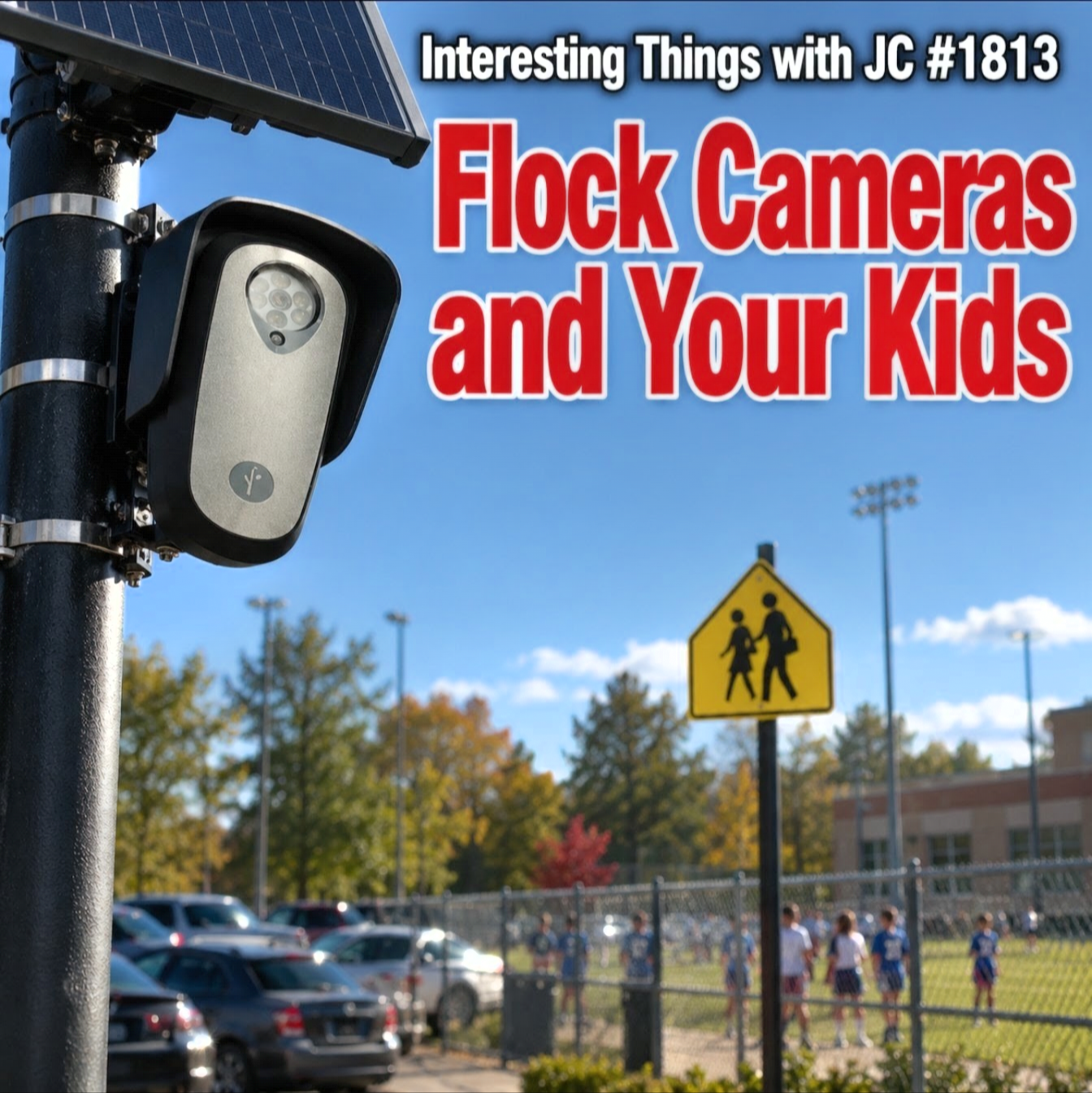
Square podcast cover art for Interesting Things with JC, episode 1813, “Flock Cameras and Your Kids.” A solar-powered Flock Safety license plate camera stands beside a school athletic field, with parked cars, students, and a pedestrian crossing sign in the background. Large red title lettering has a white outline.
Interesting Things with JC #1813:
"Flock Cameras and Your Kids"
In August 2026, a 13-year-old girl went missing while walking her family's dog in Lenoir City, Tennessee. More than a dozen agencies joined the search. Then someone who had noticed a suspicious convertible came forward with video recorded on Meta smart glasses.
Police examined the footage and searched Flock Safety license plate camera records. Within about 30 minutes, investigators had a possible address in North Carolina, nearly 300 miles away. Deputies found the girl safe roughly two hours after police received the video. She had been missing for about 28 hours.
What made the difference wasn't a camera recognizing a child's face. It was a witness noticing a car, and investigators finding where that car had been seen.
Flock's automated license plate readers photograph passing vehicles, recording plate numbers, descriptions, times, and locations. They don't use facial recognition. Police can use the records to follow leads, but a plate alone doesn't tell them who was behind the wheel.
Those records can reveal travel patterns, too. That's why access restrictions and audits they’re very important. In 2026, Flock introduced a seven-day default retention period for new law enforcement customers, while existing agencies may have different rules.
Now think about a picture posted after a youth soccer game. You might see a child's face, jersey number, school name, and teammates. A publicly posted schedule can supply the next game's location and time. The person who shares the picture may know everyone in it. The person who saves it may not.
Near a school, a license plate camera can give police a lead when a child is missing. On the sidelines, a phone camera can reveal a child's identity and where that child will be next Saturday.
Protecting children means balancing safety with privacy. Cameras can help police find a missing child, but the same technology can reveal where people go and when. And while parents want to share their children's accomplishments, those photographs can expose more than intended. The challenge isn't choosing between safety and privacy. It's using technology responsibly, limiting what we collect and share, and remembering who we're trying to protect.
These are interesting things, with JC.
Student Worksheet
Student Name: ____________________
Date: ____________________
Class: ____________________
Instructions: Listen to the episode, answer using complete sentences where requested, and distinguish information established by evidence from conclusions that require further investigation.
Part A — Comprehension
In which Tennessee city did the missing-child investigation begin?
What unusual device did the concerned citizen use to record the convertible?
What role did Flock Safety cameras play in the investigation?
Identify four categories of information that automated license plate readers record.
Why does identifying a license plate not automatically identify the driver?
Part B — Evidence and Analysis
Explain how the citizen's video and ALPR records contributed different kinds of information to the investigation.
Why could observations of the same vehicle at different locations be useful to police?
What privacy concern arises when vehicle observations are stored and searchable?
Explain why a publicly shared photograph might reveal more about a child than the photographer intended.
Describe the difference between a documented observation and an inference. Use an example from the episode.
Part C — Applied Digital Citizenship
Scenario: A parent publicly posts a photograph of a youth soccer team. The image includes players' faces, jersey numbers, and the school's name. The caption identifies the tournament, and the team website lists its next game.
Identify at least four details that could be connected to identify a child or predict the team's next location.
Recommend three practical changes that would reduce unnecessary exposure while allowing families to celebrate the team's achievement.
Explain why removing a photograph later may not completely eliminate its exposure.
Part D — Public Safety and Privacy
Identify one demonstrated public-safety benefit of ALPR technology and one privacy risk.
Propose two safeguards that could help police use camera records responsibly without eliminating their investigative value.
Part E — Reflection
Should public-safety camera systems and parents sharing children's photographs be evaluated using identical privacy rules? Explain which responsibilities are shared and which differ.
Difficulty Scaling
Level 1 — Foundational: Complete questions 1–5 and identify two privacy precautions from the scenario.
Level 2 — Proficient: Complete questions 1–15, using specific evidence from the episode.
Level 3 — Advanced: Complete all questions and write a 200–250-word evidence-based recommendation comparing institutional data safeguards with individual sharing decisions.
Student Output: A completed worksheet, an annotated evidence comparison, and a written recommendation.
Academic Integrity Guidance: Use your own words, identify sources when using outside information, and do not present assumptions about the missing-child case as established facts. Do not research or disclose the child's personal identity or private information.
Teacher Guide
Quick Start: Play the episode once without interruption. Ask students to identify the evidence that helped police and the information that could be disclosed through a public sports photograph. Replay the episode for factual verification.
Pacing Guide — Audio First
0–5 minutes: Bell ringer and prior knowledge.
5–9 minutes: First listening and initial observations.
9–14 minutes: Vocabulary review and second listening.
14–24 minutes: Case reconstruction and comprehension questions.
24–34 minutes: Youth sports photograph privacy scenario.
34–44 minutes: Evidence-based discussion and safeguards.
44–50 minutes: Exit ticket and formative assessment.
Bell Ringer
Ask students:
What information can a camera record without identifying a person?
What information might appear unintentionally in a photograph shared online?
Students write two brief observations before discussing.
Audio Guidance and Fallback
Play the complete episode once without pausing.
Replay relevant portions during the evidence-reconstruction activity.
If audio is unavailable, read the transcript aloud or assign paired reading.
Provide the transcript in advance for students requiring text access.
Time on Task: 50 minutes, including approximately six minutes allocated to listening and replay.
Materials
Episode audio or full transcript
Student worksheet
Writing materials or digital response platform
Projector or whiteboard
Teacher-prepared fictional sports photograph description
Optional printed source excerpts
Vocabulary Preparation
Introduce ALPR, investigative lead, metadata, data retention, and digital footprint before the second listening.
Clarify that the system discussed in the episode recognizes license plates, not faces.
Common Misconceptions
Misconception: A license plate identifies the person driving.
Correction: A plate identifies a vehicle registration associated with a plate; additional evidence is needed to establish who was driving.Misconception: License plate cameras continuously follow vehicles everywhere.
Correction: Fixed cameras create observations at specific locations and times. Multiple observations can help reconstruct movements.Misconception: A camera record proves a crime occurred.
Correction: A camera record may provide an investigative lead, but it does not establish guilt.Misconception: A publicly posted photograph contains only the information the person intended to share.
Correction: Background details, clothing, captions, schedules, and recognizable locations may provide additional information.Misconception: Deleting a photograph guarantees that no copies remain.
Correction: Public content may already have been downloaded, captured, or redistributed.
Discussion Prompts
What made the citizen's observation useful to investigators?
How did separate technologies contribute to the recovery?
Why is the difference between a vehicle and a person important?
What safeguards are appropriate when institutions store searchable location information?
How can parents reduce unnecessary disclosure without avoiding all family photography?
Formative Checkpoints
Students accurately distinguish vehicle recognition from facial recognition.
Students correctly identify the witness's contribution and the ALPR contribution.
Students recognize that a photograph and public schedule can be combined.
Students propose safeguards connected to a specific identified risk.
Differentiation
Additional Support: Provide a vocabulary bank and a partially completed evidence sequence.
Advanced Learners: Ask students to compare the strength and limitations of witness video, plate recognition, and corroborating records.
English Learners: Provide phonetic vocabulary support and sentence starters such as “The camera recorded…” and “Investigators still needed…”
Accessibility: Provide a readable transcript, flexible response formats, and extended processing time where appropriate.
Assessment Differentiation
Allow oral responses or dictated answers for students requiring writing accommodations.
Use shorter evidence explanations for foundational learners.
Require explicit source evaluation and qualification of uncertain claims for advanced learners.
Time Flexibility
30 minutes: Audio, five comprehension questions, scenario analysis, exit ticket.
50 minutes: Complete core lesson.
75 minutes: Add source comparison and a written recommendation.
Substitute Readiness: The transcript, vocabulary, worksheet, quiz, and answer key allow delivery without additional research. Avoid displaying identifiable photographs of actual students without appropriate permission.
Engagement Strategy: Present two hypothetical records: an ALPR observation of a vehicle at 3:15 p.m. and a publicly posted soccer photo identifying a team and its next game. Ask students to identify exactly what each record establishes and what remains unknown.
Extensions
Create a privacy checklist for a youth sports organization.
Compare two hypothetical agency data-retention policies.
Draft a school-community information sheet explaining ALPR capabilities and limitations.
Analyze how metadata can increase the usefulness and sensitivity of otherwise ordinary information.
Cross-Curricular Connections
Technology: Pattern recognition, databases, information security.
Civics: Government accountability, public safety, privacy safeguards.
English Language Arts: Evidence evaluation and explanatory writing.
Media Literacy: Contextual information, online audiences, and digital footprints.
Career Education: Digital forensics, policing, cybersecurity, information governance.
Social and Emotional Learning
Encourage respectful discussion of family decisions and public-safety concerns.
Avoid inviting students to disclose personal experiences involving missing persons or online victimization.
Emphasize informed decision-making rather than fear or blame.
Skill Emphasis: Evidence evaluation, causal reasoning, information literacy, ethical decision-making, and precise communication.
Answer Key
Lenoir City, Tennessee.
Meta smart glasses.
They supplied vehicle observations that helped investigators pursue a lead into North Carolina.
License plate number, vehicle description, location, and time.
The driver may differ from the registered owner, and the camera does not establish who was operating the vehicle.
The witness's video helped identify a vehicle of interest; ALPR records helped investigators locate relevant vehicle sightings.
Multiple observations can establish possible travel direction, timing, and locations.
Searchable records may reveal patterns of movement, creating risks if improperly accessed or used.
Faces, names, uniforms, locations, captions, and schedules can be combined to identify individuals or predict activities.
Observation: A vehicle was recorded at a particular location. Inference: A particular person was driving it.
Faces, jersey numbers, school name, tournament location, and the publicly listed next game.
Accept appropriate measures such as limiting the audience, omitting identifying captions, avoiding real-time location disclosure, cropping sensitive details, or following school photo-permission policies.
Copies, screenshots, and redistribution may persist.
Benefit: Generating leads that helped recover a missing child. Risk: Unauthorized access to vehicle movement records.
Accept documented search purposes, role-based access, audit review, limited retention, access controls, and appropriate oversight.
Answers should distinguish shared responsibilities for protecting information from the different legal, operational, and consent considerations affecting public agencies and individual families.
Quiz
Instructions: Select the best answer for each question. Do not use outside sources.
What is the primary function of automated license plate recognition technology?
A. Identifying every passenger in a vehicle
B. Recording and organizing vehicle and license plate observations
C. Determining whether a driver has committed a crime
D. Recording private conversations inside vehicles
Why was the citizen's Meta smart glasses video important in the Tennessee investigation?
A. It independently identified the missing child's exact location
B. It provided a vehicle lead that investigators could pursue
C. It automatically issued a missing-person alert
D. It established the identity of every person inside the vehicle
Which conclusion is NOT justified by a license plate observation alone?
A. A particular plate was recorded
B. A vehicle was observed at a recorded location
C. A specific person was driving the vehicle
D. A timestamp was associated with the observation
Which combination presents the clearest potential privacy concern in a publicly shared youth sports photograph?
A. A photograph of an empty soccer field
B. A photograph of a soccer ball without identifying details
C. A child's identifiable photograph combined with a school name and public game schedule
D. A photograph of an unmarked scoreboard
Which practice best supports accountable use of ALPR records?
A. Allowing unrestricted searches without records
B. Keeping all records permanently by default
C. Requiring documented search purposes and reviewing access logs
D. Publishing every vehicle observation online
Assessment
Open-Ended Assessment
Evidence Reconstruction: Explain how a citizen's video and ALPR records contributed to the Tennessee missing-child investigation. Identify what each source established, what it did not establish, and why corroboration matters.
Applied Privacy Analysis: Compare a police license plate observation with a publicly shared youth sports photograph. Explain the information each may reveal, identify relevant privacy risks, and recommend safeguards appropriate to each situation.
Assessment Requirements
Students must:
Use accurate technical vocabulary.
Include at least two specific facts from the episode.
Distinguish evidence from inference.
Explain at least one benefit and one limitation of each information source.
Provide practical, evidence-based recommendations.
3–2–1 Rubric
3 — Proficient: Accurate explanation, specific supporting evidence, clear distinctions between observation and inference, and appropriate safeguards.
2 — Developing: Mostly accurate explanation with limited supporting detail or incomplete treatment of limitations and safeguards.
1 — Beginning: Significant factual confusion, unsupported conclusions, or missing explanation of the technology and privacy issues.
Suggested Scoring: Score each open-ended response from 1–3, for a total of 6 points.
Exit Ticket
Identify one fact an ALPR camera can establish.
Identify one conclusion it cannot establish without additional evidence.
Name one detail parents should review before publicly sharing a photograph of children.
Teacher Quiz Key: 1. B; 2. B; 3. C; 4. C; 5. C.
Standards Alignment
NGSS — Science and Engineering Practices
Engaging in Argument from Evidence: Students distinguish camera observations from unsupported conclusions and justify interpretations using evidence.
Obtaining, Evaluating, and Communicating Information: Students examine the capabilities and limitations of a technical information system and communicate findings accurately.
CCSS — Reading Informational Text
CCSS.ELA-LITERACY.RI.9-10.1 — Cite Strong and Thorough Textual Evidence: Students support claims about the investigation and ALPR capabilities with evidence from the transcript and source excerpts.
CCSS.ELA-LITERACY.RI.11-12.7 — Integrate and Evaluate Multiple Sources of Information Presented in Different Media or Formats: Students compare audio reporting, written reporting, and technology-provider explanations.
CCSS — Writing
CCSS.ELA-LITERACY.W.9-10.1 — Write Arguments to Support Claims: Students construct evidence-based recommendations about responsible information collection and sharing.
CCSS.ELA-LITERACY.W.11-12.8 — Gather Relevant Information from Multiple Authoritative Sources: Students evaluate relevant evidence and distinguish verified facts from assumptions.
C3 Framework — Civics and Inquiry
D2.Civ.2.9-12 — Analyze the Role of Citizens in the U.S. Political System: Students examine the citizen's contribution to a public-safety investigation and discuss civic responsibilities.
D3.1.9-12 — Gather Relevant Information from Multiple Sources: Students evaluate evidence from news reporting, technology documentation, and child-safety guidance.
D4.1.9-12 — Construct Arguments Using Precise and Knowledgeable Claims: Students develop reasoned positions on public-safety benefits and information safeguards.
ISTE Standards for Students
1.2 Digital Citizen: Students examine digital identity, privacy, online sharing, and the long-term implications of published information.
1.3 Knowledge Constructor: Students evaluate sources, assess evidence, and construct explanations based on reliable information.
Career and Technical Education
Information Technology and Cybersecurity: Students identify access controls, audit logs, retention policies, and data governance practices.
Law, Public Safety, Corrections, and Security: Students examine investigative leads, corroboration, evidence handling, and operational accountability.
Career Readiness Competencies
Critical Thinking: Differentiate verified observations from assumptions.
Digital Literacy: Explain how digital information can be collected, connected, and redistributed.
Ethical Judgment: Recommend safeguards proportional to identifiable risks.
Communication: Present clear, evidence-supported conclusions.
UK National Curriculum
Key Stage 4 Computing: Connects to responsible, secure, and respectful use of technology, including understanding privacy implications.
Key Stage 4 Citizenship: Supports examination of individual rights, responsibilities, and the role of public institutions.
International Baccalaureate
MYP Individuals and Societies: Supports investigation of relationships among technology, institutions, and communities.
MYP Design: Supports analysis of technological solutions, user needs, limitations, and ethical considerations.
Homeschool and Lifelong Learning
Apply the lesson through family discussions, digital privacy reviews, community safety research, and practical information-sharing decisions.
Assess learning through evidence-based explanations and realistic privacy recommendations rather than age-specific standardized testing alone.
Show Notes
A missing 13-year-old girl in Tennessee was recovered safely after investigators combined a citizen's Meta smart glasses video with Flock Safety license plate camera records. This episode examines how automated license plate recognition provides investigative leads while raising questions about access, retention, and privacy. It also explores how ordinary photographs from youth sporting events can reveal children's identities, affiliations, and future locations. The accompanying lesson develops evidence evaluation, digital citizenship, media literacy, and responsible information-sharing skills through a documented public-safety case and practical classroom scenarios.
References
Jarnagin, J. (2026, August 19). 2 charged after East TN police use Flock cameras, Meta glasses video to find missing teen in NC. WVLT. https://www.wvlt.tv/2026/08/19/2-charged-after-east-tn-police-use-flock-cameras-meta-glasses-video-find-missing-teen-nc/
Walsh, K. (2026, August 21). Police find missing Lenoir City 13-year-old in North Carolina using Meta glasses video and Flock cameras. WVLT. https://www.wvlt.tv/2026/08/21/police-find-missing-lenoir-city-13-year-old-north-carolina-using-meta-glasses-video-flock-cameras/
Flock Safety. (2026, August 13). Flock updates privacy, accountability, security, and transparency safeguards. https://www.flocksafety.com/blog/flock-guardrails-address-lpr-privacy-concerns-and-police-transparency
Flock Safety. (2026, September 1). What Flock's privacy and security updates mean for private sector customers. https://www.flocksafety.com/blog/what-flocks-privacy-and-security-updates-mean-for-private-sector-customers
Flock Safety. (n.d.). Flock evidence policy. https://www.flocksafety.com/legal/flock-evidence-policy
National Center for Missing & Exploited Children. (2026). Smile, snap, share: A guide to safer back to school photos. https://cf.missingkids.org/blog/2026/smile-snap-share-a-guide-to-safer-back-to-school-photos