1805: "Emmanuel Mensah - The National Guard Mechanic”
Interesting Things with JC #1805:
Emmanuel Mensah
The National Guard Mechanic
In December 2017, 27-year-old Army National Guard mechanic Emmanuel Mensah escaped a deadly Bronx apartment fire, then repeatedly returned to rescue four neighbors. He entered the burning building once more and never emerged. His actions earned him the Soldier's Medal, the Army's highest honor for heroism outside combat.
Curriculum - Episode Anchor
Series: Interesting Things with JC
Episode Number: 1805
Episode Title: Emmanuel Mensah - The National Guard Mechanic
Host: JC Historical Focus: December 28, 2017, Bronx, New York
Subject Areas: United States History, Civics, Military History, Biography, Ethics, Fire Safety, Media Literacy
Audience: Grades 9–12, introductory college, homeschool, lifelong learners
Lesson Duration: 45–60 minutes
Instructional Format: Audio-first, evidence-based inquiry
Central Question: What can Emmanuel Mensah's actions teach us about individual courage, civic responsibility, and the historical importance of documenting ordinary people who perform extraordinary acts
Historical Context: Emmanuel Mensah was a Ghanaian-born American soldier serving in the New York Army National Guard. On December 28, 2017, he died while attempting to rescue neighbors from a devastating apartment fire in the Bronx. Military reporting credits him with helping save four people. He was posthumously awarded the Soldier's Medal for heroism outside combat.
Historical Evidence Note: Contemporary accounts differ in some details of the rescue sequence. Students should distinguish documented findings, eyewitness accounts, and conclusions based on available evidence. The Soldier's Medal is the U.S. Army's highest decoration for heroism outside combat, rather than the highest noncombat decoration across all military branches.
Lesson Overview
Essential Question: How should a society document, evaluate, and remember acts of courage performed outside traditional military combat?
Learning Objectives
By the end of this lesson, students will be able to:
Identify Emmanuel Mensah's background, military service, and actions during the 2017 Bronx apartment fire.
Explain the difference between military combat heroism and heroism recognized through the Soldier's Medal.
Reconstruct a historical sequence using verified dates, events, and sources.
Distinguish confirmed facts from interpretations and uncertain claims.
Analyze how immigration, citizenship, military service, and community responsibility intersect in Mensah's biography.
Explain how building conditions and human behavior can influence the spread of smoke and fire.
Produce a concise, evidence-supported historical account.
Measurable Learning Outcomes
Identify at least five accurate historical facts.
Sequence six significant events correctly.
Evaluate at least two historical sources.
Support a written interpretation with three pieces of evidence.
Explain the significance of Mensah's actions without inventing dialogue, motives, or undocumented events.
Instructional Approach: Students first listen to the podcast without interruption, then revisit the transcript, examine primary-source reporting, and complete a structured historical analysis.
Sensitive Content Advisory: The lesson discusses a fatal residential fire and the deaths of civilians. Avoid graphic descriptions and do not require students to disclose personal experiences involving fires or loss.
Key Vocabulary
Emmanuel Mensah (eh-MAN-yoo-el MEN-sah): Ghanaian-born American soldier recognized posthumously for attempting to rescue residents from a burning apartment building.
National Guard: A military reserve component serving both state and federal missions under applicable authority.
Private First Class (PFC): An enlisted military rank used by the U.S. Army.
Wheeled Vehicle Mechanic: A military occupational specialty responsible for inspecting, maintaining, and repairing designated military vehicles.
Soldier's Medal: A U.S. Army decoration awarded for heroism not involving actual conflict with an enemy.
Posthumous (PAHS-chuh-muhs): Occurring or awarded after a person's death.
Valor (VAL-er): Courage demonstrated in the presence of danger.
Naturalization: The legal process through which an eligible noncitizen becomes a United States citizen.
Civic Responsibility: Actions and obligations that contribute to the welfare and functioning of a community.
Primary Source: Evidence originating from the time, event, institution, or person being studied.
Corroboration: Comparing independent evidence to determine whether an account is supported.
Smoke Inhalation: Breathing smoke and potentially toxic combustion products, which can cause serious injury or death.
Means of Egress: A continuous, unobstructed route that allows occupants to leave a building safely.
Historical Interpretation: An explanation of past events developed through examination of evidence.
Narrative Core
Open — The Escape
On December 28, 2017, a devastating fire spread through an apartment building in the Bronx. Emmanuel Mensah escaped but returned to help neighbors who remained inside.
Info — The Soldier
Mensah was 27 years old, originally from Ghana, and had recently become an American citizen. He had completed Army training as a wheeled vehicle mechanic and was preparing to serve with his assigned New York Army National Guard unit.
His military career was just beginning.
Details — The Rescue
The fire began in a residential apartment and spread rapidly after an apartment door was left open during the occupants' escape.
Military reporting indicates that Mensah repeatedly entered the building and helped four people escape. He returned again to search for others but did not survive.
Thirteen people, including Mensah, died in the fire.
Reflection — Recognition Beyond Combat
Mensah's actions were recognized through the Soldier's Medal, an Army decoration for extraordinary heroism outside combat.
The award provides an opportunity to examine how military institutions recognize courage that occurs in civilian settings.
His story also demonstrates the importance of accurate historical documentation. The number of people rescued, the circumstances of his death, and the official recognition he received should be established through evidence rather than dramatic reconstruction.
Closing — Historical Legacy
Mensah had recently completed his military training, but his defining act of courage occurred in his own community.
His story is preserved through military records, contemporary reporting, and the testimony of those who knew him.
Core Historical Insight: The significance of Mensah's actions rests in what the evidence establishes about his choices and their consequences, without needing to speculate about his final thoughts.
Transcript
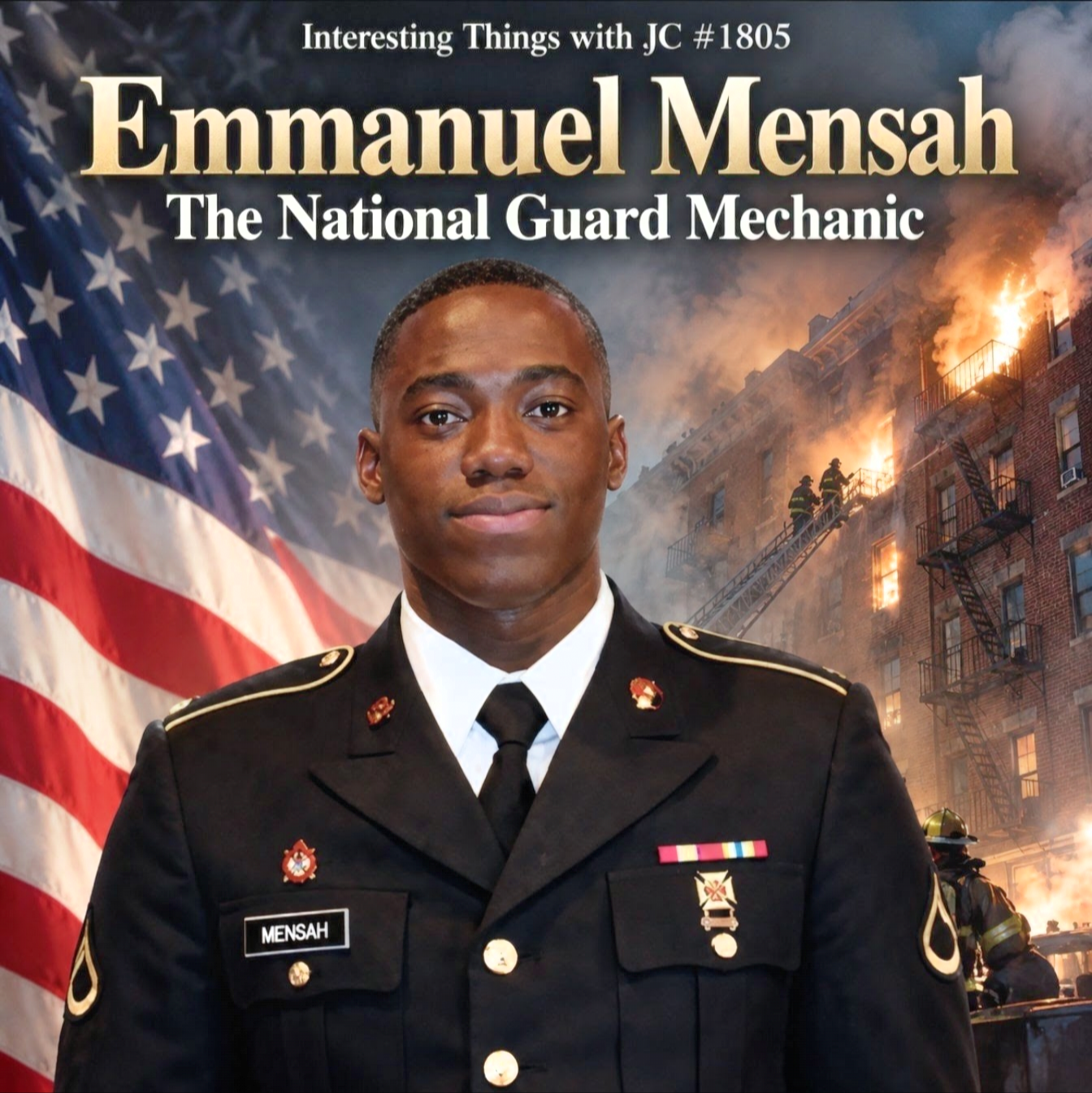
Square podcast cover art for Interesting Things with JC, episode #1805, honoring Emmanuel Mensah. A centered portrait depicts Mensah wearing a black U.S. Army National Guard dress uniform. An American flag fills the left background, while a burning Bronx apartment building, smoke, flames, and firefighters appear on the right. Across the upper portion, the text reads “Interesting Things with JC #1805,” followed by “Emmanuel Mensah” in large gold lettering and the subtitle “The National Guard Mechanic.” The lower third contains no additional text.
This commemorative royalty free artwork honors the life, courage, and enduring legacy of Emmanuel Mensah, who sacrificed his life attempting to save his neighbors on December 28, 2017. It is presented with profound respect and gratitude for his selflessness, military service, and extraordinary heroism. His sacrifice deserves to be remembered with dignity and honor.
Interesting Things with JC #1805
Emmanuel Mensah: The National Guard Mechanic
On December 28, 2017, a fire tore through a five-story apartment building in the Bronx, New York. One resident escaped safely, but when he realized his neighbors were still trapped inside, he turned around and went back in.
His name was Emmanuel Mensah, a 27-year-old private first class in the New York Army National Guard.
Originally from Ghana, Mensah had become an American citizen just three months earlier. He had enlisted in 2016, fulfilling a lifelong dream of military service, and had graduated from Army mechanic training only weeks before the fire.
He was home for the holidays, preparing to join his assigned National Guard unit in January.
The fire began when a young child accidentally ignited a gas stove. An apartment door left open during the family's escape allowed flames and smoke to spread rapidly through the building.
Mensah was already outside, but he knew people needed help.
He entered the burning building repeatedly, helping four people escape during three rescue trips.
Then he went back inside again.
This time, he never returned.
When firefighters recovered his body, its location suggested he had been searching for additional survivors.
Thirteen people ultimately died in the fire, one of New York City's deadliest residential fires in decades.
Four days later, on January 1, 2018, the Army approved Mensah for the Soldier's Medal, its highest award for heroism outside combat.
He also received New York State's Medal for Valor.
At the February 16 ceremony, his father accepted the decorations. Mensah was buried the following day with full military honors.
His father later explained that joining the American military had been his son's lifelong dream.
Mensah never deployed to a battlefield or began serving with his assigned unit.
Instead, just weeks after completing his training, he gave his life saving his neighbors.
These are interesting things, with JC.
Transcript Integrity Note: This instructional transcript retains the episode's narrative. Primary military records establish Mensah's citizenship date, military assignment, rescues, awards, and burial. The exact interval between completing training and the fire should be described as several weeks unless an independently verified graduation date is available. The 13-death total reflects later Army reporting; an earlier military release reported 12.
Student Worksheet
Student Name: ____________________ Class: ____________________ Date: ____________________
Part A — Historical Comprehension
Answer in complete sentences.
Who was Emmanuel Mensah, and what was his military rank?
In which city, borough, and year did the apartment fire occur?
From which country had Mensah immigrated?
What military specialty had Mensah recently trained for?
How many people was Mensah credited with rescuing?
What happened when he returned to the building for the final time?
Which two decorations were presented to his family?
What makes the Soldier's Medal different from a decoration specifically recognizing combat heroism?
Part B — Historical Chronology
Arrange the following events in chronological order. Write numbers 1 through 6 beside them.
___ Mensah's family receives his posthumous decorations.
___ Mensah becomes a naturalized American citizen.
___ Mensah enlists in the New York Army National Guard.
___ The Bronx apartment fire occurs.
___ Mensah completes military mechanic training.
___ The Secretary of the Army approves the Soldier's Medal.
Part C — Primary Source Investigation
Read the U.S. Army article, New York Soldier's Heroic Efforts During Fire Recognized with Posthumous Medal (February 21, 2018).
Identify the article's author, publication date, and publishing institution.
Find two facts that the article attributes to official military records or investigators.
Identify one statement from Mensah's family. What does it reveal that an official military record might not?
Explain why an official award citation is useful historical evidence but may not establish every detail of a rescue.
What additional evidence would help reconstruct the exact sequence of Mensah's entries into the building?
Part D — Evidence Classification
For each statement, classify it as Documented Fact, Reasonable Interpretation, or Unsupported Speculation. Explain your classification.
Mensah became a naturalized American citizen on September 21, 2017.
Mensah's actions demonstrated extraordinary courage.
Mensah knew with certainty that he would die when he entered the building for the final time.
The Soldier's Medal was approved on January 1, 2018.
Mensah's story illustrates that heroism can occur outside a battlefield.
Part E — Fire Safety and Historical Context
According to investigators, how did the open apartment door contribute to the fire's spread?
Why is smoke often a major threat during residential fires?
Explain why the actions of a civilian attempting a rescue should not be treated as general fire-escape instructions.
Identify two evidence-based residential fire safety practices recommended by public safety authorities.
Part F — Historical Reflection
How does Mensah's experience challenge the assumption that military heroism occurs only during warfare?
Why is it important to include Mensah's Ghanaian background and American citizenship without reducing his identity to either?
What responsibilities do historians, journalists, and educators have when describing the final moments of someone who died during an emergency?
Part G — Short Written Response
Prompt: Explain how Emmanuel Mensah's actions demonstrate the relationship between individual courage, community responsibility, and public recognition.
Requirements
Write 200–300 words.
Include at least three verified historical facts.
Use at least two credible sources.
Distinguish historical evidence from personal interpretation.
Include one explanation of the Soldier's Medal.
Conclude with a historically supported observation rather than a generalized slogan.
Difficulty Scaling
Level 1 — Foundational: Complete Parts A and B with transcript support.
Level 2 — Proficient: Complete Parts A–F independently, citing sources.
Level 3 — Advanced: Complete all parts and compare military reporting with another independent contemporary account.
Academic Integrity Guidance: Students must use their own language, attribute borrowed information, and avoid inventing dialogue, motivations, or details of the fire.
Teacher Guide
Quick Start: Introduce the episode as a historical case study involving civic courage, military recognition, and source evaluation. Play the audio once without interruption. Distribute the transcript and worksheet after listening.
Pacing Guide — Audio First
0–5 minutes — Introduction: Introduce the Bronx fire and ask students what makes an event historically significant.
5–9 minutes — Podcast: Play episode #1805. Allow students to record three facts and one question.
9–17 minutes — Comprehension: Complete Worksheet Parts A and B.
17–30 minutes — Source Investigation: Examine the Army report and complete Part C.
30–40 minutes — Evidence Analysis: Complete Parts D and E, discussing uncertainty and fire safety.
40–50 minutes — Reflection: Discuss Part F and begin the written response.
50–60 minutes — Assessment: Complete the quiz or collect written responses. Assign unfinished work as homework.
Materials
Episode #1805 audio recording
Full transcript
Student worksheet
Internet access or printed primary-source excerpts
Writing materials
Teacher answer key and assessment rubric
Teacher Background
Mensah enlisted in December 2016 and became a U.S. citizen on September 21, 2017.
He completed Advanced Individual Training at Fort Lee, Virginia, in early December 2017.
He was preparing to join the 107th Military Police Company at Fort Hamilton, Brooklyn.
Military reporting credits him with rescuing four people through repeated trips into the burning building.
The Soldier's Medal was approved January 1, 2018, and the New York State Medal for Valor was approved January 2.
Both awards were presented to his family on February 16, 2018.
He was buried with full military honors at Woodlawn Cemetery on February 17, 2018.
The United States Army
+1
Answer Key — Student Worksheet
Part A
Emmanuel Mensah was a Ghanaian-born American serving as a private first class in the New York Army National Guard.
Bronx, New York City, December 28, 2017.
Ghana.
Wheeled vehicle mechanic.
Four people.
He did not return and died in the fire.
Soldier's Medal and New York State Medal for Valor.
The Soldier's Medal recognizes Army heroism outside actual conflict with an enemy.
Part B — Correct Sequence
Enlists in December 2016.
Becomes a citizen on September 21, 2017.
Completes mechanic training in early December 2017.
Dies during the December 28, 2017 fire.
Soldier's Medal approved January 1, 2018.
Family receives decorations February 16, 2018.
Part C — Expected Responses
Col. Richard Goldenberg, February 21, 2018, U.S. Army/New York National Guard.
Examples include the official awards, citizenship date, military assignment, and investigators' description of the fire.
Mensah's father described his pride in military service; this contributes personal context.
An award citation establishes official recognition and its stated basis but does not necessarily document every moment of an emergency.
Fire department investigative reports, eyewitness interviews, dispatch records, and other contemporaneous documentation.
Part D
Documented Fact.
Reasonable Interpretation, strongly supported by the rescue accounts and official recognition.
Unsupported Speculation.
Documented Fact.
Reasonable Interpretation supported by the nature of the award and circumstances.
Part E
The open door allowed smoke and heat to move beyond the apartment and into shared building areas.
Smoke can reduce visibility, displace breathable air, and contain toxic gases, including carbon monoxide.
Emergency rescue attempts can expose unprotected individuals to fatal conditions; the recommended response is to evacuate, remain outside, and contact emergency services.
Acceptable answers include working smoke alarms, planned escape routes, closing doors behind occupants when escaping, and practicing household fire drills.
Part F — Evaluation Guidance
Students should explain that heroism can occur during civilian emergencies, including while performing actions unrelated to military assignments.
Students should connect Mensah's life experiences accurately without assigning motivations solely on the basis of nationality or citizenship.
Students should emphasize verification, source attribution, uncertainty, respect for the deceased, and avoidance of sensationalism.
Common Misconceptions
Misconception: Mensah died during a military operation. Correction: He died attempting to rescue civilians from a residential fire.
Misconception: He had already begun serving with his intended military police unit. Correction: He was scheduled to begin drilling with that unit in January 2018.
Misconception: The Soldier's Medal is the Medal of Honor. Correction: These are different decorations with different eligibility requirements.
Misconception: Every dramatic detail in a historical account is established fact. Correction: Historians must distinguish direct evidence from interpretation and speculation.
Misconception: Mensah's rescue actions are recommended fire safety procedures. Correction: Fire safety guidance directs occupants to escape, remain outside, and call emergency services.
Formative Checkpoints
Students identify three verified details after listening.
Students complete the chronological sequence correctly.
Students distinguish facts from interpretations.
Students support at least one written claim with a primary source.
Differentiation
Additional Support: Provide a partially completed timeline and vocabulary definitions.
Advanced Learners: Compare official Army accounts with independent news reporting and examine how accounts differ.
English Learners: Preteach military and civic vocabulary; allow oral rehearsal before writing.
Students with Hearing Needs: Supply the complete transcript and accessible written instructions.
Students with Trauma Sensitivities: Permit an alternative historical heroism case study without graphic fire content.
Extension Activities
Research the history and eligibility requirements of the Soldier's Medal.
Investigate immigrant service members in American military history.
Examine how New York City building and fire safety regulations address apartment doors and escape routes.
Develop a brief historical memorial biography using only corroborated evidence.
Compare official military recognition with civilian awards for rescue and public service.
Quiz
Episode #1805 — Emmanuel Mensah: The National Guard Mechanic
Student Name: ____________________ Date: ____________________ Total Points: 20
Part A — Multiple Choice (2 Points Each)
Select the best answer.
1. Where did the December 28, 2017 fire occur?
A. Brooklyn, New York
B. Bronx, New York
C. Queens, New York
D. Newark, New Jersey
2. What was Emmanuel Mensah's military specialty?
A. Combat medic
B. Infantry soldier
C. Wheeled vehicle mechanic
D. Military firefighter
3. Which country was Mensah originally from?
A. Nigeria
B. Kenya
C. Ghana
D. Liberia
4. How many people was Mensah officially credited with rescuing?
A. Two
B. Three
C. Four
D. Six
5. What distinguishes the Soldier's Medal?
A. It recognizes only combat service.
B. It recognizes Army heroism outside combat.
C. It is awarded only to military officers.
D. It is a civilian firefighting certification.
Part B — Short Answer (2 Points Each)
On what date did Mensah become a naturalized U.S. citizen?
What condition helped the Bronx apartment fire spread beyond the apartment where it began?
Why was Mensah's Soldier's Medal awarded posthumously?
Identify one reason an official military report is useful when studying Mensah's life.
Explain one important distinction between a documented historical fact and an interpretation.
Quiz Answer Key
B — Bronx, New York.
C — Wheeled vehicle mechanic.
C — Ghana.
C — Four.
B — Army heroism outside combat.
September 21, 2017.
An apartment door remained open, allowing heat and smoke to spread.
He died during the fire before the award was approved and presented.
It documents military service, award decisions, dates, and official accounts. Other reasonable answers accepted.
A documented fact is supported by identifiable evidence; an interpretation explains the meaning of that evidence.
Scoring: Questions 1–5 earn 2 points for each correct answer. Questions 6–10 earn up to 2 points each for accuracy and completeness.
Assessment
Performance Task: Historical Biography and Evidence Analysis
Student Assignment: Write a 200–300-word historical account explaining Emmanuel Mensah's actions, the circumstances surrounding the Bronx fire, and the significance of his military recognition.
Required Components
Accurate historical background
Clear chronological organization
Explanation of Mensah's rescue actions
Description of the Soldier's Medal
Three verifiable facts
Two credible sources
A concluding interpretation supported by evidence
Assessment Rubric — 20 Points
1. Historical Accuracy — 5 Points
5: All major facts accurate; chronology and distinctions carefully maintained.
4: Accurate with minor omissions.
3: Mostly accurate with some unclear details.
2: Multiple factual or chronological errors.
1: Major misunderstandings.
0: No assessable historical content.
2. Evidence and Source Quality — 5 Points
5: At least two credible sources, properly attributed, with three clearly supported facts.
4: Credible sources and evidence with minor attribution weaknesses.
3: Some appropriate evidence but incomplete source support.
2: Limited evidence or unreliable sourcing.
1: Minimal relevant evidence.
0: No supporting evidence.
3. Historical Reasoning — 5 Points
5: Clearly distinguishes facts, interpretations, and uncertainty; offers a well-supported conclusion.
4: Strong reasoning with minor weaknesses.
3: Reasonable interpretation with limited analysis.
2: Mostly summary with unsupported conclusions.
1: Little demonstrated reasoning.
0: No historical analysis.
4. Organization and Communication — 5 Points
5: Clear, concise, coherent writing meeting the assignment requirements.
4: Well organized with minor issues.
3: Understandable but uneven organization.
2: Difficult to follow or incomplete.
1: Substantial communication problems.
0: No assessable response.
Performance Levels
18–20: Advanced
15–17: Proficient
11–14: Developing
7–10: Emerging
0–6: Needs Additional Support
Assessment Integrity: Students are evaluated on historical reasoning and evidence, not on whether their personal interpretation matches the teacher's.
Standards Alignment
CCSS — English Language Arts: Grades 9–12
CCSS.ELA-LITERACY.RH.9-10.1 — Cite Specific Textual Evidence: Students support historical conclusions with evidence from military reporting.
CCSS.ELA-LITERACY.RH.9-10.2 — Determine Central Ideas: Students identify central ideas and summarize historical accounts accurately.
CCSS.ELA-LITERACY.RH.11-12.7 — Integrate and Evaluate Multiple Sources: Students compare evidence from different sources to develop an informed historical account.
CCSS.ELA-LITERACY.WHST.9-10.1 — Write Arguments: Students support a historical interpretation using evidence and reasoning.
CCSS.ELA-LITERACY.WHST.11-12.6 — Use Technology to Produce and Publish Writing: Students may prepare a digitally formatted historical biography with appropriate attribution.
CCSS.ELA-LITERACY.SL.9-10.1 — Collaborative Discussions: Students participate in evidence-based discussion of courage and public recognition.
C3 Framework — College, Career, and Civic Life
D2.His.1.9-12 — Historical Contexts: Explain how historical contexts shaped the circumstances surrounding Mensah's life and service.
D2.His.9.9-12 — Historical Sources: Analyze how the purpose and perspective of historical sources influence their usefulness.
D2.His.14.9-12 — Multiple Causes and Effects: Examine how human actions and building conditions contributed to the fire's consequences.
D3.1.9-12 — Gathering Relevant Information: Gather evidence from authoritative historical sources.
D3.2.9-12 — Evaluating Sources: Evaluate the credibility and limitations of sources.
D4.1.9-12 — Constructing Arguments: Develop evidence-based historical explanations.
NGSS — Science and Engineering Practices
This episode supports interdisciplinary connections to fire science but is not a complete NGSS physical science lesson.
Constructing Explanations and Designing Solutions: Students explain, using established fire safety principles, how open doors may influence smoke and heat movement.
Engaging in Argument from Evidence: Students distinguish investigators' findings from unsupported explanations.
ISTE Standards for Students
1.3 Knowledge Constructor: Students evaluate the accuracy, credibility, and relevance of digital historical sources.
1.6 Creative Communicator: Students present historically accurate information using appropriate media and attribution.
1.7 Global Collaborator: Students examine how individuals from different national backgrounds contribute to American communities.
ACRL Framework for Information Literacy
Authority Is Constructed and Contextual: Students distinguish institutional authority from eyewitness knowledge.
Information Creation as a Process: Students examine how historical accounts develop as additional evidence becomes available.
Research as Inquiry: Students develop questions and investigate incomplete historical records.
Scholarship as Conversation: Students compare interpretations while remaining grounded in evidence.
Bloom's Revised Taxonomy
Remember: Identify names, dates, locations, and awards.
Understand: Explain Mensah's military background and rescue actions.
Apply: Use evidence classification to assess historical statements.
Analyze: Compare sources and reconstruct chronology.
Evaluate: Assess the strength of historical claims.
Create: Produce an original evidence-supported biography.
Universal Design for Learning — UDL
Engagement: Offer choices between written, oral, and supported historical inquiry.
Representation: Provide audio, transcript, vocabulary, and primary-source documents.
Action and Expression: Allow equivalent accessible response formats while maintaining consistent evidence standards.
UK National Curriculum — History and Citizenship
History: Historical enquiry, evaluating evidence, understanding chronology, and interpreting accounts.
Citizenship: Individual responsibility, public service, democratic communities, and participation in civic life.
International Baccalaureate — Individuals and Societies
Historical source analysis and evaluation
Perspectives and interpretations
Identity, community, and citizenship
Ethical communication of historical evidence
Cambridge International — History
Knowledge and understanding of historical events
Evaluation of source evidence
Explanation of causes and consequences
Construction of substantiated historical arguments
Career and Technical Education — CTE
Public Safety: Emergency preparedness and risk awareness.
Government and Public Administration: Military service, public recognition, and civic institutions.
Transportation and Maintenance: Understanding the occupational role of a military wheeled vehicle mechanic.
Communication: Accurate research, documentation, and public presentation.
Show Notes
Episode Description
On December 28, 2017, New York Army National Guard private first class Emmanuel Mensah escaped a deadly apartment fire in the Bronx. He repeatedly returned to help his neighbors, rescuing four people before losing his life while attempting to save others.
Originally from Ghana, Mensah had recently become an American citizen and completed training as a military mechanic. His actions earned him the Soldier's Medal, the Army's highest decoration for heroism outside combat, and New York State's Medal for Valor.
Historical Timeline
December 2016: Mensah enlists in the New York Army National Guard.
September 21, 2017: Becomes a naturalized United States citizen.
Early December 2017: Completes Advanced Individual Training as a wheeled vehicle mechanic.
December 28, 2017: Dies while rescuing residents during the Bronx apartment fire.
January 1, 2018: Soldier's Medal approved.
January 2, 2018: New York State Medal for Valor approved.
February 16, 2018: Family receives both decorations at Fordham University.
February 17, 2018: Buried with full military honors at Woodlawn Cemetery.
Discussion Themes
Heroism outside combat
Immigrant contributions to American military service
Citizenship and community responsibility
Public recognition and military traditions
Historical evidence and responsible reporting
Residential fire safety
Educational Use
This episode and accompanying curriculum are intended for educational discussion, historical research, and evidence-based inquiry.
Watch: youtube.com/@interestingthingswithjc RSS | MP3 | Open Curriculum: JimConnors.net
Classroom Permissions: Free classroom use with attribution to Interesting Things with JC and Jim Connors LLC. No resale or unauthorized commercial redistribution.
References
Goldenberg, R. (2018, February 21). New York soldier's heroic efforts during fire recognized with posthumous medal. U.S. Army. https://www.army.mil/article/200819/new_york_soldiers_heroic_efforts_during_fire_recognized_with_posthumous_medal
New York National Guard. (2018, January 12). Army National Guard soldier gives his life to save others in massive NYC apartment fire. U.S. Army. https://www.army.mil/article/198721/army_national_guard_soldier_gives_his_life_to_save_others_in_massive_nyc_apartment_fire
New York State Division of Military and Naval Affairs. (2018, February 14). Family of Army Guard Pfc. Emmanuel Mensah receives posthumous heroism awards Friday, Feb. 16 at Fordham. https://dmna.ny.gov/pressroom/?id=1694033384
New York State Division of Military and Naval Affairs. (2018). Guard Times: Winter 2018. https://dmna.ny.gov/gt/gt_winter_18.pdf
New York State Division of Military and Naval Affairs. (2018). 2018 annual report. https://dmna.ny.gov/annual/NYNG_annual_report_2018.pdf
Source Evaluation Note
The February 14, 2018 military press release reported 12 fatalities, while subsequent military reporting identified 13. The curriculum uses the later reported figure and encourages students to examine how historical reporting can change as investigations and records develop.
The documented rescue account describes three successful rescue trips followed by a final return. Students should not assume an exact number of people rescued during each entry or reconstruct conversations and actions for which no evidence is available.
Interesting Things with JC™ educational curriculum. Free classroom use with attribution. No resale or unauthorized commercial redistribution.
End of Curriculum — Episode #1805