1804: "The Paul is Dead Rumor"
Interesting Things with JC #1804: "The Paul is Dead Rumor"
On October 12, 1969, a Detroit radio caller claimed Paul McCartney was dead and that Beatles records contained hidden evidence. Fans began decoding songs, album covers, and photographs, turning a bizarre rumor into an international obsession.
Curriculum - Episode Anchor
Interesting Things with JC™ — Classroom Curriculum
Episode Number: 1804
Episode Title: The "Paul is Dead" Rumor
Host: JC
Audience: Grades 9–12, introductory college, homeschool, lifelong learners
Subject Areas: U.S. History, Media Literacy, English Language Arts, Psychology, Critical Thinking
Instructional Duration: 45–60 minutes
Primary Focus: Historical misinformation, confirmation bias, evidence evaluation, mass communication Curriculum Access: Free classroom use with attribution; no login or paywall.
Central Question: How did a false claim about a famous musician spread internationally in 1969, and why did seemingly convincing evidence fail to establish its truth?
Historical Anchor: On October 12, 1969, Detroit radio broadcaster Russ Gibb discussed a rumor alleging that Beatles musician Paul McCartney had died and been replaced. Listeners began identifying supposed clues in recordings, lyrics, and album artwork.
Enduring Understanding: A claim can become widely accepted through repetition, selective interpretation, and social reinforcement without gaining reliable supporting evidence.
Essential Questions
What distinguishes evidence from interpretation?
How did radio and print media accelerate the rumor?
Why do people recognize meaningful patterns in unrelated information?
How can an invented claim become accepted as historical fact?
What standards should investigators apply before publishing or sharing a claim?
Lesson Overview
Lesson Purpose
Students investigate the 1969 "Paul is Dead" rumor as a documented case of misinformation spreading through popular culture. They examine the historical sequence, assess competing claims, identify cognitive biases, and distinguish primary-source evidence from speculation.
Learning Objectives
By the end of the lesson, students will be able to:
Reconstruct at least five significant events in the rumor's development.
Distinguish an observable fact from an interpretation or unsupported assertion.
Explain confirmation bias and its role in reinforcing a false claim.
Analyze how radio, newspapers, and audiences contributed to information circulation before the internet.
Evaluate historical sources using authorship, publication date, purpose, corroboration, and reliability.
Construct a defensible conclusion using at least three pieces of documented evidence.
Success Criteria
Students demonstrate mastery when they can accurately explain the rumor's origins, identify at least two misleading clues, and support a conclusion with independently evaluated sources.
Instructional Approach: Audio-first historical inquiry, primary-source analysis, collaborative discussion, short written assessment.
Key Vocabulary
Urban Legend: A widely circulated story presented as true despite uncertain, exaggerated, or unsupported evidence.
Misinformation: False or inaccurate information, regardless of whether someone intended to deceive.
Disinformation: False information deliberately created or distributed to mislead.
Confirmation Bias: The tendency to seek, interpret, or favor information that supports existing beliefs.
Apophenia (ap-oh-FEE-nee-uh): The perception of meaningful connections or patterns in unrelated or random information.
Backmasking: A recording technique involving sounds or messages deliberately recorded backward; distinct from merely hearing apparent words in reversed audio.
Primary Source: Material produced during the period being studied or by a direct participant.
Corroboration: Comparing independent evidence to determine whether a claim is supported.
Satire: Writing or expression using humor, irony, or exaggeration to expose or criticize an idea.
Media Literacy: The ability to access, analyze, evaluate, create, and responsibly communicate information through media.
Vocabulary Application: Students must correctly use at least four terms in their worksheet responses, discussion, or final written explanation.
Narrative Core
Open — The Radio Call
On October 12, 1969, Detroit radio host Russ Gibb received a call discussing an extraordinary allegation: Paul McCartney of the Beatles had died, and clues to his death were hidden in the band's recordings.
The claim encouraged listeners to examine familiar songs in unfamiliar ways.
Info — The Rumor Takes Shape
The story had already circulated before Gibb's broadcast. On September 17, 1969, Drake University's student newspaper, The Times-Delphic, published an article titled "Is Beatle Paul McCartney Dead?"
The rumor gained wider attention as radio audiences began exchanging supposed evidence.
Details — Finding Clues Everywhere
Listeners pointed to the Abbey Road album cover, McCartney's bare feet, and perceived hidden messages in recordings.
The repeated phrase "number nine" in "Revolution 9" was interpreted by some listeners playing the recording backward as "turn me on, dead man."
Others believed John Lennon said "I buried Paul" near the end of "Strawberry Fields Forever." Lennon identified the actual phrase as "cranberry sauce."
On October 14, University of Michigan student Fred LaBour published a satirical article that contributed additional supposed evidence. Some of his inventions were subsequently repeated as genuine clues.
Reflection — When Interpretation Becomes Evidence
The rumor expanded because participants interpreted ambiguous material through an increasingly familiar premise.
The more listeners expected to find evidence, the more ordinary details appeared meaningful.
This provides a useful historical example of confirmation bias, pattern perception, and the amplification of unsupported claims through audience participation.
Closing — The Historical Record
McCartney had not died in 1966. In November 1969, Life magazine published an interview and photographs confirming that he was alive.
The rumor nevertheless became a lasting feature of Beatles folklore.
Its history demonstrates that misinformation did not require the internet. Newspapers, broadcasters, telephone calls, records, and word of mouth could produce a similar cycle of speculation and repetition.
Narrative Takeaway: The number of people repeating a claim does not establish its accuracy.
Transcript
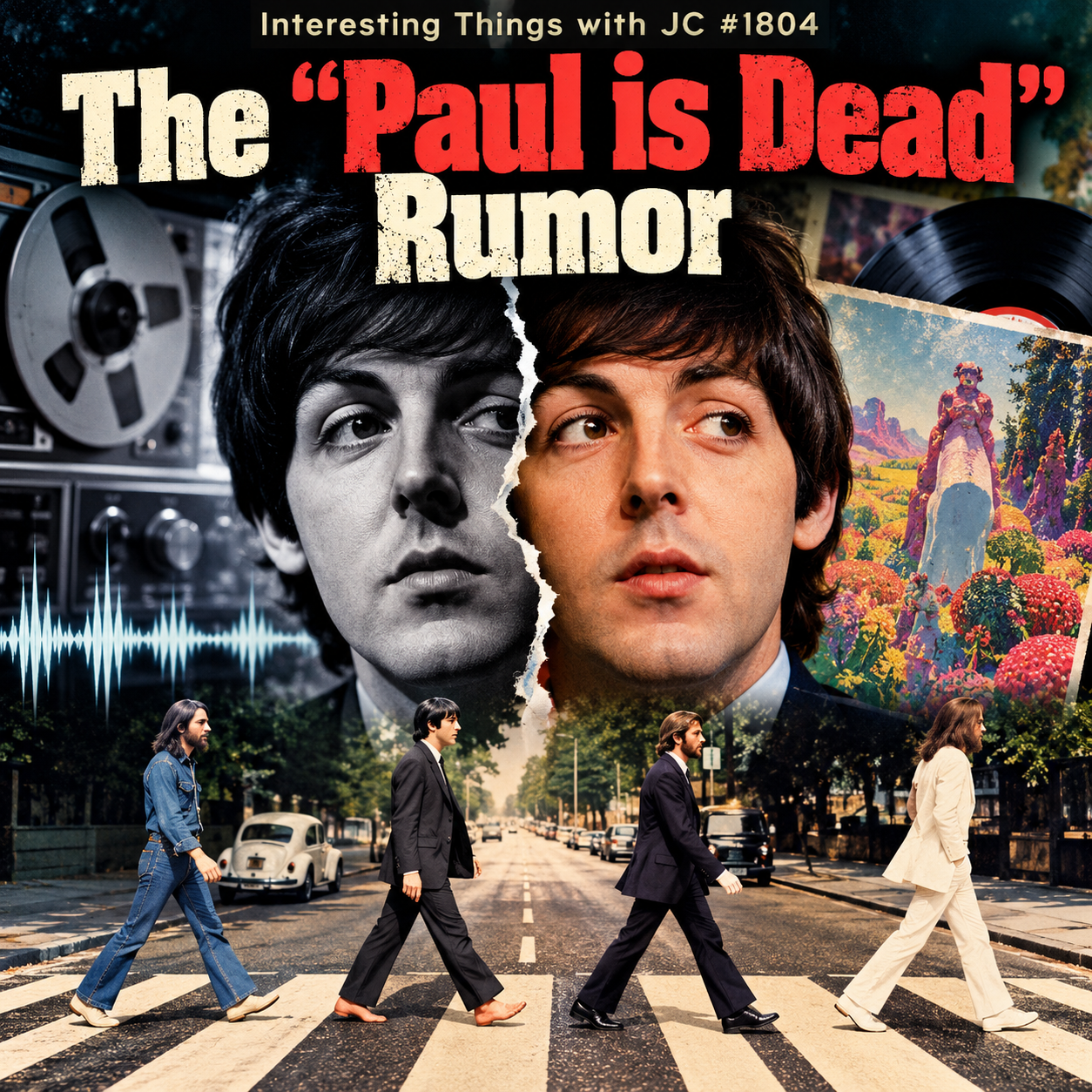
Podcast cover art for Interesting Things with JC, episode #1804, “The Paul is Dead Rumor.” A vintage 1960s-style collage features two contrasting portraits of Paul McCartney separated by a torn-paper effect, with a reel-to-reel tape recorder, vinyl record, and colorful psychedelic artwork in the background. Four Beatles-inspired figures cross Abbey Road beneath the portraits. The episode title appears in large red and cream lettering, with the podcast name and episode number at the top.
Interesting Things with JC #1804:
"The Paul is Dead Rumor"
On October 12, 1969, Detroit radio host Russ Gibb took a phone call that helped turn a scattered Beatles rumor into an international obsession.
A caller known as Tom told Gibb on WKNR-FM that Paul McCartney was dead and that clues had been hidden in Beatles records. His most famous instruction was to play “Revolution 9” backward. The repeated “number nine” could be heard as “turn me on, dead man.” Listeners called with more clues, and the story accelerated.
The rumor was already in print. On September 17, Drake University’s student newspaper, the Times-Delphic, had asked, “Is Beatle Paul McCartney Dead?” But Detroit radio gave the idea a much larger audience just weeks after Abbey Road was released.
Soon, almost anything became evidence. Paul was barefoot on the Abbey Road cover. He was walking out of step. A muffled phrase at the end of “Strawberry Fields Forever” sounded to some like “I buried Paul,” although John Lennon was actually saying “cranberry sauce.”
Then, on October 14, University of Michigan student Fred LaBour published a satirical article in The Michigan Daily, adding outrageous clues that became part of the legend. He claimed McCartney had died in a November 1966 car crash and been replaced by a Scottish look-alike named William Campbell.
The Abbey Road cover supposedly depicted a funeral procession, with John Lennon dressed in white as a heavenly figure, Ringo Starr in black as the undertaker, George Harrison in denim as the gravedigger, and barefoot Paul representing the corpse.
Paul was also holding a cigarette in his right hand, despite being left-handed, supposedly proving he was an impostor. A Volkswagen license plate reading “28IF” allegedly meant Paul would have been 28 if he had lived, although McCartney was actually 27.
Other supposed clues included the letters “OPD” on Paul's Sgt. Pepper uniform, interpreted as “Officially Pronounced Dead,” although the patch actually read “OPP,” and the claim that a walrus was a Greek symbol for a corpse, supposedly explaining the Beatles lyric identifying Paul as the walrus. That Greek meaning was entirely invented.
LaBour later admitted making up many of the clues as a joke, but people repeated them as facts. Five days later, WKNR aired a two-hour special called The Beatle Plot.
By early November, Life magazine had tracked McCartney to his farm in Scotland and put him on its cover under the headline, “Paul is still with us.”
McCartney never died in 1966. But the rumor had already shown how easily people can build a case from coincidence when they search hard enough for patterns. Decades before social media, listeners, newspapers, radio hosts, and record collectors had effectively crowdsourced a conspiracy theory.
These are interesting things, with JC.
Student Worksheet
Name: ____________________ Date: ____________________ Class: ____________________
Part A — Historical Comprehension
Answer using complete sentences and specific information from the episode.
What happened during Russ Gibb's October 12, 1969, radio program?
What role did Drake University's student newspaper play in spreading the rumor?
Identify two alleged clues found in Beatles recordings or album artwork.
What was Fred LaBour's contribution to the story?
How did Life magazine challenge the rumor?
Part B — Evidence Evaluation
Classify each statement as Verified Fact, Interpretation, or Unsupported Claim. Explain your classification.
Paul McCartney appeared barefoot on the Abbey Road album cover.
McCartney's bare feet prove that the album cover represents a funeral.
Fred LaBour published an article about the rumor in October 1969.
The Beatles secretly replaced McCartney with an identical-looking musician.
Some listeners interpreted reversed audio from "Revolution 9" as a hidden message.
Part C — Critical Thinking
Explain how confirmation bias could cause listeners to interpret ordinary recording details as evidence of a death.
Why might a satirical newspaper article become misleading when readers treat it as factual reporting?
How did audiences help distribute the rumor rather than simply receive information?
What additional evidence would be necessary to substantiate a claim that a public figure had died?
Compare one method of spreading misinformation in 1969 with a similar method used online today.
Part D — Primary-Source Investigation
Task: Examine the October 14, 1969, Michigan Daily article, "McCartney Dead; New Evidence Brought to Light," using the reference supplied by your instructor.
Identify the author, date, publication, and intended audience.
Locate two claims presented as evidence.
Explain whether either claim establishes that McCartney died.
Describe how the article's satirical purpose affects its reliability as evidence of McCartney's death.
Identify one additional source that could independently test the central allegation.
Part E — Written Reflection
Prompt: In 150–200 words, explain how the "Paul is Dead" rumor illustrates the difference between finding evidence and interpreting evidence.
Your response must:
Present a clear central claim.
Include three historically documented facts.
Explain at least one relevant cognitive bias.
Distinguish speculation from verifiable evidence.
End with a practical principle for evaluating modern information.
Difficulty Scaling
Level 1 — Foundational: Complete Parts A and B with an evidence checklist.
Level 2 — Proficient: Complete Parts A–E independently.
Level 3 — Advanced: Compare the 1969 rumor with a documented modern misinformation event, using at least two reliable sources for each case.
Student Output: Completed worksheet, primary-source analysis, and written reflection.
Academic Integrity Guidance: Cite external sources, distinguish direct quotations from paraphrases, and do not invent historical evidence.
Teacher Guide
Quick Start: Play episode #1804 without revealing the outcome. Ask students to identify the claim, the alleged evidence, and the people responsible for distributing it.
Pacing Guide — Audio First
0–5 minutes: Introduce the essential question and ask students how they would verify a reported celebrity death.
5–9 minutes: Play the episode and have students record three significant historical facts.
9–17 minutes: Review the 1969 timeline and distinguish the original rumor from its subsequent amplification.
17–28 minutes: Complete the evidence-classification exercise in Part B.
28–40 minutes: Analyze the Fred LaBour article, including its satirical purpose.
40–50 minutes: Discuss confirmation bias, pattern recognition, and audience participation.
50–60 minutes: Complete the written reflection or begin it for homework.
Materials
Episode #1804 audio and transcript.
Student worksheet.
Reproduction or accessible transcript of the October 14, 1969, Michigan Daily article.
Abbey Road cover image, if licensed or otherwise permitted for classroom display.
Whiteboard or shared document for evidence classification.
Optional excerpt from Life magazine's November 1969 coverage.
Answer Key — Part A
Russ Gibb received a caller discussing a rumor that McCartney had died and that hidden clues appeared in Beatles recordings.
The September 17 article documented the rumor before the major Detroit broadcast.
Accept examples including McCartney's bare feet, the supposed reversed message in "Revolution 9," and the alleged "I buried Paul" statement.
LaBour published a satirical article containing supposed clues, several of which he later acknowledged inventing.
Life published photographs and an interview showing McCartney alive in Scotland.
Answer Key — Part B
Verified Fact: McCartney is visibly barefoot in the photograph.
Interpretation: The funeral symbolism is an inference unsupported by the photograph itself.
Verified Fact: The article appeared on October 14, 1969.
Unsupported Claim: No credible evidence establishes a secret replacement.
Verified Fact about an interpretation: Listeners reported hearing the phrase, but that does not establish an intentional hidden message.
Part C — Expected Reasoning
Confirmation bias directs attention toward details that appear to support an existing belief while discounting contradictory evidence.
Satire may be repeated without its original context, causing invented details to be mistaken for verified reporting.
Listeners supplied new clues, telephoned broadcasters, and repeated the allegations through their own social networks.
Appropriate evidence could include reliable contemporaneous records, independently verified reporting, and corroborated documentation. Extraordinary allegations require strong, independently testable evidence.
Students may compare radio call-in participation with social-media comments, or newspaper repetition with reposting and content aggregation.
Part D — Expected Findings
Author: Fred LaBour.
Publication: The Michigan Daily.
Date: October 14, 1969.
Intended Audience: Primarily university readers, with wider circulation after publication.
Source Value: Strong evidence for how the rumor circulated; weak evidence for the alleged death.
Key Distinction: A primary source can reliably document that a claim was made without proving the claim itself.
Discussion Prompts
Why might an apparently hidden message seem more convincing than an ordinary statement?
What happens when an audience becomes involved in constructing a story?
Can a photograph be authentic while the explanation attached to it is false?
Why does repetition sometimes create the appearance of credibility?
Common Misconceptions
Misconception: Russ Gibb invented the entire rumor. Correction: The allegation was circulating before his October 12 broadcast.
Misconception: Playing a recording backward establishes an intentional message. Correction: Perceived words in reversed audio are not proof of deliberate encoding.
Misconception: Satirical articles cannot influence public beliefs. Correction: Satire can be misunderstood or repeated without context.
Misconception: Primary sources are automatically truthful. Correction: Primary sources require analysis of purpose, perspective, and corroboration.
Formative Checkpoints
Students correctly place the September 17 article before the October 12 broadcast.
Students distinguish the observable fact of bare feet from the inferred funeral symbolism.
Students explain why LaBour's article is evidence of rumor circulation, not evidence of McCartney's death.
Students identify one reliable method of independently verifying a sensational claim.
Differentiation
Additional Support: Provide a completed timeline with missing entries and a fact-versus-interpretation sorting activity.
Advanced Learners: Investigate the differences among misinformation, satire, and deliberate disinformation without assuming the intentions of every participant.
English Learners: Preteach key vocabulary, provide sentence frames, and allow paired discussion before written responses.
Accessibility: Provide an accessible transcript, descriptive text for photographs, and alternatives to reversed-audio listening activities.
Extension Activity: Have students trace a modern false claim through its earliest identifiable publication, subsequent amplification, and eventual verification or correction.
Quiz
Instructions: Select the best answer for Questions 1–8. Answer Questions 9–10 in complete sentences.
Multiple Choice — 8 Points
1. Which Detroit broadcaster helped popularize the rumor on October 12, 1969?
A. Casey Kasem
B. Russ Gibb
C. Wolfman Jack
D. Alan Freed
2. Which publication carried a documented version of the rumor on September 17, 1969?
A. Life
B. Rolling Stone
C. The Times-Delphic
D. Billboard
3. Which Beatles recording was associated with the alleged reversed phrase "turn me on, dead man"?
A. "Hey Jude"
B. "Yesterday"
C. "Revolution 9"
D. "Let It Be"
4. What was unusual about McCartney's appearance on the Abbey Road cover?
A. He was wearing a military uniform.
B. He was barefoot.
C. He was carrying a guitar.
D. He was absent from the photograph.
5. Who published a satirical article that introduced additional supposed clues?
A. George Martin
B. Fred LaBour
C. Brian Epstein
D. Derek Taylor
6. Which concept describes favoring information that supports an existing belief?
A. Corroboration
B. Confirmation bias
C. Peer review
D. Random sampling
7. What did John Lennon identify as the actual phrase heard near the end of "Strawberry Fields Forever"?
A. "I buried Paul"
B. "Paul is gone"
C. "Cranberry sauce"
D. "Number nine"
8. Which publication featured McCartney alive in Scotland in November 1969?
A. Time
B. Life
C. Newsweek
D. The Atlantic
Short Answer — 4 Points
Explain why finding a possible message in a recording played backward does not prove that the message was intentionally placed there.
Identify two ways that the public helped spread the rumor before the internet.
Quiz Answer Key
1: B — Russ Gibb
2: C — The Times-Delphic
3: C — "Revolution 9"
4: B — He was barefoot
5: B — Fred LaBour
6: B — Confirmation bias
7: C — "Cranberry sauce"
8: B — Life
9: Hearing recognizable words in ambiguous or reversed audio does not establish deliberate encoding. Independent evidence of intent would be required.
10: Accept radio call-ins, newspaper articles, conversations, record-listening groups, and the circulation of supposed clues.
Scoring: Questions 1–8 are worth 1 point each. Questions 9–10 are worth 2 points each.
Total: 12 points.
Assessment
Performance Task: Historical Misinformation Case Analysis
Assignment: Write a 250–350-word analysis explaining how the "Paul is Dead" rumor developed, spread, and persisted despite lacking credible evidence.
Required Components
An accurate historical timeline.
At least three documented historical facts.
Analysis of two supposed clues.
Explanation of confirmation bias or apophenia.
Evaluation of at least one primary source.
A conclusion connecting the historical example to responsible information evaluation.
Assessment Rubric — 20 Points
1. Historical Accuracy — 0–4 Points
4: Accurate chronology, names, dates, and historical context.
3: Mostly accurate, with minor omissions.
2: Some inaccuracies or incomplete chronology.
1: Major factual gaps or errors.
0: No meaningful historical accuracy demonstrated.
2. Evidence Evaluation — 0–4 Points
4: Clearly distinguishes facts, interpretations, and unsupported claims using specific examples.
3: Correct distinctions with adequate evidence.
2: Partial understanding or limited support.
1: Frequent confusion between claims and evidence.
0: No meaningful evidence evaluation.
3. Critical Thinking — 0–4 Points
4: Accurately explains relevant cognitive bias and its effect on the rumor.
3: Correct explanation with some supporting detail.
2: Basic explanation with limited application.
1: Minimal or inaccurate application.
0: No relevant analysis.
4. Source Analysis — 0–4 Points
4: Evaluates authorship, purpose, context, and corroboration with clear reasoning.
3: Evaluates most source characteristics.
2: Limited source evaluation.
1: Identifies sources without assessing reliability.
0: No source analysis.
5. Communication and Organization — 0–4 Points
4: Clear thesis, logical organization, precise language, and properly attributed evidence.
3: Well organized with minor weaknesses.
2: Understandable but uneven or insufficiently supported.
1: Poorly organized or difficult to follow.
0: No coherent response.
Performance Bands
18–20 Points: Advanced mastery
15–17 Points: Proficient
11–14 Points: Developing
0–10 Points: Additional support needed
Assessment Integrity: A high score requires historical accuracy and sound reasoning, not agreement with an instructor's preferred interpretation.
Standards Alignment
CCSS — Reading Informational Text, Grades 9–10
CCSS.ELA-LITERACY.RI.9-10.1 — Cite strong and thorough textual evidence to support analysis of what the text says explicitly as well as inferences drawn from the text. Students distinguish documented events from interpretations using specific source evidence.
CCSS.ELA-LITERACY.RI.9-10.6 — Determine an author's point of view or purpose in a text and analyze how an author uses rhetoric to advance that point of view or purpose. Students evaluate the purpose and rhetorical methods of the satirical Michigan Daily article.
CCSS.ELA-LITERACY.RI.9-10.9 — Analyze seminal U.S. documents of historical and literary significance. Extension alignment only, where teachers pair this lesson with qualifying historical documents; the Beatles articles alone do not establish this standard.
CCSS — Writing
CCSS.ELA-LITERACY.WHST.9-10.1 — Write arguments focused on discipline-specific content. Students construct evidence-supported historical conclusions.
CCSS.ELA-LITERACY.WHST.9-10.6 — Use technology, including the Internet, to produce, publish, and update individual or shared writing products. Students may publish a documented source analysis using digital tools.
CCSS.ELA-LITERACY.WHST.9-10.9 — Draw evidence from informational texts to support analysis, reflection, and research. Students support written conclusions with historical sources.
C3 Framework — Social Studies
D2.His.1.9-12 — Evaluate how historical events and developments were shaped by unique circumstances of time and place as well as broader historical contexts. Students investigate 1969 mass communication and popular culture.
D2.His.4.9-12 — Analyze complex and interacting factors that influenced the perspectives of people during different historical eras. Students examine how fans, journalists, and broadcasters understood and circulated the rumor.
D2.His.10.9-12 — Detect possible limitations in various kinds of historical evidence and differing secondary interpretations. Students assess the limitations of album artwork, audio interpretations, and satirical writing.
D3.1.9-12 — Gather relevant information from multiple sources representing a wide range of views while using origin, authority, structure, context, and corroborative value to guide selection. Students evaluate multiple historical accounts.
D3.2.9-12 — Evaluate the credibility of a source by examining how experts value the source. Students compare primary material with historical and journalistic analysis.
ISTE Standards — Students
1.3.b — Evaluate Information. Students assess accuracy, perspective, credibility, and relevance when evaluating historical claims.
1.3.c — Curate Information. Students organize and attribute evidence from multiple sources.
1.2.b — Online Interactions. Students examine the implications of sharing information and consider responsible communication practices.
ACRL Framework — Information Literacy
Authority Is Constructed and Contextual: Students evaluate how a source's credibility depends on its purpose and evidentiary role.
Information Creation as a Process: Students examine how a satirical article and a radio broadcast produce different types of information.
Research as Inquiry: Students test competing explanations rather than assuming the rumor is true.
Scholarship as Conversation: Students compare claims, responses, and historical reassessments.
NGSS — Science and Engineering Practices
Cross-disciplinary practice connections, not direct NGSS performance-expectation alignment:
Analyzing and Interpreting Data: Students distinguish observation from inference when evaluating photographs and recordings.
Engaging in Argument from Evidence: Students assess whether available evidence supports the claimed conclusion.
NCAS — Media Arts
Anchor Standard 7 — Perceive and analyze artistic work. Students analyze how visual and audio elements can acquire meanings beyond their original context.
Anchor Standard 8 — Interpret intent and meaning in artistic work. Students compare audience interpretations with documented artistic intent.
Career and Technical Education — Media and Communications
Information Verification: Evaluate source credibility before publication.
Editorial Judgment: Distinguish documented reporting from speculation and satire.
Responsible Communication: Recognize the consequences of repeating unverified allegations.
Bloom's Taxonomy
Remember: Identify dates, names, and publications.
Understand: Explain the historical rumor.
Apply: Classify statements by evidentiary status.
Analyze: Identify cognitive biases and information pathways.
Evaluate: Assess source credibility and corroboration.
Create: Develop an evidence-supported historical analysis.
Universal Design for Learning — UDL
Multiple Means of Engagement: Offer historical inquiry, group discussion, and comparative investigation.
Multiple Means of Representation: Provide audio, transcript, archival text, and descriptive images.
Multiple Means of Action and Expression: Permit written, oral, or accessible digital responses when aligned with assessment goals.
International Curriculum Connections
UK National Curriculum: History source evaluation, English critical reading, and media analysis.
International Baccalaureate: Theory of Knowledge — evidence, interpretation, justification, and reliability.
Cambridge International: History — source evaluation; English — writer's purpose, inference, and critical interpretation.
Alignment Note: These connections identify relevant instructional applications. They do not constitute external accreditation or imply that every listed standard is fully assessed by the lesson.
Show Notes
Episode: Interesting Things with JC #1804 Title: The "Paul is Dead" Rumor Historical Date: October 12, 1969 Location: Detroit, Michigan, United States Featured Individuals: Paul McCartney, Russ Gibb, Fred LaBour, John Lennon Primary Themes: Music history, misinformation, mass media, conspiracy theories, critical thinking
Episode Description
On October 12, 1969, a Detroit radio broadcast helped transform rumors of Paul McCartney's death into an international phenomenon. Beatles fans searched recordings, photographs, and album covers for hidden clues, while a satirical newspaper article contributed invented evidence that others repeated as fact.
Historical Timeline
September 17, 1969: Tim Harper's article appears in Drake University's Times-Delphic.
September 26, 1969: Abbey Road is released in the United Kingdom.
October 12, 1969: Russ Gibb discusses the rumor on WKNR-FM.
October 14, 1969: Fred LaBour's satirical article appears in The Michigan Daily.
October 19, 1969: WKNR broadcasts The Beatle Plot.
November 1969: Life magazine publishes McCartney's response and photographs.
Classroom Applications
Historical research and source criticism.
Media literacy and misinformation analysis.
Psychology of belief and pattern recognition.
Music history and twentieth-century popular culture.
Evidence-based writing and discussion.
References
Historical Sources
Bacon, D. (1969, November 7). The case of the “missing” Beatle: Paul is still with us. Life. https://www.the-paulmccartney-project.com/interview/the-case-of-the-mising-beatles-paul-is-still-with-us/
The Beatles Bible. (2008, April 7). The “Paul is dead” myth. https://www.beatlesbible.com/features/paul-is-dead/
Michigan Today. (2009, November 11). “Paul is dead!” (said Fred). https://michigantoday.umich.edu/2009/11/11/a7565/
Michigan Today. (2015, October 23). Episode 3: The write side of history, featuring Stephanie Steinberg. https://michigantoday.umich.edu/2015/10/23/the-write-side-of-history/
Educational Standards and Frameworks
Association of College and Research Libraries. (2016, revised 2026). Framework for information literacy for higher education. American Library Association. https://www.ala.org/acrl/standards/ilframework
CAST. (2024). Universal design for learning guidelines version 3.0. https://udlguidelines.cast.org/
Common Core State Standards Initiative. (2010). Common Core State Standards for English language arts and literacy in history/social studies, science, and technical subjects. https://corestandards.org/english-language-arts-standards/
International Society for Technology in Education. (n.d.). ISTE standards: For students. https://iste.org/standards/students
National Council for the Social Studies. (2013). The college, career, and civic life (C3) framework for social studies state standards: Guidance for enhancing the rigor of K–12 civics, economics, geography, and history. https://www.socialstudies.org/standards/c3
Historical Accuracy Note: The documented rumor predates the October 12 radio broadcast. The allegations about McCartney's death and replacement were false. The curriculum distinguishes the fact that people reported hearing hidden messages from the unsupported assertion that those messages were intentionally encoded.
Educational Use: Interesting Things with JC™ curriculum materials are provided for free educational classroom and homeschool use with attribution. Commercial resale, unauthorized redistribution as a paid product, and removal of attribution are not permitted.
The episode and curriculum are independently researched and produced. References to the Beatles, recordings, publications, and album artwork are for historical commentary, criticism, and educational analysis. Third-party materials remain the property of their respective rights holders.
Attribution: Interesting Things with JC™ — Episode #1804, "The Paul is Dead Rumor" — JimConnors.net.