1803: "Kick by INXS"
Interesting Things with JC #1803: "Kick by INXS"
In 1987, Atlantic Records executives reportedly wanted INXS to scrap their new album, Kick. Manager Chris Murphy refused, and the record went on to produce four American Top 10 hits, win five MTV Video Music Awards, and sell more than 20 million copies worldwide. Behind its success were a taxi driver waiting while a guitarist recorded a riff, an unusual promotional strategy, and a music video inspired by Bob Dylan.
Curriculum - Episode Anchor
Episode Title: Kick by INXS
Episode Number: 1803
Series: Interesting Things with JC
Host: JC
Air Date: October 11, 2026
Audience: Grades 9–12, introductory college, homeschool, lifelong learners
Subject Areas: Music History, Cultural Studies, Media Literacy, Economics, English Language Arts
Lesson Duration: 45–50 minutes
Central Question: How did a record that reportedly concerned music executives become an international commercial success?
Historical Focus: The 1987 album Kick, the development of INXS's sound, the rise of music video promotion, and the relationship between creative decisions and commercial success.
Lesson Overview
Lesson Description
Students investigate how INXS developed Kick and how songwriting, record-label decisions, music videos, and radio exposure shaped its reception. The lesson connects the album's commercial performance to broader changes in the international music industry during the 1980s.
Students will also distinguish verified historical outcomes from recollections, anecdotes, and claims that require additional documentation.
Learning Objectives
By the end of the lesson, students will be able to:
Identify the band, producer, album, and major events associated with Kick.
Explain how musical genres influenced the album's sound.
Identify four American Top 10 singles and their chart positions.
Describe how MTV and radio promotion influenced music distribution.
Distinguish a documented historical outcome from an anecdotal account.
Construct an evidence-based explanation of the album's commercial success.
Essential Questions
Why might record executives disagree with musicians about commercial potential?
How did television change music marketing during the 1980s?
What makes a historical music-industry claim credible?
Can commercial success alone establish artistic quality?
Success Criteria
Students can accurately identify at least four major historical facts, explain two promotional mechanisms, and support a written argument using two or more sources.
Key Vocabulary
INXS (in excess): Australian rock band formed in 1977.
Genre (ZHAHN-ruh): A category of music sharing recognizable stylistic characteristics.
Funk: Music characterized by strong rhythmic emphasis, syncopation, and prominent bass lines.
Syncopation (sin-kuh-PAY-shun): Rhythmic emphasis placed on beats or subdivisions that are normally less accented.
Record label: A company that finances, markets, distributes, or manages recorded music.
Producer: A person responsible for overseeing creative and technical aspects of a recording.
Demo: An early recording used to develop or present a musical idea.
Single: A recording released individually, often to promote an album.
Billboard Hot 100: A United States chart ranking songs using measures of commercial popularity.
Billboard 200: A United States chart ranking albums.
MTV: Music Television, launched in the United States in 1981.
Music video: A visual production accompanying a musical recording.
Commercial success: Financial or market performance measured through indicators such as sales, chart placement, and audience reach.
Primary source: Evidence created by someone directly involved in or observing an event.
Corroboration (kuh-rob-uh-RAY-shun): Confirmation of a claim through additional independent evidence.
Narrative Core
Open — Commercial Uncertainty
In 1987, INXS had completed an album that reportedly concerned executives at Atlantic Records. Rather than abandon the recording, the band's management pursued ways to promote it.
Information — Band and Album
INXS formed in Sydney, Australia, in 1977. Its sixth studio album, Kick, was produced by Chris Thomas and released in October 1987.
The record combined rock instrumentation with elements of funk, pop, and dance music.
Details — Composition and Promotion
The album's commercial performance was driven by several singles, including "Need You Tonight," "Devil Inside," "New Sensation," and "Never Tear Us Apart."
The connected videos for "Need You Tonight" and "Mediate" also demonstrated the growing relationship between popular music and visual media.
Reflection — Industry Change
The album's success illustrates how recorded music reached audiences through overlapping systems: radio, retail distribution, live performance, television, and record-company promotion.
Closing — Historical Significance
Kick became INXS's most commercially successful album and remains a useful case study in creative decision-making, music marketing, and international popular culture.
Transcript
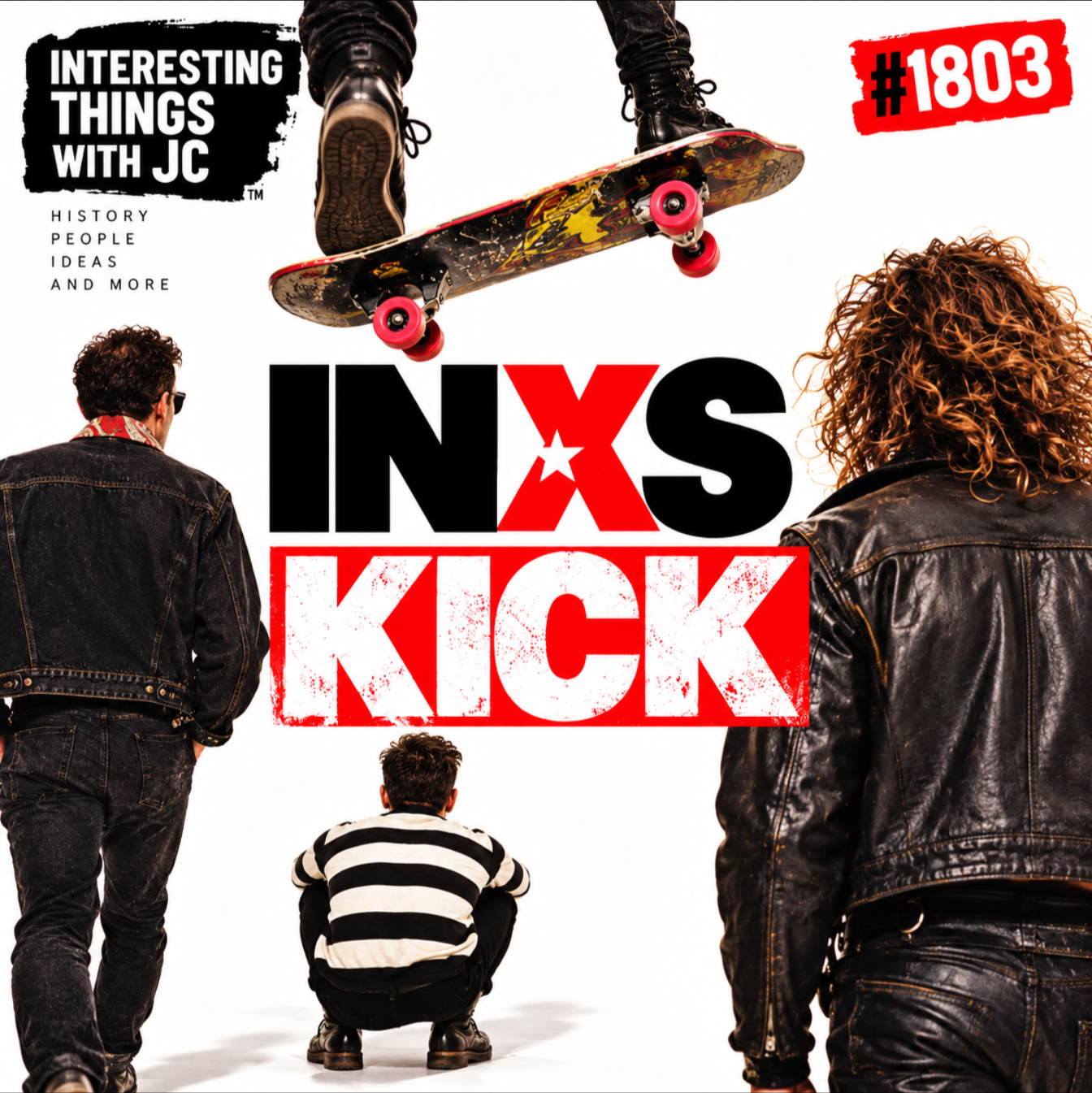
Square podcast cover art for Interesting Things with JC, episode #1803, titled “INXS Kick.” The white background features bold black and red lettering, with the podcast name in the upper left, the episode number in the upper right, and “INXS KICK” prominently centered.
Three men are shown from behind: one wearing a dark denim jacket on the left, one crouching in a black-and-white striped shirt near the bottom center, and one with curly reddish-brown hair wearing a black leather jacket on the right. Above the title, a skateboarder’s black boots and skateboard extend into the frame. Smaller text beneath the podcast name reads “History People Ideas and More.”
Interesting Things with JC #1803:
"Kick by INXS"
In 1987, an American record executive reportedly offered the manager of Australian rock band INXS one million dollars to scrap their new album and start over.
Manager Chris Murphy refused.
That album was Kick, released on October 19, 1987.
INXS, had recorded its sixth studio album with producer Chris Thomas. But executives at Atlantic Records questioned its mixture of rock, funk, and dance music.
Murphy turned to the label's college radio promotion staff, helping build interest outside conventional promotional channels.
Then came "Need You Tonight."
Guitarist Andrew Farriss was leaving for the airport when a riff came into his head. He asked his taxi driver to wait while he went inside to record it.
The driver reportedly waited around 40 minutes.
Michael Hutchence later developed the lyrics after hearing the demo, reportedly writing much of them in about ten minutes.
The song reached number one on the Billboard Hot 100 in January 1988.
But there's another detail hidden in the album.
"Need You Tonight" flows directly into "Mediate," whose music video features the band holding handwritten lyric cards, paying tribute to Bob Dylan's 1965 "Subterranean Homesick Blues."
The combined video won five awards at the 1988 MTV Video Music Awards, including Video of the Year.
Another hit, "Never Tear Us Apart," began as a blues-influenced piano composition before Chris Thomas helped reshape it with dramatic synthesized strings and Kirk Pengilly's saxophone.
Kick produced four American Top 10 singles. "Need You Tonight" reached number one, "Devil Inside" number two, "New Sensation" number three, and "Never Tear Us Apart" number seven.
The album reached number three on the Billboard 200 and became INXS's biggest commercial success, with worldwide sales exceeding 20 million copies.
The record Atlantic initially questioned ultimately delivered four major American hits and five MTV awards, establishing INXS among the world's most successful rock bands.
These are interesting things, with JC.
Student Worksheet
Student Name: ____________________ Class: ____________________
Date: ____________________
Part A — Comprehension
In which country did INXS form, and in what year?
Who produced Kick, and what was his role?
Identify three musical genres represented on the album.
Name the four American Top 10 singles from Kick.
Which single reached number one in the United States?
What visual technique in "Mediate" connects the video to Bob Dylan's earlier work?
Part B — Historical Analysis
The episode describes a reported offer of $1 million to abandon the album. What evidence would you need to establish whether that offer occurred?
Explain why college radio could be valuable in promoting a band before widespread mainstream exposure.
Identify two ways music videos could influence album sales during the 1980s.
Why is reaching number three on an album chart different from having a number-one single?
Part C — Evidence Evaluation
Classify each statement as:
D: Documented by a source supplied in this lesson.
R: Reported anecdote requiring additional verification.
I: Interpretation that must be supported by an argument.
Kick produced four American Top 10 singles.
A taxi driver waited approximately 40 minutes while Andrew Farriss recorded a musical idea.
Kick succeeded partly because it appealed to listeners of several musical genres.
The "Need You Tonight/Mediate" video received five MTV awards.
Michael Hutchence wrote much of the "Need You Tonight" lyrics in approximately ten minutes.
Part D — Data Interpretation
U.S. Billboard Hot 100 Chart Performance
The album Kick produced four singles that reached the Top 10 on the U.S. Billboard Hot 100.
"Need You Tonight" — Peaked at No. 1
"Devil Inside" — Peaked at No. 2
"New Sensation" — Peaked at No. 3
"Never Tear Us Apart" — Peaked at No. 7
Source: Rhino Entertainment / Atlantic Records, Kick retrospective.
Rhino
Calculate the arithmetic mean of the four peak chart positions.
Why does this mean not describe the album's overall popularity?
What additional information would help compare the four songs' commercial performance?
Part E — Written Reflection
In 150–200 words, explain how songwriting, radio, music videos, and business decisions contributed to the commercial success of Kick. Use at least two specific pieces of evidence.
Explain why historians must distinguish firsthand recollections from independently corroborated events.
Difficulty Scaling
Level 1 — Foundational: Complete questions 1–6 and 11–15 using the transcript.
Level 2 — Intermediate: Complete all questions and a 150-word response.
Level 3 — Advanced: Investigate one anecdote using two independently attributable sources and write a 250-word evidence evaluation.
Student Output: Completed worksheet and one evidence-based paragraph.
Academic Integrity Guidance: Cite external research, distinguish personal interpretation from historical fact, and do not present an unverified anecdote as established history.
Teacher Guide
Quick Start: Distribute the worksheet, play the episode once without interruption, then replay selected portions for evidence gathering. Use the chart table and references for source evaluation.
Materials
Episode #1803 audio or transcript
Student worksheet
Projector or classroom display
Internet access for source research, if available
Paper or digital response document
Pacing Guide — Audio First
0–5 minutes — Opening: Ask students what might cause a record label to reject an album.
5–9 minutes — Listening: Play the episode. Students identify the album, band, producer, and commercial outcomes.
9–17 minutes — Comprehension: Complete worksheet questions 1–6.
17–27 minutes — Source Evaluation: Compare the album's documented chart positions with the taxi and record-label anecdotes.
27–35 minutes — Data Activity: Complete questions 16–18 and discuss the limitations of chart rankings.
35–45 minutes — Written Analysis: Complete question 19 using two pieces of evidence.
45–50 minutes — Exit Ticket: Complete question 20 or submit a short statement distinguishing a verified fact from an anecdote.
Answer Key — Comprehension
Sydney, Australia, in 1977.
Chris Thomas; he oversaw the album's recording and creative production.
Rock, funk, and pop or dance music.
"Need You Tonight," "Devil Inside," "New Sensation," and "Never Tear Us Apart."
"Need You Tonight."
Handwritten lyric cards modeled on the visual approach used in Bob Dylan's "Subterranean Homesick Blues."
Answer Key — Analysis
A named interview, contemporary correspondence, a business record, or independently corroborating firsthand accounts. Students should consider when each source was created and the narrator's possible interests.
College radio could introduce recordings to audiences and influential DJs before national commercial stations adopted them.
Videos could increase repeated exposure, create visual recognition, and encourage audiences to purchase recordings or attend performances.
The Billboard 200 ranks albums; the Hot 100 ranks individual songs. They measure different commercial products and use different methodologies.
Answer Key — Evidence Evaluation
D — Supported by Rhino's historical album documentation.
R — Specific waiting time requires further attribution.
I — Plausible interpretation, but a causal claim requires evidence.
D — Supported by contemporary reporting.
R — Specific writing time requires further attribution.
Answer Key — Data Interpretation
(1 + 2 + 3 + 7) ÷ 4 = 3.25.
A peak-position average does not measure total sales, weeks on the chart, streaming, airplay, or album purchases. Chart rankings are ordinal, not equal-interval measurements.
Weeks charted, total sales, radio airplay, certifications, and comparable measures across a defined time period.
Discussion Prompts
Why might a successful recording sound commercially risky before release?
Could the same album have succeeded without MTV?
How should a researcher handle a memorable anecdote that cannot be independently confirmed?
What is the difference between a musician's artistic intention and an executive's sales forecast?
Common Misconceptions
Four Top 10 singles means four number-one hits: Only "Need You Tonight" reached number one in the United States.
A chart peak equals total sales: Chart rank measures relative performance within a specific reporting period.
MTV alone caused the album's success: Its contribution must be considered alongside radio, touring, distribution, and promotion.
A firsthand recollection is automatically accurate: Recollections are valuable primary evidence but can contain errors or omissions.
An album has one universal release date: Dates can differ by territory and format.
Differentiation
Additional Support: Provide the vocabulary sheet and pre-highlight key facts in the transcript.
English Learners: Preview the terms single, record label, producer, and chart position. Allow oral explanations before written work.
Advanced Learners: Compare the 1987 record business with today's streaming-driven release strategies.
Accessibility: Supply an accessible transcript, captioned videos when used, and a text alternative to all chart graphics.
Formative Checkpoints
Students correctly distinguish album charts from singles charts.
Students identify at least two documented facts.
Students identify at least one unverified anecdote.
Students explain one plausible promotional mechanism without confusing correlation with causation.
Quiz
Student Name: ____________________ Score: ______ / 20
Multiple Choice — 2 points each
1. INXS formed in which country?
A. United Kingdom
B. Australia
C. United States
D. Canada
2. In what year was Kick released?
A. 1977
B. 1981
C. 1987
D. 1997
3. Who produced Kick?
A. George Martin
B. Chris Thomas
C. Quincy Jones
D. Brian Eno
4. Which song reached number one on the U.S. Billboard Hot 100?
A. Devil Inside
B. Never Tear Us Apart
C. New Sensation
D. Need You Tonight
5. How many U.S. Top 10 singles came from Kick?
A. Two
B. Three
C. Four
D. Six
6. Which earlier musician's video inspired the handwritten cards in "Mediate"?
A. David Bowie
B. Bob Dylan
C. Prince
D. Peter Gabriel
7. Which organization presented the five awards won by the "Need You Tonight/Mediate" video in 1988?
A. Grammy Awards
B. Academy Awards
C. MTV Video Music Awards
D. American Music Awards
8. Which chart measures album performance in the United States?
A. Billboard Hot 100
B. Billboard 200
C. UK Singles Chart
D. ARIA Singles Chart
Short Answer — 2 points each
9. Explain one way music videos could help promote an album during the 1980s.
10. Why should a historian seek corroboration for the reported million-dollar offer to abandon Kick?
Teacher Answer Key
Multiple Choice: 1. B, 2. C, 3. B, 4. D, 5. C, 6. B, 7. C, 8. B.
Short Answer:
9. Accept an accurate explanation involving exposure, artist recognition, repeated television play, or consumer interest.
10. Accept an explanation that identifies the difference between an attributed recollection and independently supported historical evidence.
Scoring: 16 points multiple choice, 4 points short answer; 20 points total.
Assessment
Summative Performance Task
Title: How Did Kick Become an International Success?
Task: Students will prepare a 400–600-word historical analysis or a 3–4-minute oral presentation addressing:
How did musical innovation, record-industry decisions, and changing media technology contribute to the commercial success of INXS's Kick?
Required Evidence
At least three historically accurate facts.
At least two cited sources.
One explanation of a promotional or distribution mechanism.
One distinction between documented evidence and a reported anecdote.
A conclusion supported by the evidence presented.
Assessment Rubric — 20 Points
Assessment Task: How Did Kick Become an International Success?
Total Possible Score: 20 points Scoring Method: Five criteria, each worth 1–4 points. Add the scores to determine the final grade.
1. Historical Accuracy — 4 Points
4 — Exemplary: All major historical claims are accurate, clearly explained, and appropriately qualified.
3 — Proficient: Historical information is accurate with only minor imprecision.
2 — Developing: Several claims are unclear, incomplete, or insufficiently supported.
1 — Beginning: Major factual errors or misunderstandings are present.
2. Evidence and Citations — 4 Points
4 — Exemplary: Uses strong, relevant evidence from multiple credible sources with proper citations.
3 — Proficient: Uses adequate supporting evidence with generally accurate citations.
2 — Developing: Uses limited evidence or sources with incomplete citations.
1 — Beginning: Provides little reliable evidence or lacks meaningful citations.
3. Critical Analysis — 4 Points
4 — Exemplary: Clearly explains relationships among songwriting, promotion, media technology, and commercial success while acknowledging limitations in the evidence.
3 — Proficient: Explains the major factors contributing to the album's success.
2 — Developing: Describes historical events but provides limited analysis of their significance.
1 — Beginning: Provides little analysis or makes unsupported conclusions.
4. Organization and Structure — 4 Points
4 — Exemplary: Presents a clear introduction, logically sequenced supporting points, effective transitions, and a well-supported conclusion.
3 — Proficient: Information is organized and generally easy to follow.
2 — Developing: Organization is inconsistent, with unclear transitions or missing connections.
1 — Beginning: Work lacks a clear structure or logical progression.
5. Communication and Presentation — 4 Points
4 — Exemplary: Communicates ideas precisely, clearly, and originally using appropriate academic language.
3 — Proficient: Communicates ideas clearly with minor errors.
2 — Developing: Some language, grammar, or presentation problems interfere with understanding.
1 — Beginning: Frequent communication problems make the work difficult to understand.
Final Score Calculation
Historical Accuracy: _____ / 4
Evidence and Citations: _____ / 4
Critical Analysis: _____ / 4
Organization and Structure: _____ / 4
Communication and Presentation: _____ / 4
Total Score: _____ / 20
Performance Levels
18–20 points (90–100%): Advanced Mastery
15–17 points (75–85%): Proficient
11–14 points (55–70%): Developing
5–10 points (25–50%): Additional Support Required
Teacher Feedback: ______________________________________
Areas for Improvement: __________________________________
Recommended Next Steps: _________________________________
Extension Activity
Compare the promotion of Kick in 1987–1988 with the release of a contemporary album. Identify changes in distribution, video platforms, audience measurement, and artist-label relationships. Students must avoid assuming that a modern streaming metric is directly equivalent to a historical record sale.
Standards Alignment
CCSS Reading — Grades 9–10
CCSS.ELA-LITERACY.RH.9-10.1 — Cite specific textual evidence to support analysis of primary and secondary sources — Students cite historical reporting and record-label documentation to support claims about the album.
CCSS.ELA-LITERACY.RH.9-10.9 — Compare and contrast treatments of the same topic in several primary and secondary sources — Students compare accounts of the album's creation and promotion.
CCSS Reading — Grades 11–12
CCSS.ELA-LITERACY.RH.11-12.1 — Cite specific textual evidence to support analysis of primary and secondary sources, connecting insights gained from specific details to an understanding of the text as a whole — Students distinguish commercial facts from disputed anecdotes.
CCSS.ELA-LITERACY.RH.11-12.7 — Integrate and evaluate multiple sources of information presented in diverse formats and media — Students evaluate audio, written histories, chart data, and video.
CCSS Writing
CCSS.ELA-LITERACY.WHST.9-10.1 — Write arguments focused on discipline-specific content — Students argue which factors most strongly contributed to the album's success.
CCSS.ELA-LITERACY.WHST.11-12.1 — Write arguments focused on discipline-specific content — Advanced students develop claims, counterclaims, and evidence-based conclusions.
CCSS.ELA-LITERACY.WHST.11-12.6 — Use technology, including the Internet, to produce, publish, and update individual or shared writing products — Students prepare a sourced digital analysis.
C3 Framework — Social Studies
D2.His.10.9-12 — Detect possible limitations in various kinds of historical evidence and differing secondary interpretations — Students assess the limitations of retrospective interviews and promotional histories.
D2.His.14.9-12 — Analyze multiple and complex causes and effects of events in the past — Students investigate the interaction of radio, music television, production, and distribution.
D3.1.9-12 — Gather relevant information from multiple sources representing a wide range of views while using the origin, authority, structure, context, and corroborative value of the sources to guide the selection — Students evaluate source credibility before making historical claims.
National Core Arts Standards — Music
MU:Re7.2.H.Ia — Analyze how the elements of music, including form, relate to the style, function, and context, and explain how the analysis provides models for personal growth as a listener, creator, and/or performer — Students examine the use of rock, funk, and pop characteristics in the album.
MU:Cn11.0.H.Ia — Demonstrate understanding of relationships between music and the other arts, other disciplines, varied contexts, and daily life — Students connect music to television, marketing, and cultural history.
ISTE Standards for Students
1.3.b — Evaluate Information — Students assess accuracy, credibility, bias, and relevance in historical accounts.
1.6.c — Communicate Complex Ideas — Students present historical arguments through written or audiovisual formats.
NGSS — Science & Engineering Practices
- Analyzing and Interpreting Data — Cross-disciplinary practice connection, not a claim of alignment to an NGSS performance expectation. Students interpret numerical chart rankings and identify why ordinal rankings cannot be treated as equal-interval measures.
Career and Technical Education Connections
Arts, A/V Technology, and Communications: Music production, audio engineering, video production, and distribution.
Marketing: Audience targeting, promotional strategy, media exposure, and consumer behavior.
Business Management: Risk assessment, decision-making, and commercial forecasting.
International Curriculum Connections
UK National Curriculum — Key Stage 3 Music: Understanding music in historical context, listening with increasing discrimination, and developing knowledge of musical traditions. Adaptable to GCSE music study.
International Baccalaureate — DP Music: Exploring music in context and examining relationships among musical works, creators, audiences, and cultural settings.
Cambridge International — Music: Listening, contextual understanding, and analytical communication about musical works.
Alignment Note: These are instructional connections. They do not imply that this single lesson fully satisfies every cited standard or qualification.
Show Notes
In 1987, Australian rock band INXS released Kick, an album that blended rock, funk, and dance music. Despite reported concerns within its American record label, the album produced four U.S. Top 10 singles, including the number-one hit "Need You Tonight."
The episode examines the stories behind its recording, the influence of MTV, and the business decisions surrounding one of the most commercially successful Australian rock albums.
References
Album History and Primary Industry Sources
INXS. (n.d.). Kick. Official INXS discography. https://www.inxs.com/music/kick/
Rhino Entertainment. (2026). Kick (Rhino High Fidelity) [Press release]. https://images.rhino.com/press-release/kick-rhino-high-fidelity
Rhino Entertainment. (2026, January 22). Kick: Album of the day. https://www.rhino.com/aod/kick-inxs-2
Rhino Entertainment. (n.d.). Essential Atlantic: INXS, Kick. https://www.rhino.com/article/essential-atlantic-inxs-kick-0
Contemporary Reporting
Los Angeles Times. (1988, September 9). INXS rocks off with 5 video awards. https://www.latimes.com/archives/la-xpm-1988-09-09-ca-1872-story.html
Billboard. (1988, September 17). INXS bags five prizes at MTV awards show in L.A. https://www.worldradiohistory.com/Archive-All-Music/Billboard/80s/1988/BB-1988-09-17.pdf
Discography and Release-Date Verification
MusicBrainz. (n.d.). Kick — INXS [Release group]. https://musicbrainz.org/release-group/ec6bc9d7-01e1-3d58-8e79-960611b26f44
Educational Standards
National Governors Association Center for Best Practices & Council of Chief State School Officers. (2010). Common Core State Standards. https://www.thecorestandards.org/
National Council for the Social Studies. (2013). College, Career, and Civic Life (C3) Framework. https://www.socialstudies.org/standards/c3
National Coalition for Core Arts Standards. (2014). National Core Arts Standards. https://www.nationalartsstandards.org/
International Society for Technology in Education. (n.d.). ISTE Standards: Students. https://iste.org/standards/students
Next Generation Science Standards. (n.d.). Science and engineering practices. https://www.nextgenscience.org/
International Baccalaureate Organization. (n.d.). Music. https://www.ibo.org/programmes/diploma-programme/curriculum/the-arts/music/
Cambridge International Education. (n.d.). Cambridge IGCSE Music. https://www.cambridgeinternational.org/programmes-and-qualifications/cambridge-igcse-music-0410/