1802: "James Prescott Joule"
Interesting Things with JC #1802:
"James Prescott Joule"
In the 1840s, James Prescott Joule used falling weights and spinning paddles to measure how mechanical work produces heat, challenging a leading scientific theory and helping establish the law of energy conservation. His experiments changed how scientists understood energy, and his name became its international unit of measurement.
Curriculum - Episode Anchor
Episode Title: James Prescott Joule
Episode Number: 1802
Host: JC
Air Date: October 11, 2026
Audience: Grades 9–12, introductory college, homeschool, lifelong learners
Subject Area: Physics, thermodynamics, energy conservation, history of science, engineering
Lesson Overview
Learning Objectives
By the end of this lesson, students will be able to:
Explain how James Prescott Joule investigated the relationship between mechanical work and heat.
Describe the energy transformations occurring in Joule's paddle-wheel experiment.
Explain how Joule's measurements contributed to the development of the first law of thermodynamics.
Evaluate how quantitative experimental evidence can challenge an established scientific model.
Essential Question: How did Joule use measurement to demonstrate that mechanical work and heat are different expressions of energy?
Success Criteria
Students can:
Identify the major components of Joule's experiment.
Trace energy from falling weights to motion and then thermal energy.
Explain why measuring small temperature changes was scientifically difficult.
Connect Joule's experimental evidence to conservation of energy.
Distinguish Joule's contribution from the broader work of Mayer, Helmholtz, Thomson, and other scientists.
Student Relevance Statement: Energy conversions happen continuously in engines, appliances, electronics, vehicles, heating systems, exercise, manufacturing, and power generation. Joule's work provides part of the scientific foundation for calculating those transfers.
Real-World Connection: Engineers routinely account for mechanical, electrical, chemical, and thermal energy using a common energy unit. The joule allows energy in very different systems to be compared mathematically.
Workforce Reality: Understanding energy transfer is fundamental in mechanical engineering, electrical engineering, HVAC, automotive technology, power generation, industrial maintenance, renewable energy, physics, metrology, and manufacturing.
Key Vocabulary
James Prescott Joule — "JOOL": English physicist whose experiments established a quantitative relationship between mechanical work and heat.
Mechanical work — "meh-KAN-ih-kul wurk": Energy transferred when a force moves an object through a distance.
Thermal energy — "THUR-mul EN-er-jee": Energy associated with the microscopic motion and interactions of particles in matter.
Caloric theory — "kuh-LOR-ik THEER-ee": Historical theory that treated heat as a weightless fluid transferred between objects.
Mechanical equivalent of heat — "meh-KAN-ih-kul ih-KWIV-uh-lent": Quantitative relationship between mechanical work and the amount of heat produced.
Thermodynamics — "thur-moh-dy-NAM-iks": Branch of physics concerned with energy, heat, work, temperature, and their relationships.
Conservation of energy — "kon-sur-VAY-shun": Principle that energy cannot be created or destroyed but can be transferred or transformed.
Joule — "JOOL": SI derived unit of energy and work. One joule equals one newton-meter.
Joule-Thomson effect — "JOOL TOM-sun": Temperature change that can occur when a real gas expands through a restriction under appropriate conditions.
Narrative Core
Open
Joule begins with a practical experimental problem: falling weights are connected to paddles turning in water. Instead of simply observing that the water becomes warmer, he attempts to measure exactly how much mechanical work corresponds to the increase in temperature.
Info
James Prescott Joule was born in Salford, England, in 1818 and grew up in a brewing family. He received private instruction, including lessons from chemist John Dalton. His interests in electricity, motors, machinery, and efficiency led him toward questions about the relationship between work and heat.
Details
During Joule's lifetime, caloric theory remained an important explanation of heat. Joule's experiments approached the problem quantitatively. Falling weights supplied mechanical work. Their motion drove paddles through water. Resistance transformed mechanical energy into thermal energy, producing a small temperature increase.
The experiment demanded careful measurement because the temperature change was small and heat could also enter or leave the experimental apparatus. By comparing mechanical work with temperature change, Joule established a numerical relationship between the two.
His historical measurements were around 772 foot-pounds of work for the amount of heat needed to raise one pound of water by one degree Fahrenheit, approximately 1,047 joules and close to one British thermal unit.
Joule was part of a broader scientific development. Julius Robert Mayer and Hermann von Helmholtz independently contributed important ideas about energy conservation, while Joule later worked with William Thomson, who became Lord Kelvin.
Reflection
Joule's importance rests not simply in noticing that motion could produce heat. Frictional heating was already known. His achievement was helping establish that mechanical work and heat could be compared quantitatively as energy.
That allowed seemingly different physical processes to be examined using a common accounting principle: energy may move between forms and systems, but it does not simply vanish.
Closing
These are interesting things, with JC.
Transcript
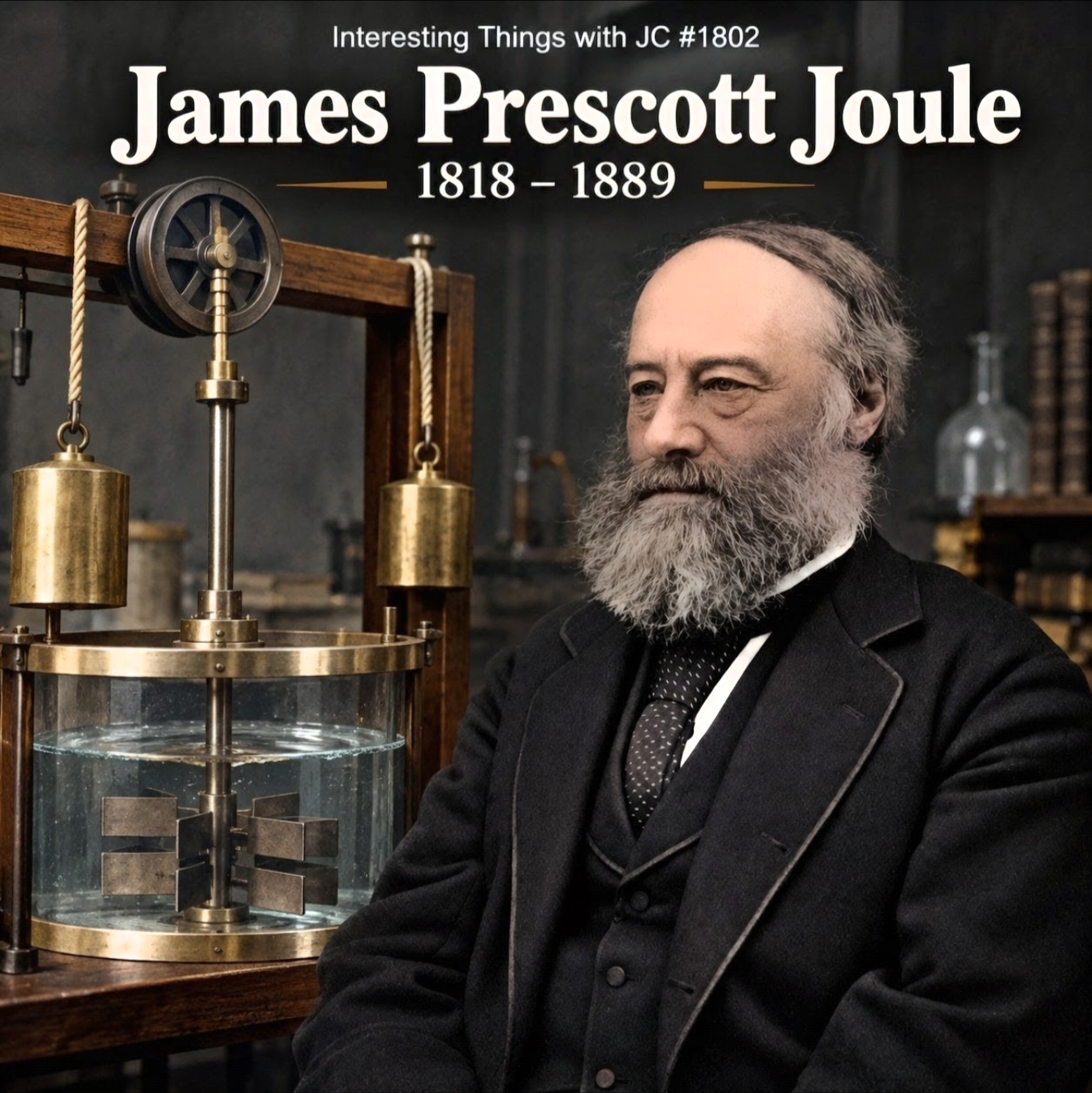
Portrait of English physicist James Prescott Joule seated in formal 19th-century clothing beside a brass paddle-wheel experiment apparatus with suspended weights and water. Text at the top reads “Interesting Things with JC #1802,” with the title “James Prescott Joule” and the dates “1818–1889.”
Interesting Things with JC #1802:
"James Prescott Joule"
In the 1840s, an English brewer's son began dropping weights attached to ropes, using them to spin paddles inside a container of water. He was trying to measure the relationship between motion and heat.
James Prescott Joule was born in Salford, England, on December 24, 1818. His family owned a brewery, and as a young man, he studied under John Dalton, the chemist who helped establish modern atomic theory.
Joule was fascinated by electricity, machinery, and how efficiently different sources of power could perform work. His experiments eventually challenged one of the leading scientific explanations of heat.
Many scientists believed heat was a weightless fluid called caloric. Friction clearly produced warmth, but explaining how that happened without creating heat posed a serious problem for the theory.
Joule approached the question experimentally.
His apparatus used falling weights to turn paddles submerged in water. As the paddles encountered resistance, mechanical energy was converted into thermal energy.
The temperature increase was tiny, often just fractions of a degree. Joule measured it carefully while accounting for heat absorbed by the apparatus and exchanged with its surroundings.
By comparing the work performed by the falling weights with the resulting temperature change, he established a measurable relationship between mechanical work and heat.
His historical result was approximately 772 foot-pounds of mechanical work for enough heat to raise one pound of water by one degree Fahrenheit. That's roughly 1,047 joules of energy, close to one British thermal unit.
Other researchers, including Julius Robert Mayer and Hermann von Helmholtz, were developing related ideas about energy conservation.
Together, their work helped establish the first law of thermodynamics: energy cannot be created or destroyed, only transferred or transformed.
Joule later collaborated with William Thomson, better known as Lord Kelvin, studying temperature changes in expanding gases.
James Prescott Joule died on October 11, 1889, at age 70.
Today, the joule is the international unit of energy, used in physics, engineering, and electrical systems worldwide.
His name became a unit of measurement because he helped demonstrate that heat and mechanical work could be measured on the same energy scale.
These are interesting things, with JC.
Student Worksheet
Comprehension
Who was James Prescott Joule, and what was unusual about his scientific background compared with a modern university researcher?
What did caloric theory propose about heat?
Describe the basic operation of Joule's paddle-wheel experiment.
What two quantities did Joule compare in order to establish the mechanical equivalent of heat?
Analysis
Why did the small temperature increase in Joule's experiment make careful experimental technique especially important?
Joule obtained a historical result of approximately 772 foot-pounds of work for enough heat to raise one pound of water by one degree Fahrenheit. What does this result demonstrate about mechanical work and heat?
Why would it be inaccurate to say that Joule alone "discovered conservation of energy"?
Explain the sequence of energy transformations beginning with the elevated weights and ending with the warmer water.
Reflection
Identify one modern machine or device in which mechanical, electrical, chemical, or thermal energy changes from one form to another. Explain the transformation.
Joule's experiment did not depend on a dramatic visual discovery. Its importance came largely from precise measurement. What does this suggest about the role of measurement in science?
Difficulty Scaling
Level 1 — Foundation: Identify the apparatus, vocabulary, people, and basic energy transformations.
Level 2 — Application: Explain how Joule's evidence challenged caloric theory and supports conservation of energy.
Level 3 — Advanced: Construct an energy-flow model and analyze experimental uncertainty, heat loss, measurement precision, and the limits of historical measurements.
Student Output: Submit completed responses to Questions 1–10 and one labeled energy-flow model showing the transformation from gravitational potential energy to mechanical motion to thermal energy.
Academic Integrity Guidance: Use the episode transcript and class materials as your primary evidence. Write explanations in your own words. Clearly identify any outside source used for additional research rather than copying or closely paraphrasing it.
Teacher Guide
Quick Start: Play Episode #1802 once without interruption. Ask students to listen specifically for what Joule measured, not simply what happened to the water. Use the worksheet immediately after listening.
Pacing Guide — Audio First
0–5 minutes: Bell Ringer and prediction.
5–9 minutes: Play the episode.
9–15 minutes: Review vocabulary and energy forms.
15–25 minutes: Student Worksheet Questions 1–8.
25–35 minutes: Energy-flow modeling and class discussion.
35–45 minutes: Open-ended assessment or quiz.
45–50 minutes: Exit Ticket and review.
Bell Ringer
Write this situation on the board:
"A falling weight turns a paddle inside a container of water."
Ask students to predict:
Where does the energy begin?
Where does it go?
What measurable change should occur?
Could all of the original energy theoretically be accounted for?
Do not explain the answer until after the episode.
Audio Guidance + Fallback: Play the complete episode first. If audio is unavailable, have the teacher or a student read the transcript aloud without stopping for explanation. Conduct discussion only after the full narrative is completed.
Time-on-Task: Approximately 45–50 minutes for a standard class period. The lesson can be reduced to approximately 25 minutes or extended to 90 minutes.
Materials
Episode audio or transcript
Student Worksheet
Pencil or digital response tool
Whiteboard or display
Calculator for optional quantitative extension
Diagram paper or digital modeling tool
Vocabulary Prep
Before listening, introduce only three terms:
Mechanical work
Thermal energy
Caloric theory
Allow students to encounter the remaining terms through the episode before formal review.
Common Misconceptions
Joule did not discover conservation of energy entirely by himself.
The paddles did not create energy; they transformed and transferred energy.
Heat and temperature are related but are not identical concepts.
Joule was not the first person to notice that friction produces warmth.
The historical 772 foot-pound measurement should not be confused with a modern exact conversion constant.
Energy conservation does not mean every energy conversion remains equally useful for performing work.
Discussion Prompts
Why was measuring the temperature change more scientifically important than merely noticing the water became warmer?
What sources of experimental error might affect Joule's apparatus?
Why would heat escaping into the room change the result?
How can a measurement undermine an established scientific model?
Why does science often advance through contributions from several researchers rather than one isolated discovery?
Formative Checkpoints
Students correctly identify the falling weights as the initial source of gravitational potential energy.
Students identify paddle motion as mechanical energy transfer.
Students identify the temperature increase as evidence of increased thermal energy.
Students distinguish heat transfer from temperature measurement.
Students recognize Mayer and Helmholtz as contributors to the broader development of energy conservation.
Differentiation
Additional Support: Provide a three-box diagram labeled "Falling Weight → Paddle Motion → Warmer Water" and ask students to insert the appropriate energy form.
Advanced Learners: Have students identify likely sources of systematic and random error in Joule's experiment.
English Learners: Preteach work, heat, energy, paddle, weight, and temperature with diagrams and concrete examples.
Auditory Learners: Replay the experiment section of the episode.
Visual Learners: Draw the apparatus and trace the energy pathway with arrows.
Quantitative Learners: Compare Joule's historical value with modern energy conversion data.
Assessment Differentiation
Allow verbal responses for students who demonstrate understanding more effectively through speech.
Permit a labeled energy diagram in place of one written paragraph for students requiring reduced writing load.
Require advanced students to address experimental uncertainty and the distinction between historical and modern values.
Time Flexibility
25-minute version: Audio, Questions 1–5, energy-flow diagram, Exit Ticket.
50-minute version: Complete lesson as written.
90-minute version: Add quantitative analysis, historical context, research comparison, and student presentations.
Substitute Readiness: A substitute can complete the lesson using only the transcript, worksheet, Teacher Guide, and Quiz. No laboratory equipment or specialized physics demonstration is required.
Engagement Strategy: Ask students to predict what happens to the energy before revealing Joule's interpretation. Revisit the prediction after the episode and require students to correct or defend their original model using evidence.
Extensions
Research the Joule-Thomson effect and explain why some gases cool during expansion under specific conditions.
Compare Joule's contribution with those of Julius Robert Mayer and Hermann von Helmholtz.
Investigate how modern calorimeters measure energy changes.
Calculate energy transformations in an electric heater, automobile brake system, or falling object.
Examine why energy conservation does not imply 100% useful-energy efficiency in real machines.
Cross-Curricular Connections
History: Scientific change during the Industrial Revolution.
Mathematics: Unit conversion, proportional relationships, measurement uncertainty.
Engineering: Efficiency, energy accounting, thermal management.
Chemistry: Calorimetry, internal energy, heat transfer.
Technology: Energy consumption and electrical power systems.
SEL: Emphasize intellectual perseverance, willingness to revise explanations when evidence changes, collaboration, and productive disagreement based on measurement rather than authority.
Skill Emphasis
Evidence-based reasoning
Scientific modeling
Quantitative literacy
Historical contextualization
Experimental design
Source evaluation
Technical communication
Answer Key — Student Worksheet
Joule was an English physicist from a brewing family who conducted much of his research outside a modern university laboratory and received private instruction, including tutoring from John Dalton.
Caloric theory treated heat as a weightless fluid that moved between objects.
Falling weights drove paddles through water. Resistance to the paddle motion transferred mechanical energy into thermal energy, raising the water's temperature.
He compared mechanical work performed by the falling weights with the resulting temperature change or quantity of heat.
A tiny temperature change could easily be distorted by heat entering or leaving the apparatus, thermometer limitations, friction elsewhere in the mechanism, or measurement error.
It demonstrated that a definite amount of mechanical work corresponded to a definite amount of thermal energy.
Mayer, Helmholtz, and other researchers independently developed related concepts of energy conservation; Joule supplied particularly important quantitative experimental evidence.
Gravitational potential energy of the raised weights → motion of the falling weights → mechanical rotation of the paddles → increased internal or thermal energy of the water and apparatus.
Answers vary. Accept any scientifically accurate example with the transformation correctly identified.
Precise quantitative evidence can test, refine, or overturn theoretical explanations even when the observable effect appears small.
Quiz Answer Key: 1-B, 2-C, 3-A, 4-D, 5-B.
Quiz
What did caloric theory primarily propose?
A. Heat was produced only by electricity.
B. Heat behaved as a weightless fluid transferred between objects.
C. Heat existed only inside gases.
D. Mechanical work could not be measured.
What supplied the mechanical work in Joule's best-known paddle-wheel experiment?
A. An electric battery
B. Steam pressure
C. Falling weights connected to the apparatus
D. Expanding gas
Why did Joule need to account for the apparatus and surrounding environment?
A. Heat could be absorbed or lost outside the water being measured.
B. The falling weights changed mass.
C. The water chemically reacted with the paddles.
D. Gravity changed during the experiment.
What was the major significance of Joule's measurements?
A. They showed temperature and energy are identical.
B. They proved water contains caloric fluid.
C. They demonstrated that friction eliminates mechanical energy.
D. They established a quantitative relationship between mechanical work and heat.
Joule's later collaboration with William Thomson contributed to research involving:
A. Atomic structure.
B. Temperature changes in expanding gases.
C. Electromagnetic radiation.
D. Radioactivity.
Assessment
Open-Ended Questions
Explain how Joule's paddle-wheel experiment provides evidence for energy transformation and conservation. Trace the energy through at least three stages and identify one experimental factor Joule needed to control or correct.
Explain why Joule's work should be understood as both an individual experimental achievement and part of a larger scientific development involving researchers such as Mayer, Helmholtz, and Thomson.
3–2–1 Rubric
3 — Strong: Scientifically accurate; clearly traces energy transformations; uses specific evidence from the episode; explains reasoning and historical context.
2 — Proficient: Mostly accurate; identifies the major energy transformation and supporting evidence; explanation contains minor omissions.
1 — Developing: Shows partial understanding but confuses major concepts, omits evidence, or does not clearly explain the energy pathway.
Exit Ticket
Complete all three statements:
The first law of thermodynamics means ______________________________.
Joule's experiment supported this idea by ______________________________.
One modern example of energy changing form is ______________________________.
Standards Alignment
NGSS — Physical Science
HS-PS3-1 — Energy: Create a computational model to calculate changes in energy within a system. Students identify and account for energy transferred from falling weights to paddle motion and thermal energy.
HS-PS3-2 — Energy: Develop and use models to illustrate energy at the macroscopic scale. Students construct a model linking gravitational potential energy, mechanical motion, and increased internal energy.
CCSS Reading in Science and Technical Subjects
CCSS.ELA-LITERACY.RST.9-10.1 — Cite specific textual evidence to support analysis of science and technical texts: Students use the transcript to support explanations of Joule's experiment and conclusions.
CCSS.ELA-LITERACY.RST.11-12.2 — Determine central ideas or conclusions of a text and summarize complex concepts: Students identify the central relationship between work, heat, and energy conservation.
CCSS Writing
CCSS.ELA-LITERACY.WHST.9-10.2 / WHST.11-12.2 — Write informative and explanatory texts about scientific procedures and processes: Students explain the paddle-wheel experiment using accurate sequence, terminology, and evidence.
C3 Framework — Historical Thinking
D2.His.1.9-12 — Evaluate historical developments within their circumstances and broader contexts: Students place Joule's research within 19th-century debates about heat and energy.
D2.His.14.9-12 — Analyze multiple and complex causes and effects of events in the past: Students examine how work by Joule, Mayer, Helmholtz, Thomson, and others contributed to the development of energy conservation.
ISTE — Knowledge Constructor
ISTE 1.3.b — Evaluate accuracy, perspective, credibility, and relevance of information and resources: Students distinguish historical claims, experimental evidence, and modern interpretations of Joule's work.
Career Readiness Competencies
Critical Thinking: Analyze evidence, identify experimental limitations, and distinguish observation from interpretation.
Quantitative Reasoning: Connect measurements, units, proportional relationships, and energy conversions.
Technical Communication: Explain a scientific mechanism clearly using appropriate terminology and evidence.
Systems Thinking: Trace energy through interacting components rather than treating each stage independently.
UK National Curriculum — Key Stage 4 Physics
Energy Changes and Transfers: Students analyze energy changes in systems involving heating and work done by forces, directly applying the concept to Joule's falling-weight and paddle apparatus.
IB MYP Sciences
Criterion A — Knowing and Understanding: Apply scientific knowledge of energy transfer and thermodynamics to explain Joule's experiment.
Criterion C — Processing and Evaluating: Interpret experimental evidence and evaluate the reliability and significance of measurements.
Homeschool and Lifelong Learning
Scientific Literacy: Explain how experimental evidence can alter accepted scientific models.
Quantitative Literacy: Interpret historical measurements and connect them with modern units.
Historical Literacy: Recognize scientific knowledge as cumulative and shaped by multiple investigators.
Applied Learning: Connect conservation of energy to machines, transportation, heating, electricity, and everyday technology.
Show Notes
James Prescott Joule's experiments helped establish that mechanical work and heat could be measured as forms of the same underlying quantity: energy. This lesson uses Joule's paddle-wheel experiment to connect physics, experimental design, measurement, scientific history, and engineering. Students trace energy through a physical system, examine why precise measurement mattered, and place Joule's work within the broader development of the first law of thermodynamics. The episode provides an accessible entry point for teaching conservation of energy while also demonstrating how scientific models change when quantitative evidence becomes strong enough to demand a better explanation.
References
American Physical Society. (2009). December 1840: Joule's abstract on converting mechanical power into heat. https://www.aps.org/apsnews/2009/12/joule-abstract-converting-mechanical-heat American Physical Society
Williams, R. (2015). June 1849: James Prescott Joule and the mechanical equivalent of heat. American Physical Society. https://www.aps.org/apsnews/2015/06/joule-mechanical-equivalent-heat American Physical Society
The Royal Society. (n.d.). James Prescott Joule. Science in the Making. https://makingscience.royalsociety.org/people/na7041/james-prescott-joule Making Science
Science Museum Group. (n.d.). Mechanical equivalent of heat apparatus. Science Museum Group Collection. https://collection.sciencemuseumgroup.org.uk/objects/co2526/mechanical-equivalent-of-heat-apparatus Science Museum Group Collection
National Institute of Standards and Technology. (2023). Joule. https://www.nist.gov/glossary-term/26261 NIST
National Institute of Standards and Technology. (n.d.). NIST Guide to the SI, Appendix B.8: Factors for units listed alphabetically. https://www.nist.gov/pml/special-publication-811/nist-guide-si-appendix-b-conversion-factors/nist-guide-si-appendix-b8 NIST