Interesting Things with JC #1548: "Sly Dunbar" – He approached music as a responsibility. By holding time steady and sessions together, he became one of the most trusted figures in Jamaican recording history. This episode reflects on a working life defined by discipline, clarity, and trust.
Curriculum - Episode Anchor
Episode Title: Interesting Things with JC #1548: "Sly Dunbar"
Episode Number: 1548
Host: JC
Audience: Grades 9–12, college intro, homeschool, lifelong learners
Subject Area: Music History, Cultural Studies, Media Production, African Diaspora Studies
Lesson Overview
This episode examines the career and working method of Sly Dunbar, focusing on how discipline, timing, and reliability shaped modern reggae, dub, dancehall, and global popular music production. Students explore how technical precision, not showmanship, can drive artistic influence and long-term impact.
Learning Objectives
Students will be able to:
Define the role of a rhythm section in recorded music and explain why timing consistency matters.
Analyze how studio discipline influenced the evolution of reggae, dub, and dancehall.
Compare live drumming and drum machine reinforcement in early electronic music production.
Explain how reliability and process can shape artistic legacy across genres.
Key Vocabulary
Rhythm section (RITH-um SEK-shun) — The core musical unit (usually drums and bass) responsible for timing and groove; Sly Dunbar’s primary role.
Dub (DUHB) — A reggae subgenre emphasizing remixing, space, and studio manipulation.
Dancehall (DANS-hawl) — A Jamaican music style built on repetition, precision, and sound-system performance.
Sound system (SOWND SIS-tuhm) — Large-scale DJ-based playback culture central to Jamaican music.
Tempo (TEM-poh) — The speed of music; Sly Dunbar was known for holding tempo without drift.
Narrative Core
Open: The episode opens with a deceptively simple statement: “I just play what the song needs,” framing reliability as a creative force.
Info: Born in Kingston and raised in Waterhouse, Sly Dunbar developed high professional standards early in a demanding musical environment.
Details: His partnership with Robbie Shakespeare formed the most recorded rhythm section in reggae history, shaping roots reggae, dub, and dancehall while influencing global pop production.
Reflection: Sly’s influence rests not on personality or image, but on consistency, discipline, and trust.
Closing: These are interesting things, with JC.
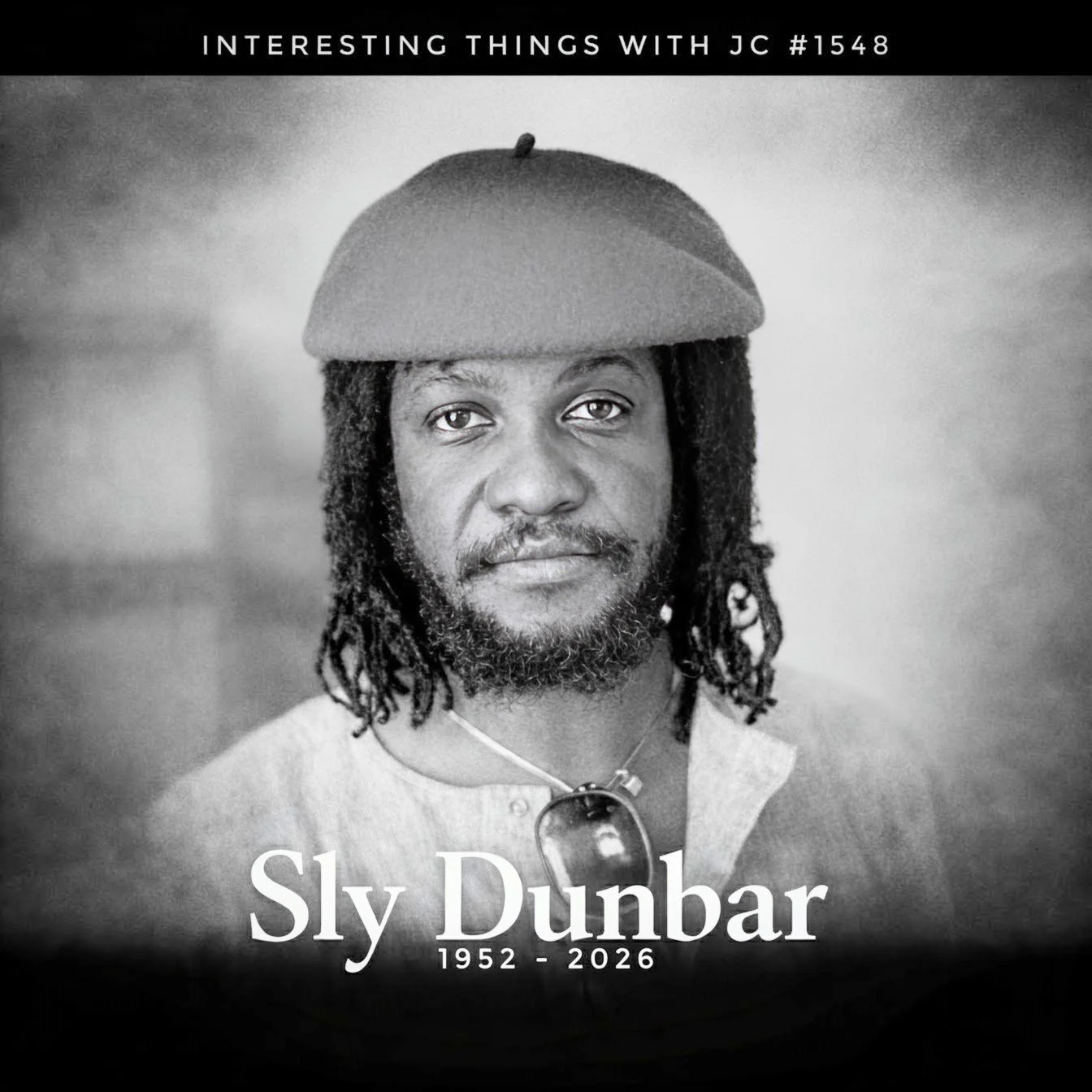
Black-and-white portrait of Jamaican drummer Sly Dunbar wearing a beret and a light-colored shirt, looking directly at the camera with a calm expression. Text at the top reads “Interesting Things with JC #1548.” Text at the bottom reads “Sly Dunbar 1952–2026.”
Transcript
Interesting Things with JC #1548: “Sly Dunbar”
“I just play what the song needs.”
When Sly said that, he meant it literally. It wasn’t modesty and it wasn’t philosophy. It described how he worked. His responsibility was to keep the music steady, clear, and usable for everyone else in the room.
That reliability made him essential. Musicians trusted him because he listened. Producers trusted him because sessions stayed under control. Tempos didn’t drift. Grooves didn’t sag. Records held together from start to finish.
Sly Dunbar was born Lowell Fillmore Dunbar in Kingston, Jamaica (KING-stun, juh-MAY-kuh), and raised in Waterhouse (WAH-ter-house). Waterhouse had a reputation inside Jamaican music. It wasn’t a place for shortcuts. Timing mattered. Tuning mattered. If you showed up unprepared, you didn’t get called back. Sly absorbed that standard early and never let it go.
That background shaped how he approached the drums. He wasn’t interested in filling space. He was interested in controlling it.
In the studio, his process was deliberate. Drum heads were tuned so they stayed consistent from take to take. Tempos were set carefully and held without rushing or dragging. Microphones were placed to capture clarity, not volume. Engineers valued him because edits were minimal. Producers valued him because sessions stayed efficient. When Sly played, the rhythm track could be trusted.
In the mid-1970s, he partnered with bassist Robbie Shakespeare. Together, they became Sly & Robbie. Over the next several decades, they formed the most recorded rhythm section in reggae history, appearing on tens of thousands of recordings. That number reflects constant demand. They were called because they delivered usable tracks quickly and consistently.
Their playing defined major strands of Jamaican music. In roots reggae, their rhythms were steady and grounded. In dub, they left space deliberately so engineers could manipulate the mix. In dancehall, they tightened patterns further, emphasizing repetition and precision as the music moved toward sound-system culture.
They worked closely with Black Uhuru (uh-HOO-roo) and were central to that group’s sound. Black Uhuru’s music relied on drum and bass patterns that were sparse, forceful, and exact. Sly’s role was to keep those patterns locked so vocals and lyrics could sit firmly on top without the rhythm shifting underneath.
They also played a key role in reshaping Grace Jones’s sound in the late 1970s and early 1980s. Her records moved away from disco’s looseness toward a harder, more controlled feel. That change came from rhythm tracks that stayed fixed in tempo and left no excess movement.
Outside reggae, Sly & Robbie were hired for practical reasons. Artists like Bob Dylan and the Rolling Stones worked in recording environments where songs could change shape from take to take. Producers brought Sly & Robbie in to stabilize those sessions. Their job wasn’t to change the style. It was to keep the rhythm consistent so arrangements could be edited, overdubbed, and mixed without falling apart.
That discipline also made their work commercially viable. Through collaborations, Sly & Robbie appeared on Billboard charts throughout the late 1970s and 1980s in dance, R&B, and crossover releases. Their rhythms reached mainstream radio because they were tight, predictable, and repeatable.
In 1985, Sly & Robbie received the Grammy Award for Best Reggae Recording with Black Uhuru’s Anthem. The award recognized a recording approach built on clarity, balance, and control rather than excess.
During the early 1980s, Sly began introducing drum machines and electronic sequencing into reggae. He didn’t abandon live drums. He used machines to reinforce timing, especially for dancehall tracks that required absolute consistency for sound-system playback. That approach later became standard practice in pop and hip hop production.
Sly Dunbar lived his life in Jamaica. He recorded around the world, but stayed rooted where his standards were formed. His influence isn’t about image or personality. It’s about reliability. Music that doesn’t drift. Records that don’t break down.
He passed away on January 26, at the age of 73. The man is gone. The working method remains.
These are interesting things, with JC.
Student Worksheet
Explain why tempo consistency mattered to Sly Dunbar’s studio reputation.
Describe how dub music uses space differently than roots reggae.
Why were Sly & Robbie trusted by producers outside reggae?
Creative prompt: Write a paragraph comparing musical reliability to teamwork in another field.
Teacher Guide
Estimated Time
45–60 minutes
Pre-Teaching Vocabulary Strategy
Listen for terms during the episode, then define them collaboratively.
Anticipated Misconceptions
Students may assume technical precision limits creativity; this episode demonstrates the opposite.
Discussion Prompts
Can discipline be a form of creativity?
Why might producers value consistency over flair?
Differentiation Strategies
ESL: Provide vocabulary with phonetic spellings.
IEP: Offer guided notes.
Gifted: Research another influential rhythm section.
Extension Activities
Analyze a reggae track for drum and bass interaction.
Cross-Curricular Connections
Physics (sound waves), Sociology (cultural production), Media Studies (studio technology).
Quiz
Q1. What was Sly Dunbar’s primary responsibility in recordings?
A. Lead vocals
B. Visual performance
C. Maintaining tempo and clarity
D. Writing lyrics
Answer: C
Q2. Which genres did Sly & Robbie help define?
A. Jazz and blues
B. Roots reggae, dub, dancehall
C. Classical and opera
D. Punk and metal
Answer: B
Q3. Why were drum machines introduced?
A. To replace drummers
B. To increase volume
C. To reinforce timing consistency
D. To reduce costs only
Answer: C
Q4. What made Waterhouse musically significant?
A. Cheap studios
B. Loose standards
C. High expectations and discipline
D. International labels
Answer: C
Q5. What legacy did Sly Dunbar leave?
A. Image-driven fame
B. Reliability and method
C. Songwriting catalog
D. Vocal style
Answer: B
Assessment
Explain how Sly Dunbar’s approach influenced global music production.
Analyze why reliability can lead to long-term artistic impact.
3–2–1 Rubric
3 = Accurate, complete, thoughtful
2 = Partial or missing detail
1 = Inaccurate or vague
Standards Alignment
CCSS.ELA-LITERACY.RH.9-10.2
Determine central ideas of informational texts through music history narrative.
CCSS.ELA-LITERACY.SL.9-10.1
Engage in collaborative discussions about cultural influence.
C3.D2.His.4.9-12
Analyze how cultural contexts shape historical developments.
ISTE 3a
Evaluate the role of technology in creative production.
UK National Curriculum – Music KS4
Understanding production techniques and musical structure.
Show Notes
This episode explores the life and working philosophy of Sly Dunbar, one of the most influential drummers in recorded music history. By focusing on timing, discipline, and reliability, Dunbar reshaped reggae and influenced global production standards. In the classroom, this episode highlights how technical mastery supports creativity and demonstrates how behind-the-scenes contributors shape culture as profoundly as front-facing stars.
References
Pareles, J. (2026, January 28). Sly Dunbar, whose drumming brought complex beats to reggae, dies at 73. The New York Times. https://www.nytimes.com/2026/01/28/arts/music/sly-dunbar-dead.html
Rolling Stone. (2026, January 26). Sly Dunbar, reggae and dancehall’s rhythm king, dead at 73. https://www.rollingstone.com/music/music-news/sly-dunbar-reggae-drummer-dead-obituary-1235504654
The Guardian. (2026, January 26). Sly Dunbar, reggae drummer and producer with Sly and Robbie, dies aged 73. https://www.theguardian.com/music/2026/jan/26/sly-dunbar-reggae-drummer-and-producer-with-sly-and-robbie-dies-aged-73
SPIN. (2026, January). Remembering Sly Dunbar, a reggae drummer with an endless groove. https://www.spin.com/2026/01/remembering-sly-dunbar-a-reggae-drummer-with-an-endless-groove
Taylor, A. (2017, April 12). Interview - Sly Dunbar's history of drumming (Part I). Reggaeville. https://www.reggaeville.com/artist-details/sly-robbie/news/view/interview-sly-dunbars-history-of-drumming-part-i
WBSS Media. (n.d.). Sly Dunbar. https://wbssmedia.com/artists/detail/885