1557: "Cessna 210"
Interesting Things with JC #1557: "Cessna 210" - One engine and a lot going on. Built to move people, fuel, and miles in one trip. It does the job if you do yours.
Curriculum - Episode Anchor
Episode Title: “Cessna 210”
Episode Number: 1557
Host: JC
Audience: Grades 9–12, college intro, homeschool, lifelong learners
Subject Area: Aviation history, engineering design, applied physics, transportation technology
Lesson Overview
This lesson examines the Cessna 210 Centurion as a case study in purpose-built engineering. Students analyze how aircraft design choices signal mission, how performance and complexity trade off against safety and skill, and why certain general aviation aircraft remain relevant long after production ends.
Students will be able to:
• Define how aircraft structure reveals intended mission and use
• Compare fixed-gear and retractable-gear aircraft in terms of speed, drag, and complexity
• Analyze how wing design, weight, and power affect range and load capacity
• Explain why the Cessna 210 earned a long service life among owners and pilots
Key Vocabulary
• Cantilever wing (kan-TUH-lee-ver): A wing supported internally without external struts, reducing drag
• Gross weight (grohs wayt): The maximum allowable weight of an aircraft including fuel, passengers, and cargo
• Useful load (YOOS-ful lohd): The weight available for people, fuel, and baggage after empty weight
• Retractable landing gear (ri-TRAK-tuh-bul): Landing gear that folds into the aircraft to reduce drag in flight
• Turbocharged (TUR-boh-chahrjd): An engine system that maintains power at higher altitudes
• Pressurized cabin (PRESH-er-eyezd): A sealed cabin allowing comfortable high-altitude flight
Narrative Core
Open
An airplane’s shape reveals its purpose, and the Cessna 210 looks built to work.
Info
General aviation shifts in the late 1950s from training aircraft toward serious transportation.
Details
A cantilever wing, retractable gear, increasing gross weight, and later turbocharged and pressurized variants define the aircraft’s capability.
Reflection
The episode highlights how disciplined design and pilot responsibility keep complex machines useful for decades.
Closing
These are interesting things, with JC.
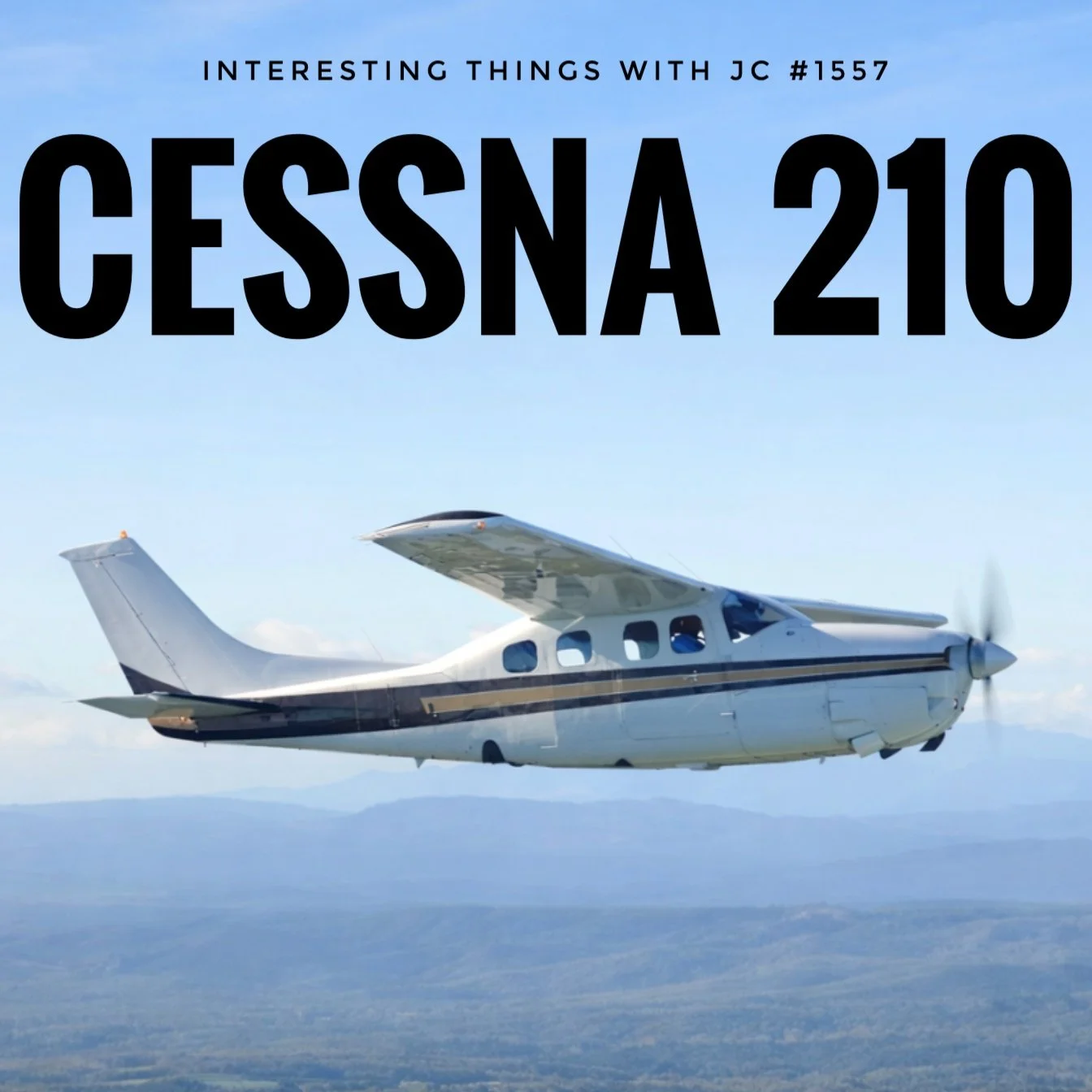
Promotional image for “Interesting Things with JC #1557: Cessna 210.” A white Cessna 210 single-engine airplane with a high wing and retractable landing gear flies from left to right against a clear blue sky above distant mountains. Large black text at the top reads “INTERESTING THINGS WITH JC #1557,” and bold black lettering across the image reads “CESSNA 210.”
Transcript
Interesting Things with JC #1557: “Cessna 210”
You can usually tell what an airplane is meant to do just by how it’s built. The Cessna 210 looks designed to haul weight, cover distance, and do it without excuses. Long nose. Tall stance. Clean wing. Nothing decorative. Everything there for a job.
The first 210 flew in 1957, built by Cessna Aircraft Company as general aviation shifted from trainers to real transportation. Called the Centurion, it sat near the top of the single-engine lineup from day one.
What set it apart was the wing. No struts. Fully cantilevered, with a heavy internal spar running through the cabin. That cut drag and boosted performance. Wingspan measures about 36 feet 9 inches, roughly 11 meters. Gross weight evolved steadily, hitting around 3,800 pounds on many later models, with turbocharged and pressurized versions pushing past 4,000.
Retractable gear, uncommon for a high-wing single and unlike simpler fixed-gear designs, paid off in speed. Normally aspirated models cruise 150 to 165 knots. Turbocharged T210s typically run 170 to 175 knots true, higher in thin air. Pressurized P210s, flown high, push into the upper 180s and beyond. Serious travel on one engine.
Load hauling built its reputation. Early models carried less. Later, lighter ones often exceed 1,300 pounds of useful load, with some reaching into the 1,600-pound range. That’s people, fuel, and bags without constant compromise. Range sits near 900 nautical miles, about 1,670 kilometers.
The cabin was built for the mission. Big doors. Solid systems. Good visibility. Some were factory equipped for flight in icing conditions, and many were upgraded later. Owners also added engine and avionics modifications, keeping the airplane relevant long after production ended.
Owners stick with them for decades despite the complexity because nothing else in the class matches the combination of real load, speed, and cross-country legs when properly maintained.
This isn’t a trainer. Approach speeds are higher and it demands discipline. Fly it right and it’s stable and predictable. Get careless, especially in power-on low-speed setups, and it can drop suddenly, reminding you to stay sharp.
Production ended in 1986 after nearly 9,000 were built. Many are still flying, doing exactly what they were made for.
That’s the Cessna 210. One engine. Serious capability. Built to earn its keep.
These are interesting things, with JC.
Student Worksheet
• What visual clues does the episode say reveal the Cessna 210’s mission?
• Why does retractable landing gear matter for speed and performance?
• How does useful load change what “travel” means in a small aircraft?
• Why does the episode emphasize discipline when flying the Cessna 210?
• Choose one design feature and explain how it reflects the aircraft’s purpose.
Teacher Guide
Estimated Time: 45–60 minutes
Pre-Teaching Vocabulary Strategy:
• Label an aircraft diagram with vocabulary terms
• Read terms aloud, then match each to a sentence from the transcript
Anticipated Misconceptions:
• Faster aircraft are always easier to fly
• More technology automatically means safer operation
• All single-engine airplanes serve the same role
Discussion Prompts:
• How does engineering balance performance with pilot responsibility?
• Why might owners accept complexity in exchange for capability?
• What does “built to earn its keep” mean in engineering terms?
Differentiation Strategies:
• ESL: sentence frames for discussion and written responses
• IEP: reduced question count; oral response option
• Gifted: compare the Cessna 210 to another high-performance single
Extension Activities:
• Physics connection: analyze drag reduction from retractable gear
• Design challenge: sketch a mission-driven aircraft and justify features
• Research: investigate why production ended despite strong capability
Cross-Curricular Connections:
• Physics: lift, drag, wing loading
• Engineering: tradeoffs between complexity and reliability
• Economics: ownership costs versus performance benefits
Quiz
Q1. What wing feature distinguishes the Cessna 210?
A. External struts
B. Cantilever design
C. Swept wings
D. Folding tips
Answer: B
Q2. Why does retractable gear increase speed?
A. Adds lift
B. Reduces drag
C. Increases weight
D. Improves fuel quality
Answer: B
Q3. What does “useful load” include?
A. Engine weight only
B. Fuel, passengers, and cargo
C. Wing structure
D. Maximum speed
Answer: B
Q4. Which variant allows high-altitude travel without oxygen masks?
A. Early 210
B. T210
C. P210
D. Fixed-gear models
Answer: C
Q5. Why is the Cessna 210 not considered a trainer?
A. It lacks stability
B. It is too small
C. It requires discipline and higher approach speeds
D. It cannot fly far
Answer: C
Assessment
Open-Ended Questions
• Explain how the Cessna 210’s design shows a clear mission focus. Use evidence from the transcript.
• Argue whether complexity is justified by performance in this aircraft. Support your answer with details.
3–2–1 Rubric
3 = Accurate, complete, thoughtful
2 = Partial or missing detail
1 = Inaccurate or vague
Standards Alignment
NGSS HS-ETS1-2
Evaluate competing design solutions by considering tradeoffs, such as performance versus complexity.
Common Core ELA (Grades 9–10)
CCSS.ELA-LITERACY.RI.9-10.1
Cite strong textual evidence from the transcript.
CCSS.ELA-LITERACY.RI.9-10.3
Analyze how technical ideas develop through a text.
C3 Framework
D2.His.2.9-12
Analyze how technological change influences society and transportation.
CTE Transportation Systems
Understand vehicle systems, performance, and operational requirements.
UK / International Equivalents
England National Curriculum KS4 Physics
Forces, motion, and real-world applications.
Cambridge IGCSE Physics
Application of forces and energy in transportation systems.
Show Notes
This episode explores the Cessna 210 Centurion as a no-nonsense general aviation aircraft built for real transportation. Through design features like its cantilever wing, retractable gear, and high useful load, the episode shows how engineering choices reflect mission and demand pilot discipline. It highlights why, decades after production ended, many Cessna 210s remain in service, still doing the job they were built to do.
References
High Sierra Pilots. (2015, February 21). Cessna 210 Centurion. https://highsierrapilots.club/cessna-210-centurion
GlobalAir.com. (n.d.). Cessna 210 specifications, performance, and range. https://www.globalair.com/aircraft-for-sale/specifications?specid=150
Aircraft Owners and Pilots Association. (n.d.). Cessna 210. https://www.aopa.org/go-fly/aircraft-and-ownership/aircraft-fact-sheets/cessna-210
Aviation Consumer. (2001, March 6). Cessna 210 Centurion. https://aviationconsumer.com/aircraftreviews/cessna-210-centurion-3
Airliners.net. (n.d.). Cessna 210 Centurion. https://www.airliners.net/aircraft-data/cessna-210-centurion/148
E3 Aviation Association. (2023, December 2). The Cessna 210 Centurion: A skybound love affair. https://e3aviationassociation.com/aviation-articles/the-cessna-210-centurion-a-skybound-love-affair
Plane & Pilot Magazine. (2022, October 12). Cessna 210 Centurion. https://planeandpilotmag.com/cessna-210-centurion-2
VREF. (2022, December 29). Explore information on Cessna's Turbo Centurion T210 F-R series. https://vref.com/news/cessna-turbo-centurion-t210-f-r