1556: "Paul Laurence Dunbar"
Interesting Things with JC #1556: "Paul Laurence Dunbar" - He worked an elevator in Dayton and wrote when the doors closed. What he heard and remembered became poems that carried far beyond Ohio.
Curriculum - Episode Anchor
Episode Title: "Paul Laurence Dunbar"
Episode Number: 1556
Host: JC
Audience: Grades 9–12, college intro, homeschool, lifelong learners
Subject Area: American Literature, U.S. History, Cultural Studies
Lesson Overview
This lesson examines how Paul Laurence Dunbar’s life circumstances, education, and work shaped his writing, and how a single national review expanded his reach. Students connect biography to literary craft, then consider how publishing pathways, performance, and public reception influence whose work endures.
Students will be able to:
Define how Dunbar’s lived experience shaped his themes and voice
Compare Dunbar’s publishing path (self-publishing to national recognition) with other writers of his era
Analyze why the 1896 review changed Dunbar’s audience and career opportunities
Explain how Dunbar’s range across forms (formal verse, dialect poetry, novels, lyrics) affected his legacy
Key Vocabulary
Dialect (DYE-uh-lekt): A language variety tied to region or community; Dunbar used it as a literary style
Underground Railroad (un-der-ground RAIL-road): A network that helped enslaved people escape; Dunbar’s father used it to reach Canada
Enlist (en-LIST): To join the military; Joshua Dunbar enlisted and served in the 55th Massachusetts Infantry
Self publish (self PUB-lish): To print and sell your own work without a publisher
Posthumous (POS-chuh-mus): Released after a person’s death; Dunbar’s later collections kept his work circulating
Tuberculosis (too-ber-kyuh-LOH-sis): A serious infectious disease that ended Dunbar’s life early
Narrative Core
Open: A young man in Dayton operates an elevator all day, watching people pass through, turning what he sees into poetry.
Info: Born in 1872 to parents who had been enslaved, Dunbar is raised in a home where memory, discipline, and language matter.
Details: He self publishes early work, then a major review in 1896 brings national recognition and wider readership.
Reflection: The episode shows how careful attention, craft, and persistence can carry work far beyond the circumstances where it begins.
Closing: These are interesting things, with JC.
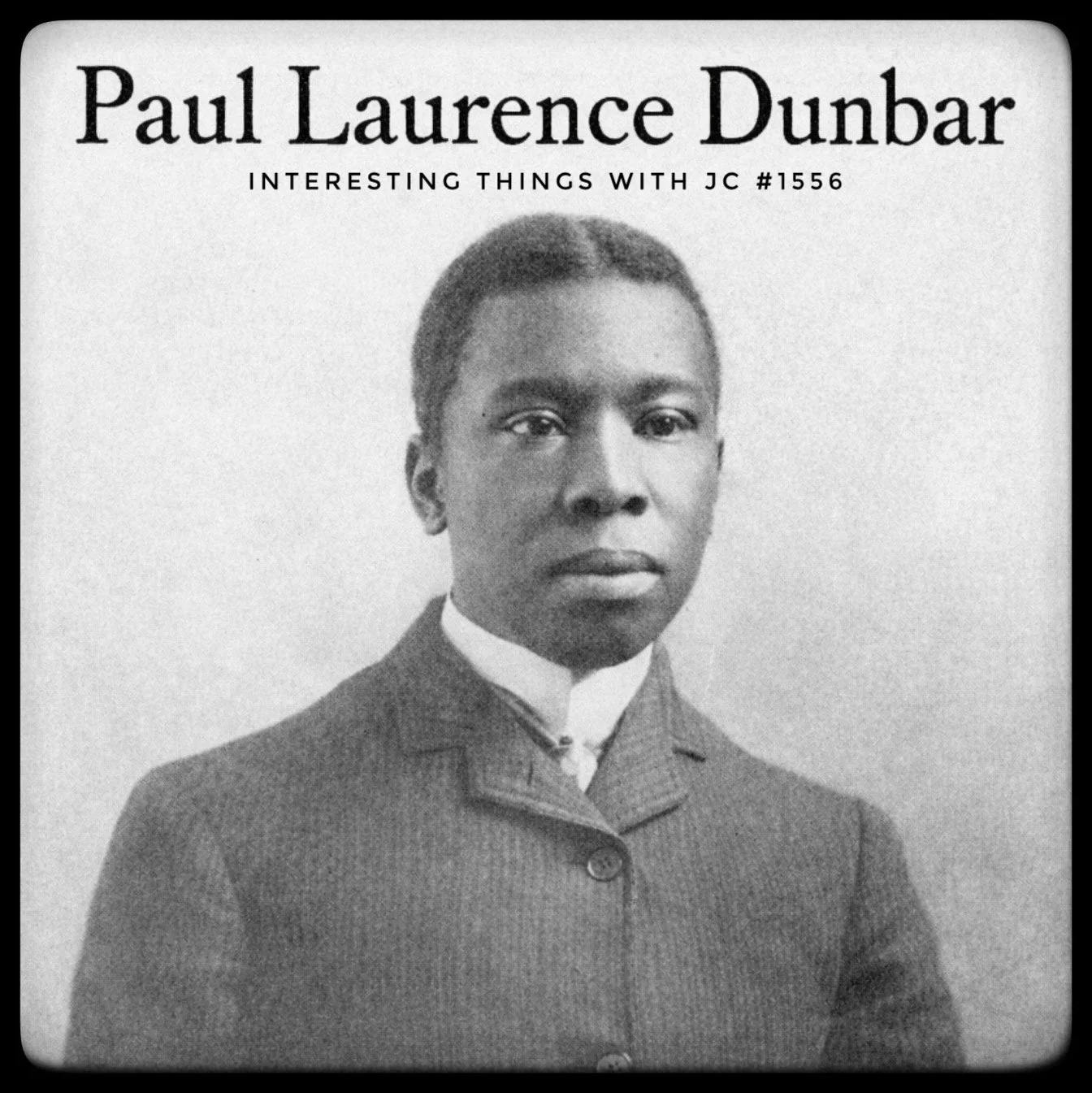
Black-and-white historical portrait of a young Paul Laurence Dunbar wearing a dark, formal suit jacket and high-collared white shirt, facing forward with a calm, serious expression. The image has a soft, slightly textured, archival appearance. At the top of the image, visible text reads “Paul Laurence Dunbar” with smaller text below reading “Interesting Things with JC #1556.” The background is plain and light, with no additional objects or scenery.
Transcript
Interesting Things with JC #1556: "Paul Laurence Dunbar"
Picture a young man in Dayton, Ohio, stuck in an iron elevator cage, pulling the lever all day. People get on, get off. He watches, listens, remembers, and turns it into poetry.
Paul Laurence Dunbar was born on June 27, 1872, in Dayton. His parents, Joshua and Matilda, had been enslaved in Kentucky. Joshua escaped through the Underground Railroad to Canada, then returned to enlist in the 55th Massachusetts Infantry and serve. In Dayton, they raised Paul on discipline and language. His mother read to him constantly. He learned that words, handled right, carried weight.
By sixteen, his poems were appearing in local newspapers. In high school, he ran the literary society, edited the school paper, and graduated alongside Orville and Wilbur Wright. They built flying machines. He built lines.
There was no money for college. So he worked, taking jobs where he could, including elevator operator in the Callahan Building. In 1892, he saved enough to self publish Oak and Ivy, selling copies by hand to the riders who passed through his day. No backing. Just work.
The turning point came in 1896. William Dean Howells reviewed Majors and Minors in Harper’s Weekly and praised the strength and honesty of the writing. That put Dunbar on the national map. Books sold nationwide. Readings drew crowds. His reputation crossed the Atlantic.
Dunbar had range, formal verse, dialect poetry, novels, and short stories. In 1903, he wrote the lyrics for In Dahomey, pronounced duh HOH mee, the first full length musical by Black writers and performers to appear on a major New York stage.
Tuberculosis ended his life early. He died on February 9, 1906, in Dayton, at the age of 33, back where he once ran the elevator. Posthumous collections, including The Complete Poems in 1913, kept his work in print and on library shelves, ensuring steady circulation for more than a century. The work that came out of that cage traveled far. The lines held. The books stayed.
These are interesting things, with JC.
Student Worksheet
• How did Dunbar’s elevator job shape what he noticed and wrote about?
• What role did Dunbar’s mother play in his development as a writer? Use evidence from the transcript.
• Why did the 1896 review matter, and what changed after it?
• Choose one detail from the episode that shows perseverance. Explain your choice.
• Write 6–8 lines of your own poem based on a routine place you see every day (bus stop, cafeteria, hallway, store).
Teacher Guide
Estimated Time: 45–60 minutes
Pre-Teaching Vocabulary Strategy:
• Quick preview: students match each term to a sentence taken from the transcript
• Pronunciation read-through, then students paraphrase each term in plain language
Anticipated Misconceptions:
• Dunbar wrote only one style of poetry
• A college education was the only path to literary success
• “Dialect poetry” automatically means “less serious” writing
Discussion Prompts:
• What does the elevator “cage” symbolize in the episode—work, limitation, observation, or something else?
• Why might a national review change an author’s life more than local popularity?
• How do publishing access and money shape whose writing gets read?
Differentiation Strategies:
• ESL: sentence starters for discussion; vocabulary in paired context sentences
• IEP: shorter text chunks; answer choices for short responses; oral response option
• Gifted: compare two Dunbar poems (one formal, one dialect) and discuss audience and purpose
Extension Activities:
• Primary-source practice: read a short Dunbar poem and annotate diction, imagery, and tone
• Timeline: create a brief timeline from 1872 to 1913 using episode details
• Theater connection: research why In Dahomey matters in U.S. performance history
Cross-Curricular Connections:
• U.S. History: Reconstruction through the early 1900s, Black military service, migration and work
• Performing Arts: musical theater history and lyric writing
• Economics: labor, wages, and self-publishing as entrepreneurship
Quiz
Q1. Where did Paul Laurence Dunbar grow up?
A. New York City
B. Dayton, Ohio
C. Boston, Massachusetts
D. Louisville, Kentucky
Answer: B
Q2. What job did Dunbar work while building his writing career?
A. Printer
B. Teacher
C. Elevator operator
D. Railroad clerk
Answer: C
Q3. What did Dunbar do in 1892 that shows initiative as a writer?
A. Won a national poetry contest
B. Self publish Oak and Ivy
C. Joined a touring theater troupe
D. Enrolled in college
Answer: B
Q4. What happened in 1896 that expanded Dunbar’s audience?
A. He moved to Europe
B. A major review praised his writing
C. He published his final book
D. He acted in a musical
Answer: B
Q5. What ended Dunbar’s life at age 33?
A. Tuberculosis
B. A workplace accident
C. Yellow fever
D. Influenza
Answer: A
Assessment
Open-Ended Questions
• Using evidence from the transcript, explain how Dunbar’s environment and responsibilities influenced his writing.
• Argue whether Dunbar’s career shows that opportunity depends more on talent, access, or persistence. Use at least two details from the episode.
3–2–1 Rubric
3 = Accurate, complete, thoughtful
2 = Partial or missing detail
1 = Inaccurate or vague
Standards Alignment
Common Core State Standards (ELA, Grades 9–10)
CCSS.ELA-LITERACY.RL.9-10.1
Cite strong and thorough textual evidence to support analysis of what the text says explicitly and implicitly, using episode details as evidence.
CCSS.ELA-LITERACY.RL.9-10.2
Determine central ideas and analyze how they develop over the course of a text, such as perseverance, craft, and recognition.
CCSS.ELA-LITERACY.RI.9-10.3
Analyze how the author unfolds a series of events and ideas, including the 1896 review as a turning point.
CCSS.ELA-LITERACY.W.9-10.2
Write informative/explanatory texts to examine and convey ideas clearly, such as a short analysis of how biography shapes writing.
CCSS.ELA-LITERACY.W.9-10.9
Draw evidence from literary or informational texts to support analysis and reflection, using details directly from the transcript.
CCSS.ELA-LITERACY.SL.9-10.1
Initiate and participate effectively in collaborative discussions, building on others’ ideas with evidence from the episode.
C3 Framework (Social Studies)
D2.His.1.9-12
Evaluate how historical events and developments shape people’s lives, including the post–Civil War context and Black military service referenced in the episode.
D2.His.4.9-12
Analyze complex sets of interrelated factors in historical events, such as opportunity, education, labor, and publishing access.
D2.His.14.9-12
Analyze multiple and complex causes and effects of events, including how national media attention influenced Dunbar’s career and readership.
D2.His.16.9-12
Integrate evidence from multiple relevant sources when extending beyond the episode (poems, biographies, theater history).
ISTE Standards (Students)
ISTE 3a
Evaluate the accuracy, perspective, and credibility of information sources when researching Dunbar’s life and publications.
ISTE 3b
Use curated sources to build knowledge and connect learning to a broader understanding of literature and history.
ISTE 6a
Choose appropriate platforms and formats to communicate ideas clearly (analysis paragraph, presentation, or creative writing response).
ACRL Framework (Intro College / Information Literacy)
Authority Is Constructed and Contextual
Examine how reviewers, publishers, and institutions influence whose writing gains authority, using the 1896 review as a case study.
Information Creation as a Process
Compare self publishing and traditional publishing as different creation pathways with different constraints.
Searching as Strategic Exploration
Develop and refine search strategies to locate Dunbar poems, historical context, and theater sources related to In Dahomey.
UK and International Equivalents (Content-Based)
England National Curriculum (KS4) English: Reading and Writing
Read and evaluate a range of texts critically; produce clear analytical writing using evidence from a text (the transcript and related poems).
AQA GCSE English Literature (Assessment Objectives AO1, AO2)
AO1: Maintain a critical style and use textual references; AO2: Analyze language, form, and structure—applied through close reading of Dunbar’s poetry and the episode’s narrative choices.
Cambridge IGCSE First Language English (Reading and Writing Objectives)
Demonstrate understanding of explicit/implicit meaning and produce coherent analytical responses using evidence.
IB DP Language and Literature: Analysis and Communication
Analyze how choices in language and structure shape meaning and audience response; communicate interpretations clearly in discussion and writing.
Show Notes
This episode follows Paul Laurence Dunbar from Dayton, Ohio, to national recognition, showing how disciplined language, observation, and steady work shaped a lasting literary voice. It connects biography to craft: poems in local papers as a teenager, self publishing while working as an elevator operator, then wider attention after a major review in 1896. The episode also highlights Dunbar’s range across forms, including lyrics for In Dahomey in 1903, and closes with how posthumous collections kept his work in circulation long after his death in 1906.
References
Encyclopedia Britannica. https://www.britannica.com/biography/Paul-Laurence-Dunbar
National Park Service. (2018, February 5). Paul Laurence Dunbar's life story. Dayton Aviation Heritage National Historical Park, U.S. Department of the Interior. https://www.nps.gov/daav/learn/historyculture/paullaurencedunbarslifestory.htm
Poetry Foundation. (n.d.). Paul Laurence Dunbar. https://www.poetryfoundation.org/poets/paul-laurence-dunbar
Academy of American Poets. (n.d.). Paul Laurence Dunbar. Poets.org. https://poets.org/poet/paul-laurence-dunbar
Library of Congress. (n.d.). Paul Laurence Dunbar: A resource guide. https://guides.loc.gov/paul-laurence-dunbar
University of Dayton. (n.d.). Paul Laurence Dunbar. https://udayton.edu/arts-sciences/initiatives/dunbar/index.php
Jarrett, G. A. (2022). Paul Laurence Dunbar: The life and times of a caged bird. Princeton University Press. https://press.princeton.edu/books/hardcover/9780691150529/paul-laurence-dunbar
Dunbar, P. L. (1913). The complete poems of Paul Laurence Dunbar. Dodd, Mead and Company. https://archive.org/details/completepoemsofp0000dunb_t7f9
Paul Laurence Dunbar website. (2022). July 13 - The critics agree. https://www.paullaurencedunbar.org/2022/s194