1555: "Project Nobska"
Interesting Things with JC #1555: "Project Nobska" – A 1956 Navy study at Woods Hole, near Nobska Lighthouse, concluded that nuclear submarines had made traditional anti-submarine warfare obsolete, shaping new undersea weapons and the future of nuclear deterrence.
Curriculum - Episode Anchor
Episode Title: Interesting Things with JC #1555: "Project Nobska"
Episode Number: 1555
Host: JC
Audience: Grades 9–12, college introductory courses, homeschool learners, lifelong learners
Subject Area: History, Cold War Studies, Science and Technology History, Military Strategy
Lesson Overview
This lesson examines Project Nobska, a 1956 National Academy of Sciences summer study that reshaped U.S. naval strategy during the Cold War. Students explore how nuclear propulsion changed submarine warfare, why detection alone became insufficient, and how interdisciplinary scientific debate led to the creation of the submarine-launched ballistic missile force. The episode highlights the relationship between science, military decision-making, and deterrence theory.
Learning Objectives
By the end of this lesson, students will be able to:
Define how nuclear propulsion changed the operational limits of submarines.
Compare traditional anti-submarine warfare assumptions with the realities introduced by nuclear submarines.
Analyze how Project Nobska influenced both anti-submarine warfare and strategic nuclear deterrence.
Explain why missile submarines became central to second-strike deterrence rather than battlefield combat.
Key Vocabulary
Nuclear submarine (new-klee-er sub-muh-reen) — A submarine powered by a nuclear reactor, allowing long-duration submerged operations without surfacing.
Second-strike capability (seh-kund stryk kay-puh-bil-uh-tee) — The assured ability to respond with nuclear force after absorbing an initial attack.
Anti-submarine warfare (an-tee sub-muh-reen wor-fair) — Military strategies and technologies designed to detect, track, and destroy submarines.
Passive sonar (pas-iv so-nar) — A listening system that detects sound without emitting signals, useful for tracking quiet submarines.
Solid-fuel missile (sol-id fyoo-uhl mis-uhl) — A rocket using solid propellant, allowing faster launch readiness and safer storage than liquid-fuel systems.
Narrative Core
Open: A secretive summer meeting on a windy point of Cape Cod, with no press and no speeches, confronts a problem the Navy cannot ignore.
Info: Nuclear submarines remove the traditional limits of endurance, speed, and surfacing that anti-submarine warfare depended on during World War II.
Details: Detection alone is no longer enough; weapons must be fast and deep-reaching, while parallel debates lead to a revolutionary idea: compact nuclear warheads on solid-fuel submarine-launched missiles.
Reflection: Missile submarines are not designed to fight but to remain unseen, ensuring deterrence through survivability rather than victory through combat.
Closing: These are interesting things, with JC.
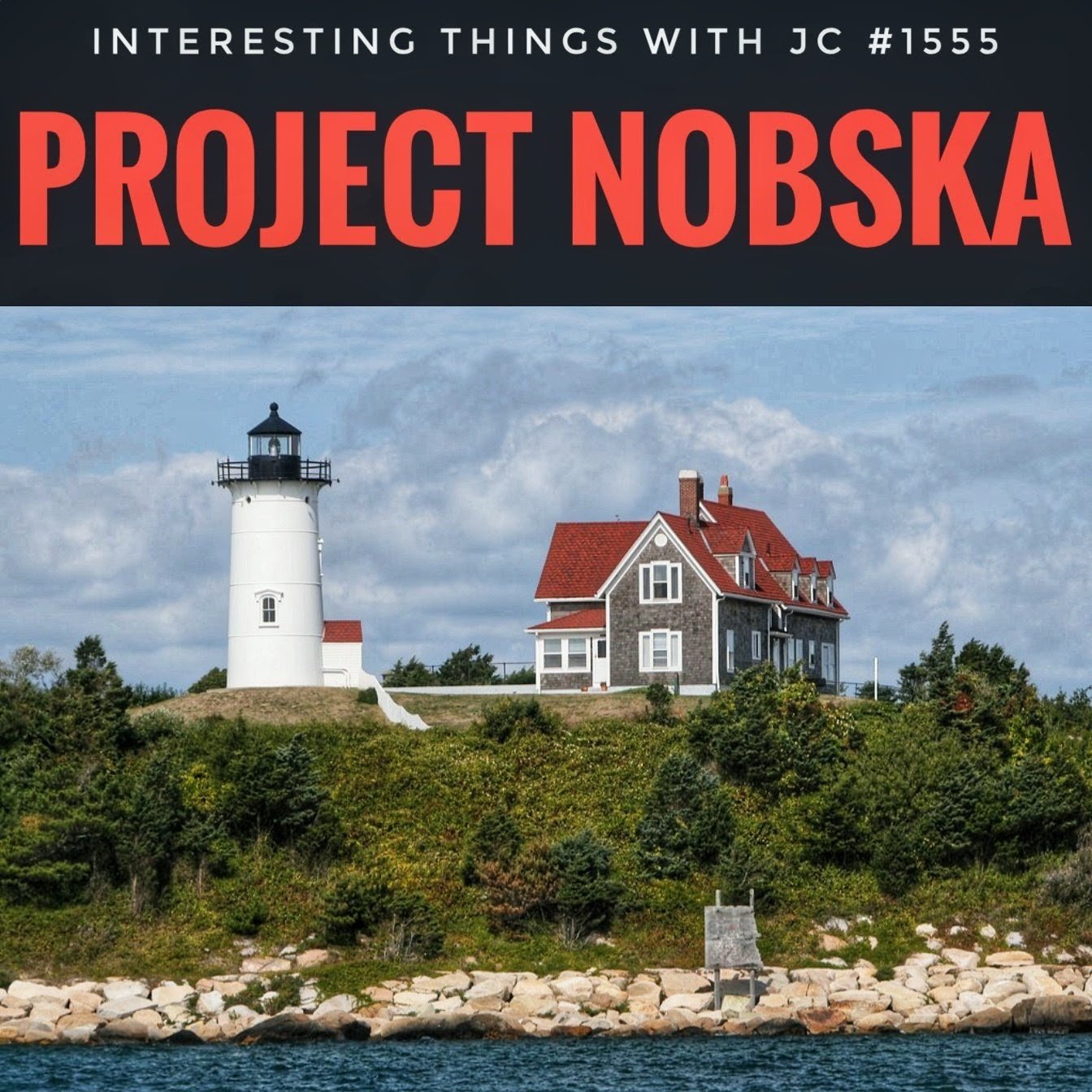
Nobska Lighthouse and keeper’s house on a grassy bluff overlooking the Atlantic Ocean in Woods Hole, Massachusetts, under cloudy skies.
Transcript
Interesting Things with JC #1555: "Project Nobska"
In the summer of 1956, a group of men met on Cape Cod at a place called Nobska Point (NOB-ska). No press. No speeches. Just a hard problem that didn’t have a comfortable answer.
The U.S. Navy had crossed a line.
Nuclear submarines were now real. They didn’t need air. They didn’t need to surface every night. They could stay underwater for weeks, move fast, and operate far from home without being seen. Everything the Navy knew about tracking submarines had been built around limits that no longer applied.
The man who forced the issue was Arleigh Burke, the Chief of Naval Operations. Burke wasn’t interested in theory. He wanted to know what still worked, what didn’t, and what had to change before someone else figured it out first.
So he ordered a summer study, held near the Woods Hole Oceanographic Institution in Woods Hole (woodz hole), Massachusetts, under the National Academy of Sciences. Seventy-three people were invited. Engineers. Submarine designers. Weapons specialists. Scientists who had already helped win one world war and were now trying to prevent another.
That included Isidor Rabi, a Nobel Prize–winning physicist, Edward Teller, deeply involved in thermonuclear weapons development, and Paul Nitze, who understood that technical decisions quickly turn into national strategy.
They didn’t agree on much at first.
Some argued that better sonar was the answer. Hear the submarine first and you win. Others pushed back. Nuclear submarines could run submerged at more than 20 knots—over 23 miles per hour or 37 kilometers per hour—and dive deeper than most weapons could reach. Even when detected, they could outrun or outlast an attack.
That disagreement forced a blunt realization.
Finding a nuclear submarine was no longer enough. You also had to be able to hit it, quickly and decisively, or it didn’t matter that you found it at all.
That drove recommendations for faster and deeper-running torpedoes, new weapons like rocket-delivered anti-submarine systems, nuclear ASW charges, and passive sonar networks that listened for faint sounds carried hundreds of miles—over 160 kilometers—through deep ocean sound channels.
Yet the study’s most famous legacy didn’t come from defense.
During discussions on nuclear weapons effects, Edward Teller challenged the Navy’s assumptions. Why design a 1960s weapon around bulky, liquid-fueled missiles and oversized warheads? He argued for compact, high-yield nuclear warheads that could fit smaller, solid-fuel missiles. Missiles that could be launched from submerged submarines, without ever surfacing.
That argument helped push the Navy away from surface-dependent Jupiter missiles and toward what became Polaris: a solid-fuel, submarine-launched ballistic missile. Paired with nuclear submarines, it created something entirely new—an invisible, survivable second-strike force.
That was the real pivot.
Missile submarines weren’t built to fight battles. They were built to stay hidden. For the sailors inside them, it meant months underwater, sealed inside steel hulls, running drills, eating, sleeping, and waiting. Their job wasn’t to fire first. Their job was to make sure no one else ever did.
Project Nobska didn’t end with a single device or blueprint. It ended with alignment. Scientists and officers agreeing that nuclear submarines had changed war itself—and that deterrence, not combat, was now the mission.
A few weeks of blunt talk on a windy point in Massachusetts helped lock in the most stable leg of the nuclear triad.
These are interesting things, with JC.
Student Worksheet
Why did nuclear propulsion make earlier submarine-tracking strategies obsolete?
Explain why detecting a nuclear submarine was no longer enough to ensure success.
Describe how scientific debate at Project Nobska influenced missile design.
In your own words, explain the concept of second-strike deterrence.
Teacher Guide
Estimated Time
One to two 50-minute class periods
Pre-Teaching Vocabulary Strategy
Introduce vocabulary using a concept map connecting propulsion, detection, weapons, and deterrence.
Anticipated Misconceptions
Students may assume missile submarines are intended for active combat rather than deterrence.
Students may believe technological progress automatically produces clear solutions rather than trade-offs.
Discussion Prompts
Why might secrecy and survivability be more important than firepower in nuclear strategy?
How do scientific disagreements contribute to better long-term decisions?
Differentiation Strategies
ESL: Provide vocabulary sentence frames and audio replay.
IEP: Offer guided notes and reduced writing length options.
Gifted: Assign primary-source analysis of Cold War strategic doctrine.
Extension Activities
Research the development of the Polaris missile system.
Debate the ethical implications of deterrence versus disarmament.
Cross-Curricular Connections
Physics: Sound propagation in ocean environments.
Civics: Civil-military decision-making.
Ethics: Moral reasoning behind deterrence theory.
Quiz
Q1. What problem prompted Project Nobska?
A. Lack of naval funding
B. Ineffective aircraft carriers
C. The emergence of nuclear submarines
D. International treaty violations
Answer: C
Q2. Why was detection alone no longer sufficient?
A. Sonar systems failed entirely
B. Submarines could not be tracked
C. Weapons could not reach fast, deep submarines
D. Crews refused to attack
Answer: C
Q3. What missile system emerged from Nobska’s recommendations?
A. Jupiter
B. Atlas
C. Minuteman
D. Polaris
Answer: D
Q4. What is the primary mission of missile submarines?
A. Launch first strikes
B. Coastal defense
C. Deterrence through survivability
D. Anti-submarine warfare
Answer: C
Q5. Which factor most stabilized the nuclear triad?
A. Faster aircraft
B. Visible missile silos
C. Hidden second-strike capability
D. Diplomatic agreements
Answer: C
Assessment
Open-Ended Questions
Explain how Project Nobska reshaped U.S. naval strategy.
Analyze why interdisciplinary collaboration was critical to its success.
3–2–1 Rubric
3 = Accurate, complete, thoughtful
2 = Partial understanding or missing detail
1 = Inaccurate or vague
Standards Alignment
NGSS HS-ETS1-2
Evaluate solutions to complex real-world problems, as students assess strategic responses to nuclear submarines.
Common Core RH.11-12.3
Analyze how events and ideas develop over time in historical texts.
C3 D2.His.14.9-12
Analyze multiple factors that influenced historical outcomes during the Cold War.
ISTE 3d
Students evaluate the societal impacts of technological innovation.
UK National Curriculum History KS4
Understanding how technology influenced global conflict and deterrence.
IB DP History
Evaluation of Cold War military and strategic developments.
Show Notes
This episode explores Project Nobska, a pivotal 1956 study that reshaped submarine warfare and nuclear deterrence. By examining the intersection of science, military strategy, and policy, the story shows how nuclear propulsion forced the Navy to rethink both combat and prevention. In the classroom, this episode helps students understand how technological change can redefine global security, highlighting why deterrence—rather than battle—became the guiding principle of nuclear-age strategy.
References
Lawrence Livermore National Laboratory. (n.d.). A strategic breakthrough: The role of Project Nobska and Polaris [PDF]. https://www.llnl.gov/sites/www/files/1956.pdf
U.S. Naval Institute. (1980). The origin of Polaris. Proceedings Magazine. https://www.usni.org/magazines/proceedings/1980/march/origin-polaris
U.S. Naval Institute. (2025, August). Strategic submarines and the Cold War end game. Naval History. https://www.usni.org/magazines/naval-history/2025/august/strategic-submarines-and-cold-war-end-game
Henneberger, M. (2024). Project Nobska (1956): An in-depth overview. Naval Reactors Historical Association. https://www.nr-ha.org/books-sources/project-nobska-(1956)%3A-an-in-depth-overview
Grokipedia contributors. (n.d.). Project Nobska. Grokipedia. https://grokipedia.com/page/project_nobska