1554: “Radio Signals from Pluto”
Interesting Things with JC #1554: “Radio Signals from Pluto” - A spacecraft rushed past Pluto with no second chance. A fading signal passing through Pluto’s thin air revealed temperatures, pressure, and hidden layers beneath the ice. For a few minutes in 2015, physics lined up just right, and Pluto gave up details images never could.
Curriculum - Episode Anchor
Episode Title: Radio Signals from Pluto
Episode Number: 1554
Host: JC
Audience: Grades 9–12, college intro, homeschool, lifelong learners
Subject Area: Astronomy, Planetary Science, Physics (Waves and Thermodynamics)
Lesson Overview
This episode examines how radio science transformed Pluto from a distant point of light into a physically characterized world. Using the 2015 flyby of New Horizons, students explore how radio waves revealed atmospheric structure, surface–atmosphere interactions, and subsurface thermal properties on Pluto and its moon Charon. The lesson emphasizes measurement, precision, and the role of physics in deep-space exploration.
Learning Objectives
Students will be able to:
Define how radio occultation works and why it is used to study planetary atmospheres.
Explain how temperature, pressure, and density affect radio signal phase and frequency.
Analyze why Pluto can sustain a transient atmosphere while Charon cannot.
Compare what radio measurements reveal versus optical images in planetary science.
Key Vocabulary
Radio occultation (RAY-dee-oh ah-kuhl-TAY-shun) — A technique where a radio signal passes through an atmosphere, revealing its structure through signal changes.
Microbar (MY-kroh-bar) — A unit of pressure equal to one-millionth of a bar, used for extremely thin atmospheres like Pluto’s.
Emissivity (ee-miss-IV-ih-tee) — A measure of how efficiently a surface emits thermal radiation compared to a perfect emitter.
Boundary layer (BOWN-dair-ee LAY-er) — The lowest part of an atmosphere where temperature and density change sharply near the surface.
Sublimation (sub-lih-MAY-shun) — The process where a solid turns directly into gas, as nitrogen ice does on Pluto.
Narrative Core
Open: A spacecraft races past Pluto at over 31,000 miles per hour, with only minutes to gather data that will never be repeated.
Info: NASA engineers rely on radio waves, not cameras, transmitting a faint signal across billions of miles through Pluto’s thin atmosphere.
Details: Tiny shifts in phase and frequency reveal temperatures near 40 kelvin, a sharp atmospheric drop-off, and nitrogen ice controlling atmospheric pressure. Charon, by contrast, shows no atmosphere at all.
Reflection: Radio waves uncover subsurface conditions and long-term thermal stability invisible to images, turning Pluto into a physical place governed by slow, predictable physics.
Closing: These are interesting things, with JC.
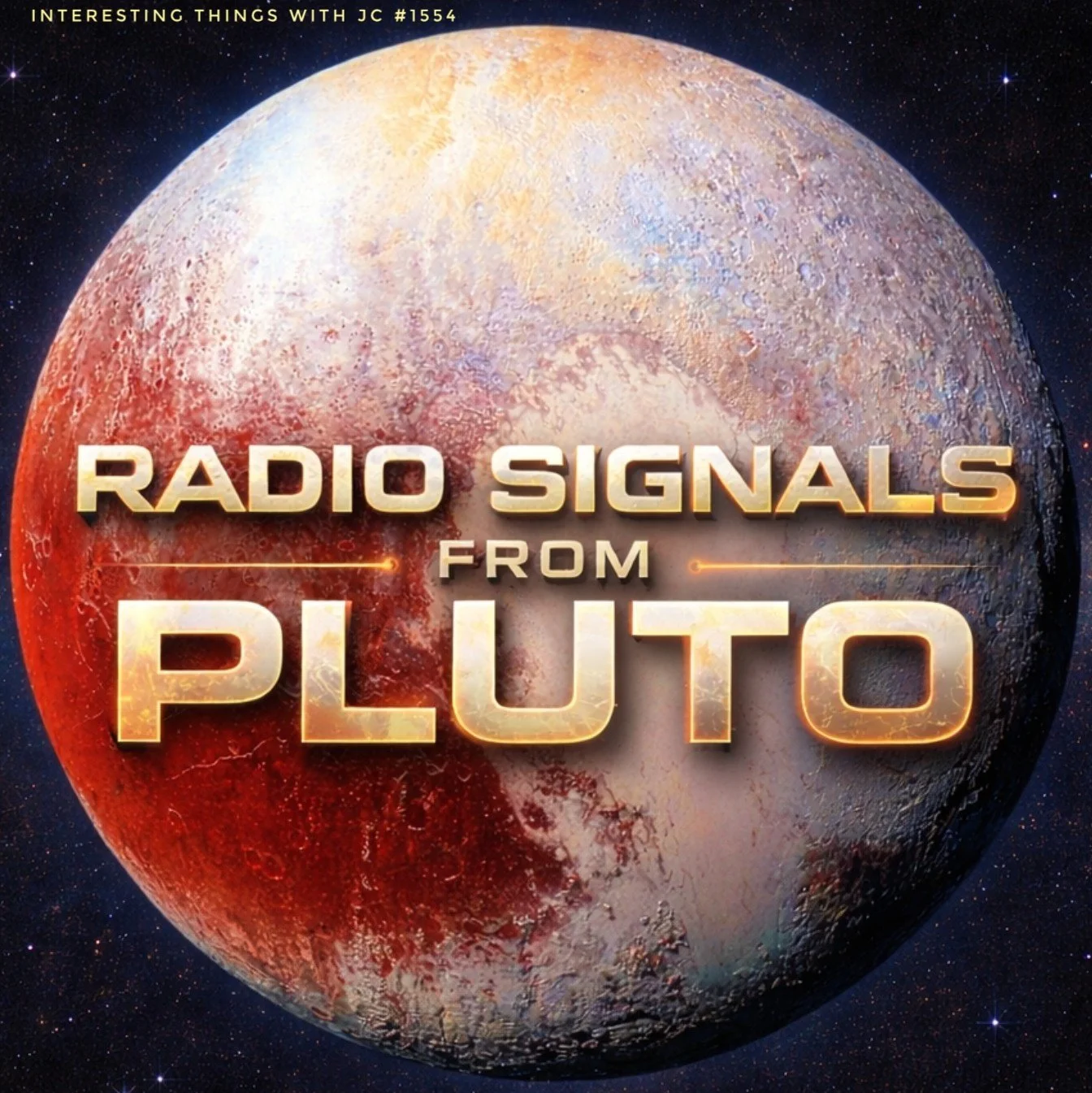
Illustrated view of Pluto against a dark, star-filled space background. The dwarf planet appears textured with reddish and pale icy regions. Overlaid text reads “Radio Signals from Pluto,” with the episode identifier “Interesting Things with JC #1554” at the top.
Transcript
Interesting Things with JC #1554: “Radio Signals from Pluto”
Imagine a spacecraft racing past Pluto at more than 31,000 miles per hour, about 50,000 kilometers per hour, with only minutes to gather everything it ever would from a world nearly 3.7 billion miles, or 5.9 billion kilometers, from Earth. On July 14, 2015, after a journey lasting nine and a half years, NASA’s New Horizons did exactly that. There would be no orbit. Pluto’s gravity was far too weak to capture the spacecraft. This was a single pass, irreversible by design. Every instrument had one chance to work.
One of the most critical measurements did not involve a camera. It depended on radio waves and timing precise enough that even microscopic errors would have erased the result.
As New Horizons slipped behind Pluto from Earth’s perspective, NASA’s Deep Space Network transmitted a continuous radio signal toward the spacecraft. The frequency was 7.2 gigahertz, corresponding to a wavelength of 4.2 centimeters, about 1.65 inches. Four antennas each transmitted roughly 20 kilowatts of power. By the time that signal crossed the void and reached Pluto, it had dimmed to roughly a billionth of a watt.
That weakened signal then passed through Pluto’s atmosphere.
Pluto’s atmosphere is extremely thin, but it is not uniform. As the radio wave moved through it, it bent slightly due to variations in density and temperature with altitude. The Radio Science Experiment onboard New Horizons measured extremely small shifts in phase and frequency, allowing scientists to reconstruct Pluto’s atmosphere from space all the way down to the surface. It was the first direct vertical profile ever obtained for Pluto.
What emerged surprised researchers. Near the ground, the atmosphere formed a cold boundary layer colder than most models had predicted. Temperatures ranged from roughly 39 to 52 kelvin—about minus 390 to minus 366 degrees Fahrenheit (minus 234 to minus 221 degrees Celsius). This reflected clear asymmetry between the two occultation paths: colder on entry over regions like Sputnik Planitia, warmer on exit. Surface pressure measured about 11.5 microbars. Earth’s sea-level pressure is about one million microbars. Pluto’s atmosphere is thinner by more than a factor of eighty thousand.
Its structure mattered as much as its thinness. The data showed the atmosphere does not fade gradually into space. Instead, it drops off sharply near the surface, especially above regions dominated by nitrogen ice, including the vast basin known as Sputnik Planitia. This confirmed that Pluto’s atmosphere is controlled directly by surface ice in equilibrium with temperature. When Pluto warms, nitrogen sublimates into gas. When it cools, that gas freezes and settles back onto the ground. Over Pluto’s 248-year orbit around the Sun, its atmosphere expands and contracts on a planetary scale.
The same radio technique was applied to Pluto’s largest moon, Charon—pronounced CARE-on, though mission teams often say KAIR-un or SHAIR-on. The result was starkly different. Charon showed no measurable atmosphere at all. Any gas released from its surface escapes immediately, confirming that Charon lacks the gravity and thermal conditions required to retain or recycle an atmosphere.
After the Earth-based signal ended, the radio experiment changed roles. Instead of listening to Earth, it listened to Pluto itself.
Any object warmer than absolute zero emits radiation. For Pluto, much of that energy emerges at radio wavelengths. On Pluto’s night side, where sunlight played no role, New Horizons measured an average brightness temperature of about 29 kelvin, roughly minus 407 degrees Fahrenheit (minus 244 degrees Celsius). Charon’s night side measured warmer, near 41 kelvin.
These measurements reached deeper than images ever could. At a wavelength of 4.2 centimeters, radio emissions can originate from beneath the surface, in some cases from depths of several feet, about one meter or more. That meant the data reflected subsurface conditions, not just frost on top. The results showed that Pluto’s surface emits heat inefficiently, with emissivity values between about 0.7 and 1.0. This points to porous, fractured ice that scatters and traps heat, acting as an insulator and preserving cold for long periods. It also suggests layered ice and long-term thermal stability beneath the surface.
Pluto’s radio story did not begin in 2015. Years earlier, ground-based observatories detected its faint thermal glow at millimeter and submillimeter wavelengths. Those measurements suggested surface temperatures in the 30 to 40 kelvin range and refined Pluto’s position in space to within tens of miles, precision that mattered when guiding a spacecraft across billions of miles.
In 2012, observations from the Herschel Space Observatory added another constraint. They showed that Pluto’s brightness temperature decreases as wavelength increases, evidence that the surface is partially transparent to its own heat. That behavior depends on ice chemistry, grain size, and porosity, properties invisible to ordinary images.
What Pluto does not produce are energetic radio emissions. There are no lightning-driven bursts, no powerful magnetic field, no auroral radio signals like those from Jupiter. Pluto is radio-quiet. And that quiet made precision possible. With no storms or magnetic noise to interfere, every measurable change could be traced directly to temperature, pressure, and motion.
For most of the twentieth century, Pluto was a mathematical outline. Its mass came from orbital calculations. Its size came from reflected sunlight and brief stellar occultations, moments when it blocked a distant star. New Horizons transformed it into a place. But radio waves revealed what images alone never could: an atmosphere balanced on frozen nitrogen, subsurface layers hidden beneath ice, and behavior governed by slow, predictable physics.
There is one final constraint. New Horizons will never return. As Pluto continues its long orbit away from the Sun, models predict its atmosphere will eventually cool further, with nitrogen freezing back onto the surface over centuries. The geometry that allowed a radio signal to skim a living atmosphere existed for minutes on a single day in 2015. That precise alignment will not occur again in the same way for hundreds of years.
What was learned from Pluto came from a signal that dimmed to near nothing, altered by a fragile layer of gas, and received only because distance, timing, and physics aligned once. Nothing about that measurement was repeatable. Nothing about it was guaranteed.
These are interesting things, with JC.
Student Worksheet
Explain why Pluto’s atmosphere can expand and collapse over time.
Describe how radio waves revealed Pluto’s atmospheric temperature near the surface.
Compare the atmospheric results for Pluto and Charon.
Why can radio measurements probe beneath Pluto’s surface when images cannot?
Teacher Guide
Estimated Time
One 45–60 minute class period
Pre-Teaching Vocabulary Strategy
Introduce pressure units and radio wavelength concepts using Earth-based examples.
Anticipated Misconceptions
Students may assume all planets have stable atmospheres.
Students may think images always provide the most detailed data.
Discussion Prompts
Why was this measurement impossible to repeat?
How does surface ice control a planetary atmosphere?
Differentiation Strategies
ESL: Visual diagrams of occultation geometry
IEP: Guided notes with key terms defined
Gifted: Independent research on radio astronomy techniques
Extension Activities
Model how signal bending changes with atmospheric density.
Compare Pluto’s atmosphere to Mars or Titan.
Cross-Curricular Connections
Physics: Wave behavior and refraction
Chemistry: Phase changes of nitrogen
Earth Science: Boundary layers and climate systems
Quiz
Q1. Why did New Horizons perform a flyby instead of orbiting Pluto?
A. Pluto was too small to detect
B. Pluto’s gravity was too weak
C. The spacecraft ran out of fuel
D. Pluto had no atmosphere
Answer: B
Q2. What unit describes Pluto’s surface pressure?
A. Pascals
B. Bars
C. Microbars
D. Atmospheres
Answer: C
Q3. What substance primarily controls Pluto’s atmosphere?
A. Methane ice
B. Water vapor
C. Carbon dioxide
D. Nitrogen ice
Answer: D
Q4. Why could radio waves detect subsurface conditions?
A. They reflect from metal
B. They penetrate ice
C. They are visible light
D. They amplify heat
Answer: B
Q5. Why is Charon airless?
A. It is too cold
B. It lacks nitrogen
C. It lacks sufficient gravity
D. It has volcanic activity
Answer: C
Assessment
Open-Ended Questions
Explain how radio occultation revealed Pluto’s atmospheric structure.
Analyze why Pluto’s atmosphere is temporary on geological timescales.
3–2–1 Rubric
3 = Accurate, complete, thoughtful
2 = Partial or missing detail
1 = Inaccurate or vague
Standards Alignment
Next Generation Science Standards (NGSS)
NGSS HS-ESS1-4
Use mathematical representations to explain planetary motion and properties.
Students examine how timing delays and signal refraction were mathematically modeled to determine Pluto’s atmospheric temperature, pressure, and structure.
NGSS HS-PS4-1
Analyze wave properties to explain information transfer.
Learners analyze how radio waves change as they pass through Pluto’s atmosphere, revealing physical conditions through frequency shifts and signal distortion.
NGSS HS-PS4-5
Communicate technical information about how electromagnetic radiation is used in technologies.
This episode demonstrates how radio science enables planetary discovery, emphasizing real-world technological applications of electromagnetic waves in space exploration.
NGSS HS-ETS1-4
Use a computer simulation to model the impact of proposed solutions to a complex real-world problem.
Students explore how computational models interpret indirect data when direct observation is impossible, a core method used in the Pluto radio occultation experiments.
NGSS HS-ESS2-2
Analyze geoscience data to make claims about system interactions and feedbacks.
Pluto’s nitrogen ice cycles and slow thermal processes allow students to compare planetary feedback systems using real scientific data.
Common Core State Standards – Literacy and Mathematics
CCSS RST.11-12.3
Follow complex multistep procedures when carrying out experiments or technical tasks.
Students track the step-by-step scientific process used to send, receive, correct, and interpret a radio signal across billions of miles.
CCSS RST.11-12.7
Integrate and evaluate multiple sources of information presented in diverse formats.
The episode supports analysis of narrative explanation alongside scientific diagrams, timing data, and modeled results.
CCSS HSN-Q.A.2
Define appropriate quantities for the purpose of descriptive modeling.
Learners evaluate why scientists selected specific measurable quantities such as signal delay, pressure, and temperature to model Pluto’s atmosphere.
ISTE Standards for Students
ISTE 4a
Students use a variety of technologies to identify and solve problems by creating new solutions.
Radio science is presented as a technological innovation that overcomes physical and observational limits in deep space research.
UK National Curriculum – Physics (Key Stage 4)
Electromagnetic waves and their properties, including transmission, refraction, and application.
The episode directly supports KS4 expectations by applying wave physics to real astrophysical measurement rather than laboratory-only scenarios.
Cambridge IGCSE Physics (0625)
Electromagnetic spectrum and wave behavior.
Students connect radio waves to the broader electromagnetic spectrum and examine how wave interactions with matter reveal physical properties.
International Baccalaureate (IB) Physics SL
Wave phenomena in astrophysical contexts.
Learners apply wave theory to understand how radio signals provide information about distant planetary environments.
Thermal physics in planetary systems.
The episode reinforces IB concepts by linking slow heat transfer and energy balance to Pluto’s nitrogen-ice–dominated surface and atmosphere.
Optional Advanced Academic Extension (Content-Based Only)
IB Theory of Knowledge – Natural Sciences (Non-Ideological Use)
Understanding how knowledge is built through indirect evidence and inference.
This alignment is appropriate when instruction focuses strictly on scientific reasoning and evidence, without philosophical or policy framing.
Show Notes
This episode explores how radio science transformed Pluto from a distant point of light into a dynamic planetary body. By tracing a single radio signal across billions of miles, scientists measured Pluto’s atmospheric temperature, pressure, and subsurface properties, revealing a world controlled by nitrogen ice and slow thermal physics. In the classroom, this episode demonstrates how indirect measurement and physics principles enable discovery where direct observation is impossible, highlighting the importance of precision, timing, and scientific modeling in modern space exploration.
References
Bird, M. K., Linscott, I. R., Hinson, D. P., Tyler, G. L., & Vincent, M. A. (2019). Radio thermal emission from Pluto and Charon during the New Horizons encounter. Icarus, 322, 192–209. https://www.sciencedirect.com/science/article/abs/pii/S0019103518304962
Bird, M. K., Linscott, I. R., Hinson, D. P., Tyler, G. L., Stern, S. A., Weaver, H. A., Olkin, C. B., Young, L. A., & Ennico, K. (2021). High-resolution radiometry of Pluto at 4.2 cm with New Horizons. Icarus, 363, 114430. https://www.sciencedirect.com/science/article/abs/pii/S0019103521001147
Butler, B. J., Gurwell, M. A., Moullet, A., Lellouch, E., & Moreno, R. (2019). Observations of Pluto's surface with ALMA. In Pluto System After New Horizons (Abstract 7058). Lunar and Planetary Institute. https://www.hou.usra.edu/meetings/plutosystem2019/pdf/7058.pdf
Gladstone, G. R., Stern, S. A., Ennico, K., Olkin, C. B., Weaver, H. A., Young, L. A., Summers, M. E., Strobel, D. F., Hinson, D. P., Kammer, J. A., Parker, A. H., Steffl, A. J., Linscott, I. R., Parker, J. W., Cheng, A. F., Slater, D. C., Versteeg, M. H., Greathouse, T. K., Retherford, K. D., ... & the New Horizons Science Team. (2016). The atmosphere of Pluto as observed by New Horizons. Science, 351(6279), aad8866. https://doi.org/10.1126/science.aad8866
Hinson, D. P., Linscott, I. R., Strobel, D. F., Tyler, G. L., Bird, M. K., Pätzold, M., ... & Tyler, G. L. (2017). Radio occultation measurements of Pluto's neutral atmosphere with New Horizons. Icarus, 290, 96–111. https://www.sciencedirect.com/science/article/abs/pii/S001910351630803X
Lellouch, E., Moreno, R., Müller, T., Biver, N., & Santos-Sanz, P. (2016). The long-wavelength thermal emission of the Pluto-Charon system from Herschel observations: Evidence for emissivity effects. Astronomy & Astrophysics, 588, A2. https://www.aanda.org/articles/aa/pdf/2016/04/aa27675-15.pdf
National Aeronautics and Space Administration. (n.d.). New Horizons. NASA Science. https://science.nasa.gov/mission/new-horizons
Tyler, G. L., Linscott, I. R., Bird, M. K., Hinson, D. P., Strobel, D. F., Pätzold, M., ... & Summers, M. E. (2008). The New Horizons Radio Science Experiment (REX). Space Science Reviews, 140(1–4), 217–259. https://ui.adsabs.harvard.edu/abs/2008SSRv..140..217T/abstract