1553: “Curling - Mixed Doubles”
Interesting Things with JC #1553: “Curling - Mixed Doubles” - Mixed doubles curling strips the sport down to two players, six stones, and no room to hide. With fewer throws and faster games, every decision shows up on the scoreboard. This episode explains how the format changed curling by exposing mistakes instead of covering them.
Curriculum - Episode Anchor
This episode examines how mixed doubles curling reshaped a centuries-old sport by stripping it to its essentials, revealing how structure, communication, and decision-making define competitive success under pressure.
Episode Title: “Curling – Mixed Doubles”
Episode Number: 1553
Host: JC
Audience: Grades 9–12, college intro, homeschool, lifelong learners
Subject Area: Sports history, physics, decision science, media studies
Lesson Overview
This lesson explores the origins, rules, and competitive significance of mixed doubles curling, highlighting how changes in format alter strategy, communication, and performance. Students analyze how sport design reflects broader principles of efficiency, accountability, and adaptation.
Learning Objectives
Define the structural rules that distinguish mixed doubles curling from traditional team curling.
Compare mixed doubles curling strategy with four-player curling formats.
Analyze how reduced team size affects communication and decision-making under pressure.
Explain why mixed doubles curling gained Olympic recognition and global relevance.
Key Vocabulary
Curling (KER-ling) — A sport played on ice where players slide stones toward a target area called the house.
Mixed Doubles (mikst DUH-buhlz) — A curling format with one male and one female athlete per team.
House (howss) — The circular 12-foot-wide target area where points are scored.
Free Guard Zone (free gard zohn) — A rule limiting early stone removal, largely absent in mixed doubles.Sweep (sweep) — The act of brushing ice to influence a stone’s speed and direction.
Narrative Core
Open: Two athletes stand alone on a sheet of ice, with no bench and no backup, immediately setting the tone for a high-pressure contest.
Info: Traditional curling developed over centuries as a slow, numbers-based team sport emphasizing patience and planning.
Details: Mixed doubles emerged in 2001 through Curling Canada initiatives led by Warren Hansen, became official with the first World Mixed Doubles Curling Championship in Vierumäki in 2008, and debuted in the Olympics in 2018. Rule changes—six stones per end, pre-positioned stones, and shared responsibilities—eliminated strategic hiding and amplified accountability.
Reflection: The format reveals that speed in sport does not come from abandoning values, but from exposing them more clearly through constraint.
Closing: These are interesting things, with JC.
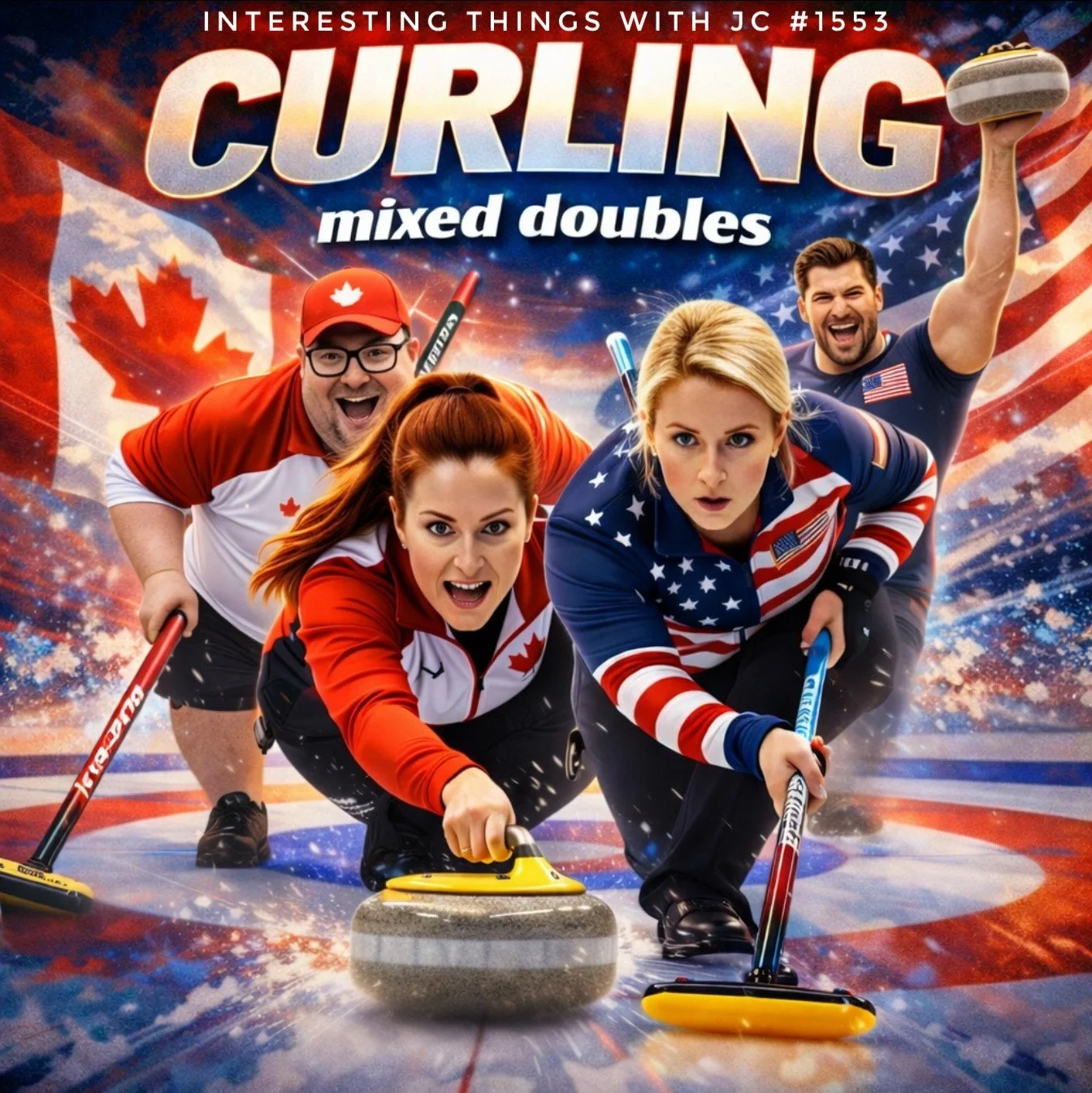
Square poster-style image of mixed doubles curling: a Canadian woman and American woman slide on the ice in front, with a smiling Canadian man holding a broom behind her and a fit American man raising a curling stone behind the U.S. player, under the title “CURLING” and subtitle “mixed doubles,” with Canadian and U.S. flags in the background.
Transcript
Interesting Things with JC #1553: “Curling – Mixed Doubles”
On a sheet of ice about 150 feet long, roughly 45.7 meters, two people stand alone. No bench. No backups. Just one man, one woman, and a game that moves fast enough to punish every mistake. This is mixed doubles curling, and it changed the sport by cutting it down to its core.
Curling itself goes back centuries, built on patience and numbers. Mixed doubles came from a different need. In 2001, Curling Canada officials, including Warren Hansen, were looking for a format that fit tight schedules and television windows without watering the game down. The answer was subtraction. Fewer players. Fewer stones. Less time to recover from bad decisions.
That structure became official in 2008 with the first World Mixed Doubles Curling Championship in Vierumäki, Finland. Switzerland won early and often, not by overpowering opponents, but by mastering communication. With only two players, sweeping calls, weight judgment, and strategy all happen in real time. There’s no skip calling shots from the house while others throw.
The rules force that honesty. Teams use six stones per end instead of eight. One stone per team is placed on the ice before the end begins, shaping strategy immediately. Games run eight ends and usually finish in about an hour. There’s no free guard zone, so protection disappears fast. The same player throws first and last. If you misread the ice early, you pay for it late.
The Olympics resisted at first. Mixed doubles missed the 2010 Vancouver Games, but debuted in 2018 at PyeongChang, where Canada won gold. In 2022, Italy claimed gold in Beijing, proof that the format rewards adaptability more than tradition.
By the 2026 Winter Olympics in Cortina d’Ampezzo, mixed doubles had become a pressure test. Canada’s Jocelyn Peterman and Brett Gallant faced the United States’ Cory Thiesse and Korey Dropkin with both teams shooting around 81 percent. Their February 6 round-robin meeting wasn’t for medals, but it shaped the standings and exposed the margins.
Stones weigh about 42 pounds, roughly 19.1 kilograms. The target is just 12 feet wide, about 3.7 meters. In mixed doubles, every call is shared, every miss is owned, and there’s nowhere to pass the blame. That’s why it works. It doesn’t speed curling up by changing its values. It speeds it up by revealing them.
These are interesting things, with JC.
Student Worksheet
Explain how reducing team size changes responsibility in mixed doubles curling.
Describe one rule that forces faster decision-making and why.
Compare mixed doubles curling to another sport that changed format for television or time constraints.
Reflect on how shared accountability affects teamwork.
Teacher Guide
Estimated Time
45–60 minutes
Pre-Teaching Vocabulary Strategy
Use diagrams of the curling house and stone placement to introduce terms visually.
Anticipated Misconceptions
Students may assume mixed doubles is less skilled than traditional curling; emphasize strategic intensity.
Discussion Prompts
How do constraints improve performance?
Why might broadcasters influence sport design?
Differentiation Strategies
ESL: Visual aids and simplified rule summaries.
IEP: Chunked reading and guided notes.
Gifted: Analyze statistical efficiency in mixed doubles matches.
Extension Activities
Physics lab on friction and sweeping effects.
Media study on Olympic broadcast timing.
Cross-Curricular Connections
Physics: Friction and momentum.
Sociology: Team dynamics.
Mathematics: Probability and scoring strategy.
Quiz
Q1. How many players are on a mixed doubles curling team?
A. Four
B. Three
C. Two
D. Five
Answer: C
Q2. How many stones per team are used per end?
A. Eight
B. Six
C. Ten
D. Four
Answer: B
Q3. What feature removes early protection of stones?
A. Extra ends
B. Free guard zone removal
C. Larger house
D. Heavier stones
Answer: B
Q4. When did mixed doubles debut in the Olympics?
A. 2010
B. 2014
C. 2018
D. 2022
Answer: C
Q5. What skill is most emphasized in mixed doubles?
A. Strength
B. Endurance
C. Communication
D. Equipment
Answer: C
Assessment
Open-Ended Questions
Explain why mixed doubles curling is described as a “pressure test.”
Analyze how format changes reveal core values of a sport.
3–2–1 Rubric
3 = Accurate, complete, thoughtful
2 = Partial or missing detail
1 = Inaccurate or vague
Standards Alignment
NGSS HS-PS2-1
Analyzing motion and forces as applied to stone movement and sweeping.
CCSS.ELA-LITERACY.RI.9-10.2
Determining central ideas of an informational text.
C3 D2.His.14.9-12
Analyzing how institutions evolve over time.
ISTE 3a
Evaluating information for accuracy and relevance.
UK National Curriculum PE KS4
Understanding tactics and strategies in competitive sports.
IB MYP Physical and Health Education
Analyzing performance and decision-making in sport contexts.
Show Notes
This episode traces the evolution of mixed doubles curling from a scheduling solution into a premier Olympic discipline. By examining rule changes, historical milestones, and real competition examples, students see how structure shapes strategy and accountability. The topic matters today because it shows how innovation can preserve core values while adapting to modern demands.
References
World Curling. (2023, July 2). The Rules of Curling and Rules of Competition. https://worldcurling.org/wp-content/uploads/2023/07/2023-The-Rules-of-Curling.pdf
World Curling. (2008). World Mixed Doubles Curling Championship 2008: Event details & results. https://results.worldcurling.org/championship/Details/339
Olympics.com. (2018). PyeongChang 2018: Curling—Mixed Doubles results. https://www.olympics.com/en/olympic-games/pyeongchang-2018/results/curling/mixed-doubles
Curling Canada. (2015, June 8). Mixed doubles curling added to 2018 Winter Olympics. https://www.curling.ca/blog/2015/06/08/mixed-doubles-curling-added-to-2018-winter-olympics/