1559: "What is Love?"
Interesting Things with JC #1559: "What is Love?" – That rush. That obsession. That can’t stop thinking about them feeling. Science says it is not magic. It is brain chemistry, attachment, and a bond built to last long after the fireworks fade.
Curriculum - Episode Anchor
Episode Title: What is Love?
Episode Number: 1559
Host: JC
Audience: Grades 9–12, college intro, homeschool, lifelong learners
Subject Area: Biology, Psychology, Anthropology, History
Lesson Overview
Students explore the biological, psychological, historical, and cultural dimensions of love through neuroscience research, evolutionary theory, and attachment studies.
Learning Objectives:
• Define romantic love as a biological and psychological phenomenon involving reward circuitry and hormones.
• Compare ancient Greek conceptualizations of love (Eros, Philia, Agape) with modern scientific understandings.
• Analyze how attachment theory explains long-term emotional bonding.
• Explain how cross-cultural research supports pair bonding as a widespread human pattern.
Key Vocabulary
• Ventral Tegmental Area (VEN-truhl teg-MEN-tuhl AY-ree-uh) — A small region deep in the brain associated with dopamine production and reward processing. When participants viewed a loved one’s photo, this region consistently activated.
• Dopamine (DOH-puh-meen) — A neurotransmitter linked to motivation, reward, and goal-directed behavior.
• Attachment Theory (uh-TACH-muhnt THEE-uh-ree) — A psychological framework developed by John Bowlby explaining how early bonds influence emotional security.
• Oxytocin (ock-see-TOH-sin) — A hormone involved in bonding, trust, and long-term attachment.
• Vasopressin (vay-zoh-PRESS-in) — A hormone associated with social bonding and partner preference in mammals.
• Pair Bonding (pair BON-ding) — A strong, lasting social and emotional partnership between two individuals.
• Eros (AIR-ohs) — Ancient Greek term for passionate romantic desire.
• Philia (FILL-ee-uh) — Ancient Greek term for friendship and loyalty.
• Agape (ah-GAH-pay) — Ancient Greek term describing selfless care or unconditional love.
Narrative Core
Open – A buzzing phone and a racing heart draw listeners into the intense focus of early attraction.
Info – Helen Fisher’s brain imaging research in the 1990s reveals activation in the ventral tegmental area when individuals view a loved one’s photograph.
Details – Published studies confirm early romantic love activates core reward circuits driven by dopamine. Historical voices like John Locke and Charles Darwin connect love to pleasure, pain, and evolutionary bonding. John Bowlby’s attachment theory explains the lasting psychological impact of early separation.
Reflection – Love emerges as more than emotion: it is a biological drive shaped by hormones, evolutionary pressures, and social bonds across cultures.
Closing – These are interesting things, with JC.
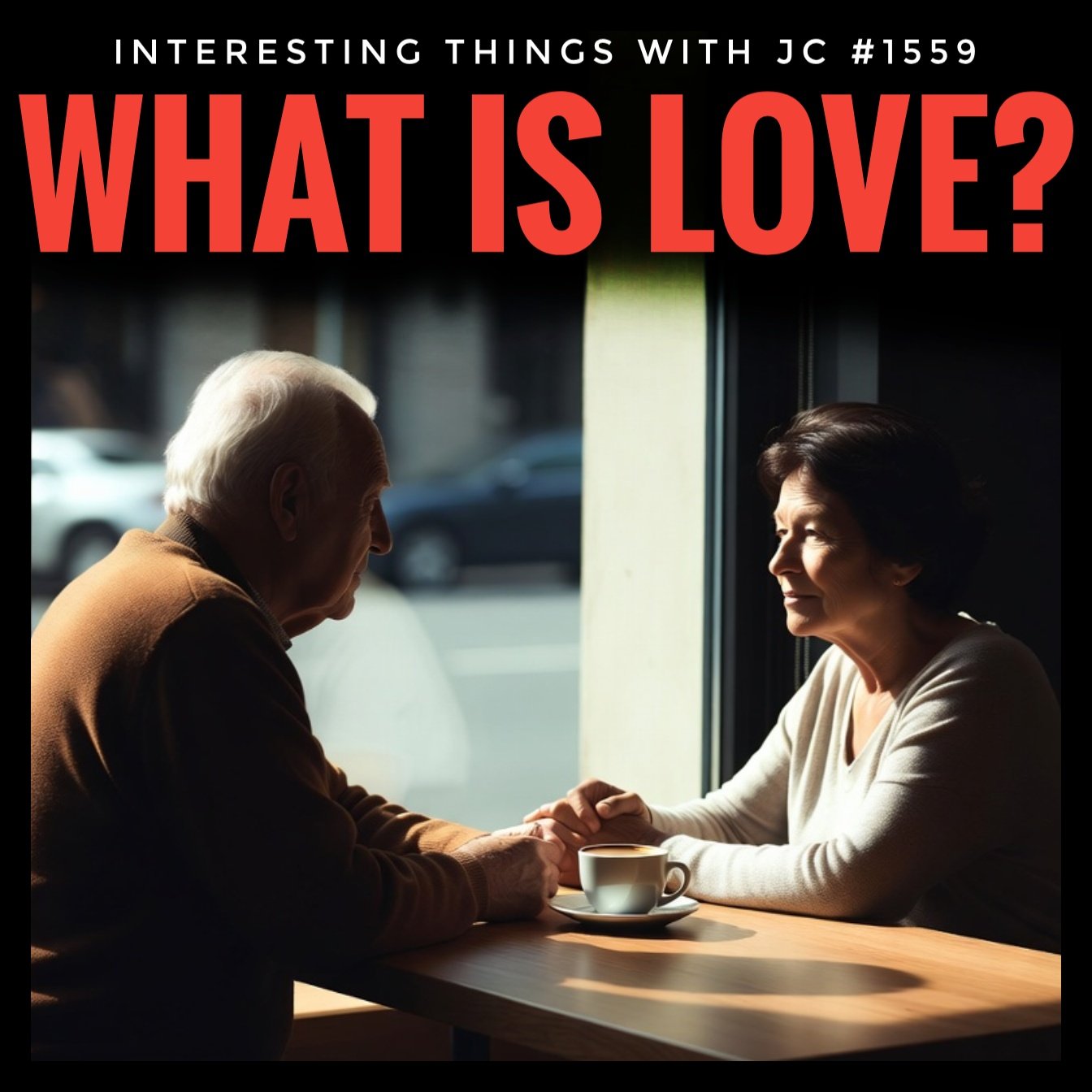
Podcast cover image for “Interesting Things with JC #1559: What Is Love?” The top of the image features bold red text reading “WHAT IS LOVE?” against a black background, with smaller white text above that says “INTERESTING THINGS WITH JC #1559.” Below the title, an elderly man and woman sit across from each other at a wooden table by a window. They are holding hands and looking at one another with calm, reflective expressions. A white coffee cup sits on the table between them. Soft natural light from the window illuminates their faces, suggesting warmth, connection, and long-term companionship.
Transcript
Interesting Things with JC #1559: "What is Love?"
Picture the moment your phone buzzes with a message from someone new. Suddenly the world narrows to that one person. Your heart races. Your thoughts fix on a single name.
In the 1990s, anthropologist Helen Fisher began scanning the brains of people who said they were deeply in love. She wanted to know what was happening beneath the feeling.
When participants looked at a photo of the person they loved, one small region deep in the brain lit up consistently. It is called the ventral tegmental area. This area runs on dopamine, a chemical tied to motivation and reward.
Published research in the early 2000s confirmed it. Early romantic love activates core reward circuits. Falling in love is not just emotion. It is a biological drive.
But love is not one single experience.
The ancient Greeks used different words to describe it. Eros (AIR-ohs) meant passionate desire. Philia (FILL-ee-uh) referred to friendship and loyalty. Agape (ah-GAH-pay) described selfless care.
In 1689, John Locke wrote that pleasure and pain shape human attachment. In 1872, Charles Darwin showed that emotional bonding has evolutionary roots across species.
During World War II, Britain evacuated hundreds of thousands of children from cities under threat of bombing. Some were sent more than 200 miles (322 kilometers) from home. Psychiatrist John Bowlby later studied the effects of those separations. His work in the 1940s and 1950s became attachment theory. Strong early bonds, he found, help create emotional security. Broken bonds can leave lasting anxiety.
Biology supports that idea. Hormones such as oxytocin and vasopressin influence long-term attachment. Research on prairie voles shows these chemicals affect partner preference and social bonding behavior.
Across more than 160 societies studied by anthropologists, some form of pair bonding appears nearly everywhere, even though customs vary widely.
Research suggests the intense phase of romantic attraction often settles after a year or two. Long-term attachment can last decades.
Science can measure brain activity. It can measure hormones. It can track behavior across time.
Consider an elderly couple sitting in a coffee shop holding hands . No fireworks. Just steady presence.
Across time and culture, the pattern repeats. Across biology, psychology, and history, love is defined as a human bond involving brain chemistry, social connection, and sustained commitment.
These are interesting things, with JC.
Student Worksheet
Describe the role of the ventral tegmental area in early romantic love.
Compare Eros, Philia, and Agape. How do they represent different forms of love?
Explain how John Bowlby’s attachment theory relates to World War II evacuations.
What role do oxytocin and vasopressin play in long-term attachment?
Why might romantic attraction settle after one or two years, according to research?
Teacher Guide
Estimated Time: 45–60 minutes
Pre-Teaching Vocabulary Strategy:
Introduce key neuroscience and psychology terms using a Frayer Model (definition, characteristics, examples, non-examples).
Anticipated Misconceptions:
• Love is purely emotional rather than biological.
• Dopamine equals happiness rather than motivation and reward.
• Attachment theory applies only to childhood.
Discussion Prompts:
• Is love more biological or social? Defend your answer with evidence.
• How do historical thinkers like Locke and Darwin contribute to modern understanding of love?
• Why might pair bonding appear across cultures?
Differentiation Strategies:
• ESL: Provide vocabulary visuals and sentence frames.
• IEP: Offer guided notes and shortened reading segments.
• Gifted: Assign comparative research on cross-species bonding behavior.
Extension Activities:
• Analyze brain imaging studies on romantic love.
• Research prairie vole bonding experiments.
• Conduct a comparative essay on attachment theory and evolutionary psychology.
Cross-Curricular Connections:
• Biology: Neurotransmitters and endocrine system.
• Sociology: Cross-cultural pair bonding.
• History: WWII evacuations and child development.
• Philosophy: Locke and human motivation.
Quiz
Q1. Which brain region activates during early romantic love?
A. Amygdala
B. Ventral Tegmental Area
C. Cerebellum
D. Hypothalamus
Answer: B
Q2. Dopamine is primarily associated with:
A. Digestion
B. Balance
C. Motivation and reward
D. Memory storage
Answer: C
Q3. John Bowlby is known for developing:
A. Behaviorism
B. Psychoanalysis
C. Attachment Theory
D. Cognitive Dissonance Theory
Answer: C
Q4. Oxytocin is most closely linked to:
A. Fear response
B. Bonding and trust
C. Muscle growth
D. Visual perception
Answer: B
Q5. Anthropological studies show pair bonding appears in:
A. Only Western societies
B. Fewer than 20 cultures
C. More than 160 societies
D. Only industrialized nations
Answer: C
Assessment
Open-Ended Questions:
Explain how neuroscience and evolutionary theory together help define love as more than emotion.
Evaluate the role of early childhood attachment in shaping adult relationships.
3–2–1 Rubric:
3 = Accurate, complete, thoughtful explanation with supporting details.
2 = Partial explanation with some missing or unclear detail.
1 = Inaccurate, vague, or unsupported response.
Standards Alignment
Common Core ELA
CCSS.ELA-LITERACY.RH.11-12.2 – Determine central ideas of a text and provide accurate summaries.
Students analyze the scientific and historical explanations of love.
CCSS.ELA-LITERACY.RST.9-10.4 – Determine meaning of domain-specific vocabulary.
Students interpret neuroscience and psychology terminology.
NGSS
HS-LS1-2 – Develop and use a model to illustrate the hierarchical organization of interacting systems.
Students connect brain structures and hormones to behavior.
HS-LS2-8 – Evaluate evidence for group behavior increasing survival.
Students analyze pair bonding from an evolutionary perspective.
C3 Framework
D2.Psy.2.9-12 – Investigate human behavior and mental processes.
Students evaluate attachment theory and reward systems.
ISTE
1.3 Knowledge Constructor – Students critically curate research on neuroscience and attachment.
International Equivalents
UK AQA Psychology A-Level: Attachment and Biopsychology Units – Study of attachment theory and brain function parallels episode content.
IB Diploma Programme Psychology: Biological approach to behavior – Links neurotransmitters and hormones to human bonding.
Cambridge International AS & A Level Biology: Nervous and hormonal control – Connects endocrine and neural systems to behavior.
Show Notes
This episode explores the science and history behind one of humanity’s most powerful experiences: love. Drawing from neuroscience research by Helen Fisher, philosophical insights from John Locke, evolutionary biology from Charles Darwin, and attachment theory developed by John Bowlby, the episode reveals that love is both biological and social. Brain imaging studies show activation of dopamine-driven reward circuits during early romantic attraction, while hormones such as oxytocin and vasopressin influence long-term bonding. Cross-cultural anthropology further demonstrates that pair bonding appears in more than 160 societies worldwide. For classrooms, this episode supports interdisciplinary learning in biology, psychology, history, and sociology, helping students understand how scientific evidence intersects with human experience.
References
Fisher, H. E., Aron, A., & Brown, L. L. (2005). Romantic love: An fMRI study of a neural mechanism for mate choice. The Journal of Comparative Neurology, 493(1), 58–62. https://doi.org/10.1002/cne.20772
Acevedo, B. P., Aron, A., Fisher, H. E., & Brown, L. L. (2012). Neural correlates of long-term intense romantic love. Social Cognitive and Affective Neuroscience, 7(2), 145–159. https://doi.org/10.1093/scan/nsq092
Bowlby, J. (1969). Attachment and loss: Vol. 1. Attachment. Basic Books. https://archive.org/details/attachmentlossvo00john
Carter, C. S. (1998). Neuroendocrine perspectives on social attachment and love. Psychoneuroendocrinology, 23(8), 779–818. https://doi.org/10.1016/S0306-4530(98)00055-3
Insel, T. R., & Hulihan, T. J. (1995). A gender-specific mechanism for pair bonding: Oxytocin and partner preference formation in monogamous voles. Behavioral Neuroscience, 109(4), 782–789. https://doi.org/10.1037/0735-7044.109.4.782
Jankowiak, W. R., & Fischer, E. F. (1992). A cross-cultural perspective on romantic love. Ethnology, 31(2), 149–155. https://doi.org/10.2307/3773618