1560: “The 3 Squeeze Rule
Interesting Things with JC #1560: “The 3 Squeeze Rule” – Three gentle squeezes, a form of nonverbal communication shared from parent to child and between couples. A simple touch tied to oxytocin bonding, stress relief, and emotional connection, showing how love can be expressed without words.
Curriculum - Episode Anchor
Episode Title: The 3 Squeeze Rule
Episode Number: 1560
Host: JC
Audience: Grades 9–12, college intro, homeschool, lifelong learners
Subject Area: Psychology, Neuroscience, Communication Studies, Health Science
Lesson Overview
This lesson looks at how people communicate without speaking and how simple physical touch can affect the brain and body. Students will examine how a small gesture can carry meaning, influence stress levels, and spread through modern culture.
Learning Objectives
Students will be able to:
• Define nonverbal communication and describe how touch sends a message.
• Explain how pressure on the skin activates nerve receptors.
• Analyze how oxytocin and cortisol are involved in bonding and stress.
• Describe how modern customs spread through digital media.
Key Vocabulary
• Oxytocin (ok-see-TOH-sin) — A hormone connected to bonding and trust. Supportive touch can help trigger its release.
• Nonverbal Communication (non-VER-buhl kuh-myoo-ni-KAY-shun) — Communication without spoken words, such as gestures, facial expressions, or touch.
• Cortisol (KOR-tuh-sawl) — A hormone released during stress. Supportive contact can sometimes help lower it.
• Mechanoreceptors (meh-KAN-oh-ree-sep-torz) — Nerve receptors in the skin that respond to pressure or touch.
• Cute Aggression (kyoot uh-GRESH-un) — A psychological term for the urge to squeeze or express energy when feeling strong affection.
Narrative Core
Open
Two people walking side by side. Hands linked. Three small squeezes. No words needed.
Info
The “three-squeeze rule” is a modern gesture where three hand squeezes mean “I love you.” It became widely shared through personal stories and early 2000s online communities.
Details
There is no historical record of this gesture in older traditions. Its impact connects to biology. Pressure on the skin activates mechanoreceptors, which send signals through the nervous system. Research shows supportive touch can encourage oxytocin release and help reduce stress responses, sometimes lowering heart rate slightly.
Reflection
The gesture carries emotional meaning while also producing measurable physical effects. The idea of “cute aggression” helps explain why strong affection can create the urge to squeeze gently as a way of expressing and regulating emotion.
Closing
These are interesting things, with JC.
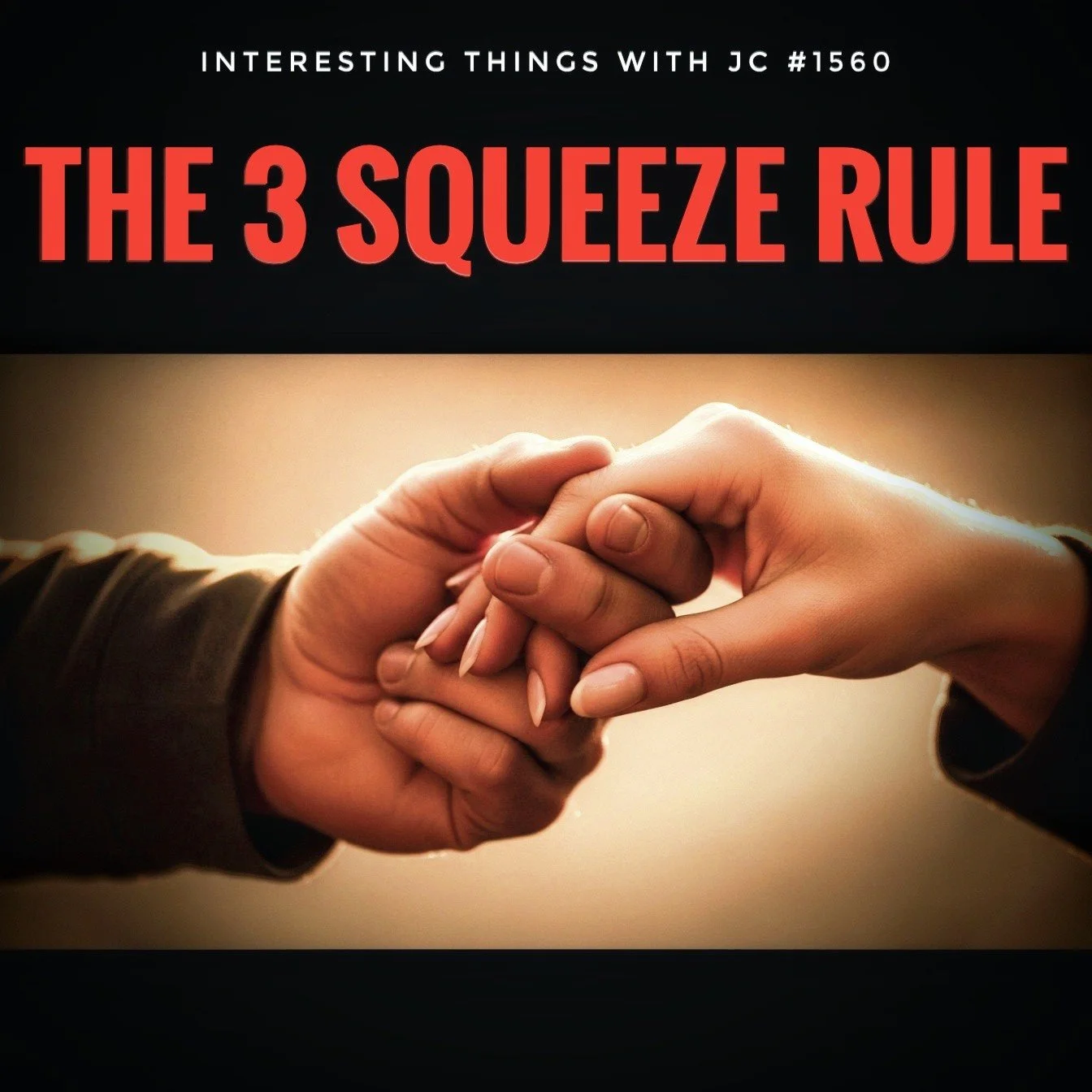
Close up image of two people gently holding hands, fingers interlocked in a soft squeeze, symbolizing affection and nonverbal connection. Warm natural light highlights the skin tones and creates a romantic atmosphere. Bold red text above reads “The 3 Squeeze Rule” with “Interesting Things with JC #1560” displayed at the top.
Transcript
Interesting Things with JC #1560: “The 3 Squeeze Rule”
Sometimes you don’t need words at all.
You’re walking together up an escalator. Maybe sitting in a lounge. Your hands are linked in that easy, familiar way, no words needed.
Then it happens….
One squeeze.
Then two.
And a third.
Three gentle pulses.
I. Love. You.
The three-squeeze rule is simple. One person presses the other’s hand three times. Most times, three squeezes, well it calls right back. Sometimes four for “I love you too.” No drama. Just shared understanding.
There’s no record of it in old letters or ancient traditions. It doesn’t trace back to 1560 or any earlier century. It’s modern. Many people say they first felt it from a parent, three squeezes before school or at bedtime, a simple “I’m here” that later became “I love you.” Others discovered it in their own relationships. By the early 2000s, personal stories began circulating online, shared in blogs and forums, then amplified by viral moments on social media, spreading it more widely. It caught on because it felt right.
And there’s a reason it feels so right.
Gentle pressure activates nerve receptors, sending signals that can release oxytocin, the hormone linked to bonding and trust. Research shows that calm, supportive touch between loved ones, it can actually lower stress hormones, promote relaxation, and sometimes ease the heart rate just a bit.
So the squeeze isn’t just symbolic….
It has a physical effect.
Psychologists describe “cute aggression,” the urge to squeeze someone that you adore when love overwhelms. The brain balances it with small actions, like a gentle grip, not to harm, but to express and regulate.
So, whether it’s a partner beside you or a child whose hand you’re holding, once agreed upon, the meaning stays....
Three pulses.
Three words.
No explanation required.
These are interesting things, with JC.
Student Worksheet
What is nonverbal communication? Give one example from the episode.
What role do mechanoreceptors play in the three-squeeze rule?
How does oxytocin relate to bonding?
Why is the three-squeeze rule considered modern rather than historical?
Create your own example of a nonverbal signal and explain what it would mean.
Teacher Guide
Estimated Time: 45–60 minutes
Pre-Teaching Vocabulary Strategy
Introduce scientific terms using short definitions and real-life examples. Use simple diagrams of the nervous system to show how signals travel from skin to brain.
Anticipated Misconceptions
• Students may think oxytocin is only related to romantic love. Clarify it is also linked to parent-child bonding and social trust.
• Students may assume the three-squeeze rule is an old tradition. Reinforce that it is modern.
• Students may misunderstand cute aggression as violent behavior. Emphasize that it refers to harmless emotional regulation.
Discussion Prompts
• Why does touch communicate meaning so effectively?
• How can something simple become meaningful in relationships?
• How does social media help spread small cultural practices?
Differentiation Strategies
• ESL: Provide vocabulary lists with visual aids.
• IEP: Offer guided notes and structured response prompts.
• Gifted: Assign review of a peer-reviewed study on oxytocin and bonding.
Extension Activities
• Research how the nervous system processes touch.
• Track another modern custom and map how it spread online.
• Write a short reflection on a meaningful nonverbal signal in daily life.
Cross-Curricular Connections
• Biology: Nervous system and hormone regulation.
• Sociology: Social bonding and shared meaning.
• Health Science: Stress and hormonal balance.
• Media Studies: Viral communication trends.
Quiz
Q1. The three-squeeze rule is an example of:
A. Written communication
B. Nonverbal communication
C. Government messaging
D. Public debate
Answer: B
Q2. Mechanoreceptors respond to:
A. Light
B. Chemicals
C. Pressure
D. Sound
Answer: C
Q3. Oxytocin is linked to:
A. Bonding
B. Vision
C. Digestion
D. Muscle strength
Answer: A
Q4. The three-squeeze rule became widely known through:
A. Ancient records
B. Medieval traditions
C. Early online sharing
D. Formal education systems
Answer: C
Q5. Cute aggression refers to:
A. Harmful behavior
B. Overwhelming affection expressed physically
C. Competitive sports
D. Fear response
Answer: B
Assessment
Explain how the three-squeeze rule demonstrates both communication and biology at work.
Describe how modern digital platforms influence the spread of cultural practices.
3–2–1 Rubric
3 = Accurate, complete, thoughtful response with clear explanation
2 = Partially accurate with some missing detail
1 = Inaccurate or unclear response
Standards Alignment
CCSS.ELA-LITERACY.RST.11-12.2
Students determine central ideas in informational text related to neuroscience and communication.
CCSS.ELA-LITERACY.SL.9-10.1
Students participate in collaborative discussions about communication and behavior.
NGSS HS-LS1-2
Students develop models explaining nervous system interactions.
NGSS HS-LS1-3
Students evaluate evidence regarding feedback mechanisms such as stress hormone regulation.
C3 Framework D2.Soc.9-12
Students analyze how social interactions influence behavior.
ISTE 1.3 Knowledge Constructor
Students evaluate digital sources to understand cultural diffusion online.
UK National Curriculum (KS4 Biology – Homeostasis and Response)
Students explain how the nervous system enables response to stimuli.
AQA GCSE Psychology – Social Influence
Students examine factors influencing interpersonal behavior.
IB Biology (DP) Topic 6: Human Physiology
Students explain hormone and nervous system interaction in regulating body processes.
Show Notes
In this episode, JC explores the “three-squeeze rule,” a modern nonverbal gesture meaning “I love you.” The episode explains how this practice spread through personal stories and early online communities in the 2000s. It also connects the gesture to biology, describing how pressure activates nerve receptors and may encourage oxytocin release while helping reduce stress responses. The topic gives students a clear example of how communication, psychology, and neuroscience intersect in everyday life, making it highly relevant to studies in biology, health science, and social behavior.
References
Aragón, O. R., Clark, M. S., Dyer, R. L., & Bargh, J. A. (2015). Dimorphous expressions of positive emotion: Displays of both care and aggression in response to cute stimuli. Psychological Science, 26(3), 259–273. https://doi.org/10.1177/0956797614561044
Aragón, O. R., & Clark, M. S. (2018). It’s so cute I could crush it! Understanding neural mechanisms of cute aggression. Frontiers in Behavioral Neuroscience, 12, Article 300. https://doi.org/10.3389/fnbeh.2018.00300
Hertenstein, M. J., Keltner, D., App, B., Bulleit, B. A., & Jaskolka, A. R. (2006). Touch communicates distinct emotions. Emotion, 6(3), 528–533. https://doi.org/10.1037/1528-3542.6.3.528
Light, K. C., Grewen, K. M., & Amico, J. A. (2005). More frequent partner hugs and higher oxytocin levels are linked to lower blood pressure and heart rate in premenopausal women. Biological Psychology, 69(1), 5–21. https://doi.org/10.1016/j.biopsycho.2004.11.002
Uvnäs-Moberg, K., Handlin, L., & Petersson, M. (2015). Neuroendocrine mechanisms involved in the physiological effects induced by skin-to-skin contact – With a particular focus on the oxytocinergic system. Infant Behavior and Development, 39, 1–12. https://doi.org/10.1016/j.infbeh.2014.12.001