Interesting Things with JC #1568: "Ski Mountaineering" – Before sunrise in the Alps, headlamps move uphill in silence. No lifts. No engines. Just lungs, legs, and gravity waiting at the top. In a world built for shortcuts, ski mountaineering still makes you earn every turn.
Curriculum - Episode Anchor
Episode Title: Ski Mountaineering
Episode Number: 1568
Host: JC
Audience: Grades 9–12, Introductory College, Homeschool, Lifelong Learners
Subject Area: Sports History, Physics of Motion, Olympic Studies, Human Performance Science
Lesson Overview
This lesson examines ski mountaineering, commonly called Skimo, as a powerful intersection of history, physics, engineering, and Olympic competition. Students will explore how a military survival skill evolved into a modern Olympic sport and how principles of friction, gravity, and energy transfer govern athletic performance.
Learning Objectives
Students will:
Define ski mountaineering and distinguish it from traditional alpine skiing.
Explain how alpine military patrols during World War I and World War II contributed to the sport’s origins.
Analyze how friction, gravity, and energy conservation apply during ascent and descent.
Evaluate the historical and cultural significance of Skimo’s addition to the 2026 Winter Olympic Games.
Interpret the phrase “earn your turns” in both literal and symbolic contexts.
Key Vocabulary
Ski Mountaineering (skee moun-tuh-NEER-ing), A winter endurance sport in which athletes climb mountains under their own power before skiing down competitively.
Skimo (SKEE-moh), The abbreviated term commonly used in international competition.
Synthetic Skins (sin-THET-ik skinz), Directional fabric strips attached to skis that allow forward glide while preventing backward sliding.
Binding (BYN-ding), A device connecting boot to ski, allowing heel lift for climbing and heel lock for descending.
Bootpack (BOOT-pak), A steep race section where athletes remove skis and run uphill carrying them.
Friction (FRIK-shun), The resistive force between surfaces in contact, essential for uphill propulsion.
Potential Energy (puh-TEN-shul EN-er-jee), Stored energy due to height above the ground.
Kinetic Energy (kih-NET-ik EN-er-jee), Energy of motion observed during descent.
Narrative Core
Open
Before sunrise in the Alps, small headlamps move uphill in silence. No lifts. No engines. Only breath and snow.
Info
Athletes climb using lightweight skis, synthetic skins, and adaptive bindings designed for efficiency.
Details
Roots in alpine military patrols of World War I and World War II
Military Ski Patrol at the 1924 Winter Olympics
Official World Championships beginning in 2002
IOC approval in July 2021
Olympic debut, February 19–21, 2026, Stelvio Ski Centre, Bormio, Italy
Sprint format lasting approximately three minutes
Reflection
The phrase “earn your turns” expresses the principle that reward follows effort.
Closing
These are interesting things, with JC.
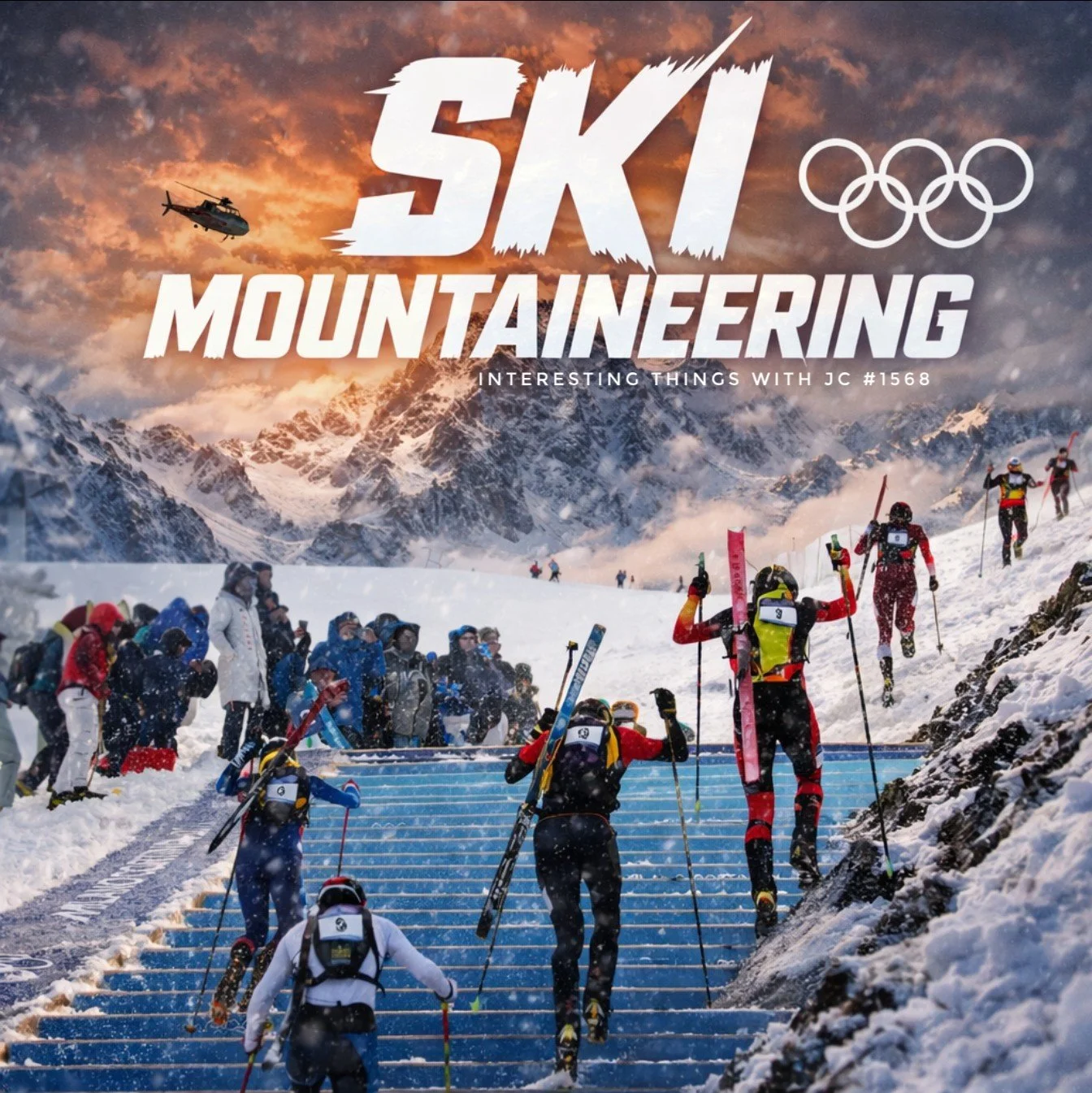
Ski mountaineering athletes climb a steep, snow-covered staircase carrying skis during an Olympic event, with spectators nearby and dramatic alpine mountains at sunset in the background. Large text reads “Ski Mountaineering” with Olympic rings and “Interesting Things with JC #1568.”
Transcript
Interesting Things with JC #1568: "Ski Mountaineering"
Before sunrise in the Alps, small headlamps move uphill in the dark.
No chairlifts. No engines. Just the sound of breath and skis sliding forward through snow.
That is ski mountaineering. Most call it Skimo.
The idea is simple. You climb the mountain under your own power. Then you race back down.
Athletes attach synthetic skins to the base of their skis. These strips grip the snow in one direction so the ski can glide forward but not slip backward. The movement becomes steady and deliberate. Step. Glide. Step. Glide.
The equipment is built for efficiency. Skis are lighter than traditional alpine skis. Bindings allow the heel to lift while climbing and lock in place for the descent. When the slope becomes too steep, racers remove their skis, strap them to their packs, and run straight up the mountain. That section is called a bootpack.
The sport grew out of necessity. Alpine military patrols used skis to cross high mountain terrain during World War I and World War II. A related event called Military Ski Patrol appeared at the first Winter Olympics in 1924. Modern competitive ski mountaineering was formalized much later, with official World Championships beginning in 2002.
In July 2021, the International Olympic Committee approved ski mountaineering for the 2026 Winter Games. It became the first completely new sport added to the Winter Olympics in 28 years, since snowboarding in 1998.
From February 19 to 21, 2026, at the Stelvio Ski Centre in Bormio, pronounced Bor-mee-oh, Italy, the sport made its Olympic debut. The sprint lasts about three minutes. Racers climb, transition quickly, and descend through a technical course where one mistake can end the heat.
There is a phrase in this sport. Earn your turns.
You do not ride up. You work your way up. Every descent is paid for on the climb.
In a world built for shortcuts, ski mountaineering still measures effort the old-fashioned way.
One step at a time.
These are interesting things, with JC.
Student Worksheet
Short Answer
How do synthetic skins use friction differently than traditional ski bases?
Why were skis essential for alpine military patrols during World War I and World War II?
What physical challenges are present in the Olympic sprint format?
Explain how potential energy during ascent converts into kinetic energy during descent.
Creative Prompt
Write a brief reflection explaining how “earn your turns” could apply to academic or athletic achievement.
Teacher Guide
Estimated Time: 60 minutes
Pre-Teaching Vocabulary Strategy
• Demonstrate friction with textured materials
• Use incline models to show gravity’s effect
• Provide historical images of alpine patrol units
Anticipated Misconceptions
• Skimo uses ski lifts
• It is identical to alpine downhill racing
• It has no historical roots
Discussion Prompts
• Why do many sports originate from survival or military skills?
• Should Olympic sports reflect tradition, popularity, or physical difficulty?
• How does technology shape modern athletic performance?
Differentiation Strategies
ESL: Visual vocabulary cards and structured sentence frames
IEP: Guided notes and chunked questions
Gifted: Calculate work done using W = mgh for a 250 m climb
Extension Activities
• Physics lab measuring friction on inclined surfaces
• Compare 1924 Military Ski Patrol with 2026 Olympic Skimo
• Engineering challenge, design a lightweight ski binding
Cross-Curricular Connections
Physics: Newton’s Laws, energy transfer, friction
History: World War I and World War II mountain warfare
Engineering: Materials science and efficiency design
Physical Education: Aerobic endurance and VO₂ max
Media Studies: Olympic sport inclusion processes
Quiz
Q1. What allows a skier to climb without sliding backward?
A. Ice spikes
B. Synthetic skins
C. Snowboards
D. Poles only
Answer: B
Q2. Modern Ski Mountaineering World Championships began in:
A. 1924
B. 1998
C. 2002
D. 2021
Answer: C
Q3. The Olympic sprint lasts approximately:
A. 30 seconds
B. 1 minute
C. 3 minutes
D. 10 minutes
Answer: C
Q4. “Earn your turns” emphasizes:
A. Speed over safety
B. Climbing before descending
C. Team scoring
D. Equipment weight
Answer: B
Q5. The IOC approved Skimo in:
A. 1998
B. 2002
C. 2014
D. 2021
Answer: D
Assessment
Open-Ended Questions
Evaluate how ski mountaineering reflects both historical necessity and modern innovation.
Analyze how physics principles govern both ascent and descent phases.
3–2–1 Rubric
3 = Accurate, complete, detailed explanation with historical and scientific references
2 = Partially accurate with limited detail
1 = Inaccurate or vague response
Standards Alignment
Next Generation Science Standards, NGSS
HS-PS2-1, Analyze forces and acceleration during uphill climbing.
HS-PS3-1, Calculate gravitational potential energy changes.
HS-PS3-2, Model energy conservation between ascent and descent.
HS-ETS1-2, Design and evaluate engineering solutions for equipment efficiency.
Common Core State Standards, CCSS, ELA
RST.11-12.2, Determine central ideas in technical text.
WHST.9-12.2, Write informative texts explaining scientific processes.
SL.11-12.1, Engage in collaborative academic discussion.
C3 Framework, Social Studies
D2.His.1.9-12, Evaluate historical influence on modern institutions.
D2.His.14.9-12, Analyze multiple causes and effects of historical developments.
ISTE Standards for Students
3, Knowledge Constructor, Research and synthesize Olympic sport evolution.
4, Innovative Designer, Apply design thinking to athletic equipment.
Career and Technical Education, CTE
Engineering and Technology Pathway Standard 2, Apply materials science to product performance.
International Equivalents
UK National Curriculum, Key Stage 4 Physics, Analyze gravitational potential energy and friction.
AQA GCSE Physical Education, Paper 1, Energy systems and endurance performance.
IB Diploma Programme Physics, Topic 2 Mechanics, Apply Newton’s Laws and conservation of energy.
Cambridge IGCSE Physical Education, Evaluate factors affecting athletic performance.
Show Notes
In this episode, ski mountaineering, commonly called Skimo, is explored as both an endurance challenge and a modern Olympic sport. Originating from alpine military patrols in World War I and World War II, the discipline evolved into organized world competition beginning in 2002 and achieved Olympic status at the 2026 Winter Games in Bormio, Italy. Students learn how directional friction from synthetic skins enables uphill motion, how potential energy transforms into kinetic energy on descent, and why “earn your turns” captures both the physical and philosophical spirit of the sport. This interdisciplinary topic connects physics, engineering, history, and athletic performance in a compelling, real-world Olympic context.
References
Dynafit. (2024, January 31). Jakob Herrmann sets new world record in ski mountaineering. https://www.dynafit.com/en-us/world-record-by-jakob-herrmann
International Olympic Committee. (2021, July 20). Ski mountaineering added to the 2026 Winter Olympic program. https://Olympics.com
International Ski Mountaineering Federation. (2023, October 25). ISMF Sporting Rules & Guidelines 2023-2024. https://www.ismf-ski.org
PlanetMountain. (2021, March 22). Martina Valmassoi breaks 24-hour uphill ski record, climbs staggering 17,645m. https://www.planetmountain.com/en/news/snow-ski-skimountaineering/martina-valmassoi-breaks-24-hour-uphill-ski-record-climbs-staggering-17645m.html
USA Skimo. (2024). Guide to ski mountaineering (Skimo) racing: Gear and rules. https://www.usaskimo.org/guide-to-ski-mountaineering/
USA Today. (2026, February 10). 2026 Winter Olympics ski mountaineering schedule: Date, TV, streaming. https://www.usatoday.com/story/sports/olympics/2026/02/10/winter-olympics-2026-ski-mountaineering-schedule-date-tv-streaming-skimo/88603842007/