Interesting Things with JC #1567: "The Reverend Jesse Jackson & Progressive Supranuclear Palsy" – He marched with Dr. King. He ran for president. He stood in rooms where history was made. After a long public battle with Progressive Supranuclear Palsy, Reverend Jesse Jackson passed away at 84. His final years revealed a rare disease. His life revealed resolve.
Curriculum - Episode Anchor
Episode Title: The Reverend Jesse Jackson & Progressive Supranuclear Palsy
Episode Number: 1567
Host: JC
Audience: Grades 9–12, college intro, homeschool, lifelong learners
Subject Area: U.S. History, Civics, Biology (Neurology), Health Science
Lesson Overview
Students will explore the life of Reverend Jesse Jackson alongside the medical science of Progressive Supranuclear Palsy (PSP), analyzing how public leadership intersects with neurodegenerative disease.
Learning Objectives:
Define Progressive Supranuclear Palsy (PSP) and explain how it differs from Parkinson’s disease.
Compare classic Parkinson’s disease with atypical parkinsonism, including PSP.
Analyze how physical health can impact public leadership and civic participation.
Explain the neurological mechanisms of tauopathies and their effects on the brain.
Key Vocabulary
Progressive Supranuclear Palsy (proh-GRESS-iv soo-pruh-NOO-klee-er PAL-see) — A rare neurodegenerative disorder affecting balance, eye movement, speech, and swallowing; also known as Steele-Richardson-Olszewski syndrome.
Tauopathy (tau-OP-uh-thee) — A class of neurodegenerative diseases characterized by abnormal accumulation of tau protein in brain cells.
Atypical Parkinsonism (ay-TIP-ih-kul PAR-kin-suh-niz-um) — A group of disorders with symptoms similar to Parkinson’s disease but with different underlying pathology and progression.
Levodopa (lee-voh-DOH-puh) — The primary medication used to treat Parkinson’s disease symptoms, often less effective in PSP.
Aspiration Pneumonia (as-puh-RAY-shun new-MOH-nee-uh) — A lung infection caused by inhaling food, liquid, or saliva, often a complication of swallowing impairment in neurological disease.
Basal Ganglia (BAY-suhl GANG-glee-uh) — Structures deep within the brain that coordinate movement and posture.
Narrative Core
Open – The episode begins with the announcement of Reverend Jesse Jackson’s passing at age 84 and introduces his long public life.
Info – Background on his civil rights activism, founding of Operation PUSH, and presidential campaigns in 1984 and 1988.
Details – His initial Parkinson’s diagnosis in 2017, later revised in 2025 to Progressive Supranuclear Palsy; explanation of PSP’s rarity, neurological basis, symptoms, and progression.
Reflection – The contrast between public visibility and private physical effort; how neurodegenerative disease affects identity and capability.
Closing – These are interesting things, with JC.
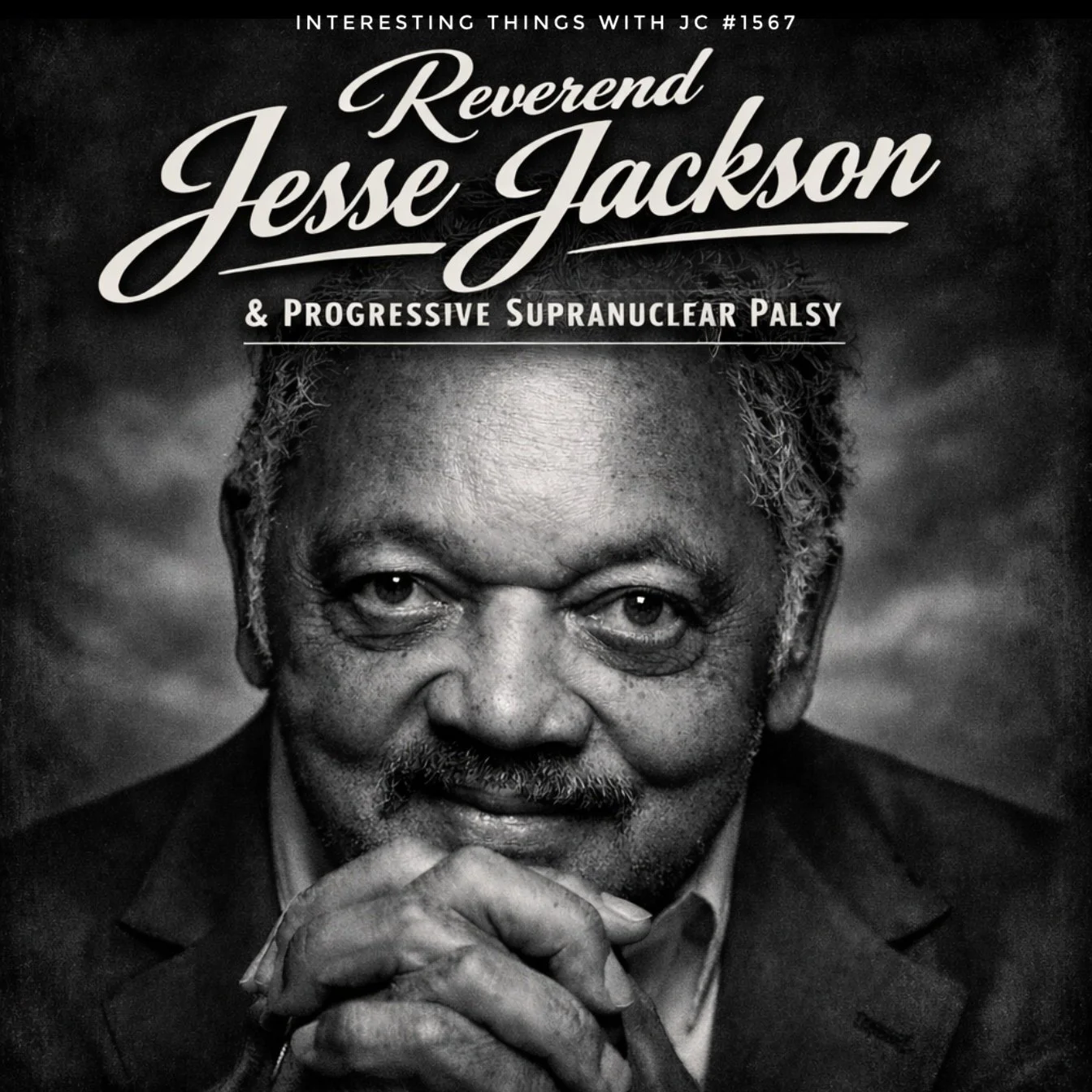
Black-and-white portrait of Reverend Jesse Jackson with hands clasped under his chin, looking thoughtfully at the camera. Text reads: “Interesting Things with JC #1567 – Reverend Jesse Jackson & Progressive Supranuclear Palsy.” This image is used for educational and informational purposes under fair use (17 U.S.C. §107). It is not used for commercial sale or product endorsement, and no fee is charged for access to this content.
Transcript
Interesting Things with JC #1567: "The Reverend Jesse Jackson & Progressive Supranuclear Palsy"
On February 17, 2026, Reverend Jesse Louis Jackson passed away at 84 years old in Chicago, Illinois.
For more than five decades, he was a visible figure in American public life. Born October 8, 1941, in Greenville, South Carolina, he marched with Dr. Martin Luther King Jr. in the 1960s. He founded Operation PUSH in 1971. He ran for President of the United States in 1984 and again in 1988. In 1988, he won 11 Democratic primaries and caucuses and earned more than 6.9 million votes.
His work required physical presence. Standing for extended periods. Traveling across the country. Appearing in rooms where endurance was part of the responsibility.
In November 2017, he publicly announced that he had been diagnosed with Parkinson’s disease after experiencing symptoms for several years. Muscle stiffness. Slowed movement. Changes in balance. The diagnosis fit the signs.
In April 2025, physicians confirmed a different and rarer condition: Progressive Supranuclear Palsy, known as PSP. The formal medical name is Steele Richardson Olszewski syndrome, first described in 1964.
PSP is rare. It affects approximately 5 to 6 people per 100,000. In the United States, with a population of roughly 335 million people, that equals about 20,000 to 25,000 individuals at any given time.
It is classified as an atypical parkinsonism. Early symptoms resemble Parkinson’s disease, which can contribute to delayed or revised diagnoses. Unlike classic Parkinson’s, PSP progresses more rapidly and does not respond well to levodopa, the primary medication used to treat Parkinson’s.
PSP is a tauopathy. Abnormal tau protein accumulates inside neurons and damages areas of the brainstem and basal ganglia responsible for posture, vertical eye movement, speech, and swallowing.
Its clinical pattern is distinct.
Frequent backward falls often appear early. Difficulty moving the eyes downward makes stairs and curbs hazardous. Speech can become slurred. Swallowing may become impaired, increasing the risk of aspiration pneumonia, a leading complication.
Significant disability often develops within 3 to 5 years of symptom onset. Average survival typically ranges from 7 to 10 years after diagnosis, although progression varies.
In November 2025, Reverend Jackson was hospitalized for complications related to PSP, including infection. On February 17, 2026, he passed away.
In public appearances during his later years, his movements were slower. His gait had changed. His speech required greater effort.
PSP limits balance and coordination. It reduces range of motion. It turns automatic movements into deliberate ones.
For someone whose career depended on standing, traveling, and speaking, those physical changes were visible.
He continued making appearances during the progression of his illness.
The public saw the podium.
It did not see the effort required to reach it.
Progressive Supranuclear Palsy remains uncommon and is often unfamiliar outside neurological practice. Because its early symptoms resemble Parkinson’s disease, patients are sometimes initially diagnosed under that label before progression reveals a different condition. There is no cure. There is no treatment proven to slow the disease. Management focuses on safety, fall prevention, and speech and swallowing support.
Many rare neurodegenerative disorders follow this pattern. Limited awareness. Diagnostic complexity. No definitive reversal once neurological damage begins.
Reverend Jesse Jackson’s life covered 84 years.
His final chapter included a disease that slowly limited what his body could do.
But it did not rewrite who he had already been.
These are interesting things, with JC.
Student Worksheet
Define Progressive Supranuclear Palsy and explain why it is often confused with Parkinson’s disease in early stages.
Calculate the approximate number of PSP cases in a population of 100 million using the rate provided. Show your reasoning.
Analyze how PSP could specifically affect someone whose career depends on public speaking and travel.
Explain the role of tau protein in neurodegenerative disease.
Reflect: How does public leadership change when physical ability declines? Provide evidence from the transcript.
Teacher Guide
Estimated Time
45–60 minutes
Pre-Teaching Vocabulary Strategy
Introduce neurological terminology using visual diagrams of the brainstem and basal ganglia. Use Frayer Models for tauopathy and atypical parkinsonism.
Anticipated Misconceptions
• All movement disorders are Parkinson’s disease.
• Levodopa works for all parkinsonian conditions.
• Rare diseases are insignificant in public health.
Discussion Prompts
• Why might PSP be misdiagnosed initially?
• How does visibility in public life affect perceptions of illness?
• What challenges do rare diseases pose for medical research?
Differentiation Strategies
ESL: Provide illustrated vocabulary sheets and sentence frames.
IEP: Offer guided notes and chunked reading segments.
Gifted: Assign independent research comparing PSP to corticobasal degeneration or multiple system atrophy.
Extension Activities
• Research the 1964 medical description of Steele-Richardson-Olszewski syndrome.
• Create a visual comparison chart of Parkinson’s disease vs. PSP.
• Interview a healthcare professional about neurodegenerative disease care models.
Cross-Curricular Connections
Biology: Protein misfolding and cellular pathology.
Civics: The role of public figures in American democracy.
Health Science CTE: Clinical diagnosis and patient care planning.
Statistics: Prevalence calculations and epidemiology.
Quiz
Q1. Progressive Supranuclear Palsy is classified as:
A. A viral infection
B. An atypical parkinsonism
C. An autoimmune disorder
D. A muscular disease
Answer: B
Q2. PSP primarily involves abnormal accumulation of which protein?
A. Dopamine
B. Myelin
C. Tau
D. Insulin
Answer: C
Q3. Which symptom commonly appears early in PSP?
A. Tremor
B. Backward falls
C. Seizures
D. Memory loss
Answer: B
Q4. PSP responds well to levodopa treatment.
A. True
B. False
C. Only in early stages
D. Only in severe stages
Answer: B
Q5. PSP was first medically described in:
A. 1954
B. 1964
C. 1974
D. 1984
Answer: B
Assessment
Open-Ended Questions:
Compare and contrast Parkinson’s disease and Progressive Supranuclear Palsy in terms of symptoms, progression, and treatment response.
Analyze how Reverend Jesse Jackson’s later public appearances illustrate the physical realities of neurodegenerative disease.
3–2–1 Rubric:
3 = Accurate, complete, thoughtful response with specific details
2 = Partially accurate with minor missing elements
1 = Inaccurate, vague, or unsupported
Standards Alignment
Common Core ELA
CCSS.ELA-LITERACY.RST.11-12.2
Determine central ideas of a complex text; students analyze medical and historical information from the transcript.
CCSS.ELA-LITERACY.RH.11-12.7
Integrate quantitative data (PSP prevalence statistics) with historical narrative.
NGSS
HS-LS1-2
Develop and use a model to illustrate hierarchical organization of interacting systems within multicellular organisms (neurological systems affected by tau accumulation).
HS-LS1-4
Use a model to illustrate cellular processes such as protein function and disruption in disease.
C3 Framework for Social Studies
D2.His.14.9-12
Analyze multiple and complex causes of events in the past (civil rights leadership and health context).
ISTE Standards
1.3 Knowledge Constructor
Students critically evaluate medical and historical information sources.
UK National Curriculum (Biology – Key Stage 5 Equivalent)
AQA A-Level Biology 3.2.1
Exchange and transport; applied to neurological degeneration and system failure.
Cambridge International AS & A Level Biology
9700 Topic 14
Homeostasis and control; application to nervous system regulation.
Show Notes
This episode examines the life and final years of Reverend Jesse Jackson, a prominent civil rights leader and two-time U.S. presidential candidate, alongside an exploration of Progressive Supranuclear Palsy (PSP), a rare neurodegenerative disorder. Students learn how PSP differs from Parkinson’s disease, how tau protein accumulation damages the brainstem and basal ganglia, and why misdiagnosis can occur. By combining civic history with neurological science, the episode provides a multidisciplinary case study showing how public leadership intersects with human biology. The topic remains highly relevant as populations age and awareness of neurodegenerative disorders increases. It offers opportunities for discussion in history, biology, health science, and statistics classrooms.
References
• National Institute of Neurological Disorders and Stroke. (2023). Progressive supranuclear palsy information page. https://www.ninds.nih.gov/health-information/disorders/progressive-supranuclear-palsy
• CurePSP. (2024). What is PSP? https://www.psp.org/iwanttolearn/progressive-supranuclear-palsy
• National Institute on Aging. (2023). Parkinson’s disease basics. https://www.nia.nih.gov/health/parkinsons-disease
• Steele, J. C., Richardson, J. C., & Olszewski, J. (1964). Progressive supranuclear palsy. Archives of Neurology, 10(4), 333–359. https://jamanetwork.com/journals/jamaneurology/article-abstract/568676
• Federal Election Commission. (1989). Official 1988 presidential primary vote totals. https://www.fec.gov/resources/cms-content/documents/1988presgeresults.pdf