Interesting Things with JC #1566: "Smokey Robinson" – Before Motown had a sound, it had a poet. From a small Detroit studio to thousands of songs that shaped American music, Smokey Robinson didn’t just write hits, he built the emotional architecture of an era.
Curriculum - Episode Anchor
Episode Title: Smokey Robinson
Episode Number: 1566
Host: JC
Audience: Grades 9–12, college intro, homeschool, lifelong learners
Subject Area: U.S. History, Music History, Cultural Studies, Media Studies
Lesson Overview
Students will explore the life and influence of Smokey Robinson, examining his role in shaping American popular music and the rise of Motown Record Corporation.
Learning Objectives
Students will be able to:
Define the historical significance of Motown in the development of American popular music during the 1960s.
Analyze Smokey Robinson’s contributions as both a songwriter and executive within Motown.
Explain how “A Quiet Storm” influenced R&B radio programming and genre identity.
Compare Smokey Robinson’s artistic and leadership roles to other influential figures in American music history.
Key Vocabulary
Motown (MOHT-town) — A Detroit-based record company founded in 1959 that became one of the most influential labels in American music history.
R&B (ahr-en-bee) — Rhythm and Blues; a genre blending jazz, gospel, and blues traditions.
Vice President (VYCE PREZ-uh-dent) — An executive leadership role; Robinson held this position at Motown while still recording and touring.
Quiet Storm (KWY-uht STORM) — A smooth R&B style and radio format named after Robinson’s 1975 album.
Billboard Hot 100 (BIL-board HOT wun-HUN-dred) — A national music chart ranking the most popular songs in the United States.
Hitsville U.S.A. (HITS-vil yoo-ess-AY) — The nickname for Motown’s original Detroit headquarters at 2648 West Grand Boulevard.
Narrative Core
Open
Born in Detroit’s North End in 1940.
Nicknamed “Smokey Joe” by an uncle.
Grew up blocks from Aretha Franklin.
Info
Formed early vocal groups in high school.
Auditioned for Berry Gordy Jr. in 1958.
That audition contributed directly to the creation of Motown in 1959.
Details
1960: “Shop Around” became Motown’s first million-seller and #1 R&B hit.
Wrote major hits including:
“My Girl” for The Temptations
“My Guy” for Mary Wells
“Ain’t That Peculiar” for Marvin Gaye
Served as Motown’s vice president by the early 1960s.
1975: Released A Quiet Storm, influencing national R&B radio.
1987: Won a Grammy for “Just to See Her.”
Inducted into the Rock and Roll Hall of Fame (1987).
Awarded the Gershwin Prize for Popular Song (2016).
Bob Dylan called him “America’s greatest living poet.”
Reflection
Demonstrates how artistic talent and business leadership can coexist.
Illustrates Detroit’s central role in American cultural history.
Shows resilience through personal struggle and recovery.
Closing
These are interesting things, with JC.
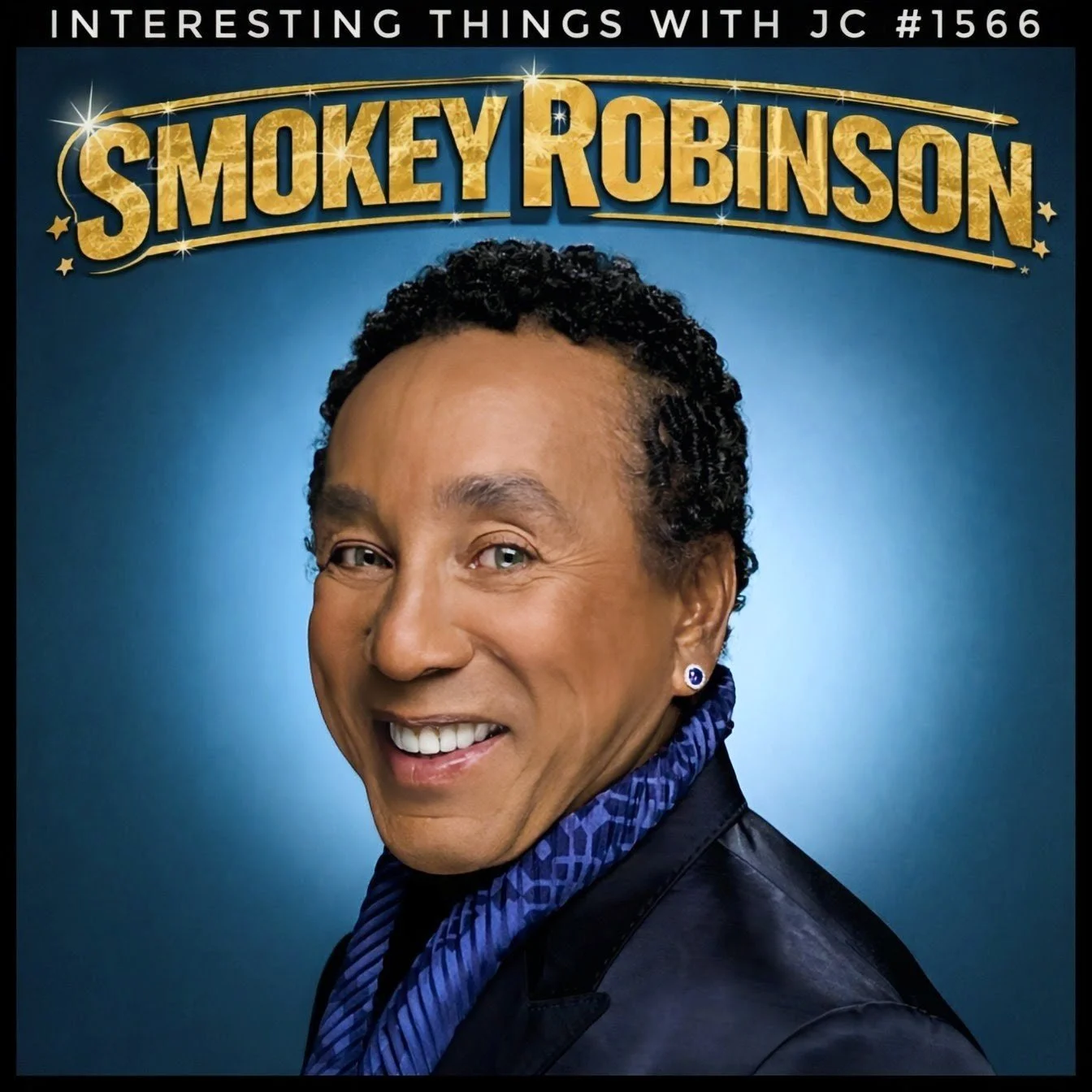
Promotional cover image for “Interesting Things with JC #1566: Smokey Robinson.” A smiling portrait of Smokey Robinson wearing a dark jacket and blue scarf appears against a blue background, with his name displayed in large gold lettering at the top. This image is used under fair use for educational and informational purposes related to music history and cultural study. No fee is charged for its use in this academic context.
Transcript
Interesting Things with JC #1566: "Smokey Robinson"
William Smokey Robinson Jr. was born on February 19, 1940, in Detroit, Michigan, in the city’s North End, about 3 miles north of downtown, roughly 5 kilometers.
He grew up just blocks from a young Aretha Franklin. As a boy, an uncle who loved cowboy films called him “Smokey Joe.” The “Joe” was later dropped. The name stayed.
As a teenager at Northern High School, he formed a vocal group called the Five Chimes. They became the Matadors. In 1958, they auditioned for Berry Gordy Jr. That audition directly led to the creation of Motown Record Corporation, formally incorporated in January 1959.
In 1960, The Miracles released “Shop Around.” It sold more than one million copies and became Motown’s first number one hit on the Billboard R and B chart. At a time when national success required physical pressing plants, trucking routes, and radio promotion across nearly 3,000 miles of coastline, about 4,800 kilometers, a Detroit label had broken through.
Smokey was the lead singer. He was also the writer.
He has been credited with writing or co-writing thousands of songs, with many profiles citing more than 4,000 compositions across his career. Whether measured in the thousands or several thousand, the body of work is rare in American music.
Inside a modest house at 2648 West Grand Boulevard, known as Hitsville U.S.A., measuring roughly 2,400 square feet, about 223 square meters, Smokey worked in Studio A. The room was small. Musicians stood shoulder to shoulder. He often began with poems, shaping lyrics first, then building melody around them.
With The Miracles, he recorded “You’ve Really Got a Hold on Me” in 1962. “The Tracks of My Tears” in 1965. “I Second That Emotion” in 1967. “The Tears of a Clown,” first released in 1967, reached number one on the Billboard Hot 100 in 1970.
He shaped other careers through songwriting. In 1964, he wrote “My Girl” for The Temptations. It reached number one on the Billboard Hot 100 in 1965. He wrote “My Guy” for Mary Wells in 1964 and “Ain’t That Peculiar” for Marvin Gaye in 1965.
By around 1961, still in his early twenties, Smokey was named vice president of Motown. He was guiding artists while recording and touring himself.
In 1972, at age 32, he stepped away from touring to focus on executive work. In 1973, he returned as a solo artist. In 1975, he released A Quiet Storm. The album’s title became the name of a national radio format that defined late-night R and B programming for decades.
As a solo artist, he recorded “Cruisin’” in 1979 and “Being with You” in 1981, which reached number one in the United Kingdom and number two on the Billboard Hot 100. In 1987, “Just to See Her” earned him a Grammy Award.
He has spoken openly about a cocaine addiction in the early 1980s. In 1986, he has said he experienced a turning point through prayer and faith, crediting that moment with ending the addiction. By the late 1980s, he was touring steadily again.
The recognition reflects the scale of his contribution. Rock and Roll Hall of Fame induction in 1987. Songwriters Hall of Fame in 1989. National Medal of Arts in 2002. Kennedy Center Honors in 2006. Gershwin Prize for Popular Song in 2016.
He continues touring nationally, including dates on his Legacy of Love Tour in 2026, and released What the World Needs Now in 2025, marking the fiftieth anniversary era of A Quiet Storm.
More than seven decades in music. Thousands of songs. Leadership inside one of the most influential record companies in American history.
Bob Dylan once called him “America’s greatest living poet.”
From a small Detroit studio to stages across the country, Smokey Robinson did not just write hits. He helped build a sound that endures.
These are interesting things, with JC.
Student Worksheet
Explain how Smokey Robinson’s 1958 audition influenced the founding of Motown.
Identify two songs Robinson wrote for other artists and explain their impact.
Describe how A Quiet Storm changed radio programming.
Analyze how Robinson balanced creative and executive roles.
Teacher Guide
Estimated Time
1–2 class periods (45–90 minutes)
Pre-Teaching Vocabulary Strategy
Provide a word wall featuring Motown, R&B, Billboard, and Quiet Storm.
Play short clips to contextualize vocabulary.
Anticipated Misconceptions
Students may assume performers do not write their own material.
Students may believe Motown was based in New York or Los Angeles rather than Detroit.
Discussion Prompts
How did geography influence the Motown sound?
What qualities make a songwriter influential across generations?
Differentiation Strategies
ESL: Provide sentence stems and vocabulary scaffolds.
IEP: Offer guided notes and structured summaries.
Gifted: Research additional Motown executives and analyze business strategy.
Extension Activities
Compare Motown’s artist development model to modern record labels.
Analyze lyrical structure in “The Tracks of My Tears.”
Cross-Curricular Connections
Economics: Supply chains in 1960s music distribution.
Sociology: Music and the Civil Rights-era cultural landscape.
Media Studies: Evolution of radio formats.
Quiz
Q1. In what city was Smokey Robinson born?
A. Chicago
B. Detroit
C. New York
D. Atlanta
Answer: B
Q2. “Shop Around” was significant because it:
A. Was recorded in New York
B. Introduced disco
C. Became Motown’s first #1 R&B hit
D. Was his final song
Answer: C
Q3. What album introduced the Quiet Storm format?
A. Cruisin’
B. Being with You
C. A Quiet Storm
D. Legacy of Love
Answer: C
Q4. Smokey Robinson served as vice president of which company?
A. Atlantic Records
B. Capitol Records
C. Motown
D. Columbia Records
Answer: C
Q5. Who called Smokey Robinson “America’s greatest living poet”?
A. Marvin Gaye
B. Berry Gordy Jr.
C. Bob Dylan
D. Stevie Wonder
Answer: C
Assessment
Evaluate Smokey Robinson’s dual impact as both an artist and executive.
Explain how Motown influenced national music distribution and cultural identity.
3–2–1 Rubric
3 = Accurate, complete, thoughtful, with supporting detail.
2 = Partial explanation or missing supporting detail.
1 = Inaccurate, vague, or incomplete.
Standards Alignment
CCSS.ELA-LITERACY.RH.9-10.2
Determine central ideas of a historical text — Students analyze Robinson’s role in Motown’s history.
CCSS.ELA-LITERACY.SL.11-12.1
Initiate and participate effectively in discussions — Used during reflection prompts.
C3.D2.His.14.9-12
Analyze multiple factors influencing historical events — Applied to Motown’s rise.
National Core Arts Standards (MU:Re7.2.HSII)
Evaluate how music reflects societal context.
ISTE 1.3 Knowledge Constructor
Students critically curate information about music history.
UK National Curriculum (Key Stage 4 – Music)
Develop critical understanding of music and its cultural contexts.
Cambridge IGCSE Music (Component 1)
Listening and analysis of musical styles and traditions.
Show Notes
This episode explores the life and legacy of Smokey Robinson, from his Detroit childhood to his leadership role within Motown and his enduring solo career. Students learn how a modest studio at Hitsville U.S.A. became the birthplace of a sound that shaped American culture. The episode highlights songwriting craft, business leadership, resilience, and innovation in radio formatting through the Quiet Storm movement. In the classroom, this topic connects music history with economics, leadership studies, and cultural analysis, helping students understand how individual creativity can influence national identity.
References
Robinson, S. (1975). A Quiet Storm [Album]. Tamla Records. https://www.discogs.com/master/154597-Smokey-Robinson-A-Quiet-Storm
Rock & Roll Hall of Fame. (n.d.). Smokey Robinson. https://www.rockhall.com/inductees/smokey-robinson
John F. Kennedy Center for the Performing Arts. (2006). Smokey Robinson – Kennedy Center Honoree. https://www.kennedy-center.org/artists/r/ro-rz/smokey-robinson/
Billboard. (1960). The Miracles – “Shop Around” chart history. https://www.billboard.com/artist/the-miracles/chart-history/