Interesting Things with JC #1565: "Robert Duvall" – From the stillness of Boo Radley to the authority of Kilgore and the hard earned humility of Mac Sledge, Robert Duvall shaped American film through discipline and restraint. Across six decades, he proved that control, not volume, creates lasting power.
Curriculum - Episode Anchor
Episode Title: Robert Duvall
Episode Number: 1565
Host: JC
Audience: Grades 9–12, College Intro, Homeschool, Lifelong Learners
Subject Area: Film Studies, U.S. History, Performing Arts, Media Literacy
Lesson Overview
This lesson examines the life and career of Robert Duvall, focusing on how discipline, military experience, formal acting training, and cultural exploration shaped one of the most respected careers in American film history.
Learning Objectives
Students will be able to:
• Define major milestones in Robert Duvall’s life and career.
• Analyze how his military service influenced his portrayal of authority figures and soldiers.
• Compare two significant film roles and evaluate differences in characterization.
• Explain how discipline and preparation contribute to long-term success in creative fields.
Key Vocabulary
• Method Acting (METH-uhd AK-ting) — A performance style focused on emotional truth and lived experience. Duvall trained under Sanford Meisner, who emphasized authenticity.
• Rear Admiral (REER AD-muh-ruhl) — A senior U.S. Navy officer rank achieved by Duvall’s father.
• Private First Class (PRY-vit FIRST klas) — A junior enlisted U.S. Army rank held by Duvall during 1953–1954.
• Authenticity (aw-then-TISS-uh-tee) — The quality of being genuine or realistic; a defining trait of Duvall’s performances.
• Academy Award (uh-KAD-uh-mee uh-WARD) — A prestigious film industry honor presented annually; Duvall won Best Actor in 1983.
• Redemption (ri-DEM-shun) — Personal recovery or moral renewal; central to his role as Mac Sledge in Tender Mercies.
Narrative Core
Open
• Introduction to Robert Duvall’s birth in 1931 in a U.S. Navy family.
• Emphasis on discipline and structured upbringing.
Info
• Service in the U.S. Army (1953–1954).
• Study at the Neighborhood Playhouse under Sanford Meisner.
• Early struggles in New York alongside fellow aspiring actors.
Details
• Film debut as Boo Radley in To Kill a Mockingbird (1962).
• Portrayal of Tom Hagen in The Godfather films.
• Performance as Lt. Col. Kilgore in Apocalypse Now (1979).
• Academy Award win for Tender Mercies (1983).
• Cultural passion for Argentine tango leading to Assassination Tango (2002).
• Later life in Virginia maintaining a ranch lifestyle.
Reflection
• Discipline and authenticity as keys to sustained excellence.
• The connection between lived experience and credible storytelling.
Closing
• These are interesting things, with JC.
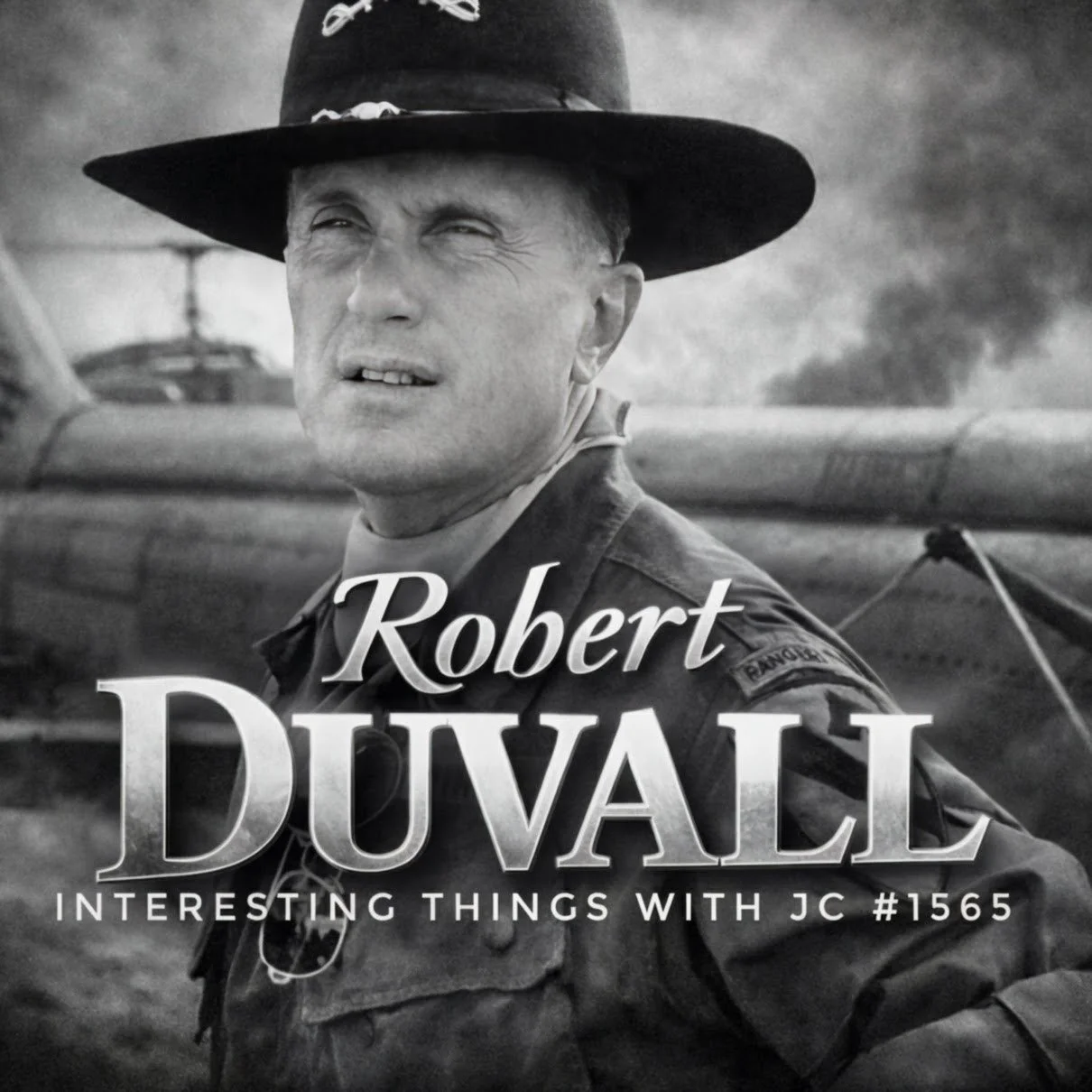
Black-and-white promotional image of actor Robert Duvall wearing a wide-brimmed military-style hat and uniform shirt. He is looking slightly off-camera with a serious expression. A helicopter is visible in the blurred background. Large white text across the center reads “Robert Duvall,” and smaller text at the bottom reads “Interesting Things with JC #1565.”
Transcript
Interesting Things with JC #1565: “Robert Duvall”
Robert Selden Duvall was born January 5, 1931, in San Diego, California, into a U.S. Navy family. His father rose to the rank of rear admiral, and that structured upbringing followed him throughout his life. Family lineage connected him to Confederate General Robert E. Lee, a link that later came full circle when Duvall portrayed Lee on screen. Before acting, he served in the U.S. Army from 1953 to 1954 as a private first class during the post Korean War period, an experience that shaped the realism audiences later saw in his military roles.
After leaving the service, Duvall moved to New York City and studied at the Neighborhood Playhouse under Sanford Meisner. Those early years were difficult. He shared a small apartment with Dustin Hoffman and remained close friends with Gene Hackman, part of a generation of young actors focused on steady work rather than instant recognition. His film debut arrived in 1962 as Boo Radley in “To Kill a Mockingbird.” With almost no dialogue, he built a presence through observation and control.
Through the late 1960s and early 1970s, Duvall became a dependable figure in American cinema. As Tom Hagen in “The Godfather” and “The Godfather Part II,” he portrayed the calm strategist inside a volatile family. In 1979, he delivered one of his most remembered performances as Lieutenant Colonel Kilgore in “Apocalypse Now,” blending discipline, confidence, and dark humor shaped by his own military experience.
In 1983, Duvall won the Academy Award for Best Actor for “Tender Mercies,” portraying Mac Sledge, a country singer seeking redemption. He learned guitar and singing for the role to keep the performance grounded. Throughout the 1980s and 1990s, he appeared in numerous Best Picture nominated films, placing himself within many of the most respected productions of the era.
Away from film sets, Duvall developed a deep connection to Argentine tango and spent long stretches in Buenos Aires (BWAY-nos AIR-eez). That passion led him to write, direct, and star in “Assassination Tango” in 2002, a film blending a crime story with authentic tango culture and real dancers. His marriage to Argentine actress Luciana Pedraza (loo-see-AH-nah peh-DRAH-zah) reflected that part of his life.
Many viewers remember him as Gus McCrae in “Lonesome Dove,” a role he once described as his personal Hamlet. In later years he lived on a ranch near Middleburg and The Plains, Virginia, raising cattle and maintaining a grounded lifestyle away from Hollywood.
Across more than 6 decades and over 90 film and television projects, Robert Duvall earned widespread respect for consistency and discipline. When he passed away peacefully at his Virginia home on February 15, 2026, at age 95, he was survived by his wife, Argentine actress Luciana Pedraza. Tributes focused on the lasting impact of a career built on authenticity and dedication to craft.
From Boo Radley’s performance to Kilgore’s battlefield confidence and the worn humility of Mac Sledge, Robert Duvall left behind a body of work defined by patience, precision, and respect for storytelling.
These are interesting things, with JC.
Student Worksheet
Short-Answer Questions
How did Robert Duvall’s military service influence his later film performances? Provide one example.
Compare Tom Hagen and Lt. Col. Kilgore. What leadership traits distinguish them?
Why is authenticity important in acting? Use evidence from the episode.
How did Duvall’s interest in Argentine tango influence his creative direction later in life?
Identify two personal traits that contributed to Duvall’s long-term success.
Teacher Guide
Estimated Time
• 50–60 minutes
Pre-Teaching Vocabulary Strategy
• Introduce military ranks visually.
• Provide brief explanation of the Meisner technique.
• Preview film stills for contextual grounding.
Anticipated Misconceptions
• Acting success depends solely on talent rather than discipline.
• Military structure and artistic expression are unrelated.
• An actor’s personality and character roles are identical.
Discussion Prompts
• How does lived experience strengthen storytelling?
• What role does discipline play in creative excellence?
• Why might Duvall describe Gus McCrae as his “Hamlet”?
Differentiation Strategies
ESL
• Sentence starters for written responses.
• Vocabulary charts with visuals.
IEP
• Guided notes template.
• Reduced question set with extended time.
Gifted
• Comparative study with another 1970s actor.
• Research and presentation on the Meisner technique.
Extension Activities
• Character analysis of a selected film clip.
• Research historical context of post-Korean War America.
Cross-Curricular Connections
History
• Post–Korean War military culture.
Music
• Country music traditions in Tender Mercies.
Cultural Studies
• Origins and structure of Argentine tango.
Media Literacy
• Career longevity in the American film industry.
Quiz
Q1. Where was Robert Duvall born?
A. New York City
B. San Diego, California
C. Dallas, Texas
D. Richmond, Virginia
Answer: B
Q2. What rank did Duvall hold in the U.S. Army?
A. Captain
B. Rear Admiral
C. Private First Class
D. Sergeant Major
Answer: C
Q3. Which film earned Duvall the Academy Award for Best Actor?
A. Apocalypse Now
B. The Godfather
C. Lonesome Dove
D. Tender Mercies
Answer: D
Q4. Under which acting teacher did Duvall study?
A. Lee Strasberg
B. Sanford Meisner
C. Stella Adler
D. Elia Kazan
Answer: B
Q5. What cultural tradition inspired Assassination Tango?
A. Flamenco
B. Ballet
C. Argentine tango
D. Jazz
Answer: C
Assessment
Open-Ended Questions
Analyze how Robert Duvall’s upbringing and military service shaped his professional identity.
Evaluate the importance of discipline and authenticity in sustaining a six-decade career in film.
3–2–1 Rubric
3 = Accurate, detailed, thoughtful response with clear evidence
2 = Partial explanation with some missing detail
1 = Inaccurate, vague, or unsupported response
Standards Alignment
Common Core State Standards (ELA)
CCSS.ELA-LITERACY.RI.9-10.2
Analyze central ideas and their development in a biographical text.
CCSS.ELA-LITERACY.RI.11-12.3
Evaluate how individuals and events interact over time.
C3 Framework for Social Studies
D2.His.2.9-12
Analyze change and continuity in historical context.
National Core Arts Standards (Theatre)
TH:Re7.1.I
Analyze how cultural perspectives influence performance.
TH:Pr6.1.II
Explore how performance communicates meaning.
ISTE Standards
1.3 Knowledge Constructor
Critically evaluate media and construct knowledge from multiple sources.
International Academic Equivalents
UK National Curriculum (KS4 English)
• Critical analysis of nonfiction texts.
AQA GCSE Drama
• Understanding practitioner influence on acting technique.
IB Diploma Programme – Film
• Analyze film within historical and cultural contexts.
Cambridge IGCSE Literature in English
• Character and thematic analysis in narrative texts.
Show Notes
This episode highlights the disciplined life and enduring career of Robert Duvall, tracing his journey from a structured Navy upbringing and U.S. Army service to an Academy Award-winning career spanning more than six decades. Through roles such as Boo Radley, Tom Hagen, Lt. Col. Kilgore, Mac Sledge, and Gus McCrae, Duvall demonstrated how authenticity, preparation, and lived experience strengthen storytelling. His passion for Argentine tango and grounded ranch life in Virginia further reflect a commitment to discipline and cultural depth. In the classroom, this episode reinforces the connection between biography, historical context, artistic craft, and professional longevity—making it ideal for interdisciplinary study in film, history, and media literacy.
References
Academy of Motion Picture Arts and Sciences. (1984). The 56th Academy Awards (1984) nominees and winners. https://www.oscars.org/oscars/ceremonies/1984
American Film Institute. (n.d.). Robert Duvall biography. https://www.afi.com/laa/robert-duvall/
Encyclopaedia Britannica. (n.d.). Robert Duvall. https://www.britannica.com/biography/Robert-Duvall