Interesting Things with JC #1564: "China's Hypersonic Threat" – For most of American history, oceans meant time. At Mach 10, a thousand miles can disappear in minutes. As hypersonic weapons compress distance into decision, the question is no longer geography....it’s judgment under pressure.
Curriculum - Episode Anchor
Episode Title: China’s Hypersonic Threat
Episode Number: 1564
Host: JC
Audience: Grades 9–12, college intro, homeschool, lifelong learners
Subject Area: Defense Technology, Physics, Modern Military History, Geopolitics
Lesson Overview
This lesson explores how hypersonic missile systems compress strategic timelines and alter geographic assumptions that shaped 20th-century defense planning. Using comparisons between World War II naval operations, Cold War missile routes, and modern hypersonic systems, students analyze how physics, geography, and decision-making intersect in contemporary security environments.
Learning Objectives
Students will be able to:
Define hypersonic speed and explain how Mach numbers relate to the speed of sound.
Compare World War II naval warning timelines with modern hypersonic strike timelines.
Analyze how hypersonic glide vehicles differ from traditional ballistic missile trajectories.
Explain how Arctic geography influences intercontinental missile routes.
Evaluate how reduced warning time affects strategic planning and layered defense systems.
Key Vocabulary
Hypersonic (hī-pər-ˈsä-nik) — Traveling faster than Mach 5; some systems described in the episode approach Mach 10.
Mach Number (mäk) — A measurement comparing an object’s speed to the speed of sound; Mach 10 equals ten times the speed of sound.
Hypersonic Glide Vehicle (ˌhī-pər-ˈsä-nik glīd ˈve-hə-kəl) — A vehicle boosted to high altitude that reenters the atmosphere and maneuvers laterally at extreme speeds.
Ballistic Missile (bə-ˈli-stik) — A missile that follows a largely predictable arc after its powered boost phase.
Plasma Blackout (ˈplaz-mə ˈblak-ˌau̇t) — Disruption of radar or communications caused by ionized air surrounding a high-speed reentry vehicle.
Intercontinental Ballistic Missile (ICBM) — A long-range missile designed to travel between continents, often following polar routes during the Cold War.
Layered Defense — A multi-tiered defensive approach combining detection, tracking, interception, and decision coordination.
Narrative Core
Open
The episode begins with the Battle of Midway, emphasizing how oceans once provided hours of warning and strategic depth.
Info
Introduction of the YJ-21 and its reported hypersonic capabilities.
Overview of DF-17, DF-26, and DF-27 systems and their assessed operational roles.
Details
Explanation of Mach 10 travel times and compressed decision windows.
Description of plasma formation during reentry and radar interference.
Discussion of Arctic missile routes and Cold War polar trajectories.
Reflection
Geography has not changed, but time margins have narrowed.
Strategic planning now centers on speed, detection, and decision cycles.
Closing
These are interesting things, with JC.
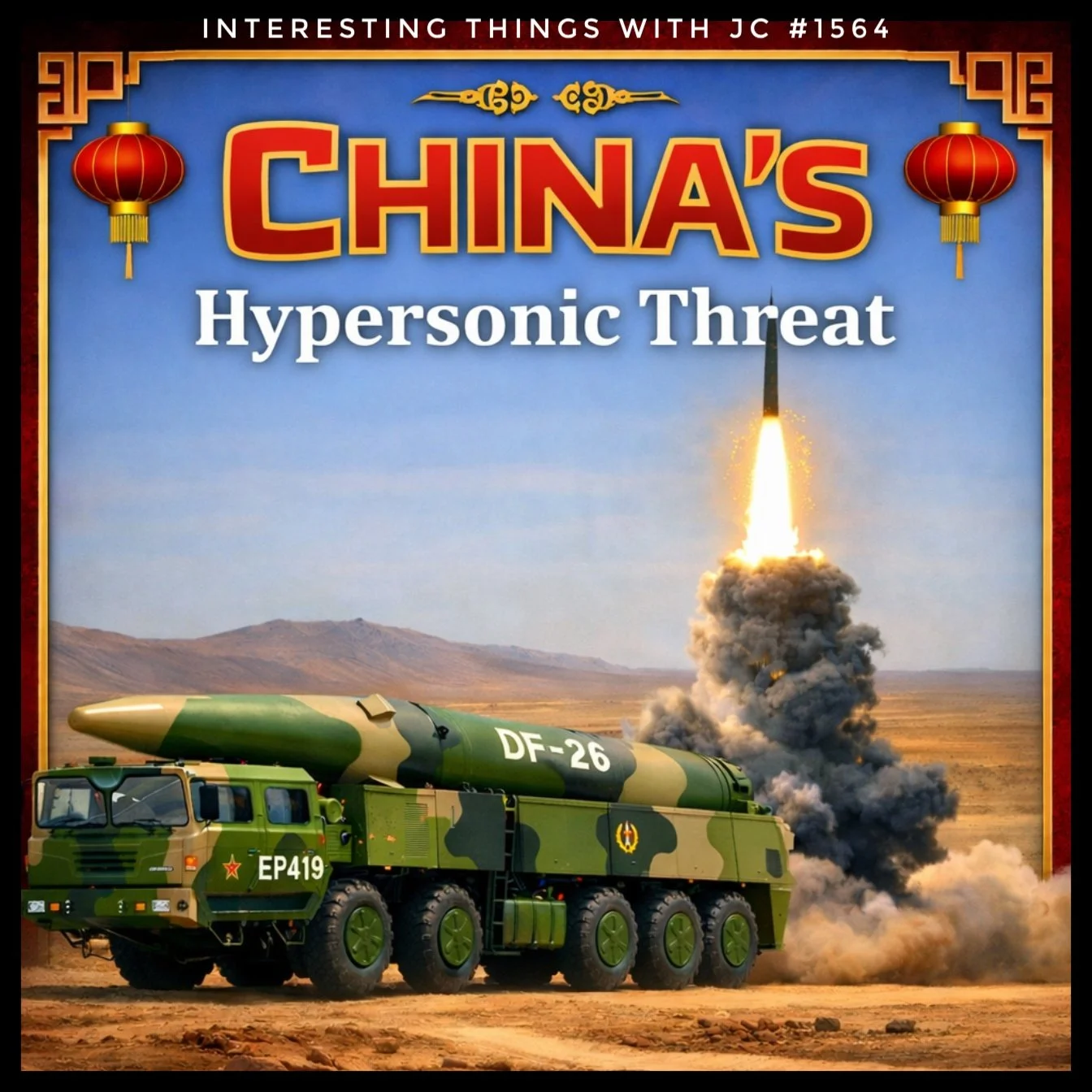
Promotional graphic for “Interesting Things with JC #1564” titled “China’s Hypersonic Threat.” The image shows a large green DF-26 missile mounted on a military transport truck in a desert landscape. In the background, a missile launches vertically into the sky with bright flames and a thick plume of smoke rising behind it. The top of the image features bold red and gold lettering with decorative lantern graphics.
Transcript
Interesting Things with JC #1564: “China's Hypersonic Threat”
For most of American history, the ocean meant time.
In June 1942, during the Battle of Midway, American carriers moved across the Pacific at about 30 knots, roughly 35 miles per hour. Aircraft launched into open sky and searched for ships across an ocean that spans 63 million square miles, about 165 million square kilometers. Commanders measured danger in hours. Distance gave warning.
Today, distance can shrink to minutes.
In 2022, Chinese state media released footage of a missile known as the YJ 21, also called Yíngjī 21. Western assessments classify it as a hypersonic anti ship ballistic missile. The 2025 China Military Power Report places its range well beyond 1,000 kilometers, with extended reach when launched from aircraft like the H-6N bomber or from modern surface warships.
Chinese sources describe speeds approaching Mach 10. At that velocity, 1,000 miles can be covered in under eight minutes.
As a hypersonic vehicle reenters the atmosphere, friction can drive temperatures above 2,000 degrees Celsius, about 3,600 degrees Fahrenheit. The air ionizes, forming a plasma layer that can interfere with radar tracking during the final seconds of flight. That blackout effect was first observed in missile testing during the 1950s. Today, it reduces the defender’s margin at precisely the moment accuracy matters most.
Other systems expand the picture. The DF 17, Dōngfēng 17, carries a hypersonic glide vehicle that descends into the upper atmosphere and maneuvers laterally at extreme speed. The DF 26, Dōngfēng 26, entered service around 2016 and is assessed in significant numbers. More recent reporting identifies the longer range DF 27 as fielded, extending potential anti ship reach even farther.
When Americans think about distance, they often picture crossing the Pacific. But geography works both ways.
From northern latitudes, the shortest path between continents arcs over the Arctic. During the Cold War, intercontinental ballistic missiles were designed to follow that polar route, not a straight line across the ocean. Today, strategic alignment and growing cooperation between China and Russia have renewed attention on northern approaches. Hypersonic systems launched from high latitudes would travel the same curved Earth pathways that Cold War planners studied for decades.
The map looks different when viewed from above the pole.
What ties all of this together is time.
A carrier group at sea might move 15 miles in fifteen minutes. A hypersonic missile can cross thousands of kilometers in that same span. Inside a combat information center, radar operators monitor symbols that represent real threats. Each one demands classification, coordination, and decision.
The ocean is still wide. Alaska is still cold. Guam has not moved. Ships still maneuver. Sailors still stand watch.
But the decision space is tighter than it once was.
The United States is responding with improved space based tracking, new interceptors, and continued refinement of layered defenses. The goal is simple. See earlier. Decide faster. Preserve margin.
At Mach 10, time itself becomes contested.
Preparation, training, and steady judgment remain the constants.
These are interesting things, with JC.
Student Worksheet
Explain how hypersonic speed changes strategic warning time compared to World War II naval operations.
Describe how plasma formation during reentry interferes with radar systems.
Compare ballistic missile trajectories with hypersonic glide vehicle flight paths.
Why are Arctic routes strategically significant in missile planning?
Creative Prompt: Write a brief paragraph explaining why “time becomes contested” in hypersonic warfare.
Teacher Guide
Estimated Time
50–60 minutes
Pre-Teaching Vocabulary Strategy
Review atmospheric layers and speed of sound concepts.
Use globe demonstrations to illustrate polar great-circle routes.
Anticipated Misconceptions
Hypersonic systems travel in straight lines across maps.
Faster always means impossible to intercept.
Geography has become irrelevant.
Discussion Prompts
How does viewing the world from above the North Pole change strategic thinking?
Why is time as important as distance in military planning?
How does physics shape geopolitics?
Differentiation Strategies
ESL: Provide labeled diagrams of glide vs. ballistic paths.
IEP: Offer structured comparison charts.
Gifted: Assign research on Cold War early warning radar systems.
Extension Activities
Calculate great-circle distances using polar projections.
Compare Cold War ICBM routes with modern hypersonic pathways.
Analyze the physics of atmospheric ionization.
Cross-Curricular Connections
Physics — Thermodynamics and kinetic energy.
Geography — Polar projection mapping.
History — Cold War missile strategy.
Engineering — Materials capable of withstanding 2,000°C temperatures.
Quiz
Q1. Hypersonic speed is defined as:
A. Faster than Mach 1
B. Faster than Mach 3
C. Faster than Mach 5
D. Faster than Mach 20
Answer: C
Q2. Plasma blackout is caused by:
A. Fuel exhaustion
B. Ionized air around the vehicle
C. Radar shutdown
D. Electronic malfunction
Answer: B
Q3. Cold War ICBMs typically followed which route?
A. Across the Pacific directly
B. Across the Atlantic
C. Over polar regions
D. Along the equator
Answer: C
Q4. A carrier group moving at 30 knots travels approximately how far in 15 minutes?
A. 150 miles
B. 60 miles
C. 15 miles
D. 300 miles
Answer: C
Q5. The central theme of the episode is:
A. Naval shipbuilding
B. Arctic climate
C. Compressed decision timelines
D. Aircraft range
Answer: C
Assessment
Open-Ended Questions
Analyze how Arctic geography influences modern missile strategy.
Evaluate how compressed timelines affect defense planning and command decisions.
3–2–1 Rubric
3 = Accurate, complete, thoughtful explanation with supporting detail
2 = Partial explanation with limited detail
1 = Inaccurate or vague response
Standards Alignment
NGSS HS-PS2-1
Analyze motion using Newton’s laws in relation to high-speed propulsion systems.
NGSS HS-ESS2-2
Analyze Earth systems, including atmospheric interaction during reentry.
CCSS.ELA-LITERACY.RST.11-12.2
Determine central ideas of complex scientific and technical texts.
CCSS.ELA-LITERACY.WHST.11-12.1
Write evidence-based arguments in discipline-specific contexts.
C3 Framework D2.Geo.4.9-12
Analyze how geographic factors influence political and strategic power.
ISTE 1.3 Knowledge Constructor
Evaluate credibility of technological and defense-related sources.
International Equivalents
UK National Curriculum KS4 Physics — Forces, motion, and energy transfer.
AQA A-Level Physics — Mechanics and thermal physics.
IB Diploma Programme Physics — Motion and energy transfer in atmospheric systems.
Cambridge IGCSE Physics (0625) — Forces and thermal properties of matter.
Show Notes
In this episode, JC explores how hypersonic missile technology compresses strategic timelines and reshapes long-standing assumptions about distance and warning. From the Battle of Midway to Cold War polar missile routes and modern hypersonic glide vehicles, the episode connects physics, geography, and strategic planning. Students examine Mach speed, atmospheric reentry heating, plasma blackout effects, and Arctic great-circle routes to understand how time has become a defining variable in contemporary defense strategy. This interdisciplinary topic bridges physics, history, geography, and engineering, offering rich opportunities for classroom exploration.
References
U.S. Department of Defense. (2025, December 23). Annual report to Congress: Military and security developments involving the People's Republic of China 2025. https://media.defense.gov/2025/Dec/23/2003849070/-1/-1/1/ANNUAL-REPORT-TO-CONGRESS-MILITARY-AND-SECURITY-DEVELOPMENTS-INVOLVING-THE-PEOPLES-REPUBLIC-OF-CHINA-2025.PDF
U.S. Department of Defense. (2024, December 18). Military and security developments involving the People's Republic of China 2024. https://media.defense.gov/2024/Dec/18/2003615520/-1/-1/0/MILITARY-AND-SECURITY-DEVELOPMENTS-INVOLVING-THE-PEOPLES-REPUBLIC-OF-CHINA-2024.PDF
Federation of American Scientists. (2025, September 4). Nuclear weapons at China's 2025 Victory Day parade. https://fas.org/publication/nuclear-weapons-at-chinas-2025-victory-day-parade
The Diplomat. (2024, November 5). Japan awards MHI $368 million contract for development of the Glide Phase Interceptor. https://thediplomat.com/2024/11/japan-awards-mhi-368-million-contract-for-development-of-the-glide-phase-interceptor