Interesting Things with JC #1570: "Snake Oil: Why Smart People Still Buy It" – A bottle. A bold promise. A line of believers. Snake oil was never just a scam. It was a lesson in how fast the brain trades doubt for hope.
Curriculum - Episode Anchor
Episode Title: Snake Oil: Why Smart People Still Buy It
Episode Number: #1570
Host: JC
Audience: Grades 9–12, college intro, homeschool, lifelong learners
Subject Area:
Media literacy, psychology, U.S. history, consumer science, neuroscience (intro)
Lesson Overview
Learning Objectives:
Define key persuasion concepts (authority bias, scarcity, social proof, placebo effect) and use them accurately in context.
Compare 1800s “snake oil” marketing tactics with modern equivalents (wellness claims, hype-driven investing, online influence).
Analyze how expectation can change pain perception and belief, using evidence from placebo research (endorphins/opioids; dopamine pathways).
Explain why intelligent people can still be misled by confident messaging and emotional decision-making, and propose a simple evaluation checklist.
Key Vocabulary
Snake oil (snayk oyl) — A product marketed as a cure-all, often fraudulent; “The salesman claimed the bottle was ‘snake oil’ that could fix any pain.”
Patent medicine (PAT-ent MED-uh-sin) — A widely sold remedy, often unproven, especially common in the 19th–early 20th century; “Patent medicines were promoted with bold claims and few ingredients listed.”
Authority bias (uh-THOR-ih-tee BY-iss) — The tendency to trust a claim more when it comes from a confident or “expert” source; “The pitch worked because authority bias lowered skepticism.”
Scarcity pressure (SKAIR-sih-tee PRESH-er) — A sales tactic that suggests limited supply or time to force quick decisions; “Limited stock made people buy before thinking.”
Social proof (SOH-shul proof) — Assuming something is true or valuable because many others believe or do it; “Seeing a crowd made the cure seem legit.”
Placebo effect (pluh-SEE-boh ih-FEKT) — Symptom improvement driven by expectation and context, even if the treatment is inactive; “Belief triggered real changes in how pain was felt.”
Dopamine (DOH-puh-meen) — A brain chemical involved in motivation, learning, and reward; “Expectation can influence dopamine activity in measurable ways.”
Narrative Core
Open:
Traveling salesmen in the American West sell “miracle cures” from wagons; the bottle looks real and the pitch feels certain.
Info:
Real snake oil had a historical basis: Chinese water-snake oil was associated with high omega-3 content and was used for aches, which helped the idea sound credible when it spread.
Details:
In the U.S., famous “snake oil” products often contained no snake oil. Investigations into Clark Stanley’s “snake oil” found a mixture largely including mineral oil plus other ingredients (like beef fat and irritants such as turpentine/capsicum), illustrating how packaging and persuasion can replace truth.
Reflection:
Belief often starts emotionally: urgency, certainty, and crowds short-circuit scrutiny. Placebo research shows expectation can activate measurable biology tied to pain relief (endogenous opioid activity) and, in some conditions, dopamine release linked to anticipated benefit.
Closing:
These are interesting things, with JC.
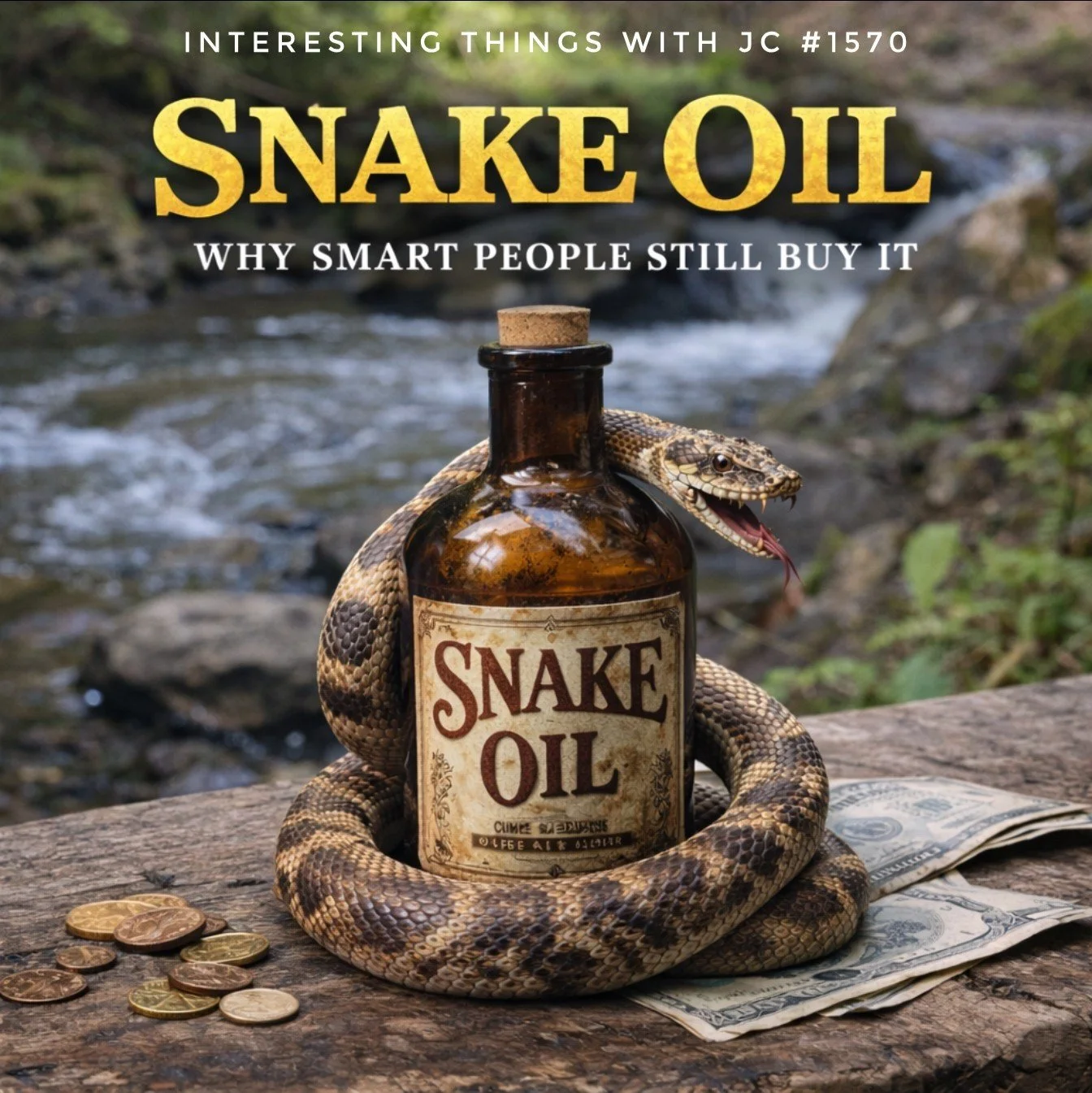
Podcast cover image reading “Interesting Things with JC #1570 – Snake Oil: Why Smart People Still Buy It,” featuring a vintage bottle labeled “Snake Oil” wrapped by a snake, with coins and cash on a wooden surface beside a flowing stream in the background.
Transcript
Interesting Things with JC #1570: "Snake Oil: Why Smart People Still Buy It"
In the late 1800s, traveling salesmen crossed the American West selling miracle cures from the back of wagons. Chinese railroad workers shared real snake oil from water snakes, rich in omega 3s for genuine relief, until American salesmen swapped it for cheap substitutes made from mineral oil and alcohol. The bottle looked convincing. The pitch sounded certain. And people lined up.
The interesting part is not just the fraud. It is the psychology behind belief.
Human brains are wired to look for fast solutions when life feels uncertain. A confident pitch, “limited stock,” and “everyone’s buying it” can short circuit scrutiny in seconds. Authority bias, scarcity pressure, and social proof work together because the brain wants resolution more than complexity.
Even smart people are vulnerable because belief is emotional before it becomes logical. When expectation kicks in, the brain releases endorphins that ease pain and dopamine that creates the feeling that something is working, even if the bottle holds little more than hope. That reaction has been measured in clinical studies and helps explain why early buyers swore the cures worked.
The pattern never disappeared. Think crypto pumps promising financial freedom overnight, or wellness gurus selling 200 dollar supplements as life changers. Same playbook, new packaging.
The real lesson is not cynicism. It is awareness. When a claim feels urgent, simple, and certain, that is the moment to slow down and ask harder questions. Real solutions usually arrive with data, patience, and a little less hype.
Snake oil did not vanish. It just learned how to speak modern language.
These are interesting things, with JC.
Student Worksheet
In your own words, explain how scarcity pressure and social proof can change someone’s decision-making in under a minute.
Identify two details in the episode that made “snake oil” sound believable to buyers. Why did those details matter?
Create a 5-question “Slow Down Checklist” you would use before buying a product that promises quick results.
Modern parallel: Pick one example (a wellness claim, a social media product, or a hype investment). List the “same playbook” elements you notice (certainty, urgency, authority, crowd effects).
Short reflection: Why might a placebo effect feel like “proof” even when the product does not contain what it claims?
Teacher Guide
Estimated Time
45–60 minutes (or two 30-minute sessions)
Pre-Teaching Vocabulary Strategy
Quick-sort: students place terms into two columns: “Persuasion tactics” vs. “Brain/biology.”
Then pair-share: each student uses one word in a sentence tied to a real-life ad or trend.
Anticipated Misconceptions
“Only gullible people get scammed.” (Correct: smart people can be influenced by universal cognitive shortcuts and emotional context.)
“Placebo means fake, so nothing changes.” (Correct: placebo responses can involve measurable changes in pain processing and neurotransmitter systems.)
“If someone felt better, the cure must have worked chemically.” (Correct: symptom relief can be real even if the cause is expectation and context.)
Discussion Prompts
What language patterns signal “urgent, simple, certain” claims? Give examples.
Why do crowds and testimonials feel like evidence? What’s missing?
How would you redesign a product ad to be honest and still persuasive?
Differentiation Strategies: ESL, IEP, gifted
ESL: provide sentence frames (“This claim uses scarcity because…”) and a word bank with icons.
IEP: reduce writing load, offer multiple-choice for identifying tactics, then one short paragraph for reflection.
Gifted: add an evidence task—students locate one credible scientific or historical source and explain how it supports or complicates the episode’s claims (with proper citation).
Extension Activities
“Ad Lab”: students design two ads for the same product, one ethical (data, limits, transparent claims) and one unethical (hype tactics). Class votes and explains why.
Mini research: investigate a historical patent medicine label and identify what information is missing (ingredients, dosage, evidence).
Cross-Curricular Connections
History: consumer protection and early regulation of medical claims (context for why fraudulent cures became a public issue).
Biology/Health: pain pathways, expectation, and the endogenous opioid system.
Math/Stats: correlation vs. causation; why testimonials are weak evidence compared to controlled studies.
ELA: rhetoric, tone, and claims/evidence analysis in persuasive texts.
Quiz
Q1. Which tactic relies on “Everyone is buying it”?
A. Scarcity pressure
B. Social proof
C. Confirmation bias
D. Random chance
Answer: B
Q2. Which best explains why “smart people” can still buy questionable cures?
A. Intelligence eliminates emotion
B. Belief forms emotionally before it becomes logical
C. Facts always beat confidence
D. Only uneducated people are targeted
Answer: B
Q3. In historical U.S. “snake oil” cases, what was often true about the product’s contents?
A. It always contained high omega-3 snake extract
B. It was mainly a mixture like mineral oil with other additives, not real snake oil
C. It was regulated and clinically tested
D. It was identical to traditional Chinese formulations
Answer: B
Q4. Placebo analgesia has been linked to activation of which system?
A. Endogenous opioid (endorphin) system
B. Skeletal system
C. Digestive enzymes
D. Visual cortex only
Answer: A
Q5. Which “red flag” combination should make a buyer slow down?
A. Careful language, data, and limitations
B. Urgent, simple, certain claims
C. Transparent pricing and refunds
D. Peer-reviewed citations
Answer: B
Assessment
Explain how authority bias, scarcity pressure, and social proof can combine to reduce scrutiny. Use one historical example from the episode and one modern example.
Describe how expectation can change a person’s experience of pain or improvement, and why that can feel like “proof” to the buyer. Include at least one scientific detail.
3–2–1 Rubric (for each question)
3 = Accurate, complete, thoughtful (uses correct terms, clear examples, and a correct explanation of placebo-related biology)
2 = Partial or missing detail (some correct terms/examples, but unclear reasoning or limited evidence)
1 = Inaccurate or vague (misuses terms, weak/no examples, or incorrect claims about how placebo works)
Standards Alignment
Common Core State Standards (CCSS) – ELA (Grades 9–12)
CCSS.ELA-LITERACY.RI.9-10.8 — Evaluate an author’s argument and specific claims; students assess persuasive “miracle cure” language vs. evidence.
CCSS.ELA-LITERACY.RI.11-12.7 — Integrate and evaluate multiple sources; students compare historical reporting and scientific placebo findings.
CCSS.ELA-LITERACY.SL.11-12.1 — Collaborative discussions; students debate ethical persuasion vs. manipulation using examples.
C3 Framework (College, Career, Civic Life)
D2.His.4.9-12 — Analyze complex historical causes and effects; students connect consumer culture, medicine marketing, and regulation context.
D2.Eco.2.9-12 — Analyze incentives; students identify why hype sells and how markets reward attention.
D2.Civ.4.9-12 — Explain how rules and institutions address public problems; students discuss why fraud prevention matters in consumer protection.
NGSS (High School)
HS-LS1-2 — Develop/Use models of systems; students model how brain expectation and signaling can influence perceived symptoms (intro-level, concept-focused).
HS-ETS1-3 — Evaluate solutions to a problem; students create and defend a “buyer’s checklist” as a tool to reduce risk from misleading claims.
ISTE Standards (Students)
ISTE 3a (Knowledge Constructor) — Students evaluate credibility and bias in sources about health claims and hype trends.
ISTE 2b (Digital Citizen) — Students practice safe, responsible decision-making when encountering persuasive online content.
International Equivalents (content-based, non-ideological)
England: National Curriculum (Key Stage 4) – Science: “Scientific attitudes” and evidence — Emphasis on evaluating claims with evidence; aligns to analyzing placebo research and product claims.
England: GCSE English Language – Critical reading — Identify viewpoints and evaluate how writers use language to influence audiences; aligns to “urgent, simple, certain” persuasion analysis.
IB DP Psychology (Core: Research methods; Ethics; Biological approach, where applicable) — Evaluating studies on expectation/placebo mechanisms and interpreting findings responsibly.
Show Notes
This episode traces how “snake oil” became a symbol of fraud by pairing a vivid historical scene, wagon-era cure sellers, with the psychology of belief that still shapes modern decisions. Students explore how persuasion shortcuts (authority, scarcity, social proof) can override careful thinking, especially in uncertain moments, and why even intelligent people are susceptible. The lesson then connects belief to biology through placebo research showing that expectation can produce measurable changes in pain processing and, in some conditions, dopamine signaling tied to anticipated benefit—helping explain why people may sincerely report improvement. The classroom relevance is immediate: from wellness marketing to hype-driven financial promises, the same tactics reappear in updated packaging, and the practical takeaway is learning to slow down, demand evidence, and recognize “urgent, simple, certain” claims as a cue to think harder.
References
Smithsonian Magazine. (2024, October 21). How snake oil became a symbol of fraud and deception. https://www.smithsonianmag.com/innovation/how-snake-oil-became-a-symbol-of-fraud-and-deception-180985300/
Scientific American. (2007, November 1). Snake-oil salesmen were on to something. https://www.scientificamerican.com/article/snake-oil-salesmen-knew-something/
Levine, J. D., Gordon, N. C., & Fields, H. L. (1978). The mechanism of placebo analgesia. The Lancet. https://pubmed.ncbi.nlm.nih.gov/80579/
Zubieta, J.-K., Bueller, J. A., Jackson, L. R., Scott, D. J., Xu, Y., Koeppe, R. A., Nichols, T. E., & Stohler, C. S. (2005). Placebo effects mediated by endogenous opioid activity on μ-opioid receptors. Journal of Neuroscience. https://pmc.ncbi.nlm.nih.gov/articles/PMC6725254/
de la Fuente-Fernández, R., Ruth, T. J., Sossi, V., Schulzer, M., Calne, D. B., & Stoessl, A. J. (2001). Mechanism of the placebo effect in Parkinson’s disease. Science. https://pubmed.ncbi.nlm.nih.gov/11498597/
Lidstone, S. C., Schulzer, M., Dinelle, K., Mak, E., Sossi, V., Ruth, T. J., de la Fuente-Fernández, R., & Stoessl, A. J. (2010). Effects of expectation on placebo-induced dopamine release in Parkinson disease. JAMA Psychiatry. https://jamanetwork.com/journals/jamapsychiatry/fullarticle/210854
WUNC. (2013, August 26). A history of “snake oil salesmen.” https://www.wunc.org/2013-08-26/a-history-of-snake-oil-salesmen