Interesting Things with JC #1571: "What Loss Leaves Behind" – Loss doesn’t happen once. It comes back on birthdays, holidays, and random afternoons when you still reach for the phone. Over time, you realize it didn’t just take something. It changed you.
Curriculum - Episode Anchor
Episode Title: What Loss Leaves Behind
Episode Number: #1571
Host: JC
Audience: Grades 9–12, introductory college, homeschool, lifelong learners
Subject Area:
Health Education (Grief & Coping), Psychology (Human Development), ELA (Narrative & Reflective Writing)
Lesson Overview
By the end of this lesson, learners will be able to:
Define layered grief and describe how it can reappear over time in predictable “life-moment” triggers.
Analyze how the episode uses concrete details and reflection to communicate emotional experiences.
Explain how personal values and identity can be shaped over time after loss (post-loss growth and meaning-making).
Compare short-term and long-term responses to loss, including healthy coping and common challenges.
Key Vocabulary
Grief (greef) — The set of emotional, cognitive, and physical responses to loss; in the episode, grief returns “in layers” over time.
Trigger (TRIG-er) — A reminder that brings feelings back strongly; the episode names birthdays, holidays, and unexpected moments as triggers.
Bereavement (buh-REEV-ment) — The period after a loss when people adapt to life without someone; the episode emphasizes how time continues while feelings shift.
Meaning-making (MEE-ning MAY-king) — Creating an understanding of how an experience changed you; the episode frames the “real story” as who you become.
Perspective (per-SPEK-tiv) — A way of seeing events over time; the episode highlights gradual changes in pride, time assumptions, and relationships.
Resilience (ri-ZIL-yens) — The ability to keep functioning and recover amid stress; the episode points to “standing steady when it matters.”
Narrative Core
Open:
Loss is introduced as something that doesn’t strike once—it returns in layers.
Info:
The immediate aftermath: quiet rooms, an empty chair, life feeling “off” despite nothing physically moving.
Details:
The “later weight” appears on milestones and random moments; grief can harden someone or keep them “dug in” for years.
Reflection:
Over time, loss can sharpen awareness: pride, assumptions about time, and how small conflicts can become lasting distance.
The legacy theme: you carry forward what the person put in you—how you lead, love, and show up.
Closing:
These are interesting things, with JC.
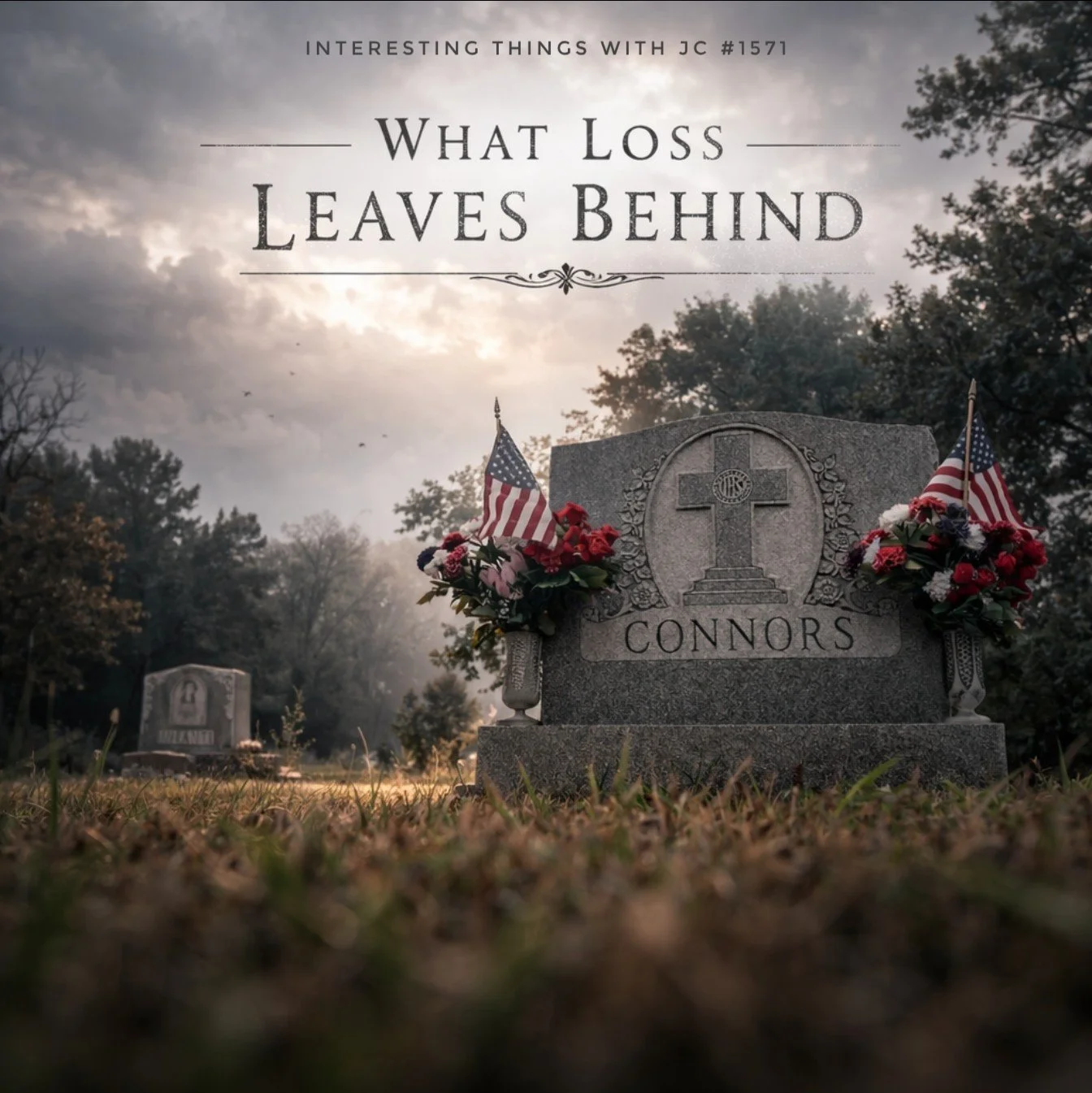
Podcast cover art for “Interesting Things with JC #1571: What Loss Leaves Behind,” showing a cemetery at dawn with a “CONNORS” headstone, flowers, and small American flags under a cloudy sky.
Transcript
Interesting Things with JC #1571: "What Loss Leaves Behind"
Loss does not hit you once. It hits you in layers.
The first layer is the day it happens. The stillness in the house. The empty chair. The way everything feels off even though nothing in the room actually moved. It feels final. Like a door shut and you did not get a say in it.
The real weight shows up later. On birthdays. On holidays. On some random afternoon when something big happens and your first thought is still to reach for the phone.
Then it hits you again.
Time keeps going. Years turn into decades. At first, grief feels heavy. It can change your edges. It can harden you in places. It can make you dig in and stay there longer than you expected.
For some people, that digging in lasts years. For some, it never fully goes away.
Still, over time, your perspective begins to shift, often so gradually you barely notice it.
You become more aware of how easy it is to let pride take over. How simple it is to assume there will always be more time. How quickly small things can grow into permanent distance.
Loss does not make you perfect. It does not automatically soften you.
But it can make you more aware.
You begin to see what stuck. The lessons you carry without thinking. The standards you live by. The way you handle pressure. The way you keep your word. The way you stand steady when it matters.
At some point, you realize loss did not just take something. It worked on you.
You do not freeze someone in the moment you lost them. You carry forward what they put in you. In how you lead. In how you love. In how you show up.
The day itself is no longer the center of the story.
The real story is who you became because of it.
These are interesting things, with JC.
Student Worksheet
In your own words, explain what JC means by “loss hits you in layers.” Give two examples from the episode.
Identify three “later” moments JC lists that can bring grief back. Why might these moments feel intense?
The episode says grief can “harden you” or make you “dig in.” What could those phrases mean in real life?
Write a short reflection (8–12 sentences): How can loss change the way someone handles pride, time, or relationships? Use at least two vocabulary words.
Creative option: Write a letter to your future self about one value you want to carry forward from someone who influenced you (real or fictional).
Teacher Guide
Estimated Time
45–60 minutes (or two 30-minute sessions)
Pre-Teaching Vocabulary Strategy
Quick sort: Students match vocabulary terms to example phrases from the transcript (teacher provides 6–8 excerpt cards).
Add a “feelings-to-words” mini-lesson: students choose one term (trigger, meaning-making, resilience) and paraphrase it in everyday language.
Anticipated Misconceptions
Misconception: Grief follows a fixed schedule or “ends” after a certain time.
Reframe: The episode highlights recurring waves and long-term adaptation.
Misconception: If grief returns, it means someone is “not coping well.”
Reframe: Triggers and anniversaries are common and can be part of normal adjustment.
Misconception: Loss automatically makes people kinder or wiser.
Reframe: The episode explicitly says it doesn’t make you perfect or automatically soften you.
Discussion Prompts
What does the “empty chair” symbolize beyond the literal object?
Why might pride and “assuming there will always be more time” become more visible after loss?
What does it mean to “carry forward what they put in you”? Can this apply to mentors and communities too?
Differentiation Strategies: ESL, IEP, gifted
ESL: Provide sentence frames (e.g., “A trigger is…,” “One way perspective shifts is…”). Allow oral responses or bilingual brainstorming.
IEP: Offer a graphic organizer with two columns: “Immediate layer” vs. “Later layers.” Provide chunked reading of the transcript.
Gifted: Extend into a craft analysis, identify repetition, imagery, and pacing; write a short response mimicking the episode’s style with a different theme.
Extension Activities
Personal narrative writing workshop: students draft a reflective essay on a turning point that changed their values (loss can be optional; allow any significant change).
Media literacy: compare how a poem, a song, and this monologue treat grief (focus on techniques, not personal disclosure).
Health connection: research coping supports (sleep, routines, social support, counseling) and create a “support menu” poster for students.
Cross-Curricular Connections: (e.g., physics, sociology, ethics)
Psychology: identity development, coping, and meaning-making over time.
ELA: imagery, repetition, tone, and reflective monologue structure.
Sociology: how cultural rituals (holidays, anniversaries) shape remembrance and community support.
Quiz
Q1. What does JC say about how loss arrives?
A. It happens once and then fades
B. It hits in layers over time
C. It only affects emotions, not behavior
D. It always makes people softer
Answer: B
Q2. Which examples does the episode give of grief returning later?
A. Work promotions only
B. Birthdays, holidays, random afternoons
C. Only the day of the funeral
D. Only when someone moves away
Answer: B
Q3. According to the episode, grief can sometimes do what to a person?
A. Make them perfect
B. Automatically solve conflicts
C. Harden them or keep them “dug in”
D. Remove all memories
Answer: C
Q4. What shift does JC describe happening gradually over time?
A. Forgetting the person completely
B. Perspective changing and awareness increasing
C. Avoiding all reminders forever
D. Becoming the same person as before
Answer: B
Q5. What is “the real story” by the end of the episode?
A. The exact day of the loss
B. The place where it happened
C. Who you became because of it
D. A list of holidays
Answer: C
Assessment
Explain how the episode describes short-term versus long-term experiences of grief, using at least two specific details from the transcript.
Analyze the claim “loss did not just take something; it worked on you.” What does this mean, and what evidence from the episode supports it?
3–2–1 Rubric
3 = Accurate, complete, thoughtful (uses specific transcript details; explains ideas clearly; connects evidence to claim)
2 = Partial or missing detail (some accurate points but limited evidence or unclear explanation)
1 = Inaccurate or vague (minimal understanding; little/no evidence; off-topic)
Standards Alignment
CCSS.ELA-LITERACY.RI.9-10.2 — Determine central ideas and analyze their development; students identify the episode’s central claim about layered grief and how it unfolds.
CCSS.ELA-LITERACY.RI.9-10.4 — Determine meaning of words and phrases, including figurative language; students interpret imagery like “empty chair,” “layers,” and “worked on you.”
CCSS.ELA-LITERACY.W.9-10.2 — Write informative/explanatory texts; students explain layered grief and meaning-making with organized reasoning and evidence.
CCSS.ELA-LITERACY.W.9-10.9 — Draw evidence from texts to support analysis; students cite transcript details in written responses.
ISTE 3 (Knowledge Constructor) — Students curate and evaluate resources (optional extension on coping supports) and synthesize findings into a product.
International equivalents (content-based, non-ideological):
UK National Curriculum (KS4) English: Reading comprehension and analysis — Analyze how writers use language and structure to shape meaning; aligns with imagery/repetition analysis in the monologue.
Cambridge IGCSE First Language English: Reading and Writer’s Effects — Explain how language achieves effects; aligns with evaluating tone, pacing, and figurative meaning.
IB DP Language A: Language and Literature (Analysis) — Analyze how choices of style and structure create meaning; aligns with transcript-based textual analysis and reflective writing.
Show Notes
This episode presents grief as a layered experience: the first shock of absence, and the later waves that return during milestones and unexpected moments. It explores how time moves forward while loss continues to reshape perspective, highlighting pride, assumptions about “more time,” and how small conflicts can become permanent distance. For classrooms, the piece offers a respectful entry point to discuss coping, identity development, and reflective writing craft without requiring personal disclosure. Students can analyze imagery and structure while also building health literacy around normal grief reactions and meaning-making.
References
American Psychological Association. (n.d.). Grief. APA Dictionary of Psychology. https://dictionary.apa.org/grief
American Psychological Association. (n.d.). Bereavement. APA Dictionary of Psychology. https://dictionary.apa.org/bereavement
National Institute of Mental Health. (n.d.). Coping with traumatic events. https://www.nimh.nih.gov/health/topics/coping-with-traumatic-events