1574: "Milli Vanilli and the Sound of Silence"
Interesting Things with JC #1574: "Milli Vanilli and the Sound of Silence" – Three No. 1 hits. A Grammy. Millions of fans. Then one skipped track blew it all up. When the truth came out, music had to face a brutal question: who are you really listening to?
Curriculum - Episode Anchor
Episode Title: Milli Vanilli and the Sound of Silence
Episode Number: 1574
Host: JC
Audience: Grades 9–12, college intro, homeschool, lifelong learners
Subject Area: Media literacy, Music history, Consumer awareness (law/ethics), Communications (credibility and trust)
Lesson Overview
Learning Objectives:
Define lip-syncing, producer-driven projects, and consumer fraud in the context of recorded music.
Compare stage performance roles versus studio production roles using Milli Vanilli and “The Real Milli Vanilli.”
Analyze how evidence (live malfunction, admissions, lawsuits) changed public perception and institutional response (Grammy revocation).
Explain how trust functions in media markets and why audiences react strongly when authenticity expectations are violated.
Key Vocabulary
Lip-sync (LIP singk) — Performing while miming to prerecorded vocals; context: The scandal centered on audiences believing the onstage performers were the recorded singers.
Session vocalist (SEH-shun VOH-kuh-list) — A professional singer hired to record vocals for a project; context: Studio singers recorded the lead tracks while others fronted the act publicly.
Producer-driven project (pruh-DOO-ser DRIH-vən PRAH-jekt) — A music act shaped primarily by a producer’s concept and assembly of talent; context: Frank Farian built the project structure and presentation.
Consumer fraud (kuhn-SOO-mer frawd) — Deceptive business practice that can mislead buyers; context: Lawsuits and a refund program followed the revelation.
Credibility (KREH-duh-BIH-luh-tee) — The quality of being trusted or believed; context: The episode focuses on how credibility is earned, lost, and sometimes rebuilt.
Class-action settlement (KLAS AK-shun SET-uhl-mənt) — A legal agreement resolving many similar claims at once; context: Refunds were approved for eligible buyers.
Narrative Core
Open – How the story hooks the listener.
Two young men win Best New Artist at the 1990 Grammys—peak fame, flashing lights, a cultural moment.
Info – Background or supporting context.
Rapid rise: hit album, heavy MTV rotation, chart success; producer-built pop machine and image-first marketing.
Details – The twist, turning point, or key facts.
The voices on the records were not the public performers.
A live backing-track glitch at Lake Compounce becomes a visible crack in the illusion.
Producer admission and Grammy revocation follow; legal fallout leads to refunds.
Reflection – Broader meaning or emotional resonance.
Trust is human, not technical: audiences connect the face to the voice. When that bond breaks, reputations collapse—and consequences can be lasting.
Closing – Always close with:
These are interesting things, with JC.
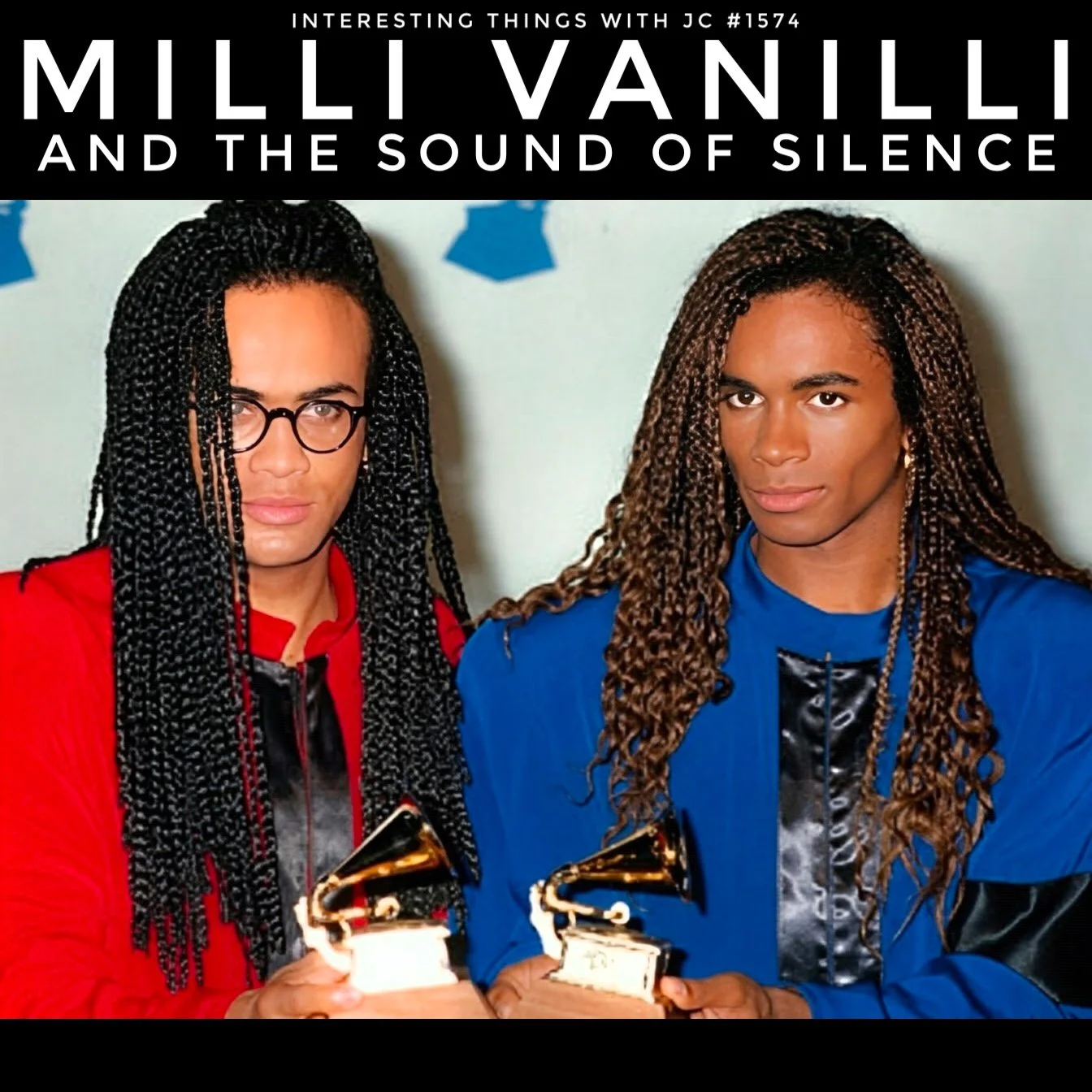
Square podcast cover for “Interesting Things with JC #1574: Milli Vanilli and the Sound of Silence.” Two men with long braided hair pose side-by-side, one in red and one in blue, each holding a gold Gramophone-style music trophy, with the episode title in large white text across the top.
Transcript
Interesting Things with JC #1574: “Milli Vanilli and the Sound of Silence”
In February of 1990, two young men stood beneath the lights at the 32nd Annual Grammy Awards in Los Angeles, California. When the envelope was opened for Best New Artist, their names were read aloud. They stepped forward and accepted one of the highest honors in American music.
Rob Pilatus, born in Munich, Germany in 1965, and Fabrice Morvan, born in Paris, France in 1966, had risen quickly. Their album “Girl You Know It’s True,” released in the United States in March 1989, reached No. 14 on the Billboard 200. It produced three No. 1 singles on the Billboard Hot 100: “Baby Don’t Forget My Number,” “Girl I’m Gonna Miss You,” and “Blame It on the Rain.”
The album was certified 6× platinum by the Recording Industry Association of America, representing over 6 million units sold in the United States, and global estimates reach up to 14 million copies worldwide.
They were young, athletic, and camera-ready. MTV played their videos constantly. Concert venues filled. The sound fit radio perfectly.
But the voices on those records did not belong to them.
The project was created by German producer Frank Farian, born in Kirn, West Germany in 1941. He had used a similar formula before with the disco group Boney M., where studio vocals and stage performers were often separate.
For Milli Vanilli, Farian used trained studio vocalists Charles Shaw, John Davis, and Brad Howell for the lead tracks. Rob and Fab were hired to front the act and perform to prerecorded recordings. Their initial contract reportedly included an advance in the range of $20,000 to $30,000. They later earned more through touring, but said they had little control over the recordings or overall structure.
The real singers were not unknown amateurs. John Davis had prior professional recording experience in Europe. Brad Howell had recorded under the name J.D. Howell before joining the project. In 1991, Farian released “The Moment of Truth,” credited to The Real Milli Vanilli, featuring Davis and Howell as visible performers. The album reached the top 20 in Germany and the top 10 in Austria, but it failed to recreate the original success. The voices that powered the hits finally stood at the microphone in public. By then, the momentum was gone.
Warning signs had surfaced in late 1989 when Charles Shaw gave an interview in Germany stating that Rob and Fab were not the real singers. He later recanted after reportedly receiving payment.
The illusion finally broke on July 21, 1989, at an MTV-sponsored concert at Lake Compounce in Bristol, Connecticut.
During a performance of “Girl You Know It’s True,” the backing track malfunctioned. The line repeated over and over. “Girl, you know it’s… Girl, you know it’s…”
The glitch lasted seconds. The damage lasted years.
On November 14 and 15, 1990, Frank Farian publicly admitted that Rob and Fab had not sung on the album. On November 19, 1990, the National Academy of Recording Arts and Sciences officially revoked Milli Vanilli’s Grammy Award. The duo returned the award at a press conference on November 20. It remains the only Grammy ever rescinded.
The fallout moved into the courts. Arista Records dropped the group. More than 26 lawsuits were filed in the United States under consumer fraud laws. In 1992, a class-action settlement created a refund program allowing consumers to claim up to $3.00 per compact disc, with lesser amounts for other formats. The settlement was uncapped. Early estimates suggested potential exposure in the tens of millions if all buyers filed claims, though only a small percentage ultimately did.
For Rob Pilatus, the collapse became deeply personal. He later described feeling like a scapegoat. Fame had arrived quickly, and so had public ridicule. He struggled with substance abuse in the years that followed.
On April 3, 1998, at age 32, he was found dead in a hotel room in Friedrichsdorf, near Frankfurt, Germany. Authorities ruled the cause an accidental overdose involving alcohol and prescription drugs.
Fabrice Morvan survived and continued performing under his own name. Decades later, in late 2025, Fab Morvan earned a Grammy nomination for the 2026 awards in Best Audio Book, Narration, and Storytelling Recording for narrating his memoir, You Know It’s True, his own voice reclaiming the narrative. A reputation can fracture. A story can still endure.
Studio manipulation had existed long before this case. Overdubbing and producer-driven projects were common. What made Milli Vanilli different was the scale. Three No. 1 hits in America. A multi-platinum album. A Grammy Award granted before the truth surfaced.
Music runs on trust. When people buy a record, they assume the voice belongs to the face on the cover. That understanding is not technical. It is human.
Technology changes. Image moves faster. But the question remains the same.
Does the voice match the name?
The songs still stream. They still run about four minutes. The hooks still stick.
But the reminder lasts longer.
These are interesting things, with JC.
Student Worksheet
Short-answer (3–5):
1) What assumption do audiences usually make when they see an artist on an album cover or in a music video?
2) Describe how the Lake Compounce performance malfunction functioned as evidence for the public.
3) Why did the Grammy revocation matter culturally, beyond just being an award decision?
4) What is one way the music industry can be “authentic” while still using studio tools like overdubs?
5) Creative prompt: Write a 150–200 word “press statement” that an artist might use to rebuild trust after a credibility crisis (focus on honesty, accountability, and next steps).
Teacher Guide
Estimated Time
45–60 minutes (single class) or 2 days (deeper media-literacy extension)
Pre-Teaching Vocabulary Strategy
“Sort & Predict”: Put key terms on the board (lip-sync, session vocalist, credibility, consumer fraud, class-action).
Students sort into Music/Industry, Law/Consumer, Trust/Reputation, then predict how each will appear in the story.
Anticipated Misconceptions
“All lip-syncing is automatically illegal.” (Clarify: legality depends on claims made to consumers and contractual disclosures.)
“Studio editing equals cheating.” (Clarify: editing is common; the controversy here was identity and attribution.)
“Only performers are responsible.” (Clarify: projects involve producers, labels, marketing, and contracts.)
Discussion Prompts
What is the difference between performance and authorship/attribution in music?
Should institutions (awards, labels) have rules requiring clearer disclosure for producer-built acts? Why or why not?
When does a brand become “deceptive” instead of “stylized”?
Differentiation Strategies: ESL, IEP, gifted
ESL: Provide a timeline template with sentence frames (“First…, then…, as a result…”) and allow oral responses.
IEP: Chunk the episode into 3 parts; give guided notes with fill-in-the-blank vocabulary and a word bank.
Gifted: Add a “comparative case” mini-research task: find another example of disputed authorship/attribution in media and compare public response.
Extension Activities
Media evidence lab: Students list each “claim,” then match it to “evidence” (malfunction, admission, revocation, settlement).
Contract & credits simulation: Students design album credits that accurately reflect roles (performer, vocalist, producer, songwriter).
Modern connection: Discuss how narration/voice can restore agency—connect to Morvan’s 2026 audiobook nomination.
Cross-Curricular Connections:
Civics/Law: Class actions, consumer protection, remedies (refunds).
Economics: Brand value, trust as market capital, reputational loss.
ELA: Memoir and narrative voice; framing, point of view, and credibility.
Music/Arts: Ethics of attribution; the role of producers and studio musicians in pop production.
Quiz
Q1. What was the key deception at the center of the Milli Vanilli controversy?
A. They used too much studio reverb
B. They performed without instruments
C. They did not sing the vocals on the records credited to them
D. They refused to tour in the U.S.
Answer: C
Q2. What happened during the Lake Compounce performance that increased suspicion?
A. The drummer quit mid-song
B. The backing track repeated a lyric due to a malfunction
C. The power went out for the whole concert
D. A new singer joined unexpectedly
Answer: B
Q3. What institutional consequence made this case historically unique?
A. Their songs were permanently banned from streaming
B. Their label was dissolved
C. Their Grammy was revoked
D. MTV issued a lifetime ban
Answer: C
Q4. What was one result of the legal fallout in the U.S.?
A. A refund program allowing claims up to $3 per CD
B. Mandatory jail time for lip-syncing
C. A ban on producer-led groups
D. A requirement that all concerts be acoustic
Answer: A
Q5. According to recent reporting, what later career milestone did Fabrice Morvan achieve connected to telling his story?
A. A nomination for audiobook narration and storytelling
B. A second Best New Artist win
C. A legal settlement payout
D. A role as CEO of a record label
Answer: A
Assessment
Open-ended Question 1: Using the episode, explain why “trust” is central to music marketing and audience connection. Include at least two specific episode events as evidence.
Open-ended Question 2: Argue whether the main harm in this case was consumer deception, industry attribution, or public humiliation—and defend your choice with facts from the episode.
3–2–1 Rubric (apply to each question):
3 = Accurate, complete, thoughtful (uses multiple correct facts, clear reasoning, strong connection to trust/credibility)
2 = Partial or missing detail (some correct facts, but limited explanation or weak evidence)
1 = Inaccurate or vague (few/no correct facts, unclear argument, minimal connection to episode)
Standards Alignment
Common Core ELA (Grades 9–10 / 11–12)
CCSS.ELA-LITERACY.RI.9-10.1 / RI.11-12.1 — Cite strong textual evidence; students cite episode-based facts (timeline, admissions, legal settlement).
CCSS.ELA-LITERACY.RI.9-10.2 / RI.11-12.2 — Determine central ideas; analyze “trust vs. image” as the episode’s central concept.
CCSS.ELA-LITERACY.SL.9-10.1 / SL.11-12.1 — Collaborative discussion; debate authenticity, disclosure, and responsibility across stakeholders.
CCSS.ELA-LITERACY.W.9-10.1 / W.11-12.1 — Argument writing; defend claims about harm and accountability using evidence.
C3 Framework (Social Studies)
D2.Civ.2.9-12 — Analyze civic virtues/principles; connect consumer trust and institutional response (awards, refunds) to public accountability.
D2.Eco.2.9-12 — Analyze economic decision-making; discuss reputational damage and incentives in entertainment markets.
D2.His.4.9-12 — Analyze complex factors; explain how technology, marketing, and contracts shaped outcomes.
ISTE Standards (Students)
ISTE 3a (Knowledge Constructor) — Evaluate sources and evidence (what counts as proof in media scandals).
ISTE 2b (Digital Citizen) — Examine credibility and identity online/offline; connect to modern media branding and authenticity expectations.
ISTE 6a (Creative Communicator) — Produce a clear press statement or media message to rebuild trust (extension/worksheet).
National Core Arts Standards (Music/Media)
NCAS (Music) – Responding: Analyze — Students analyze how production choices affect meaning and audience interpretation.
NCAS (Music) – Connecting — Relate music to social/cultural context: why attribution matters to listeners and institutions.
International Equivalencies (content-based, non-political)
UK National Curriculum (English: KS4 Spoken English / Reading) — Present viewpoints and respond to questions; analyze non-fiction narrative claims and evidence.
Cambridge IGCSE First Language English (Reading/Directed Writing) — Evaluate how writers shape meaning; produce purposeful writing (press statement, analysis).
IB DP Language A: Language & Literature — Analyze how text and context shape meaning; study authenticity, persona, and public narrative.
Show Notes
Milli Vanilli’s rise and collapse offers a classroom-ready case study in how media credibility works: audiences often assume that the face, name, and voice presented in public belong to the same person, and when that assumption breaks, trust can collapse instantly. The episode traces the arc from chart-topping success to the infamous live-track malfunction at Lake Compounce, the producer’s admission, the rare Grammy revocation, and the consumer refund settlement—then closes by showing how narrative voice can be reclaimed decades later through Fabrice Morvan’s audiobook nomination. In class, students can use this story to practice evidence-based reasoning, distinguish performance from attribution, and discuss how institutions and consumers respond when authenticity expectations are violated.
References
Philips, C. (1990, November 20). Milli Vanilli’s Grammy rescinded by academy. Los Angeles Times. https://www.latimes.com/archives/la-xpm-1990-11-20-mn-4948-story.html
Judge OKs rebates to settle Milli Vanilli class-action suit. (1992, March 25). Los Angeles Times. https://www.latimes.com/archives/la-xpm-1992-03-25-fi-4362-story.html
Fab Morvan earns Grammy nomination 35 years after Milli Vanilli controversy. (2025, November 8). People. https://people.com/fab-morvan-earns-grammy-nomination-35-years-after-milli-vanilli-controversy-11846355
How Fab Morvan of Milli Vanilli mounted one of the great redemption arcs in Grammys history. (2026, January 30). Los Angeles Times. https://www.latimes.com/entertainment-arts/music/story/2026-01-30/fab-morvan-grammys-milli-vanilli-you-know-its-true-audiobook
On This Day in 1989, the “Bristol Incident” marked one of the cringiest moments in lip-syncing history. (2025, July 21). American Songwriter. https://americansongwriter.com/on-this-day-in-1989-the-bristol-incident-marked-one-of-the-cringiest-moments-in-lip-syncing-history/
Milli Vanilli chart history (Hot 100). (n.d.). Billboard. https://www.billboard.com/artist/milli-vanilli/