1576: "Barbara Ann and the Accidental Hit"
Interesting Things with JC #1576: "Barbara Ann and the Accidental Hit" – A band on a deadline. A tape machine still rolling. They were just messing around, and accidentally made one of the most recognizable chants in pop history.
Curriculum - Episode Anchor
A rushed holiday-album deadline, an “accidental” studio moment, and how an intentionally imperfect take of “Barbara Ann” became one of The Beach Boys’ biggest hits—showing how authenticity can outperform ambition.
Episode Title: Barbara Ann and the Accidental Hit
Episode Number: 1576
Host: JC
Audience: Grades 9–12, college intro, homeschool, lifelong learners
Subject Area:
Music history, media literacy, recording technology, U.S. cultural history
Lesson Overview
Students examine how a late-1950s doo-wop song (“Barbara Ann”) traveled from local recording culture to major-label pop success, and how production choices (or deadlines) can shape what audiences perceive as “real.”
3–4 measurable learning objectives:
Define how chart metrics (Billboard vs. other trade charts) can reflect popularity differently using “Barbara Ann” as a case study.
Compare “street-corner” doo-wop recording practices with mid-1960s studio production approaches described in the episode.
Analyze how “constructed spontaneity” (overdubbed party ambience, leaving mistakes/laughter) influences listener perception of authenticity.
Explain how industry timelines and deadlines can affect creative decisions and release strategies (album cut → radio interest → single release).
Key Vocabulary
Doo-wop (doo-WAHP) — A style of vocal-group pop built around harmony “stacking” and repeating syllables; central to early versions of “Barbara Ann.”
Single (SIN-guhl) — A short release (often one main track plus a B-side) intended for radio play and sales.
B-side (BEE-syd) — The “flip side” track paired with a single; here, “Girl Don’t Tell Me.”
Overdub (OH-ver-duhb) — Recording additional sounds onto existing audio (e.g., adding laughter/chatter to create a party feel).
Multi-track recording (MUL-tee-trak ri-KOR-ding) — Recording separate parts on different tracks for greater control in mixing; expanding quickly in the mid-1960s.
Splicing (SPLY-sing) — Physically cutting and joining magnetic tape to edit audio, common before digital editing.
Hot 100 (hot HUN-dred) — Billboard’s major U.S. singles chart; “Barbara Ann” peaked at No. 2.
UK Singles Chart (Yoo-KAY SIN-guhlz chart) — The official UK ranking; “Barbara Ann” peaked at No. 3.
Narrative Core (Based on the PSF – use renamed labels)
Open – How the story hooks the listener.
The Beach Boys walk into Western Recorders (Sept. 23, 1965), under pressure for a fast holiday release, and start “fooling around.”
Info – Background or supporting context.
“Barbara Ann” begins in Queens (late 1950s), is recorded by The Regents, and becomes a national hit in the early 1960s.
Mid-1960s pop is evolving fast, and Brian Wilson is simultaneously pursuing more ambitious studio work.
Details – The twist, turning point, or key facts.
The “party” vibe is partly constructed; chatter and laughter are used to create an illusion of a gathering.
Dean Torrence joins in on lead vocals; an audible “Thanks, Dean” remains in the final track.
Capitol releases “Barbara Ann” as a single on December 20, 1965 with “Girl Don’t Tell Me” as the B-side; it becomes a major chart success.
Reflection – Broader meaning or emotional resonance.
“Real” often wins: laughter, imperfect notes, and loose energy can feel more human than polished perfection—especially under deadline pressure.
Closing – Always close with:
These are interesting things, with JC.
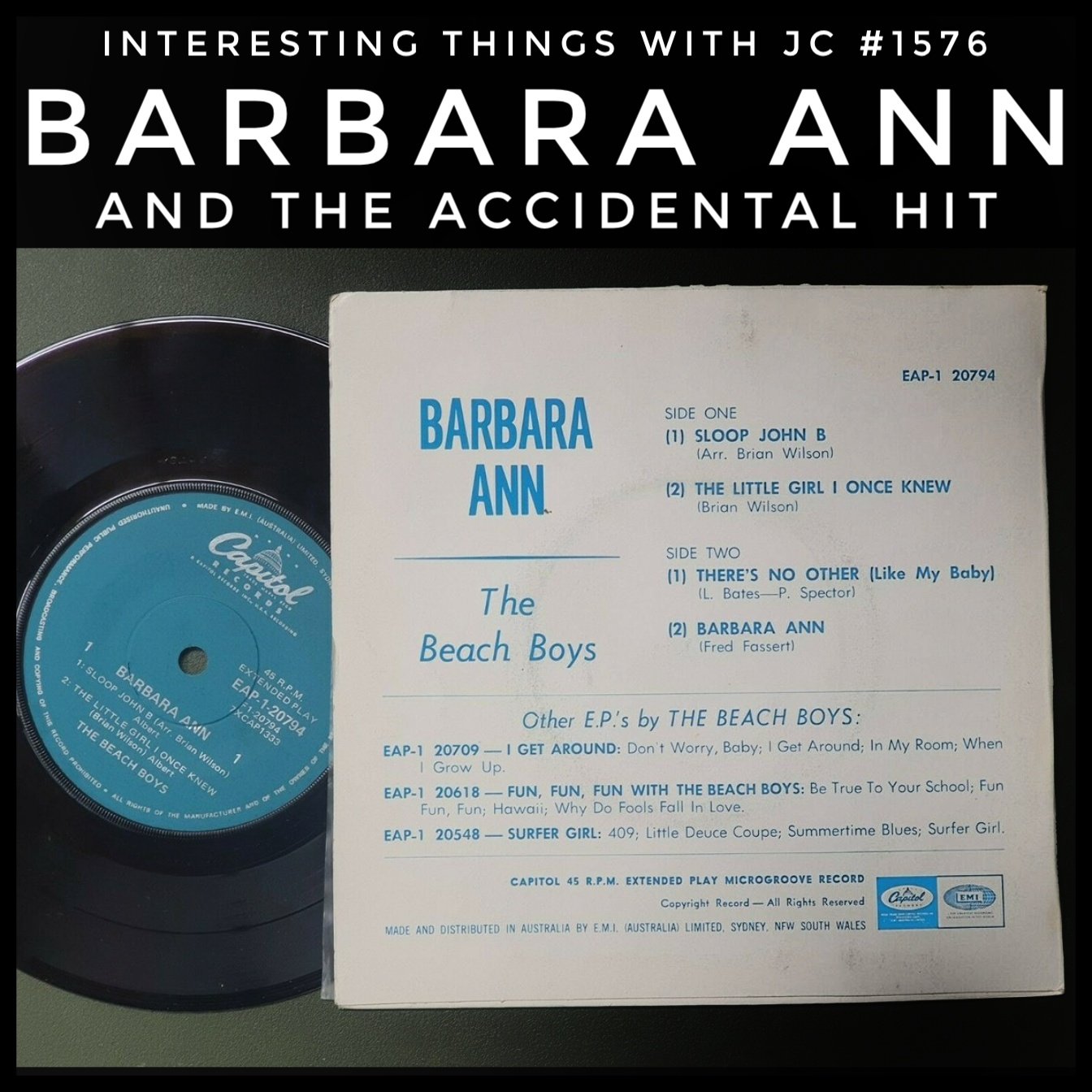
Cover graphic for “Interesting Things with JC #1576: Barbara Ann and the Accidental Hit,” featuring bold white title text above a photo of a vinyl record and its sleeve.
Transcript
Interesting Things with JC #1576: "Barbara Ann and the Accidental Hit"
On September 23, 1965, The Beach Boys stepped into Western Recorders in Hollywood and shut the door behind them. It was not a grand hall. Just a modest working studio room where microphones hung low and a tape machine waited.
Capitol Records wanted an album quickly for the Christmas season.
Brian Wilson was already deep into the ambitious work that would become Pet Sounds.
Instead of layering orchestration that day, they started fooling around.
Guitars were passed from hand to hand. A tambourine rattled. Someone tapped bongos. They nearly slipped into “Baa Baa Black Sheep” before catching themselves. The tape kept running.
And out of that room came one of the most recognizable chants in American music.
Ba ba ba ba Barbara Ann.
The song began in Queens, New York, in 1958. Fred Fassert wrote it for his younger sister, Barbara Ann Fassert. His brother Chuck sang with a neighborhood doo wop group called The Regents. They recorded it and pressed it onto 7-inch vinyl singles spinning at 45 revolutions per minute.
Seven inches. Seventeen point eight centimeters. A lightweight disc you could hold in one hand.
In 1961, Gee Records released it nationally. It climbed to number 13 on the Billboard Hot 100. No orchestration. No elaborate studio tricks. Just tight harmonies and repetition that stuck.
That is the first layer. Street-corner music. Young voices stacking because they could.
By late summer 1965, the industry had changed. The Beatles were reshaping pop structure. Multi-track recording was expanding rapidly. Brian Wilson was pushing toward complex arrangements, session players, and precise studio construction.
But Capitol wanted product.
Beach Boys’ Party! became their tenth studio album and their third that year. Recording took place over several days in August and September. The “party” sound heard on the album was largely assembled after the fact. Songs were tracked individually. Laughter and chatter were overdubbed later to create the illusion of a gathering.
It sounded casual. It was built that way.
When they began “Barbara Ann,” Dean Torrence of Jan and Dean happened to be there and joined on lead vocals. Contract rules kept him uncredited, but at the end of the track Carl Wilson shouts, “Thanks, Dean.” That moment stayed.
They left in the laughter. They left in the cracked notes. The final verse drifts slightly off course.
Brian Wilson later said they were “just fooling around.” That phrase matters. Because fooling around, after years of harmony discipline, still meant control underneath the looseness.
Radio stations began spinning the album cut. Listener demand built quickly. Capitol released it as a single on December 20, 1965, backed with “Girl Don’t Tell Me.”
It rose to number 2 on the Billboard Hot 100 in early 1966. It reached number 1 on Cash Box and Record World. Only The Beatles with “We Can Work It Out” and Petula Clark with “My Love” kept it from the top Billboard position.
In the United Kingdom, it reached number 3, their highest British placement at that time. It topped charts in parts of Europe and reached number 4 in Italy.
Beach Boys’ Party! climbed to number 6 in the United States and number 3 in the UK. In its initial commercial run, it moved faster than Pet Sounds, even though Pet Sounds would later become the more celebrated album.
That contrast is the center of the story.
One of the band’s biggest commercial successes came from a relaxed session built around acoustic guitars and group vocals, while Brian Wilson was constructing one of the decade’s most ambitious studio records.
There is another layer.
In 1965, editing meant cutting physical tape with a blade and splicing it by hand. Every correction carried risk. Leaving in laughter and small imperfections was not just creative freedom. It was efficient under deadline pressure.
You can hear Brian shout, “Hey, it’s Hal and his famous ashtrays!” referring to session drummer Hal Blaine and his well-known ashtray percussion trick from other recordings. Someone yells, “Stretch it, Carl!” during the guitar solo. Those were offhand moments.
They became permanent.
In the years that followed, stripped-down performances would continue to draw audiences. Acoustic sets. Live sessions without polish. The appetite for something human did not disappear as studios became more sophisticated.
Technology grows more advanced. Production budgets expand. Sound gets cleaner.
But people still respond to voices in a room.
Fred Fassert wrote a melody for his sister in 1958. A local vocal group sang it into a modest microphone. Seven years later, a California band under commercial pressure picked it up while trying to redefine their sound.
These are interesting things, with JC.
Student Worksheet
How did “Barbara Ann” change from its early doo-wop roots to The Beach Boys’ hit version? Name two differences described in the episode.
The episode says the “party” sound was “built.” What production choices created that effect?
Why might leaving in laughter, imperfect notes, or side-comments make a recording feel more authentic to listeners?
In what way did a deadline (Capitol wanting a Christmas-season album) influence what happened in the studio?
Creative prompt: Write a 6–8 sentence “studio diary entry” from the point of view of a musician in the room during the “Barbara Ann” take.
Teacher Guide
Estimated Time
45–60 minutes (or two 30-minute sessions)
Pre-Teaching Vocabulary Strategy
“Hear it, see it, use it”:
Hear: teacher reads each term aloud (doo-wop, overdub, splicing).
See: students match terms to short definitions.
Use: students write one sentence explaining how a term connects to the episode.
Anticipated Misconceptions
Students may assume the “party” sound is fully live and unplanned (clarify how overdubs can simulate an environment).
Students may assume “No. 1” always means Billboard (clarify that different trade charts existed and could rank songs differently).
Students may think editing was always easy (clarify physical tape splicing vs. modern digital editing).
Discussion Prompts
If an artist “constructs” spontaneity, is it still authentic? Why or why not?
Why might audiences respond strongly to “voices in a room” even as technology improves?
Should record labels release what sells fastest, or what artists consider most important?
Differentiation Strategies: ESL, IEP, gifted
ESL: Provide a mini word bank with phonetic spellings; allow answers as labeled sketches (studio scene + arrows).
IEP: Offer sentence starters (“One way the song felt real was…”) and allow oral responses.
Gifted: Have students compare chart systems and argue which better reflects “popularity,” citing evidence.
Extension Activities
Create a timeline (1958 → 1961 → 1965 → 1966) with one sentence per date explaining what changed.
“Production choices lab” (no audio required): students annotate a transcript excerpt, marking where “imperfections” or “room moments” influence the story.
Cross-Curricular Connections
Physics/Engineering: Sound capture basics—microphones, room acoustics, tape machines.
Math: Ratios and measurement—7-inch records, 45 rpm, unit conversion (inches to centimeters).
U.S. History/Culture: Postwar youth culture and the rise of mass-market pop distribution.
Media Literacy: How labels package “realness” and how audiences interpret it.
Quiz
Q1. What label pressure set up the recording situation described in the episode?
A. A world tour deadline
B. A Christmas-season album deadline
C. A film soundtrack contract
D. A television talent show requirement
Answer: B
Q2. Who wrote “Barbara Ann” originally?
A. Brian Wilson
B. Fred Fassert
C. Carl Wilson
D. Hal Blaine
Answer: B
Q3. What was a key production technique used to create the “party” feeling on the album?
A. Removing background sound entirely
B. Overdubbing laughter and chatter
C. Recording only orchestral instruments
D. Using only one microphone outdoors
Answer: B
Q4. What was the Billboard Hot 100 peak position for The Beach Boys’ “Barbara Ann”?
A. No. 1
B. No. 2
C. No. 7
D. No. 13
Answer: B
Q5. What detail in the recording hints at an uncredited guest vocalist?
A. A spoken “Thanks, Dean” near the end
B. A long orchestral interlude
C. A hidden backward message
D. A drum solo credited in the liner notes
Answer: A
Assessment
Open-ended Question 1
Explain how a recording can be “casual-sounding” but still carefully shaped. Use at least two examples from the episode (e.g., overdubs, leaving in mistakes, tape editing limits).Open-ended Question 2
Argue whether “authenticity” in music depends more on how something is made or how it feels to listeners. Support your answer using the “Barbara Ann” story and one real-world example from music culture today.3–2–1 Rubric
3 = Accurate, complete, thoughtful (uses multiple episode facts; clear reasoning; strong examples)
2 = Partial or missing detail (some accurate facts; limited explanation or support)
1 = Inaccurate or vague (few or incorrect facts; unclear claim; minimal support)
Standards Alignment
CCSS.ELA-LITERACY.RI.9-10.3 — Analyze how the episode’s events unfold and connect (deadline → recording choices → release → chart impact).
CCSS.ELA-LITERACY.RI.11-12.2 — Determine central ideas (authenticity vs. ambition; “constructed spontaneity”) and summarize with evidence.
CCSS.ELA-LITERACY.SL.9-10.1 — Participate in collaborative discussions evaluating how production decisions shape meaning and audience response.
C3 D2.His.14.9-12 — Analyze multiple factors that influenced historical outcomes (technology, industry pressure, audience demand in 1960s pop).
ISTE 3a (Knowledge Constructor) — Evaluate sources (charts, official listings) and synthesize evidence about popularity and reception.
NCAS: MU:Re7.2.HS (Perceive and analyze artistic work) — Analyze how musical elements and performance context contribute to the listener’s experience (harmonies, group chant, “room energy”).
International Equivalents (content-based, non-ideological)
UK National Curriculum (KS4) English: Spoken English — Structured discussion and argument using evidence from a spoken text (podcast episode).
Cambridge IGCSE (First Language English) Reading/Analysis — Analyze how language and structure convey meaning in a nonfiction narrative.
IB DP Language and Literature (Analysis of non-literary texts) — Analyze how purpose and audience shape communication (label strategy, “party” framing, authenticity cues).
Show Notes
This episode traces the unlikely path of “Barbara Ann” from a late-1950s Queens doo-wop origin to a mid-1960s Beach Boys smash that sounded like a carefree singalong, yet was shaped by studio decisions and a record-label deadline. Students can use the story to explore how music moves through culture, how “authentic” moments can be intentionally preserved (or even constructed), and how different chart systems can tell different truths about popularity. In class, the episode works as a compact case study in media literacy: what we hear as spontaneous may be produced, edited, and packaged, yet still feel real enough to last for decades.
References
Billboard. (1966, January 29). Billboard Hot 100: Week of January 29, 1966 (showing “Barbara Ann” peak position information). https://www.billboard.com/charts/hot-100/1966-01-29/
Official Charts Company. (1966, March 10). Official Singles Chart Top 100 (UK) (showing “Barbara Ann” peak position). https://www.officialcharts.com/charts/singles-chart/19660310/7501/