1575: "Joni Eareckson Tada: Paralyzed at Seventeen"
Interesting Things with JC #1575: "Joni Eareckson Tada: Paralyzed at Seventeen" – At 17, Joni Eareckson dove into shallow water and never moved her body the same way again. No miracle fixed her. What changed instead was her life’s direction. Sometimes healing is not physical. Sometimes it is deeper.
Curriculum - Episode Anchor
Episode Title: Joni Eareckson Tada: Paralyzed at Seventeen
Episode Number: #1575
Host: JC
Audience: Grades 9–12, college intro, homeschool, lifelong learners
Subject Area
Biography and memoir, health science (nervous system/spinal cord injury), media literacy, ethics/psychology (resilience, coping)
Lesson Overview
Learning Objectives
By the end of this lesson, students will be able to:
Define key medical and narrative terms (e.g., quadriplegia, cervical vertebrae, rehabilitation) as used in the episode.
Analyze how the episode uses chronology, precise details, and reflection to build meaning without relying on a “miracle cure” ending.
Explain the difference between a primary source (memoir/autobiography) and adaptations (film), including why release-date claims should be verified.
Evaluate how individuals and organizations can redirect hardship into community impact using evidence from the episode.
Key Vocabulary
Quadriplegic (kwahd-ruh-PLEE-jik) — A person with paralysis affecting all four limbs; in the episode, Joni becomes paralyzed from the shoulders down after a neck injury.
Cervical vertebrae (SUR-vih-kul VER-tuh-bray) — The bones in the neck labeled C1–C7; the episode describes damage around C4–C5 after impact.
Spinal cord (SPY-nul kord) — The nerve “highway” sending signals between brain and body; damage can cause paralysis and chronic pain.
Traction (TRAK-shun) — A medical method using pulling force to stabilize the spine; the episode notes months in traction and rehab.
Rehabilitation (ree-huh-bih-lih-TAY-shun) — Therapy and training to regain function and adapt; the episode emphasizes long-term rehab rather than a quick recovery.
Adaptation (ad-uhp-TAY-shun) — A retelling of a story in another medium (book to film); the episode references a film version of her autobiography.
Chronic pain (KRAH-nik payn) — Pain lasting months or longer; the episode notes long-term nerve pain following the injury.
Narrative Core
Open – How the story hooks the listener
A single summer dive in 1967 looks safe—until it isn’t—and a life changes in an instant.
Info – Background or supporting context
Joni is 17, athletic, a strong swimmer, raised in a Christian home, and expects healing through prayer.
Medical context: traction, rehabilitation, permanent spinal cord damage, and decades of nerve pain.
Details – The twist, turning point, or key facts
The water is shallow; impact crushes cervical vertebrae; paralysis follows.
She describes depression, anger, suicidal thoughts, and feeling abandoned—without a “miracle cure” resolution.
She redirects her life into art, music, writing, and disability ministry (including wheelchair distribution).
Reflection – Broader meaning or emotional resonance
The episode frames “healing” as more than physical restoration: purpose, honesty, and service can grow out of suffering.
Media literacy note for classrooms: the script states a specific nationwide film premiere date, but major film records list different release information; students can practice verification using credible catalogs.
Closing – Always close with: "These are interesting things, with JC."
These are interesting things, with JC.
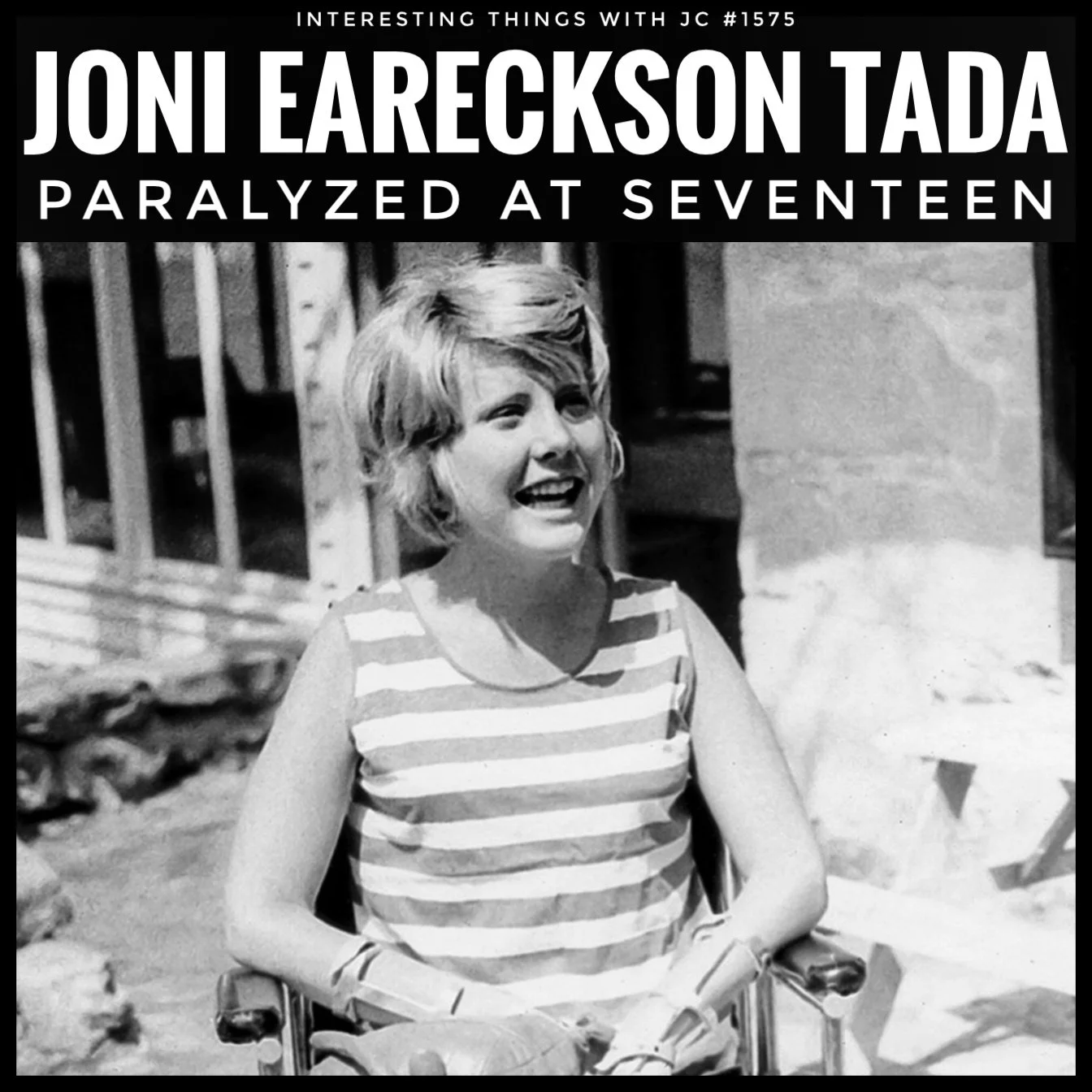
Black-and-white photo of Joni Eareckson Tada smiling in a wheelchair, with the title “Interesting Things with JC #1575: Joni Eareckson Tada — Paralyzed at Seventeen.” Fair use notice: This image is used for commentary, criticism, education, and identification in connection with the podcast episode, and is not intended to replace the original work or harm the market for the copyrighted material; all rights remain with the respective copyright holder(s).
Transcript
Interesting Things with JC #1575: "Joni Eareckson Tada: Paralyzed at Seventeen"
In July of 1967, seventeen-year-old Joni Eareckson dove into the Chesapeake Bay during a family outing in Maryland. The water looked deep. It wasn’t. Her head struck the sandy bottom, crushing her fourth and fifth cervical vertebrae. In an instant, she became a quadriplegic, paralyzed from the shoulders down.
She was 5 feet 6 inches tall, about 168 centimeters, with a strong swimmer’s build. After the accident, she would spend months in traction and rehabilitation. Doctors stabilized her neck, but the spinal cord damage was permanent. She lost all movement below her shoulders and most hand function. Chronic nerve pain would follow her for decades.
Raised in a Christian home, she believed God would heal her. She prayed. Churches prayed. Friends prayed. Years passed. No physical recovery came.
In 1976, at age twenty-six, she published her autobiography, Joni. The book sold more than 5 million copies worldwide.
On February 28, 1979, the feature film “Joni” premiered nationwide in the United States. The movie was based on her 1976 autobiography and starred Joni Eareckson Tada playing herself. That premiere marked a major public milestone, twelve years after her diving accident in July 1967.
But what made the story powerful wasn’t a miracle cure. It was honesty. She wrote about depression. About anger. About suicidal thoughts. About feeling abandoned.
Instead of walking again, she built something else.
She founded Joni and Friends in 1979, a ministry that now serves in more than 50 countries, distributing wheelchairs, offering family support, and advocating for people with disabilities. She recorded music. She painted by holding a brush between her teeth. She spoke to presidents and pastors.
Her body never healed. Her life did.
Suffering did not disappear. It was redirected.
That dive in 1967 measured only a few feet, less than 3 feet, under 1 meter of water. But its consequences stretched across continents and generations.
These are interesting things, with JC.
Student Worksheet
Short Answer: What specific mistake made the dive dangerous, and what immediate injury did it cause?
Short Answer: List two long-term impacts the episode describes (medical, emotional, or practical).
Creative Prompt: The episode says, “Suffering did not disappear. It was redirected.” Explain what “redirected” means using two concrete examples from the story.
Media Literacy: The script gives a precise nationwide premiere date for the film “Joni.” Write two steps you would take to verify that claim using reputable sources (film catalogs, publisher pages, library databases).
Connection Question: What does the episode suggest about the difference between “physical healing” and “life healing”?
Teacher Guide
Estimated Time
45–60 minutes (single class) or two 45-minute sessions (deeper research + discussion)
Pre-Teaching Vocabulary Strategy
“Concept Sort” in pairs: students sort terms into Medical, Storytelling, and Media/Publishing categories, then justify one placement aloud.
Anticipated Misconceptions
“Quadriplegia always means total loss of all arm/hand movement.” (Reality varies by injury level and severity.)
“If a story mentions a specific date, it must be correct.” (Teach verification and source quality.)
“Healing only means physical recovery.” (Help students distinguish physical outcomes from psychosocial adaptation.)
Discussion Prompts
How does the episode build emotional honesty without turning the story into sensationalism?
Which details make the narrative feel “precise” and credible? Which details would you want to verify?
What responsibilities do filmmakers have when adapting real lives?
What does long-term adaptation look like in real life (technology, rehab, community supports)?
Differentiation Strategies: ESL, IEP, gifted
ESL: Provide a vocabulary bank with sentence frames (“In the episode, traction means…”, “One long-term effect was…”)
IEP: Offer choices for response format (oral recording, graphic organizer, bullet answers). Chunk tasks into 2–3 questions at a time.
Gifted: Assign a mini “source audit” comparing 3 credible sources (film catalog + publisher + organization history) and rating reliability.
Extension Activities
Create a one-page “timeline + impacts” infographic: injury (1967), memoir publication (1976), organization founding (1979), plus two later impacts.
Art and engineering connection: research adaptive tools used by artists with limited mobility and present one design improvement idea.
Cross-Curricular Connections
Biology/Health Science: Nervous system pathways; spinal cord injury levels; pain signaling.
English Language Arts: Memoir as a genre; tone and theme; adaptation differences (book vs. film).
Psychology: Coping, resilience, and meaning-making after trauma.
Civics/Sociology: Disability access, community services, and assistive technology.
Quiz
Q1. What caused the parhe episode?
A. A car accident
B. A shallow-water diving injury
C. A mountain climbing fall
D. A boating collision
Answer: B
Q2. Which part of the body was primarily injured in the episode’s accident?
A. Lower back vertebrae
B. Ankles and feet
C. Cervical vertebrae in the neck
D. Skull only
Answer: C
Q3. What genre best describes Joni (1976) as mentioned in the episode?
A. Fantasy novel
B. Autobiography/memoir
C. Newspaper series
D. Scientific textbook
Answer: B
Q4. Which theme is emphasized by the line “Suffering did not disappear. It was redirected”?
A. Instant cures are guaranteed
B. Avoiding all hardship is possible
C. Meaning and service can grow from hardship
D. Hardship always ends quickly
Answer: C
Q5. What is a responsible next step when an episode gives a precise film premiere date?
A. Assume it’s correct because it’s specific
B. Verify using credible film catalogs or databases
C. Only use social media as proof
D. Ignore the date entirely
Answer: B
Assessment
Open-Ended Question 1
Using evidence from the episode, explain how the story’s message changes when the ending is not a miracle cure.
Open-Ended Question 2
Identify one claim in the episode that is easy to verify and one that is harder to verify. Explain what sources you would use and why.
3–2–1 Rubric
3 = Accurate, complete, thoughtful (Uses multiple episode details; clear reasoning; verification plan is credible.)
2 = Partial or missing detail (Some correct facts; limited explanation; sources or reasoning are vague.)
1 = Inaccurate or vague (Major errors; little evidence; verification plan not credible or missing.)
Standards Alignment
CCSS.ELA-LITERACY.RH.11-12.1
Cite specific textual evidence to support analysis of the episode’s claims and timeline.
CCSS.ELA-LITERACY.RH.11-12.2
Determine central ideas (adaptation, resilience, service) and summarize key points accurately.
CCSS.ELA-LITERACY.WHST.11-12.7
Conduct short research projects to verify publication/release facts using reliable sources (publisher pages, film catalogs).
NGSS.HS-LS1-2
Use a model to illustrate how body systems interact (nervous system signaling and how spinal cord injury disrupts function).
NGSS.HS-LS1-3
Plan an investigation/argument about feedback mechanisms and bodily regulation, extending to pain signaling and long-term impairment (age-appropriate, non-clinical).
C3.D2.His.14.9-12
Analyze multiple and complex causes/effects over time (a single event leading to decades of impact and organizational outcomes).
ISTE.3.1d (Knowledge Constructor)
Build knowledge by actively exploring and evaluating the credibility of sources when checking dates, sales claims, and organizational reach.
International (content-based equivalents)
UK National Curriculum (English: KS4 Reading and Writing)
Critical reading and evidence-based writing about memoir, theme, and authorial choices.
Cambridge IGCSE First Language English (Reading/Writing objectives)
Analyze how writers achieve effects; produce clear, evidence-supported responses.
IB DP Language and Literature (Analysis and Interpretation)
Analyze how purpose, audience, and stylistic choices shape meaning in non-fiction narrative.
Show Notes
Joni Eareckson Tada’s story begins with a split-second misjudgment in shallow water in July 1967 that results in a life-altering spinal cord injury and quadriplegia. The episode follows the immediate medical aftermath (traction, rehabilitation, permanent paralysis, chronic nerve pain) and then moves into the long emotional arc—honest accounts of depression, anger, suicidal thoughts, and feeling abandoned—without turning the narrative into a simple “miracle cure.” Instead, the focus shifts to how Joni redirected her life into writing, art, music, and disability ministry, describing lasting impact through service and advocacy. Details in the script also invite a valuable classroom skill: verifying factual claims (for example, film release dates and publication milestones) using reputable catalogs and publisher/organizational records.
References
American Film Institute. (n.d.). Joni (1980). AFI Catalog of Feature Films. https://catalog.afi.com/Catalog/MovieDetails/56450
Joni and Friends. (2026, February 3). Joni Eareckson Tada’s groundbreaking autobiography debuts to a new generation [Press release]. https://joniandfriends.org/press-releases/joni-eareckson-tadas-groundbreaking-autobiography-debuts-to-a-new-generation/
Rotten Tomatoes. (n.d.). Joni. https://www.rottentomatoes.com/m/joni
Joni and Friends. (2014, January 25). Wheels for the World. https://joniandfriends.org/wheels-for-the-world/wheels-for-the-world/