Interesting Things with JC #1590: "The Penn Dixie Fossil Site" – In western New York, families split open shale and touch a vanished sea nearly 380 million years old. Beneath an old quarry floor, the Devonian still waits...silent, buried, and full of creatures that never saw the world to come.
Curriculum - Episode Anchor
Episode Title: The Penn Dixie Fossil Site
Episode Number: 1590
Host: JC
Audience: Grades 9–12, college intro, homeschool, lifelong learners
Subject Area: Earth science, paleontology, geology, environmental history
Lesson Overview
Students examine how Penn Dixie Fossil Park in Hamburg, New York preserves a Middle Devonian marine ecosystem from about 380 million years ago, how quarrying exposed those fossil-bearing rocks, and how community action protected the site for science and public learning. The episode connects fossil evidence, sedimentary rock formation, extinction, local geology, and public stewardship. Key factual details in the episode align with Penn Dixie’s official historical materials and New York geology sources, including the site’s protection timeline, current 54-acre scale, Devonian fossil context, and current seasonal operation.
Learning Objectives
By the end of this lesson, learners will be able to:
Define how fossils form in sedimentary environments such as mud-rich seafloors.
Compare the ancient Devonian shallow-sea environment of western New York with the modern landscape of towns, roads, and Lake Erie.
Analyze how quarrying exposed fossil-bearing shale and why Penn Dixie became an important paleontological site.
Explain how local citizens and scientists helped preserve Penn Dixie for education, research, and public access.
Key Vocabulary
Devonian (deh-VOH-nee-un) — The Devonian Period was a span of geologic time roughly 419 to 359 million years ago; the fossils at Penn Dixie come from the Middle Devonian, about 380 million years ago.
Trilobite (TRY-loh-byte) — A marine arthropod fossil commonly found at Penn Dixie; Eldredgeops rana is one of the best-known trilobites from the site.
Brachiopod (BRAK-ee-oh-pod) — A shelled marine animal that lived on the seafloor and is commonly preserved in Devonian rocks.
Shale (shayl) — A fine-grained sedimentary rock formed from compacted mud; visitors at Penn Dixie split shale to reveal fossils.
Sediment (SED-uh-muhnt) — Small particles of mud, silt, sand, or organic matter that settle and can later harden into rock.
Extinction (ek-STINGK-shun) — The disappearance of a species or many species; by the end of the Devonian, Earth experienced a major extinction event affecting marine life.
Appalachian Basin (ap-uh-LATCH-un BAY-sin) — A broad sedimentary basin that once held shallow seas and now underlies much of the eastern United States, including western New York.
Crinoid (KRY-noid) — A marine animal related to starfish that lived attached to the seafloor and is sometimes called a “sea lily.”
Narrative Core
Open
The story hooks the listener by placing families in a real public fossil park near Buffalo, where splitting shale can reveal creatures from roughly 380 million years ago.
Info
The episode explains that western New York was once covered by a shallow inland sea in the Appalachian Basin during the Middle Devonian Period. Marine animals such as trilobites, brachiopods, crinoids, and corals lived on that seafloor.
Details
The key facts show how dead marine organisms were buried in mud, preserved in shale, and later exposed when the area was worked as the Bay View Quarry and later by Penn Dixie Cement Corporation. The episode also notes that citizens and scientists acted in the 1990s to protect the site, leading to public preservation.
Reflection
The broader meaning is that a familiar modern place can preserve a vanished world. Penn Dixie shows how geology, community action, and public science can work together to protect deep-time evidence.
Closing
These are interesting things, with JC.
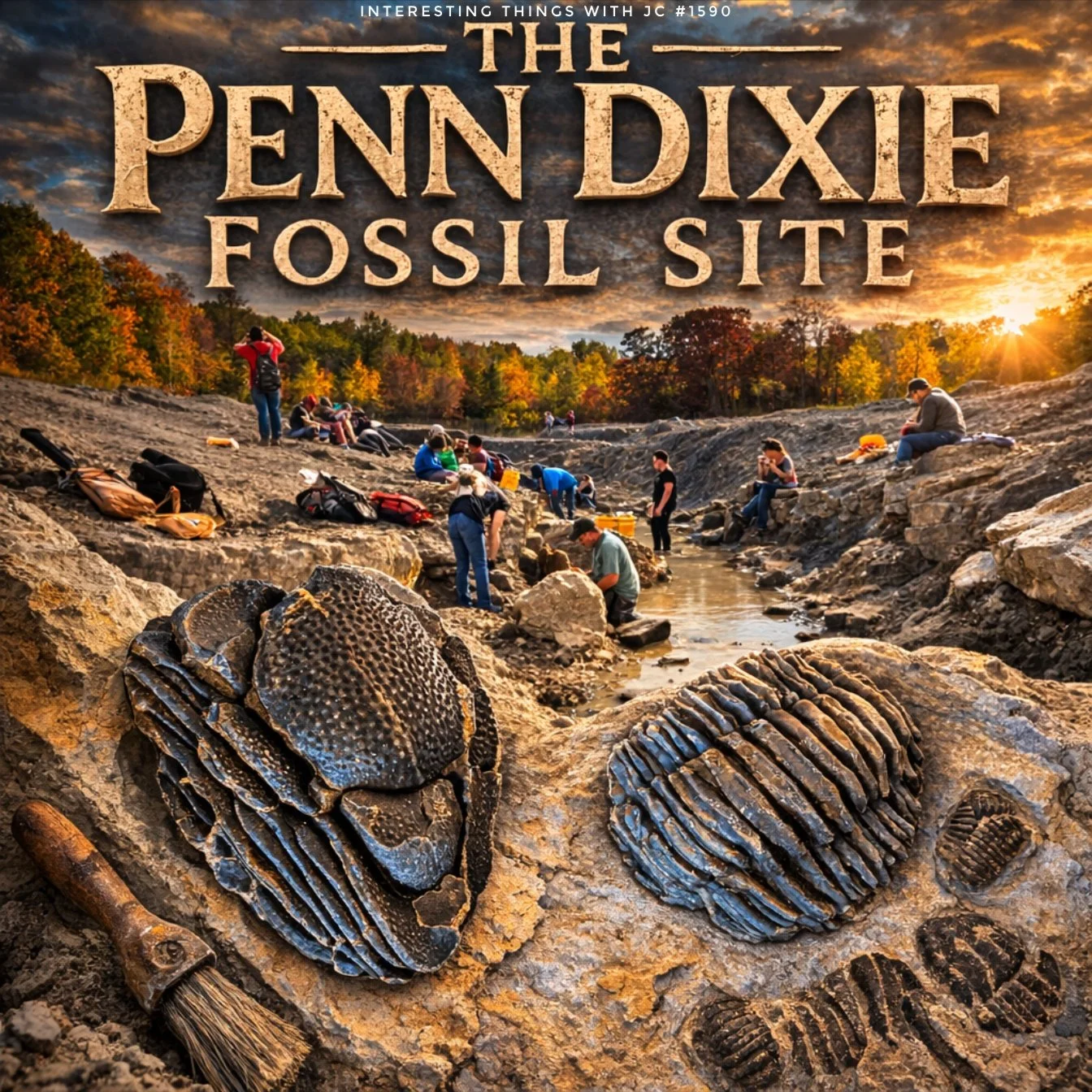
Promotional cover image for “Interesting Things with JC #1590: The Penn Dixie Fossil Site.” The scene shows an open rocky fossil quarry at sunset, with several people spread across the site searching for fossils along a shallow muddy trench. In the foreground, two very large trilobite fossils are prominently displayed on exposed rock beside a brush, with several smaller fossil shapes nearby. Autumn trees in shades of orange, red, and gold line the background under a dramatic cloudy sky. Large title text across the top reads, “The Penn Dixie Fossil Site,” with smaller text above it reading, “Interesting Things with JC #1590.”
Transcript
Interesting Things with JC #1590: "The Penn Dixie Fossil Site"
Penn Dixie Fossil Park sits in Hamburg, New York, about 12 miles (19 kilometers) south of Buffalo near Lake Erie.
Today it’s a public fossil site covering about 54 acres (roughly 2.3 million square feet, or 22 hectares). Families come here with small hammers to split open pieces of shale.
Sometimes those rocks reveal creatures that lived about 380 million years ago.
Fossils from the Middle Devonian Period, about 380 million years old, lie inside those rocks—long before Lake Erie or the Ice Age lakes like Lake Warren existed. At that time Western New York lay beneath a shallow inland sea that filled the Appalachian Basin.
Marine animals lived across the seafloor where towns and highways now stand. Trilobites such as Eldredgeops rana (EL-dredge-ops RAY-nah) crawled along the bottom. Brachiopods opened and closed their shells in the currents. Crinoids and corals grew along parts of the seabed.
This marine ecosystem thrived shortly before one of Earth’s major extinction events. By the end of the Devonian Period, roughly 75 percent of marine species would disappear during what scientists call the Late Devonian extinction.
When those animals died, their shells settled into mud on the sea floor.
More sediment buried those layers over millions of years, slowly hardening the mud into shale and preserving the shapes of the animals inside. Many trilobites here are found remarkably intact because fine seafloor mud buried them quickly, sealing them away from oxygen and scavengers.
Those rock layers eventually became part of the bedrock of western New York.
Hundreds of millions of years later, people began cutting into those rocks.
The land operated as the Bay View Quarry, later owned by the Penn Dixie Cement Corporation, from the early twentieth century until mining stopped in the 1960s. Workers blasted and removed rock used in cement and steel production.
As the quarry deepened, the digging cut directly into the ancient seabed and exposed one of the richest Devonian fossil beds in North America.
Mining stopped in the 1960s, leaving the fossil layers exposed.
In the early 1970s fossil collectors and paleontologists began visiting the abandoned quarry. One of the people who helped spread word about the site was fossil enthusiast Dan Cooper.
By 1990 local residents and scientists realized the site could easily disappear to development.
So the community stepped in.
In 1993 the Hamburg Natural History Society formed to protect the quarry. In 1995 the Town of Hamburg purchased the property, and in 1996 about 32.5 acres (roughly 131,500 square meters) were transferred to the society. The protected area has since expanded to about 54 acres.
Admission is modest, typically in the mid-teens for adults, with discounts for seniors, military members, students, and children. The park generally operates seasonally from spring through fall.
Today anyone can walk onto the old quarry floor, split open the shale, and see marine life from a sea that covered western New York nearly 400 million years ago.
These are interesting things, with JC.
Student Worksheet
Describe how mud on an ancient seafloor can eventually become shale containing fossils.
Name two kinds of marine organisms mentioned in the episode and explain what they tell us about Penn Dixie’s ancient environment.
Why did quarrying make Penn Dixie important to fossil collectors and paleontologists?
How did local community action help preserve Penn Dixie?
Creative prompt: Write a short museum label for a trilobite found at Penn Dixie. Include its age, environment, and why it matters.
Teacher Guide
Estimated Time
35–50 minutes
Pre-Teaching Vocabulary Strategy
Introduce Devonian, shale, fossil, sediment, trilobite, and extinction before listening or reading. Have students sort the words into three groups: time, rock processes, and organisms. Then ask students to predict what kind of place Penn Dixie used to be.
Anticipated Misconceptions
Students may think fossils form quickly. Clarify that fossilization usually takes place over long spans of burial, compression, and mineral preservation.
Students may assume western New York always looked like it does now. Emphasize that the region once lay beneath a shallow sea.
Students may think quarrying and science always oppose each other. Explain that industrial excavation exposed the fossil beds, while preservation efforts later protected them.
Students may confuse dinosaurs with Devonian life. Penn Dixie’s best-known fossils are marine invertebrates from long before dinosaurs appeared.
Discussion Prompts
How can a local landscape act as evidence for a vanished world?
Why do some fossils preserve better than others?
What responsibilities do communities have when a scientifically important site is threatened?
How does public access to a fossil park change the way people learn science?
Differentiation Strategies
ESL
Use a labeled visual timeline showing “ancient sea,” “burial,” “rock formation,” “quarry,” and “public fossil park.” Pair vocabulary with images and sentence frames.
IEP
Provide the transcript in chunks with guiding questions after each section. Allow oral responses or graphic organizers in place of full written paragraphs.
Gifted
Invite students to compare Penn Dixie with another fossil Lagerstätte or major public fossil locality and evaluate why preservation conditions differ.
Extension Activities
Have students create a geologic timeline placing the Devonian Period, the Late Devonian extinction, the Ice Age lakes, the quarry era, and the park’s preservation era.
Ask students to sketch a Devonian seafloor scene using only organisms named in the episode.
Research how local museums, parks, or historical societies protect scientific or cultural resources.
Cross-Curricular Connections
Biology: extinction, ecosystems, adaptation, marine life
Chemistry: mineralization and sedimentary processes
History: industrial quarrying and local land-use change
Civics: community preservation and public stewardship
Media literacy: how short-form educational storytelling conveys scientific information accurately
Quiz
Q1. What kind of environment covered western New York during the Middle Devonian?
A. A desert basin
B. A shallow inland sea
C. A glacier field
D. A tropical rainforest
Answer: B
Q2. Which fossil organism is specifically named in the episode?
A. Tyrannosaurus rex
B. Mammuthus primigenius
C. Eldredgeops rana
D. Archaeopteryx
Answer: C
Q3. What rock do visitors commonly split open at Penn Dixie?
A. Granite
B. Marble
C. Basalt
D. Shale
Answer: D
Q4. What helped expose the fossil-rich layers at Penn Dixie?
A. Volcanic eruption
B. Quarry mining
C. River flooding
D. Meteor impact
Answer: B
Q5. Which group formed in 1993 to help protect the site?
A. National Park Service
B. Hamburg Natural History Society
C. U.S. Geological Survey
D. Buffalo Science Museum
Answer: B
Assessment
Open-Ended Question 1
Explain how fossils at Penn Dixie formed and why many are well preserved.
Open-Ended Question 2
Describe how human activity both revealed and protected the fossil site.
3–2–1 Rubric
3 = Accurate, complete, thoughtful; uses clear scientific and historical details from the episode
2 = Partially accurate; includes some correct ideas but misses important details or connections
1 = Inaccurate or vague; shows limited understanding of fossil formation, geology, or site history
Standards Alignment
NGSS HS-ESS1-5 — Evaluate evidence of Earth’s past and present processes to explain geologic history. Students use the fossil-bearing shale and Devonian seafloor evidence to interpret environmental change.
NGSS HS-LS4-1 — Communicate scientific information that common ancestry and biological evolution are supported by multiple lines of evidence. Fossils at Penn Dixie provide evidence of ancient marine life and change through time.
NGSS HS-LS4-5 — Evaluate evidence supporting claims that environmental changes can affect species survival. The episode’s reference to the Late Devonian extinction supports discussion of large-scale biodiversity loss.
CCSS.ELA-LITERACY.RST.9-10.2 — Determine central ideas of a science text and summarize them accurately. Students identify the main scientific and historical claims in the episode.
CCSS.ELA-LITERACY.RST.11-12.7 — Integrate and evaluate multiple sources of information presented in diverse formats. Students can pair the episode with maps, geologic timelines, and fossil images.
CCSS.ELA-LITERACY.WHST.9-10.2 — Write informative texts to examine and convey complex ideas clearly. Students explain fossil formation and site preservation using domain vocabulary.
C3 D2.Geo.4.9-12 — Analyze relationships between the environmental characteristics of places and human activities. Students examine how an ancient seafloor became a quarry and later a protected education site.
C3 D2.His.1.9-12 — Evaluate how historical events and developments were shaped by unique circumstances of time and place. Students consider how geology, mining, and local activism shaped Penn Dixie’s history.
ISTE 1.3.c Knowledge Constructor — Students evaluate the accuracy and perspective of scientific information from curated sources. The episode can be paired with official geologic and museum resources for verification.
CTE Science, Technology, Engineering, and Mathematics Career Cluster ST.2 — Apply scientific inquiry and technical knowledge to real-world settings. Students connect paleontology, geology, museum education, and conservation careers to the site.
UK National Curriculum KS4 Geography/Science (merged equivalent) — Develop understanding of Earth processes, environmental change, and evidence-based scientific explanation. Penn Dixie supports study of past environments and geological timescales.
AQA GCSE Biology/Geology-related content (merged equivalent) — Use fossil evidence and Earth history to explain long-term biological and environmental change. The episode aligns with interpretation of fossils as evidence.
IB MYP Sciences Criterion B/C (merged equivalent) — Inquire, process, and evaluate scientific information to explain natural phenomena. Students investigate how sediment, burial, and time produced fossils and how evidence supports those conclusions.
Cambridge IGCSE Biology/Environmental Management (merged equivalent) — Interpret fossil evidence and long-term environmental change using scientific reasoning and structured explanation.
Show Notes
Penn Dixie Fossil Park in Hamburg, New York preserves one of the best-known publicly accessible Middle Devonian fossil localities in North America. The episode introduces students to a place where a modern quarry floor opens directly onto an ancient seafloor, allowing learners to connect fossil formation, sedimentary rock, marine ecosystems, extinction, industrial history, and community preservation in one case study.
For classroom use, this topic matters because it turns abstract geologic time into a local, observable story: organisms lived in a shallow sea about 380 million years ago, were buried in mud that became shale, and were later revealed through quarrying before citizens helped protect the site for public science.
Penn Dixie’s official materials confirm the preservation history, the 54-acre size, and the protection timeline, while current visitor information supports the episode’s note that the park operates seasonally and charges modest admission in the mid-teens for adults. The scientific context for the Devonian sea, Appalachian Basin geology, and Late Devonian extinction is also consistent with reputable geology and reference sources.
References
Hamburg Natural History Society. (n.d.). Hours & rates (2025 rates). Penn Dixie Fossil Park & Nature Reserve. https://penndixie.org/hours-and-rates/
Hamburg Natural History Society. (n.d.). Mission statement. Penn Dixie Fossil Park & Nature Reserve. https://penndixie.org/mission-statement/
Hamburg Natural History Society. (2015, October 10). Penn Dixie Chronicle. Penn Dixie Fossil Park & Nature Reserve. https://penndixie.org/wp-content/uploads/2016/04/pd-news-sept-oct-2015-1.pdf
Hamburg Natural History Society. (2018). A window into the Devonian period of western New York. Penn Dixie Fossil Park & Nature Reserve. https://penndixie.org/wp-content/uploads/2018/02/penndixieofficialfieldguide.pdf
New York State Department of Environmental Conservation. (2009). Chapter 4: Geology. https://extapps.dec.ny.gov/docs/materials_minerals_pdf/fsgeis2015ch4.pdf
New York State Department of Environmental Conservation. (n.d.). New York state geology and its relationship to oil, gas and solution mining. https://extapps.dec.ny.gov/docs/materials_minerals_pdf/dgeisv1ch5.pdf
Encyclopaedia Britannica. (2026, February 21). Background extinction rate. https://www.britannica.com/science/background-extinction-rate