Interesting Things with JC #1591: "The NIKE Site Hidden in the Woods Near Orchard Park" – In woods south of Buffalo, the ground still remembers a Cold War secret. Beneath the trees once stood a hidden missile shield, built for the unthinkable and waiting in silence.
Curriculum - Episode Anchor
Episode Title: The Nike Site Hidden in the Woods Near Orchard Park
Episode Number: 1591
Host: JC
Audience: Grades 9–12, introductory college, homeschool learners, and lifelong learners
Subject Area: U.S. history, Cold War studies, military technology, geography, media literacy
Lesson Overview
This lesson uses the episode to examine how Cold War air defense systems were placed near strategically important industrial regions and how local landscapes can preserve traces of national defense infrastructure. Archival and military-history sources confirm that the Orchard Park-area Nike installation was part of the Niagara Falls–Buffalo defense network and that the local site, with a control area in Orchard Park and a launch area in Aurora. Those same sources identify it as a Nike Ajax-era dual site; teachers should note that this archival record differs from some details in the episode script.
Students will analyze why Buffalo and nearby industrial facilities mattered to Cold War planners, how Nike sites were organized, and how historical storytelling can be compared with documentary evidence. The lesson also builds source-evaluation skills by having students distinguish between accurate broad themes in the episode and details that require correction or qualification from the historical record.
3–4 measurable learning objectives using action verbs:
Define the purpose of the Nike air defense system within the broader Cold War context.
Compare the roles of a launcher area and an Integrated Fire Control area in a Nike missile battery.
Analyze why the Buffalo–Niagara region was considered strategically important in the 1950s and early 1960s.
Explain how historians use official records to verify or challenge claims made in popular historical storytelling.
Key Vocabulary
Nike missile system (NY-kee) — A U.S. Army surface-to-air missile defense network built during the Cold War to protect major cities and industrial regions from enemy aircraft.
Cold War (kohld wawr) — The long period of political and military tension between the United States and the Soviet Union after World War II.
Integrated Fire Control (IN-tuh-gray-tid fyer kuhn-TROHL) — The radar-and-computing section of a Nike site that tracked aircraft and guided missiles.
Nike Ajax (NY-kee AY-jaks) — The earlier Nike missile used at the Orchard Park/Aurora BU-34/35 site according to U.S. Army Corps of Engineers records.
Nike Hercules (NY-kee HER-kyuh-leez) — A later, more powerful Nike missile that could travel at about Mach 3.65 and could carry either high-explosive or nuclear warheads at some sites.
Interceptor (in-ter-SEP-ter) — A defensive missile designed to meet and destroy an incoming aircraft or threat before it reaches its target.
Strategic target (struh-TEE-jik TAR-git) — A place considered important in war because of its industry, transportation, energy production, or military value.
Archival record (ar-KY-vuhl REK-erd) — Historical evidence preserved in official reports, military documents, photographs, and other primary sources.
Narrative Core
Open:
The episode opens with an ordinary-looking wooded landscape near Orchard Park and invites listeners to imagine that this quiet place once stood on nuclear alert, immediately creating tension between present-day calm and Cold War danger.
Info:
The script explains the Cold War, the Nike missile defense network, and Buffalo’s strategic importance because of heavy industry, steel production, transportation, and nearby power infrastructure. These broad themes align with regional historical sources about the Buffalo–Niagara defense zone.
Details:
The central detail is that the weapons were hidden underground and coordinated by radar and analog computing systems rather than being visible as open launch pads. A teacher note is important here: official records identify the Orchard Park-area site, with a control area and Aurora launch area, and describe it as a Nike Ajax site rather than a confirmed Hercules battery.
Reflection:
The story encourages reflection on how communities can live alongside major defense infrastructure without always recognizing it, and how landscapes preserve hidden layers of national history.
Closing:
These are interesting things, with JC.
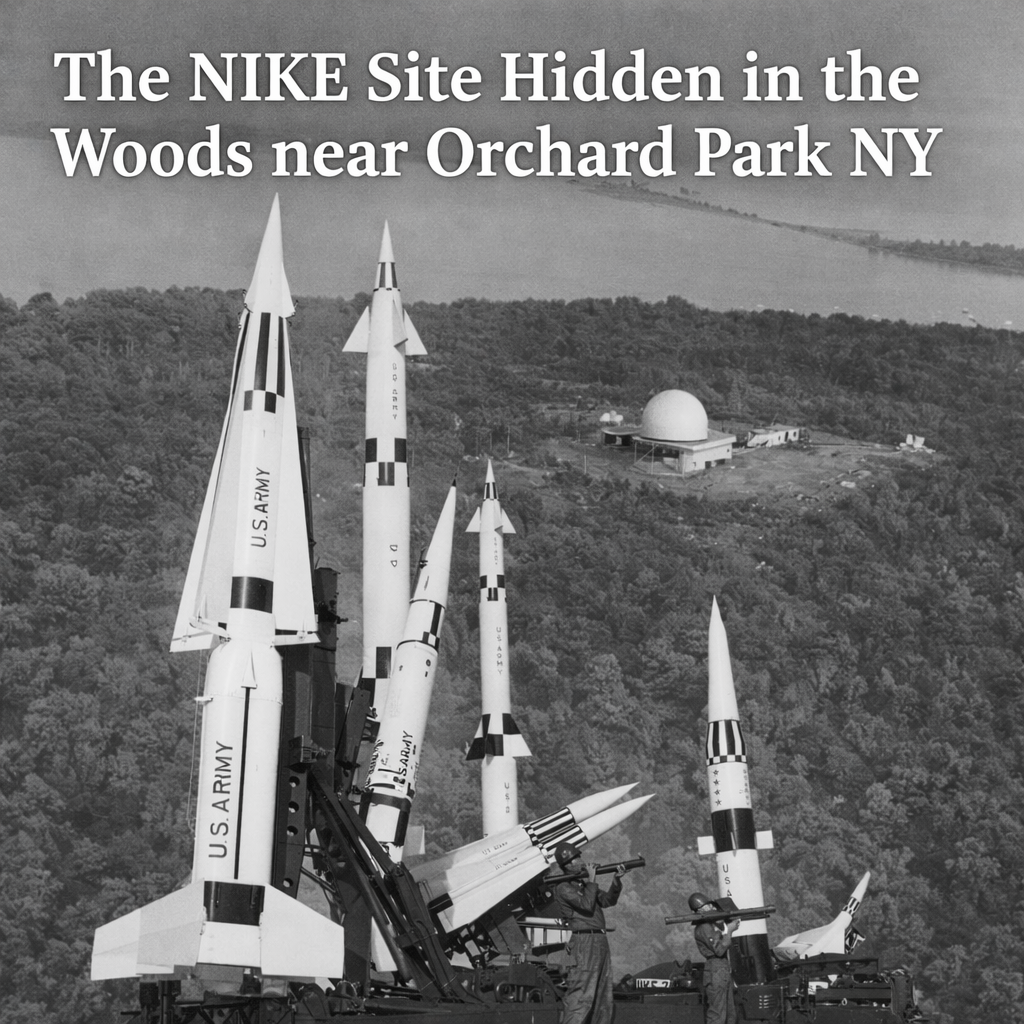
Black-and-white graphic titled “The NIKE Site Hidden in the Woods near Orchard Park NY.” Several U.S. Army Nike missiles stand on launchers in the foreground, with a wooded hillside and a radar dome facility in the distance.
Transcript
Interesting Things with JC #1591: "The Nike Site Hidden in the Woods Near Orchard Park"
South of Buffalo, New York, in the woods near the town of Orchard Park, there is land that looks almost ordinary. Trees. Dirt roads. Patches of uneven ground where grass grows thicker in long curved lines. If you walk through the area today, you might never guess that for more than a decade this place stood on alert to defend an American city from nuclear attack.
In the late 1950s, during the height of the Cold War, the United States Army built a ring of missile defenses around major industrial centers. Buffalo was one of them. The system was called the Nike missile defense network.
At first glance the installation didn’t look like a missile base at all. There were no rockets visible from the road. No towering launch pads. What people saw instead were low grassy mounds, chain-link fences, and radar antennas slowly turning on nearby hilltops.
The real weapons were hidden underground.
Military planners had chosen Orchard Park for a reason. During the 1950s, Buffalo was considered a critical industrial target. Just south of the city sat the massive Bethlehem Steel plant in Lackawanna, one of the largest steel producers in the United States. The region also supported aircraft manufacturing, heavy machinery production, and shipping routes through the Great Lakes. Just upstream on the Niagara River stood the hydroelectric plants supplying enormous electrical power to the northeastern United States.
To Cold War planners, that combination made Buffalo strategically valuable.
Bombers approaching from the Soviet Union were expected to cross the Arctic, pass through Canadian airspace, and then approach American cities over the Great Lakes. From Orchard Park, which sits on higher ground south of Buffalo, radar crews had a clear view of aircraft approaching across Lake Erie.
Every Nike missile base was divided into two separate locations.
One was the launcher area. Here the missiles themselves were stored in reinforced underground magazines. Steel doors protected the storage bays, and hydraulic elevators could raise the weapons to the surface within minutes. Once above ground, each missile was placed onto a launcher rail angled toward the sky. A typical battery held twelve missiles ready for use.
Several miles away sat the Integrated Fire Control area. This was the brain of the system. Radar antennas scanned the sky and tracked incoming aircraft, sometimes more than 100 miles away, or about 160 kilometers. Inside the control buildings, analog computers processed radar data and calculated where an interceptor missile needed to meet its target.
All of this technology was operating before digital computers were common.
The Orchard Park site originally used the Nike Ajax missile. Later, it upgraded to the larger and far more powerful Nike Hercules.
The Hercules missile measured about 41 feet long, roughly 12.5 meters. When launched, it could reach speeds of about Mach 3.6, roughly 2,760 miles per hour, or about 4,440 kilometers per hour. Its interception range extended close to 75 miles, around 120 kilometers.
Some versions of the Hercules carried conventional explosives. Others could carry nuclear warheads designed to destroy entire bomber formations with a single detonation high in the sky. Public records remain unclear about whether nuclear weapons were ever stored at the Orchard Park battery, though many other Nike Hercules sites across the United States definitely maintained them.
Local residents remember the base clearly.
Farmers and families living nearby often saw Army trucks traveling the narrow roads. Radar dishes rotated slowly day and night. Guard towers stood above the fences while soldiers maintained constant watch. What looked like farmland was actually part of a nationwide shield protecting American cities.
The site remained active through some of the most dangerous moments of the Cold War, including the Cuban Missile Crisis in October of 1962.
But technology changes quickly in wartime planning. By the late 1960s, the threat of long-range bomber attacks was being replaced by intercontinental ballistic missiles traveling thousands of miles through space. Defensive systems built to stop aircraft were no longer the primary answer.
One by one, the Nike sites around Buffalo were shut down.
The Orchard Park installation closed around 1970. Equipment was removed. Buildings were dismantled. Over time the forest crept back across the land.
Yet the landscape still carries traces of what once stood there. Concrete foundations remain buried beneath leaves. Long earth berms that once shielded missile launchers still shape the ground. Old service roads wind quietly through the woods.
For a generation of Americans, that quiet patch of land south of Buffalo stood ready every hour of the day. Hidden beneath the soil were missiles built to intercept enemy bombers at three times the speed of sound, part of a defensive network stretching across the country during one of the most tense periods in modern history.
Today, most people walking those woods never realize what stood there.
But for decades, that hillside near Orchard Park was one small piece of the shield guarding the United States.
These are interesting things, with JC.
Student Worksheet
Why did Cold War planners consider the Buffalo–Niagara region strategically important? Use at least two details from the episode and one from class discussion or source review.
Describe the difference between the launcher area and the Integrated Fire Control area at a Nike site.
Why would a missile base be designed to look unobtrusive from the road?
Compare the episode’s description of the Orchard Park site with the historical record. What details match, and what details appear disputed?
Creative prompt: Write a short first-person reflection from the perspective of a local teenager in 1962 who lives near the site during the Cuban Missile Crisis.
Teacher Guide
Estimated Time
45–60 minutes for one class period, or 90 minutes with source comparison and writing extension
Pre-Teaching Vocabulary Strategy
Begin with a vocabulary sort. Have students group terms into three columns: Cold War, technology, and local geography. Then ask them to predict how all three categories connect in one story.
Anticipated Misconceptions
Students may assume all Nike sites were identical; in reality, site configurations and later upgrades varied.
Students may assume every local historical claim in a narrative script is automatically exact; this lesson is a good opportunity to model source verification.
Students may assume the Orchard Park site definitely housed Hercules missiles or remained open until 1970, but identify it as a Nike Ajax dual site active into March 1963.
Discussion Prompts
How does geography shape military planning?
Why were industrial cities seen as strategic targets during the Cold War?
What happens when a compelling historical story contains a few disputed details?
Should preserved military landscapes be marked more clearly for the public?
Differentiation Strategies: ESL, IEP, gifted
ESL: Provide a picture-supported glossary for terms like radar, interceptor, industrial, and strategic.
IEP: Break the source comparison task into a two-column organizer labeled “episode claim” and “documented evidence.”
Gifted: Ask students to investigate whether another Buffalo-area or Niagara-area Nike site later converted to Hercules.
Extension Activities
Students create a local-history map marking Buffalo, Orchard Park, Aurora, Lackawanna, and Niagara Falls.
Students write a brief evidence-based correction note for the episode using archival sources.
Students research how analog computing supported Cold War defense systems before widespread digital computing.
Cross-Curricular Connections: (e.g., physics, sociology, ethics)
Physics: Speed, trajectory, radar detection, and interception timing
Geography: Elevation, air routes, industrial corridors, Great Lakes positioning
Computer science: Analog vs. digital computation in targeting systems
Civics/history: Public memory, secrecy, and local communities during the Cold War
Quiz
Q1. What was the main purpose of the Nike missile system?
A. To launch communications satellites
B. To defend cities and strategic regions from enemy aircraft
C. To transport troops across the Atlantic
D. To monitor weather patterns
Answer: B
Q2. According to the documented structure of Nike sites, what was the role of the Integrated Fire Control area?
A. Storing food and medical supplies
B. Housing tanks and artillery
C. Tracking targets and guiding missiles
D. Repairing civilian vehicles
Answer: C
Q3. Why was the Buffalo region considered strategically important during the Cold War?
A. It was the nation’s capital
B. It had heavy industry, transportation links, and nearby power generation
C. It was a major film-production center
D. It had the largest naval base in the country
Answer: B
Q4. Which missile do official records identify for the Orchard Park/Aurora site?
A. Minuteman
B. Polaris
C. Nike Ajax
D. Nike Hercules
Answer: C
Q5. What is one major historical-thinking skill emphasized by this lesson?
A. Memorizing every military acronym
B. Accepting all narratives without question
C. Comparing a story with documentary evidence
D. Ignoring local geography
Answer: C
Assessment
2 open-ended questions
Explain how the Buffalo–Niagara region’s industry and geography made it important to Cold War defense planners.
Evaluate the episode as a piece of historical storytelling. What does it communicate effectively, and what details should be revised based on the archival record?
Include a 3–2–1 rubric:
3 = Accurate, complete, thoughtful; uses evidence from both the episode and historical sources
2 = Partially accurate; includes some evidence but misses important detail or nuance
1 = Inaccurate or vague; little or no supporting evidence
Standards Alignment
U.S. Standards
CCSS.ELA-LITERACY.RH.9-10.1 — Cite specific textual evidence to support analysis of primary and secondary sources. Students compare the episode script with documented records of BU-34/35.
CCSS.ELA-LITERACY.RH.11-12.2 — Determine central ideas of a source and provide an accurate summary. Students identify the central historical claim of the episode and test it against archival evidence.
CCSS.ELA-LITERACY.WHST.9-10.2 — Write informative texts to examine and convey complex ideas clearly. Students can produce a short evidence-based correction or historical summary.
C3 D2.His.1.9-12 — Evaluate how historical events and developments were shaped by unique circumstances of time and place. Students examine why the Buffalo–Niagara region mattered in the Cold War.
C3 D2.Geo.1.9-12 — Use geographic representations and reasoning to interpret relationships among places and regions. Students map the location of Orchard Park, Aurora, Buffalo, and Niagara-area infrastructure.
ISTE 3a: Knowledge Constructor — Students plan and employ effective research strategies to locate information and other resources for intellectual or creative pursuits. This fits the source-verification component of the lesson.
Career Readiness / CTE Standards
Career Ready Practice 2 — Apply appropriate academic and technical skills. Students combine historical reasoning, technical vocabulary, and evidence-based writing.
Career Ready Practice 6 — Demonstrate creativity and innovation. Students may design local-history exhibits, maps, or public interpretation panels for the site.
International Academic Equivalents
UK National Curriculum (History, Key Stage 4) — Develop and deploy historically grounded claims by understanding how evidence is used rigorously. This aligns with comparing narrative claims to documentary evidence.
AQA GCSE History: AO3 — Analyze, evaluate, and use sources to make substantiated judgments. The lesson directly supports source analysis and reliability.
IB Diploma Programme History — Evaluate sources and interpret the past through evidence, perspective, and context. This aligns with the lesson’s emphasis on checking archival records against secondary storytelling.
Cambridge IGCSE History Assessment Objective 3 — Interpret and evaluate sources in their historical context. Students practice determining what can and cannot be confirmed from the record.
Show Notes
This episode explores a hidden layer of Cold War history in western New York by focusing on the former Nike missile installation associated with Orchard Park. It is highly relevant for classroom use because it connects local geography, national defense, industrial history, and historical thinking in one compact narrative. The topic matters today because many communities still contain overlooked Cold War sites, and studying them helps students understand how landscapes preserve the memory of global conflict.
For educators, one especially valuable dimension is that the episode can be paired with source analysis: official U.S. Army Corps of Engineers records and regional military-history documentation identify the local installation, with a control area in Orchard Park and a launch area in Aurora, and describe it as a Nike Ajax site rather than a clearly documented Orchard Park Hercules battery. That makes the episode useful not only for content knowledge but also for teaching how historians verify claims.
References
U.S. Army Corps of Engineers, New York District. (n.d.). Niagara Falls–Buffalo Defense Nike Battery. https://www.nan.usace.army.mil/Missions/Environmental/Environmental-Remediation/Niagara-Falls-Buffalo-Defense-Nike-Battery/
Robitaille, P. (2015). History of the Niagara–Buffalo Army Air Defense, 1952–1970. Nike Missile Site Historical Society. https://nikemissile.org/NFBU/NFBU52-70.pdf
U.S. Army Redstone Arsenal. (n.d.). Nike Hercules missile. https://history.redstone.army.mil/miss-nikeherc.html
Hamburg Historical Society. (n.d.). Hamburg Nike Missile Base. https://www.hamburghistoricalsociety.org/hamburg-nike-missile-base
Buffalo Architecture and History. (n.d.). Bethlehem Steel in Lackawanna. https://buffaloah.com/h/beth/