Interesting Things with JC #1592: "Three's Company" – One small apartment. One suspicious landlord. And one lie that made the arrangement possible. When Jack Tripper pretends to be something he isn’t, a simple living situation becomes one of the most recognizable engines of television comedy.
Curriculum - Episode Anchor
Episode Title: Three's Company
Episode Number: 1592
Host: JC
Audience: Grades 9–12, introductory college, homeschool learners, lifelong learners
Subject Area: Media Studies, U.S. Cultural History, Television Studies, ELA Informational Analysis
Lesson Overview
This lesson uses the episode on Three’s Company to examine how a late-1970s American sitcom used farce, social norms, and housing realities to build comedy around a shared-apartment premise. The series premiered on ABC on March 15, 1977, ran for eight seasons, and was adapted from the British sitcom Man About the House. It became one of the highest-rated programs on U.S. television, finishing #2 overall in the 1979–1980 Nielsen season rankings with a 26.3 rating.
Students will analyze how television comedy reflects real-life social tensions, including changing expectations about gender roles, cohabitation, and affordability in urban life. The episode also provides a strong case study in how performance, timing, character chemistry, and misunderstanding shape sitcom storytelling.
Learning objectives:
Define farce and explain how misunderstanding drives sitcom structure in Three’s Company.
Compare the cultural assumptions of late-1970s television audiences with contemporary attitudes toward roommates, gender expectations, and apartment living.
Analyze how casting, performance style, and adaptation from British television helped shape the show’s success.
Explain why the series matters as both entertainment history and a primary example of mainstream American situation comedy.
Key Vocabulary
Farce (färs) — A style of comedy built on mistaken identity, misunderstanding, exaggeration, and precisely timed chaos. In Three’s Company, small misunderstandings quickly become major comic problems.
Sitcom (sit-kom) — Short for “situation comedy,” a television format built around recurring characters in familiar settings. Three’s Company is a classic American sitcom centered on an apartment and its residents.
Cohabitation (koh-hab-ih-TAY-shən) — Living together in the same home. The show’s entire premise depends on anxiety about unmarried men and women sharing an apartment.
Adaptation (ad-ap-TAY-shən) — A new version of an existing story or program. Three’s Company was adapted from the British series Man About the House.
Nielsen ratings (NEEL-sən RAY-tingz) — A long-used U.S. system for measuring television audiences. The show ranked #2 overall in the 1979–1980 season.
Pilot (PY-lət) — A trial episode used to test a television concept before a series is ordered. Multiple early versions of the Three’s Company pilot were filmed before the final cast was set.
Spin-off (spin-awf) — A new series built from characters or situations introduced in another show. The Ropers and Three’s a Crowd both came from Three’s Company.
Narrative Core
Open
A hot blonde, a practical brunette, and a good looking young man walk into American television. The hook immediately frames the episode as both a joke and a cultural snapshot.
Info
The episode establishes the setting in Santa Monica, the financial need for a third roommate, and the moral objection of landlord Stanley Roper. It then explains that the series premiered on ABC in 1977 and was adapted from a British sitcom.
Details
The central details include Jack Tripper’s lie that he is gay, the chemistry of John Ritter, Joyce DeWitt, and Suzanne Somers, the role of the Ropers and later Ralph Furley, the structure of farce, the show’s ratings success, its 172-episode run, and its spin-offs.
Reflection
The episode argues that the series lasted because the comic situation reflected real pressures in everyday life: rent, housing, social expectations, and the need to improvise around them. That social tension made the comedy feel believable to viewers then and recognizable now.
Closing
These are interesting things, with JC.
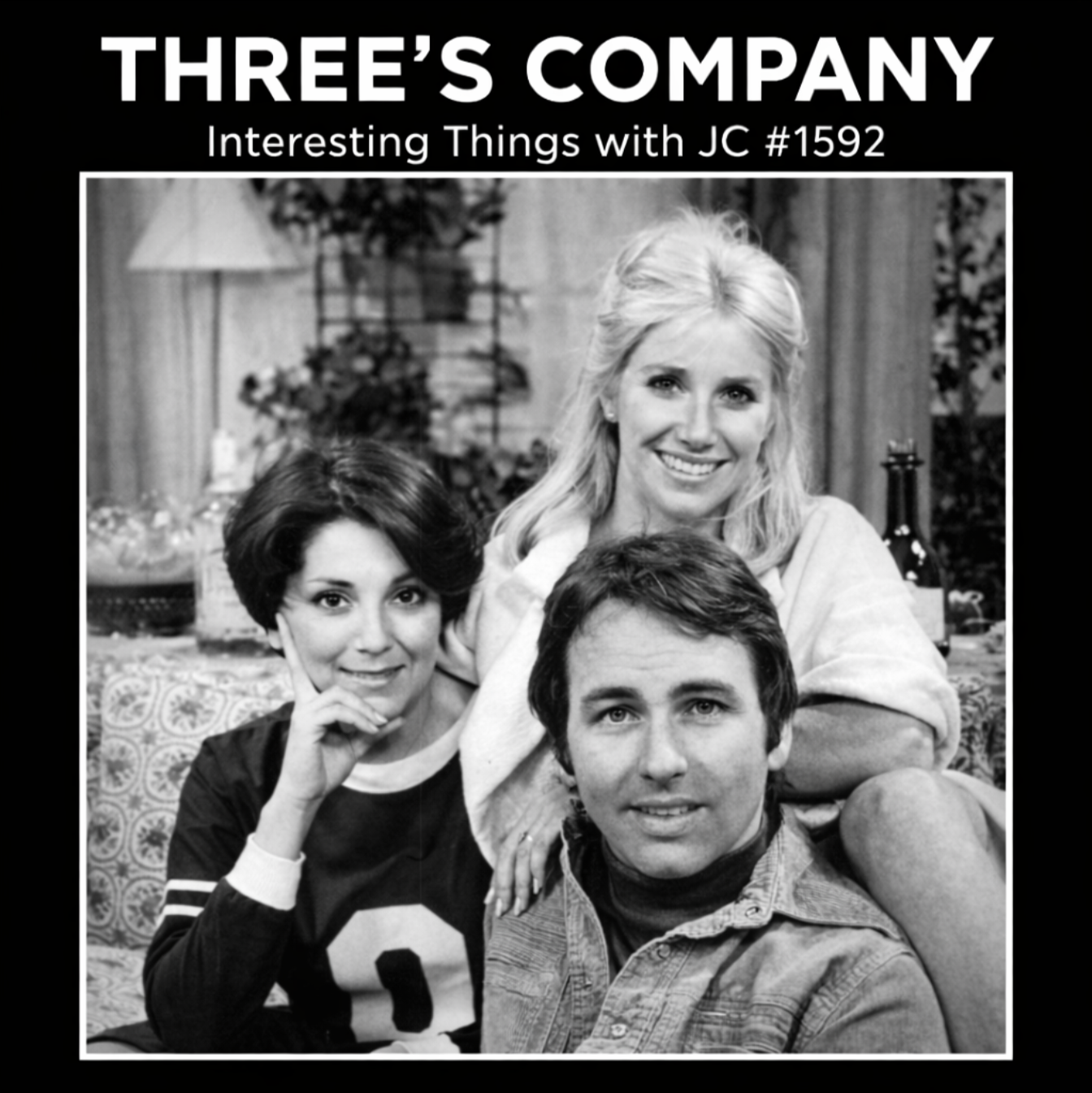
Black-and-white promotional image for “Three’s Company” with the title “THREE’S COMPANY” at the top and the subtitle “Interesting Things with JC #1592.” Three smiling adults are posed closely together in a living-room setting, with one seated in front and two behind. Used for nonprofit open educational commentary and teaching as a low-resolution reference for analysis. No ownership of the original copyrighted material is claimed.
Transcript
Interesting Things with JC #1592: "Three's Company"
A hot blonde, a practical brunette, and a good looking young man walk into American television.
The first thing the young man does is lie.
Not because he wants to.
Because in 1977 that is the only way the apartment arrangement will work.
The setting is Santa Monica, California, a coastal city about 15 miles (24 kilometers) west of downtown Los Angeles. Two young women share an apartment but cannot quite afford the rent on their own. They need a third roommate.
The problem lives downstairs.
The landlord, Stanley Roper, believes unmarried men and unmarried women living together is unacceptable.
So when Jack Tripper moves in, the explanation becomes simple.
Jack tells Stanley he is gay.
That single misunderstanding becomes the engine behind one of the most recognizable sitcoms in American television history.
On March 15, 1977, Three's Company premiered on ABC. The show was adapted for American television by writers Don Nicholl, Michael Ross, and Bernie West. Their source was a British sitcom called Man About the House, first broadcast in the United Kingdom in 1973.
Getting the show on television took several attempts.
ABC filmed multiple pilot episodes in 1976 while trying to find the right cast combination. One early version featured actress Valerie Curtin in the role that later became Janet Wood. The chemistry did not work, so the network ordered changes and tried again.
When the final trio appeared together, the show finally worked.
John Ritter played Jack Tripper, an aspiring chef who worked in restaurants while sharing the apartment.
Joyce DeWitt played Janet Wood, the practical roommate who usually understood what was happening while everyone else scrambled in confusion.
Suzanne Somers played Chrissy Snow, cheerful, trusting, and sometimes naïve. Her character gave the show much of its energy.
John Ritter, born September 17, 1948, in Burbank, California, brought a rare style of physical comedy to television. His performance drew inspiration from performers such as Dick Van Dyke and silent film comedians including Charlie Chaplin. Ritter could stumble across a room, juggle multiple misunderstandings, and turn confusion into perfectly timed comedy.
But the apartment upstairs was only half the stage.
Downstairs lived the landlords.
Stanley Roper, played by Norman Fell, constantly suspected something improper was happening above him. His wife Helen Roper, played by Audra Lindley, often delivered sharp observations that cut through Stanley's suspicions with perfect timing.
Later seasons introduced another landlord.
Ralph Furley, played by Don Knotts, brought a nervous and energetic style of comedy. American audiences already knew Knotts for playing Barney Fife on The Andy Griffith Show.
The series itself was set in Santa Monica. Exterior shots used in the opening credits during the first three seasons came from a real house located at 2912 4th Street in Santa Monica. The building was actually a single family home used to represent the fictional apartment building.
The comedy style of the show followed a classic theatrical form called farce.
Farce works through misunderstanding. Someone overhears part of a conversation. Someone else jumps to the wrong conclusion. A lie meant to fix one problem creates several more. Doors open at exactly the wrong moment.
Within minutes everyone believes something that is not true.
In Three's Company, something as small as a rumor, a phone call, or a misplaced jacket could grow into complete chaos by the end of the episode.
Critics sometimes dismissed the show as simple comedy.
Audiences responded differently.
After its debut on March 15, 1977, the show climbed quickly in the television ratings. During the 1979 to 1980 season, Three's Company ranked #2 overall in the Nielsen ratings behind only 60 Minutes. The show earned a 26.3 rating and became the highest rated comedy in the United States, often drawing between 20 and 25 million viewers each week.
One episode in 1979 drew particularly massive attention. The episode that led directly into the premiere of the spin off series The Ropers delivered one of the largest audiences in the show's history, demonstrating just how dominant the sitcom had become.
By the time the series ended on September 18, 1984, Three's Company had produced 172 episodes across eight seasons.
That equals seven years, six months, and three days on American television.
The show's success created spin off series.
The Ropers followed Stanley and Helen Roper after the characters moved away from the apartment building in 1979.
Three's a Crowd continued Jack Tripper's story after the original series ended.
The original trio carried the show through its most popular seasons. Suzanne Somers left after Season Five following a contract dispute. Later seasons introduced new roommates including Cindy Snow, played by Jenilee Harrison, and Terri Alden, played by Priscilla Barnes.
Yet when people remember the show today, they usually remember something much simpler.
Three roommates sharing a small apartment.
Three people trying to keep their jobs, pay the rent, and avoid their landlord's suspicion.
Underneath the comedy sat a reflection of real life in the late 1970s.
Housing costs were rising in many American cities. Young adults increasingly relied on roommates to afford rent. Older expectations about respectability still existed.
The comedy lived right in the middle of that tension.
So the characters improvised.
Jack pretended to be something he was not.
The landlord pretended to believe him.
The roommates pretended everything upstairs was normal.
It never was.
Yet week after week audiences returned because the chemistry between three people made the chaos believable.
On March 15, 1977, that apartment door opened for the first time.
Nearly five decades later the joke still works.
Not because of the lie.
Because the situation still feels real.
Three people.
One small apartment.
And the complicated arrangements people create just to make everyday life work.
These are interesting things, with JC.
Student Worksheet
What specific lie allows Jack Tripper to move into the apartment, and why is that lie necessary within the world of the show?
Explain how farce works in Three’s Company. Give two examples from the episode’s description of how misunderstanding creates comedy.
Why might the apartment setup have felt both controversial and believable to viewers in 1977?
Compare Janet Wood and Chrissy Snow as described in the transcript. How do their personalities contribute differently to the show’s humor?
Creative response: Write a short modern sitcom premise in which a housing problem forces characters into an unusual living arrangement. Use misunderstanding, but keep the tone classroom-appropriate.
Teacher Guide
Estimated Time
One 45–60 minute class period, or two shorter class periods if students also complete the quiz and open-ended assessment.
Pre-Teaching Vocabulary Strategy
Begin with a quick matching exercise using the terms farce, sitcom, adaptation, pilot, cohabitation, and Nielsen ratings. Then ask students to predict how each term might connect to a television show from the late 1970s before hearing or rereading the transcript.
Anticipated Misconceptions
Students may assume the show’s premise was mainly about romance rather than housing economics and social respectability. The episode makes clear that rent-sharing and the landlord’s moral assumptions are central to the setup. Students may also assume “simple comedy” means “culturally unimportant,” when in fact the show’s ratings success and longevity indicate major popular influence.
Some students may confuse farce with random silliness. Clarify that farce is structured comedy: timing, false assumptions, overheard dialogue, and escalating confusion are deliberately built into the plot.
Discussion Prompts
Why did a roommate arrangement need a “cover story” in this sitcom’s world?
What does the show reveal about American attitudes in the late 1970s?
Why do audiences often remember chemistry between actors more than plot details?
Can a comedy be historically useful even when critics dismiss it? Why?
How does a setting as ordinary as an apartment become a strong storytelling engine?
Differentiation Strategies
For ESL learners:
Provide a vocabulary bank with sentence frames such as “The misunderstanding begins when…” and “The show reflects 1970s attitudes because…”.
For IEP supports:
Chunk the transcript into short sections labeled setting, conflict, cast, comedy style, and legacy. Offer guided notes and allow oral responses.
For gifted learners:
Ask students to compare Three’s Company with another adaptation, remake, or sitcom from a different decade and evaluate what changed culturally.
Extension Activities
Research task: Compare Three’s Company with Man About the House and identify what changed in the American adaptation.
Performance task: In small groups, stage a 60-second classroom-safe farce scene using only misunderstanding and timing.
Media history task: Chart where the show fits in late-1970s television popularity using Nielsen rankings.
Cross-Curricular Connections
History: post-1970s shifts in urban living, social norms, and popular culture.
Sociology: household structure, changing expectations about unmarried adults, and roommate economics.
Theater: farce, timing, entrances, exits, and comic escalation.
Media literacy: adaptation, audience appeal, and the difference between critical and popular reception.
Quiz
Q1. On which network did Three’s Company premiere?
A. NBC
B. ABC
C. CBS
D. PBS
Answer: B
Q2. Three’s Company was adapted from which British sitcom?
A. Fawlty Towers
B. Are You Being Served?
C. Man About the House
D. Some Mothers Do ’Ave ’Em
Answer: C
Q3. What lie allows Jack Tripper to move into the apartment?
A. He is married
B. He is a chef with money
C. He is related to Janet
D. He is gay
Answer: D
Q4. Which term best describes the show’s comedy style?
A. Tragedy
B. Documentary realism
C. Farce
D. Satirical news
Answer: C
Q5. How many episodes did the series produce?
A. 86
B. 120
C. 172
D. 210
Answer: C
Assessment
Open-ended question 1:
Explain how Three’s Company used comedy to reflect real social tension in the late 1970s.
Open-ended question 2:
Analyze why a show criticized as “simple” could still become one of the most watched programs in the United States.
3–2–1 Rubric
3 = Accurate, complete, thoughtful; uses specific details from the transcript and connects them clearly to social context or media form.
2 = Partially accurate; includes some correct detail but explanation is underdeveloped or missing clear connection.
1 = Inaccurate, vague, or too limited to demonstrate understanding.
Standards Alignment
CCSS.ELA-LITERACY.RI.11-12.1
Students cite strong and thorough textual evidence when explaining the show’s premise, comic structure, and cultural setting. This fits transcript-based analysis of explicit statements and inferred social attitudes.
CCSS.ELA-LITERACY.RI.11-12.2
Students determine central ideas, such as misunderstanding, housing pressure, and social respectability, and analyze how those ideas develop across the episode.
CCSS.ELA-LITERACY.SL.11-12.1
Students participate in collaborative discussion about television history, adaptation, and the social meaning of comedy. This standard supports seminar-style discussion tied to the episode’s evidence.
C3 D2.His.1.9-12
Students evaluate how a television series was shaped by the unique historical circumstances of the late 1970s, including social expectations and audience culture.
C3 D2.His.2.9-12
Students analyze change and continuity by comparing 1977 attitudes about shared housing and gender norms with present-day expectations.
ISTE 1.3 Knowledge Constructor
Students research the series, verify claims, and evaluate media sources for accuracy and relevance while building a short historical or cultural analysis.
AQA A-level Media Studies 7572: Television in the Global Age
Students examine television as a media form shaped by audience, context, genre, and industry practice. This episode supports analysis of sitcom conventions, representation, and format adaptation.
IB Diploma Programme Language A: Language and Literature
Students analyze how meaning changes with context of production and reception, especially in non-literary texts such as television narratives and scripts. That makes the episode appropriate for media-text interpretation.
Cambridge International AS & A Level Media Studies 9607
Students develop understanding of the place of media in everyday life and evaluate how television texts are constructed for audiences. Three’s Company works well as a case study in mainstream broadcast media and adaptation.
Show Notes
Three’s Company premiered on ABC on March 15, 1977, after multiple pilot attempts, and went on to run for eight seasons and 172 episodes. Adapted from the British sitcom Man About the House, the series used farce, mistaken assumptions, and strong cast chemistry to turn a simple roommate arrangement into one of the biggest television hits of its era. Its success was measurable as well as cultural: the show finished #2 overall in the 1979–1980 U.S. season ratings, behind only 60 Minutes, with a 26.3 rating.
In the classroom, this topic matters because it helps students see how popular entertainment can reveal historical attitudes about gender, housing, morality, and the economics of everyday life. It also gives teachers a strong, age-appropriate entry point into media literacy, genre study, adaptation, and the difference between critical opinion and mass audience appeal.
References
Brooks, T., & Marsh, E. (2007). The complete directory to prime time network and cable TV shows, 1946–present (9th ed.). Ballantine Books. https://books.google.com/books/about/The_Complete_Directory_to_Prime_Time_Net.html?id=w8KztFy6QYwC
IMDb. (n.d.). Three's Company (TV series 1976–1984). https://www.imdb.com/title/tt0075596/
Mann, C. (1998). Come and Knock on Our Door: A Hers and Hers and His Guide to "Three's Company". United States: St. Martin's Press. https://www.google.com/books/edition/Come_and_Knock_on_Our_Door/iSfplRxL8gIC?hl=en&gbpv=0
Museum of Broadcast Communications. (n.d.). Three's Company. https://www.museum.tv/tv-encyclopedia-17/threes-company
Rating Graph. (n.d.). Three's Company (1976-1984) ratings. https://www.ratingraph.com/tv-shows/three-s-company-ratings-2102
Television Obscurities. (2009, September 20). The 1979-1980 season, week by week. https://www.tvobscurities.com/2009/09/the-1979-1980-season-week-by-week
When I Am Not A Stalker. (2012, March 23). The “Three’s Company” apartment building. https://www.iamnotastalker.com/2012/03/23/the-threes-company-apartment-building
World Radio History. (1980). Nielsen report on television 1980. https://www.worldradiohistory.com/Archive-Ratings-Documents/Nielsen-Report-on-Television-1980.pdf